Capitalism / Empire’s Social Order & Cohesion Structures
Autonomization / fixity of institutions
Through its name and its language, what the institution promises is that a single thing, in this lower world, will have transcended time, will have with­ drawn itself from the unpredictable flux of becoming, will have established a bit of tangible eternity, an unequivocal meaning, free of human ties and situations - a definitive stabilization of the real, like death. This whole mirage dissolves when a revolution breaks out. Suddenly what seemed eternal collapses into time as though into a bottomless pit. What seemed to plunge its roots into the human heart turns out to have been nothing but a fable for dupes. The palaces are vacated and one discovers in the prince's abandoned jumble of papers that he no longer believed in it all, if he ever had. For behind the facade of the institution, what goes on is always something other than it claims to be, it's precisely what the institution claimed to have delivered the world from: the very human comedy of the coexis­tence of networks, of loyalties, of clans, interests, lineages, dynasties even, a logic of fierce struggles for territories, resources, miserable titles, influence­ stories of sexual conquest and pure folly, of old friendships and rekindled hatreds. Every institu­tion is, in its very regularity, the result of an intense bricolage and, as an institution, of a denial of that bricolage. Its supposed fixity masks a gluttonous appetite for absorbing, controlling, institutionalizing everything that's on its margins and harbors a bit of life. The real model of every institution is universally the Church. Just as the Church clearly does not have as its goal leading the human flock to its divine salvation, but rather achieving its own salvation in time, the alleged function of an institution is only a pretext for its existence. In every institution the Legend of the Grand Inquisitor is re-enacted year after year. Its true purpose is to persist. […] Reducing delinquency and "defending society" are only the pretext of the carceral institu­tion. If, during the centuries it has existed, it has never succeeded at these things - on the contrary - this is because its purpose is different; it's is to go on existing and growing if possible, which means tending to the breeding ground of delin­quency and managing the illegalities. […] Of course in every institution there are sincere people who really think they are there to accomplish their mission. But it's no acci­dent if those people see themselves systematically obstructed, are systematically kept out of the loop, punished, bullied, eventually ostracized, with the complicity of all the "realists" who keep their mouths shut. These choice victims of the institu­tion have a hard time understanding its double talk, and what is really being asked of them. Their fate is to always be treated there as killjoys, as rebels, and to be endlessly surprised by that. The Invisible Committee, Now, p.72-74
The real has something intrinsically chaotic about it that humans need to stabilize by imposing a legibility, and thereby a foreseeability, on it. And what every institution provides is precisely a stationary legibility of the real, an ultimate stabi­lization of phenomena. If the institution suits us so well, it's because the sort of legibility it guarantees saves us above all, each one of us, from affirming anything whatsoever, from risking our singular reading of life and of things, from producing together an intelligibility of the world that is properly ours and shared in common. The problem is that choosing not to do that is the same as choosing not to exist. It's to resign from life. In reality, what we need are not institutions but forms. It so happens, in fact, that life, whether biological, singular or collective, is precisely a continual creation of forms. It suffices to perceive them, to accept allowing them to arise, to make a place for them and accompany their metamorphosis. A habit is a form. A thought is a form. A friendship is a form. A work is a form. A profession is a form. Everything that lives is only forms and interactions of forms. The Invisible Committee, Now, p.68-69
There's a perverse dialectic between institution and movements, which testi­fies to the former's relentless survival instinct. A reality as ancient, massive, and hieratic as that, inscribed in the bodies and minds of its subjects for the hundreds of years the French state has existed, could not have lasted so long if it had not been able to tolerate, monitor, and recuperate critics and revolutionaries as they presented them­ selves. The carnivalesque ritual of social movements function within it as a safety valve, as a tool for managing the social as well as for renewing the institution. They bring it the flexibility, the young flesh, the new blood that it so cruelly lacks. Generation after generation, in its great wisdom, the state has been able to co-opt those who showed themselves amenable to being bought off, and crush those who acted intransigent. It's not for nothing that so many leaders of student movements have so naturally advanced to ministerial posts, being people who are sure to have a feel for the state, that is, an appreciation of the institution as mask. The Invisible Committee, Now, p.75-76
Capital as Self-Expanding Value & Autonomization of Capital
[…] in the circulation M—C—M, both the money and the commodity represent only different modes of existence of value itself, the money its general mode, and the commodity its particular, or, so to say, disguised mode. It is constantly changing from one form to the other without thereby becoming lost, and thus assumes an automatically active character. If now we take in turn each of the two different forms which self-expanding value successively assumes in the course of its life, we then arrive at these two propositions: Capital is money: Capital is commodities. In truth, however, value is here the active factor in a process, in which, while constantly assuming the form in turn of money and commodities, it at the same time changes in magnitude, differentiates itself by throwing off surplus value from itself; the original value, in other words, expands spontaneously. For the movement, in the course of which it adds surplus value, is its own movement, its expansion, therefore, is automatic expansion. Because it is value, it has acquired the occult quality of being able to add value to itself. It brings forth living offspring, or, at the least, lays golden eggs. Value, therefore, being the active factor in such a process, and assuming at one time the form of money, at another that of commodities, but through all these changes preserving itself and expanding, it requires some independent form, by means of which its identity may at any time be established. And this form it possesses only in the shape of money. […] Value therefore now becomes value in process, money in process, and, as such, capital. It comes out of circulation, enters into it again, preserves and multiplies itself within its circuit, comes back out of it with expanded bulk, and begins the same round ever afresh.1; M—M', money which begets money, such is the description of Capital from the mouths of its first interpreters, the Mercantilists. Marx, Capital, Volume 1, Marx Engels Collected Works Volume 35 (International Publishers), p.164-165
As the conscious representative of this movement, the possessor of money becomes a capitalist. His person, or rather his pocket, is the point from which the money starts and to which it returns. The expansion of value, which is the objective basis or mainspring of the circulation M—C—M, becomes his subjective aim, and it is only in so far as the appropriation of ever more and more wealth in the abstract becomes the sole motive of his operations, that he functions as a capitalist, that is, as capital personified and endowed with consciousness and a will. Use values must therefore never be looked upon as the real aim of the capitalist' ; neither must the profit on any single transaction. The restless never-ending process of profit-making alone is what he aims at. This boundless greed after riches, this passionate chase after exchange value, is common to the capitalist and the miser; but while the miser is merely a capitalist gone mad, the capitalist is a rational miser. The never-ending augmentation of exchange value, which the miser strives after, by seeking to save his money from circulation, is attained by the more acute capitalist, by constantly throwing it afresh into circulation. Marx, Capital, Volume 1, Marx Engels Collected Works Volume 35 (International Publishers), p.163-164
That’s the wonder of Marx for me: he discovers in the movement of capitalism a Hegelian process. If you read Capital, the whole passage from money to capital is the hegelian process where money as neutral universality subjectivizes itself, becomes its own agent. Zizek, Slavoj Zizek vs. Terry Pinkard (How to Read Hegel) by Sublation Media with Douglas Lain, https://www.youtube.com/live/3deVNo03awg?si=leQQ0oJqhXNL9UNb&t=1680 28:00
The repetition or renewal of the act of selling in order to buy, is kept within bounds by the very object it aims at, namely, consumption or the satisfaction of definite wants, an aim that lies altogether outside the sphere of circulation. But when we buy in order to sell, we, on the contrary, begin and end with the same thing, money, exchange value; and thereby the movement becomes interminable. No doubt, M becomes M + ΔM, £100 become £110. But when viewed in their qualitative aspect alone, £110 are the same as £100, namely money; and considered quantitatively, £110 is, like £100, a sum of definite and limited value. If now, the £110 be spent as money, they cease to play their part. They are no longer capital. Withdrawn from circulation, they become petrified into a hoard, and though they remained in that state till doomsday, not a single farthing would accrue to them. If, then, the expansion of value is once aimed at, there is just the same inducement to augment the value of the £110 as that of the £100; for both are but limited expressions for exchange value, and therefore both have the same vocation to approach, by quantitative increase, as near as possible to absolute wealth. Momentarily, indeed, the value originally advanced, the £100 is distinguishable from the surplus value of £10 that is annexed to it during circulation; but the distinction vanishes immediately. At the end of the process, we do not receive with one hand the original £100, and with the other, the surplus value of £10. We simply get a value of £110, which is in exactly the same condition and fitness for commencing the expanding process, as the original £100 was. Money ends the movement only to begin it again. Therefore, the final result of every separate circuit, in which a purchase and consequent sale are completed, forms of itself the starting-point of a new circuit. The simple circulation of commodities — selling in order to buy — is a means of carrying out a purpose unconnected with circulation, namely, the appropriation of use values, the satisfaction of wants. The circulation of money as capital is, on the contrary, an end in itself, for the expansion of value takes place only within this constantly renewed movement. The circulation of capital has therefore no limits. Marx, Capital, Volume 1, Marx Engels Collected Works Volume 35 (International Publishers), p.162-163
Value is a relation or process that unfolds itself and maintains itself through different forms — in one moment money, the next the commodities that compose the labour process (including the commodity labour-power), the next the commodity product, and then again money — whilst always maintaining a relation in its money form to its commodity form and vice versa. For Marx then, value is not the embodiment of labour in the commodity, nor an unmoving substance. It is rather a relation or process which dominates those who bear it: a substance that is at the same time subject. Endnotes, Communisation and Value Form Theory, Endnotes #2 (2010), https://endnotes.org.uk/articles/communisation-and-value-form-theory
The Neue Marx-Lektüre argued that neither Engels’ interpretation, nor any of the proposed modifications of it, did justice to the motion behind the order and development of the categories in Capital. Rather than an advance from a non-capitalist earlier stage, or hypothetical simplified model, of simple commodity production to a later stage, or more complex model, of capitalist commodity production, the movement in Capital was to be grasped as a presentation of the capitalist totality from the outset, moving from the abstract to the concrete. In The Logical Structure of Marx’s Concept of Capital, Helmut Reichelt developed a conception which, in one form or other, is now basic to theorists of systematic dialectic: that the “logic of the concept of capital” as a self-determining process corresponds to the going-beyond-itself of the Concept in Hegel’s Logic. According to this view the world of capital can be seen as objectively idealist: e.g. the commodity is a “sensous-supersensous thing”. The dialectic of the value-form shows how, starting with the simplest commodity form, the material and concrete aspects of the social life process are dominated by the abstract and ideal social-forms of value. For Marx, as Reichelt puts it: “Capital is thus conceived as a constant change of forms, into which use-value is constantly both integrated and expelled. In this process, use-value too, assumes the form of an eternally vanishing object. But this constantly renewed disappearance of the object is the condition for the perpetuation of the value itself — it is through the always reproduced change of forms that the immediate unity between value and use-value is retained. What is thus constituted is an inverted world in which sensuousness in the widest sense — as use-value, labour, exchange with nature — is demoted to a means of the self perpetuation of an abstract process that underlies the whole objective world of constant change. […] The whole sensuous world of human beings who reproduce themselves through the satisfaction of needs and labour is step-by-step sucked into this process, in which all activities are “in themselves inverted”. They are all, in their vanishing appearance, immediately their own opposite; the persistence of the general.” This is the ontological inversion, the possession of material life by the spirit of capital. It is what Camatte grasped in his recognition of the importance of the understanding of capital as value in process and as subsumption. If there is no use-value other than in the form of value in capitalist society, if value and capital constitute a forceful, totalising form of socialisation that shapes every aspect of life, their overcoming is not a matter of the mere replacement of market mechanisms through a state manipulation or workers’ self-management of these forms, but demands a radical transformation of every sphere of life. By contrast, the traditional Marxist conception derived from Engels — according to which the law of value pre-existed capitalism — separated the theory of the market and value from that of surplus value and exploitation and thus opened up the possibility of ideas of a socialist law of value, a socialist form of money, “market socialism” and so forth. Endnotes, Communisation and Value Form Theory, Endnotes #2 (2010), https://endnotes.org.uk/articles/communisation-and-value-form-theory
Whereas in bourgeois social science, and in the dominant forms of Marxism, abstraction is a mental act, Marx argued that a different form of abstraction was present in capitalism: “real” or “practical abstraction” that people carry out in exchange without even knowing it. […] For Marx the most striking example of “real abstraction” is the money form of value, and perhaps the most far-reaching contribution of the German debates lies in their development of a “monetary theory of value” along the lines already laid out by Rubin. In an important passage from the 1st edition of Capital Marx describes money as an abstraction that perversely takes on a real-world existence independently of its particulars — “It is as if alongside and external to lions, tigers, rabbits, and all other actual animals ... there existed also in addition the animal, the independent incarnation of the entire animal Kingdom.” [Marx, ‘The Commodity, Chapter One, Volume One of the first edition of Capital’ in Value: Studies by Karl Marx, trans. A. Dragstedt (New Park 1976), p. 27.] The products of private labour must be exchanged with this concrete representation of abstract labour for their social validity to be realised in actuality. Thus an abstraction — rather than a product of thought — exists in the world as an object with a social objectivity to which all must bow. Traditional Marxism overlooked this discussion, and generally followed Ricardo and bourgeois economics in viewing money as simply a useful technical tool for facilitating the exchange of pre-existing commodity values. By contrast the German debates picked up on the strange kind of objectivity of value — that it does not inhere in any particular commodity, but only exists in the relation of equivalence between a commodity and the totality of other commodities — something that can only be brought about through money. This role of money in a generalised commodity society feeds back onto the experience of living labour itself. To the extent that labour is simply an activity carried out for money, the kind of labour performed is a matter of indifference and chance. The organic link that existed in previous societies between particular individuals and specific forms of labour is broken. A subject able to move indifferently between different forms of labour is developed: Here, then, for the first time, the point of departure of modern economics, namely the abstraction of the category “labour”, “labour as such”, labour pure and simple, becomes true in practice. The simplest abstraction, then, which modern economics places at the head of its discussions, and which expresses an immeasurably ancient relation valid in all forms of society, nevertheless achieves practical truth as an abstraction only as a category of the most modern society. Abstract labour then as a practical abstraction is a fundamentally capitalist form of labour — a product of the reduction of all activities to abstract money-generating activity. Endnotes, Communisation and Value Form Theory, Endnotes #2 (2010), https://endnotes.org.uk/articles/communisation-and-value-form-theory
The critical import of value-form theory is that it calls into question any political conception based on the affirmation of the proletariat as producer of value. It recognises Marx’s work as an essentially negative critique of capitalist society. In reconstructing the Marxian dialectic of the value-form, it demonstrates how the social life process is subsumed under — or “form-determined” by — the value-form. What characterises such “form-determination” is a perverse priority of the form over its content. Labour does not simply pre-exist its objectification in the capitalist commodity as a positive ground to be liberated in socialism or communism through the alteration of its formal expression. Rather, in a fundamental sense value — as the primary social mediation — pre-exists and thus has a priority over labour. As Chris Arthur argues: "At the deepest level, the failure of the tradition that uses the model of “simple commodity production”, is that it focuses on the human individual as the originator of value relationships, rather than viewing human activities as objectively inscribed within the value form… In truth, however, the law of value is imposed on people through the effectivity of a system with capital at its heart, capital that subordinates commodity production is the aim of valorisation and it is the real subject (identified as such by Marx) confronting us.” [Chris Arthur, ‘Engels, Logic and History’ in Riccardo Bellofiori, ed., Marxian Economics a Reappraisal: Essays on Volume III of Capital, vol. 1 (Macmillan 1998), p. 14.] While it seems true and politically effective to say that we produce capital by our labour, it is actually more accurate to say (in a world that really is topsy turvy) that we, as subjects of labour, are produced by capital. Socially necessary labour time is the measure of value only because the value-form posits labour as its content." Endnotes, Communisation and Value Form Theory, Endnotes #2 (2010), https://endnotes.org.uk/articles/communisation-and-value-form-theory
I like Marx’s sociological approach in the first chapter of Capital when he discusses the commodity, value and the fetishism of commodities. There, he observes that value is a concept belonging to the social plane. On the other hand, and unlike Zizek, to the extent that Marx considers the autonomization of value and capital as a kind of (especially non-metaphorical) subjectification, I am really skeptical of this part (and probably don’t like the Hegelian ontology pervading it). I see it more as the autonomization of an institution (the market and the social logic of value and capital) rather than a metaphysical Hegelian process. I think the latter mystifies the fact that it is really our social action (its constitution and orientation) that defines and constitutes value and capital.
Aris Goudouras
Interestingly here the capitalist appears as personified capital, i.e. it’s value (in the form of capital) which is the real subject and agent.
Subjects & human archetypes in contemporary capitalist societies
Nothing shocks us about this; nothing catches us unawares or radically alters our feeling toward life. We were born inside the catastrophe and we have established a strange and comfortable relation of habit with it. Almost an intimacy. For as long as we can remember there has been no news besides that of the Global Civil War. We have been raised as survivors, as machines of survival. We have been raised with the idea that life consists in continually going on; walking in indifference until crushed among other bodies who walk identically, who stumble and get crushed in turn. In the end, the only novelty of the present epoch is that none of this can be hidden anymore, that in a sense everybody knows it. Hence the most recent visible hardening of the system: its motives are exposed, it would be pointless to wish them away. Anonymous, Call, p.6-7
The real lie is not the one we tell others but the one we tell ourselves. The first lie is relatively exceptional in comparison with the second. The big lie is refusing to see certain things that one does see, and refusing to see them just as one sees them. The real lie is all the screens, all the images, all the explanations that are allowed to stand between oneself and the world. It's how we regularly dismiss our own perceptions. So much so that where it's not a question of truth, it won't be a question of anything. The Invisible Committee, Now, p.11-12
Politics, in truth, is the interplay between different realms, the alliance between those that are compatible and the confrontation between those that are irreconcilable. Therefore we say that the central political fact of the last thirty years went unnoticed. Because it took place at such a deep level of reality that it cannot be called political without bringing about a revolution in the very notion of the political. Because this level of reality is also the one where the division is elaborated between what is taken for reality and what is not. This central fact is the triumph of Existential Liberalism. The fact that it is now considered natural for everyone to have a rapport with the world based on the idea that each person has her own life. That such a life consists in a series of choices, good or bad. That each person can define herself by an ensemble of qualities, of properties, that make her, through her continual balancing of those properties, a unique and irreplaceable being. That the contract adequately epitomizes relations between individuals, and that respect epitomizes all virtue. That language is nothing but a means of arriving at an agreement. That, in reality, the world is composed on one side of things to manage, and on the other of an ocean of self-absorbed individuals, who in turn have a regrettable tendency to turn themselves into things, letting themselves become managed. Of course, cynicism is only one of the possible features of the infinite clinical diagnoses of Existential Liberalism. It also includes depression, apathy, immunodeficiency (every immune system is intrinsically collective), dishonesty, judicial harassment, chronic dissatisfaction, denied affection, isolation, illusions of citizenship, and the loss of all generosity. Existential liberalism has propagated its desert so well that even the most sincere Leftists express their utopia with its very terms. “We will rebuild an egalitarian society in which each person makes her contribution and from which each person gets her needs met from it... As far as individual desires are concerned, it could be egalitarian if each person consumes in proportion to the efforts she is ready to contribute. Naturally it will be necessary to redefine the method of evaluating the efforts contributed by each person,” write the organizers of the Alternative, Anti-capitalist, and Anti-war Village against the G8 summit in Evian in a text entitled When Capitalism and Wage Labor Will Have Been Abolished! Here is a key to the triumph of Empire: managing to keep in the shadows, to surround with silence the very terrain on which it maneuvers, the field upon which it fights the decisive battle: that of manipulating feelings, of defining the limits of the perceptible. In such a way it preventively paralyzes any defense at the very moment of its operation, and ruins the very idea of a counter-offensive. The victory is won whenever the militant, at the end of a hard day of Political Work, slumps down in front of an action movie. Anonymous, Call, p.7-8
The pervasiveness of the commodity has inserted itself everywhere. This pervasiveness is the most effective instrument for disconnecting ends from means, to reduce everyday life to a living-space we are only required to manage. Everyday life is what we are supposed to want to return to; the acceptance of a necessary and universal neutralization. It is the ever-growing renunciation of the possibility of an unpostponed joy. As a friend once said, it is the average of all our possible crimes. Anonymous, Call, p.14
Rare are the collectivities that can escape the abyss that waits for them: mashing of the real into an extreme flatness, community as the epitome of average intensity, a slow disintegration clumsily filled with a bunch of banal and falsely sophisticated banter. Neutralization is an essential characteristic of Liberal Society. Everybody knows the centers of neutralization, where it is required that no emotion stands out, where each person has to contain herself, and everybody experiences them as such: businesses (and what isn’t a business these days?), night clubs, bowling alleys and golf courses, museums, etc. Since everyone knows what these places are about, the real question is to know why — despite that — they can still be so popular. Why wish for, always and above all, that nothing happens that might provoke stirrings that go too deep? Out of habit? Because of despair? Because of cynicism? Or else: because you can feel the delight of being somewhere while not being there, of being there while being essentially somewhere else; because what we are at base would be preserved to the point of no longer even having to exist. […] The acceptance of these neutralizations can of course go hand in hand with great creative efforts. You can experiment up to the point of madness, on condition that you are a single creator, and that you produce the proof of this singularity in public (your works). You can still know what the stirrings are, but only on condition that you experience them alone, and that you are limited to passing them on indirectly. You will thereby be recognized as an artist or as a thinker, and, perhaps if you are politically engaged, you will be able to toss as many bottles into the ocean as you like, with the clear conscience of one who sees farther and who has warned others. Like many, we have experienced that emotions stuck internally turn out badly: they can even turn into symptoms. The rigidities we observe in ourselves come from the partitions that every person believes herself obliged to put up in order to define her own limits, and to contain within her self what must not burst forth. Anonymous, Call, p.15
At root it is here that we begin, where we find each other. What is most singular in us calls to be shared. But we note this: not only is what we have to share obviously incompatible with the dominant order, but this order strives to track down any kind of sharing for which it does not lay down the rules. For instance, the barracks, the hospital, the prison, the asylum, and the retirement home are the only forms of collective living allowed in the metropole. The normal condition is the isolation of everyone in their private cubicle. This is where they return endlessly, however strong the repulsion they feel, however great the encounters they make elsewhere. We have known these conditions of existence, and we will never return to them. They weaken us too much. Make us too vulnerable. Make us waste away. Isolation, in primal cultures, was the harshest sentence that could be passed on a member of the community. It is now the common condition. The rest of the disaster follows logically. It is on account of this narrow idea that everybody has of their own home that makes it seem natural to leave the street to the police. The world could not have been made so uninhabitable, nor sociality so controlled — from malls to bars, from boardrooms to backrooms — had not everyone been previously granted the shelter of private space. Anonymous, Call, p.17
We do not perceive humans to be isolated from each other or from the other beings of this world; we see them bound by multiple connections that we have learned to deny. This denial allows the blocking of emotional exchanges through which these multiple connections are experienced. This blockage, in turn, is necessary to make us accustomed to the most neutral, the most lifeless, the most average feelings; that which makes us long for vacations, lunch-breaks, or evenings out as a godsend — that is to say something just as neutral, average, and lifeless — but freely chosen. The imperial order, which is particularly Westernized, is nourished through this boredom. Anonymous, Call, p.15
Not so long ago, when one met some­ one it was still natural to ask: "So what do you do in life?" And the answer came just as naturally. One still managed to say what position one held in the general organization of production. That could even serve as a calling card. In the time since, the wage-earning society has imploded to such an extent that one avoids questions of this sort, which tend to make people uneasy. Everyone patches things together, gets by, branches off, takes a break, starts up again. Work has lost its luster and its centrality, not just socially but existentially as well. The Invisible Committee, Now, p.91-92
Waged labor was the form by which a certain order was maintained. The fundamental violence it contains, the violence that is obscured by the broken­ down body of the assembly-line worker, the miner killed in a methane explosion, or the burnout of employees under extreme managerial pressure, has to do with the meaning of life. By selling their time, by turning themselves into the subject of the thing they're employed to do, the wage worker places the meaning of their existence in the hands of those who care nothing about them, indeed whose purpose is to ride roughshod over them. The Invisible Committee, Now, p.94
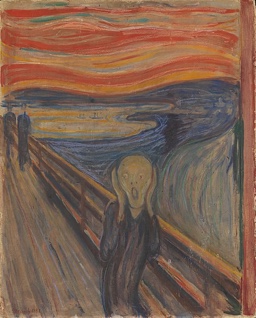
The wage system has enabled generations of men and women to live while evading the question of life's meaning, by "making themselves useful," by "making a career," by "serving." The wage worker has always been free to postpone this question till later-till retirement, let's say-while leading an honorable social life. And since it is apparently "too late" to raise it once retired, all that's left to do is to wait patiently for death. We will thus have been able to spend an entire life without entering into existence. There is a good reason why Munch's painting, The Scream, portrays, still today, the true face of contemporary humanity. What this desperate individual on their jetty doesn't find is an answer to the question, "How am I to live?" The Invisible Committee, Now, p.94-95
It's necessary above all to maintain the reign of the economy beyond the extinction of the wage system. This has to do with the fact that if there is less and less work, everything is all the more mediated by money, be it in very small amounts. Given the absence of work, the need to earn money in order to survive must be maintained. Even if a universal basic income is established one day, as so many liberal economists recommend, its amount would need to be large enough to keep a person from dying of hunger, but utterly insufficient to live on, even fru­ gally. We are witnessing a change of regime within economy. The majestic figure of the Worker is being succeeded by the puny figure of the Needy Opportunist [le Crevard]-because if money and control are to infiltrate everywhere, it's necessary for money to be lacking everywhere. Henceforth, everything must be an occasion for generating a little money, a little value, for earning "a little cash." The present technological offensive should also be understood as a way to occupy and valorize those who can no longer be exploited through waged labor. What is too quickly described as the uberization of the world, unfolds in two different ways. Thus on the one hand you have Uber, Deliveroo and the like, that unskilled job opportu­nity requiring only one's old machine as capital. Every driver is free to self-exploit as much as they like, knowing that they must roll around fifty hours a week to earn the equivalent of the minimum wage. And then there are Airbnb, BlaBlaCar, dating sites, "coworking," and now even "cohoming" or "costorage," and all the applications that enable the sphere of the valorizable to be extended to infinity. What is involved with the "collaborative economy," with its inexhaustible possibilities of valorization, is not just a mutation of life-it's a mutation of the possible, a mutation of the norm. Before Airbnb, an unoccupied room was a "guest room" or a room available for a new use; now it's a loss of income. Before BlaBlaCar, a solo drive in one's car was an occasion to daydream, or pick up a hitchhiker, or whatever, but now it's a missed chance to make a little money, and hence a scandal, economically speaking. What one gave to recycling or to friends one now sells on Le bon coin. It's expected that always and from every point of view one will be engaged in calculating. That the fear of "missing an opportunity" will goad us forward in life. The important thing is not working for one euro an hour or making a few pennies by scanning contents for Amazon Mechanical Turk, but where this participation might lead someday. Henceforth everything must enter into the sphere ofprofitability. Everything in life becomes valorizable, even its trash. And we ourselves are becoming needy opportunists, human trash, who exploit each other under the pretext of a "sharing economy." If a growing share of the population is destined to be excluded from the wage system this is not in order to allow it the leisure to go hunt Pokemons in the morning and to fish in the afternoon. The inven­tion of new markets where one didn't imagine them to be the year before illustrates this fact that is so difficult to explain to a Marxist: capitalism doesn't so much consist in selling what is produced as in rendering accountable whatever is not yet accountable, in assigning a measureable worth to what seemed to be absolutely unsusceptible to that the day before, in creating new markets. That is its oceanic reserve of accumulation. Capitalism is the universal expansion of measurement. The Invisible Committee, Now, p.96-98
With the theory of human capital, man is less the possessor of an indefinite duster of capitals-cultural, relational, professional, financial, symbolic, sexual, health­ than he is himselfthat duster. He is capital. He constantly arbitrates between increasing what he is as capital, and the fact of selling it in some market or other. He is inseparably the producer, the product, and the seller of the product. Football players, actors, stars, and popular YouTubers are logically the heroes of the era of human capital, people whose value fully coincides with what they are. Micro-economics thus becomes the general science of behaviors, whether this is in commerce, at church, or in love. Everyone becomes an enterprise guided by a constant concern with self­ valorization, by a vital imperative of self-promotion. In essence man becomes the optimizing creature­ the Needy Opportunist. The Invisible Committee, Now, p.99-100
The folly of evaluation obviously dominates every aspect of contemporary work, but it also rules as a mistress over everything that escapes that sphere. It determines even the solitary jogger's relationship with themselves, the jogger who, in order to improve their performances, needs to know them in detail. Measurement has become the obligatory mode of being of all that intends to exist socially. The Invisible Committee, Now, p.101
Monetary accumulation is the postponement of any actual enjoyment; since money brings into equivalence as possibilities the whole array of things that can be bought with it. Every expenditure, every purchase is first a for­feiture, relative to what money is capable of Every specific enjoyment it allows one to acquire is first a negation of the set of other potential enjoyments it contains within it. In the epoch of human capital and living currency, every moment of life and every real relation are haloed by a set of possible equivalents that gnaw at them. Being here involves the untenable renunciation of being everywhere else, where life is apparently more intense, as our smartphone has charged itself with informing us. Being with a particular person is an unbearable sacrifice of all the other persons with whom one could just as well be with. Every love is vitiated in advance by all the other possible loves. Hence the impossibility of being there, the ineptitude for being-with. Universal unhappiness. Torture by possibilities. Sickness unto death. "Despair," as Kierkegaard diagnosed it. The Invisible Committee, Now, p.105-106
What within us is anxious to protect the inner chains that bind us, What there is within us so sick that it clings to our conditions of existence, precarious though they are, What's so exhausted from troubles, jolts, needs, that on a given day tomorrow seems farther away than the moon, What finds it pleasant to pass the time in hip cafes sipping lattes with jungle in the background while surfing on one's MacBook-the Sunday of life alloyed with the end of history, Is expecting solutions. Cities in transition, social and solidarity economy, Sixth Republic, alternative municipalism, universal basic income, the film Tomorrow, migration into space, a thousand new prisons, expulsion of all foreigners from the planet, man-machine fusion. Whether they're engineers, managers, act1v1sts, politicians, ecologists, actors, or simple hucksters, all those who claim to offer solutions to the present disaster are really doing just one thing: imposing their definition of the problem on us, hoping to make us forget that they themselves are plainly part of the problem. As a friend said, "The solution to the problem you see in life is a way of living that makes the problem disappear." The Invisible Committee, Now, p.127-128
However repressed it may be, the question of communism remains the heart of our epoch. If only because the rule of its contrary-economy-has never been so complete. The delegations from the Chinese state who go every year to place flowers on Marx's tomb in London don't fool anybody. One can avoid the communist question, of course. One can get used to stepping over the bodies of the homeless or migrants on one's way to the office every morning. One can follow the melting of the polar ice in real time, or the rise of the oceans and the panicked pell-mell migrations of animals and humans alike. One can go on preparing one's cancer with every forkful of mashed potatoes that one swallows. One can tell oneself that the recovery, or a dose of authority, or ecofeminism will eventually fix all this. Continuing in such a manner is possi­ble, at the cost of suppressing our feeling that the society we live in is intrinsically criminal, and one that doesn't miss a chance to remind us that we belong to its little association of miscreants. Every time we come in contact with it-by using any of its devices, consuming the least of its commodities, or doing whatever job we do for it-we make our­ selves its accomplices, we contract a little of the vice on which it is based: that of exploiting, wrecking, undermining the very conditions of every earthly existence. There's no longer any place for innocence in this world. We only have the choice between two crimes: taking part in it or deserting it in order to bring it down. The Invisible Committee, Now, p.127-128
One can live a whole life without experiencing anything, by being very careful not to think and feel. Existence is then reduced to a slow process of degradation. It wears down and ruins, instead of giving form. After the miracle of the encounter, relations can only go from wound to wound towards their con­sumption. Life, on the contrary, gradually gives form to whoever refuses to live beside themselves, to whoever allows themselves to experience. They become a form of life in the full sense of the term. The Invisible Committee, Now, p.143
Existential Liberalism is the spontaneous ethics suitable for Social Democracy seen as a political ideal. You will never be a better citizen than when you are capable of renouncing a relation or a struggle in order to maintain your status. It will not always be without suffering, but that is precisely where Existential Liberalism is efficient: it even provides the remedies to the discomforts that it generates. The check to Amnesty International, the fair trade coffee, the demo against the last war, seeing the latest Michael Moore film, are so many non-acts disguised as gestures that will save you. Carry on exactly as usual; that is to say go for a walk in the designated spaces and do your shopping, the same as always. But on top of that, in addition, ease your conscience; buy No Logo, boycott Shell. This should be enough to convince you that political action, at bottom, does not require very much, and that you too are capable of engaging in it. There is nothing new in this buying and selling of indulgences, but the problem becomes palpable in the prevailing confusion. The invocatory culture of Another World Is Possible leaves little room to speak of ethics beyond consumer etiquette. The increase in the number of environmentalist, humanitarian, and solidarity associations opportunely channels general discontent and thus contributes to the perpetuation of this state of affairs, through personal valorization, official recognition and its first prize of honestly awarded subsidies; the worship, in short, of social usefulness. Above all, no more enemies. At the very most, problems, abuses seen as catastrophes — dangers from which only the mechanisms of power can protect us. Anonymous, Call, p.14
Like many, we have experienced that emotions stuck internally turn out badly: they can even turn into symptoms. The rigidities we observe in ourselves come from the partitions that every person believes herself obliged to put up in order to define her own limits, and to contain within herself what must not burst forth. When, for some reason or other, these partitions happen to crack and break, then things come up that might be unpleasant, which may even appear frightful — but it is a fright capable of freeing us from fear. Calling into question both our individual limits and the borders drawn by civilization can be a life-saver. The existence of any real community necessitates a certain physical danger: when emotions and thoughts are no longer ascribable to any one person, when interactions are recovered in which feelings, ideas, impressions, and emotions are exchanged carelessly. It must be understood that community per se is not the solution: it is its disappearance, everywhere and always, that is the problem. Anonymous, Call, p.15
Until the environment is collectively dominated, there will be no individuals — only specters haunting the objects anarchically presented to them by others. In chance situations we meet separated people moving randomly. Their divergent emotions neutralize each other and maintain their solid environment of boredom. As long as we are unable to make our own history, to freely create situations, striving toward unity will introduce other separations. The quest for a central activity leads to the formation of new specializations. Debord, Critique of Separation (Film), 1961 - https://remixedcity.wordpress.com/2014/02/17/critique-of-separation-english-subtitles-by-guy-debord-1961/
Here is daylight, and here are perspectives that now no longer mean anything. The sectors of a city are, at a certain level, decipherable. But the personal meaning they have had for us is incommunicable, like all that secrecy of private life regarding which we possess nothing but pitiful documents. Debord, Critique of Separation (Film), 1961 - https://remixedcity.wordpress.com/2014/02/17/critique-of-separation-english-subtitles-by-guy-debord-1961/
All existing equilibrium, however, is brought back into question each time unknown people try to live differently. But it’s always far away. We learn of it through the papers and newscasts. We remain outside it, confronted with just another spectacle. We are separated from it by our own nonintervention. It makes us disappointed in ourselves. At what moment was choice postponed? We haven’t found the arms we needed. We have let things go. I have let time slip away. I have lost what I should have defended. This general critique of separation obviously contains and covers some particular memories. A less recognized pain, the awareness of a less explainable indignity. Exactly what separation was it? How quickly we have lived! It is to this point in our unreflecting history that I bring us back. Everything that concerns the sphere of loss — that is to say, the past time I have lost, as well as disappearance, escape, and more generally the flowing past of things, and even what in the prevalent and therefore most vulgar social sense of the use of time is called wasted time — all this finds in that strangely apt old military expression, en enfants perdus, its meeting ground with the sphere of discovery, of exploration of unknown terrains; with all the forms of quest, investigation, adventure, avant-garde. It is the crossroads where we have found and lost ourselves. Debord, Critique of Separation (Film), 1961 - https://remixedcity.wordpress.com/2014/02/17/critique-of-separation-english-subtitles-by-guy-debord-1961/
We have invented nothing. We adapt ourselves, with a few variations, into the network of possible courses. We get used to it, it seems. No one has the enthusiasm on returning from a venture that they had on setting out on it. My dears, adventure is dead. Debord, Critique of Separation (Film), 1961 - https://remixedcity.wordpress.com/2014/02/17/critique-of-separation-english-subtitles-by-guy-debord-1961/
It isn’t only work that has become more tenuous. The neoliberal attacks on public services, welfare programmes and trade unions mean that we are increasingly living in a world deprived of security or solidarity. Mark Fisher & Darren Ambrose, Time-Wars: Towards an Alternative for the Neo-Capitalist Era, K-Punk: The Collected and Unpublished Writings of Mark Fisher, 2018, p.519
The consequence of the normalisation of uncertainty is a permanent state of low-level panic. Fear, which attaches to particular objects, is replaced by a more generalised anxiety, a constant twitching, an inability to settle. The uncertainty of work is intensified by digital communication technology. As soon as there is email, there are no longer working hours nor a workplace. What characterises the present moment more than our anxious checking — of our messages, which may bring opportunities or demands (often both at the same time), or, more abstractly, of our status, which, like the stock market is constantly under review, never finally resolved? Mark Fisher & Darren Ambrose, Time-Wars: Towards an Alternative for the Neo-Capitalist Era, K-Punk: The Collected and Unpublished Writings of Mark Fisher, 2018, p.519
Campagna’s call for a “radial atheism” is based on the recognition that the precariousness that cannot be eliminated is that of life and the body. If there is no afterlife, then our time is finite. Curiously, however, we subjects of late capitalism act as if there is infinite time to waste on work. Work looms over us as never before.“In an eccentric and an extreme society like ours”, argue Carl Cederstrom and Peter Fleming in their book Dead Man Working, “working has assumed a universal presence — a worker’s society in the worst sense of the term — where even the unemployed and children become obsessed with it.” Work now colonises weekends, late evenings, even our dreams. “Under Fordism, weekends and leisure time were still relatively untouched”, Cederstrom and Fleming point out, “Today, however, capital seeks to exploit our sociality in all spheres of work. When we all become “human capital” we not only have a job, or perform a job. We are the job.” Mark Fisher & Darren Ambrose, Time-Wars: Towards an Alternative for the Neo-Capitalist Era, K-Punk: The Collected and Unpublished Writings of Mark Fisher, 2018, p.519-520
We are required to live in the condition that Linda Stone has called “continuous partial attention”, where our attention is habitually distributed across multiple communication platforms. As Franco “Bifo” Berardi has argued, we now live in the tension between the infinity of cyberspace and the vulnerable finitude of the body and the nervous system. “The acceleration of information exchange has produced and is producing an effect of a pathological type on the individual human mind and even more on the collective mind,” Berardi writes in Precarious Rhapsody, "Individuals are not in a position to process the immense and always growing mass of information that enters their computers, their cell phones, their television screens, their electronic diaries and their heads. However, it seems indispensable to follow, recognise, evaluate, process all this information if you want to be efficient, competitive, victorious. [...] The necessary time for paying attention to the fluxes of information is lacking.” The consequence is a strange kind of existential state, in which exhaustion bleeds into insomniac overstimulation (no matter how tired we are, there is still time for one more click) and enjoyment and anxiety co-exist (the urge to check emails, for instance, is both something we must do for work and a libidinal compulsion, a psychoanalytic drive that is never satisfied no matter how many messages we receive). The fact that the smartphone makes cyberspace available practically anywhere at anytime means that boredom (or at least the old style, “Fordist” boredom) has effectively been eliminated from social life. Yet boredom, like death, posed existential challenges that are far more easily deferred in the always-on cyberspatial environment. Ultimately, communicative capitalism does not vanquish boredom so much as it “sublates” it, seeming to destroy it only to preserve it in a new synthesis. The characteristic affective tonality for the insomniac drift of cyberspace, in which there is always one more click to make, one more update to check, combines fascination with boredom. Mark Fisher & Darren Ambrose, Time-Wars: Towards an Alternative for the Neo-Capitalist Era, K-Punk: The Collected and Unpublished Writings of Mark Fisher, 2018, p.520-521
Anxiety is the emotional state that correlates with the (economic, social, existential) precariousness which neoliberal governance has normalised. Mark Fisher & Darren Ambrose, No One is Bored, Everything is Boring, K-Punk: The Collected and Unpublished Writings of Mark Fisher, 2018, p.556
many cases of depression and anxiety are the effects of neoliberalism’s successful tendency to privatise stress, to convert political antagonisms into medical conditions. Mark Fisher & Darren Ambrose, No One is Bored, Everything is Boring, K-Punk: The Collected and Unpublished Writings of Mark Fisher, 2018, p.557
Perhaps the feeling most characteristic of our current moment is a mixture of boredom and compulsion. Even though we recognise that they are boring, we nevertheless feel compelled to do yet another Facebook quiz, to read yet another Buzzfeed list, to click on some celebrity gossip about someone we don’t even remotely care about. We endlessly move among the boring, but our nervous systems are so overstimulated that we never have the luxury of feeling bored. No one is bored, everything is boring. Mark Fisher & Darren Ambrose, No One is Bored, Everything is Boring, K-Punk: The Collected and Unpublished Writings of Mark Fisher, 2018, p.558
Till now we have been considering the estrangement; the alienation of the worker only in one of its aspects, i.e., the worker's relationship to the products of his labour. But the estrangement is manifested not only in the result but in the act of production, within the producing activity itself. How could the worker come to face the product of his activity as a stranger, were it not that in the very act of production he was estranging himself from himself? The product is after all but the summary of the activity, of production. If then the product of labour is alienation, production itself must be active alienation, the alienation of activity, the activity of alienation. In the estrangement of the object of labour is merely summarised the estrangement, the alienation, in the activity of labour itself. What, then, constitutes the alienation of labour? First, the fact that labour is external to the worker, i.e., it does not belong to his intrinsic nature; that in his work, therefore, he does not affirm himself but denies himself, does not feel content but unhappy, does not develop freely his physical and mental energy but mortifies his body and ruins his mind. The worker therefore only feels himself outside his work, and in his work feels outside himself. He feels at home when he is not working, and when he is working he does not feel at home. His labour is therefore not voluntary, but coerced; it is forced labour. It is therefore not the satisfaction of a need; it is merely a means to satisfy needs external to it. Its alien character emerges clearly in the fact that as soon as no physical or other compulsion exists, labour is shunned like the plague. External labour, labour in which man alienates himself, is a labour of self-sacrifice, of mortification. Lastly, the external character of labour for the worker appears in the fact that it is not his own, but someone else's, that it does not belong to him, that in it he belongs, not to himself, but to another. Just as in religion the spontaneous activity of the human imagination, of the human brain and the human heart, operates on the individual independently of him—that is, operates as an alien, divine or diabolical activity—so is the worker's activity not his spontaneous activity. It belongs to another; it is the loss of his self. […] This relation [the relation of labour to the act of production] is the relation of the worker to his own activity as an alien activity not belonging to him; it is activity as suffering, strength as weakness, begetting as emasculating, the worker's own physical and mental energy, his personal life—for what is life but activity?—as an activity which is turned against him, independent of him and not belonging to him. Here we have self-estrangement, as previously we had the estrangement of the thing. Marx, Economic and Philosophic Manuscripts, Marx Engels Collected Works Volume 3 (International Publishers), p.274-275
Vea said, “But tell us about Anarres—what’s it really like? Is it so wonderful there really?” […] “I don’t know,” he [Shevek] said; his tongue felt half paralyzed. “No. It is not wonderful. It is an ugly world. Not like this one. Anarres is all dusty and dry hills. All meager, all dry. And the people aren’t beautiful. They have big hands and feet, like me and the waiter there. But not big bellies. They get very dirty, and take baths together, nobody here does that. The towns are very small and dull, they are dreary. No palaces. Life is dull, and hard work. You can’t always have what you want, or even what you need, because there isn’t enough. You Urrasti have enough. Enough air, enough rain, grass, oceans, food, music, buildings, factories, machines, books, clothes, history. You are rich, you own. We are poor, we lack. You have, we do not have. Everything is beautiful here. Only not the faces. On Anarres nothing is beautiful, nothing but the faces. The other faces, the men and women. We have nothing but that, nothing but each other. Here you see the jewels, there you see the eyes. And in the eyes you see the splendor, the splendor of the human spirit. Because our men and women are free—possessing nothing, they are free. And you the possessors are possessed. You are all in jail. Each alone, solitary, with a heap of what he owns. You live in prison, die in prison. It is all I can see in your eyes—the wall, the wall!” Le Guin, The Dispossessed, p.298-299 (HarperCollins 2002 ISBN 0-06-050400-5)

Culture and Art
One of the contradictions of the bourgeoisie in its period of decline is that while it respects the abstract principle of intellectual and artistic creation, it resists actual creations when they first appear, then eventually exploits them. This is because it needs to maintain a certain degree of criticality and experimental research among a minority, but must take care to channel this activity into narrowly compartmentalized utilitarian disciplines and avert any holistic critique and experimentation. In the domain of culture the bourgeoisie strives to divert the taste for in- novation, which is dangerous for it in our era, toward certain confused, degraded and innocuous forms of novelty. Through the commercial mechanisms that control cultural activity, avant-garde tendencies are cut off from the segments of society that could support them, segments already limited because of the general social conditions. The people within these tendencies who become well known are generally accepted as exceptional individuals, on the condition that they accept various renunciations: the essential point is always the renunciation of a comprehensive opposition and the acceptance of fragmentary works susceptible to diverse interpretations. This is what gives the very term “avant-garde,” which in the final analysis is always defined and manipulated by the bourgeoisie, a dubious and ridiculous aspect. Debord, Report on the Construction of Situations, theanarchistlibrary.org, p.4
Situationist critique and construction concerns, at every level, the use value of life. Just as our conception of urbanism is a critique of urbanism; just as our experience of leisure is in fact a refusal of leisure (in the dominant sense of separation and passivity); our designation of everyday life as our field of action means a critique of everyday life, one that will have to be "radical critique accomplished, and no longer advocated or indicated" […]. We do not claim to have invented extraordinary ideas within modern culture, but rather to have begun to draw attention to how extraordinary the nothingness of modern culture is. Specialists in cultural production are the ones who resign themselves most easily to their separation, and thus to their deficiency. But it is the whole of present society that cannot avoid the problem of the recuperation of its countless alienated, uncontrolled capabilities. The Situationist Frontier, Internationale Situationniste #5, https://libcom.org/article/situationist-frontier
Existential Liberalism is the spontaneous ethics suitable for Social Democracy seen as a political ideal. You will never be a better citizen than when you are capable of renouncing a relation or a struggle in order to maintain your status. It will not always be without suffering, but that is precisely where Existential Liberalism is efficient: it even provides the remedies to the discomforts that it generates. The check to Amnesty International, the fair trade coffee, the demo against the last war, seeing the latest Michael Moore film, are so many non-acts disguised as gestures that will save you. Carry on exactly as usual; that is to say go for a walk in the designated spaces and do your shopping, the same as always. But on top of that, in addition, ease your conscience; buy No Logo, boycott Shell. This should be enough to convince you that political action, at bottom, does not require very much, and that you too are capable of engaging in it. There is nothing new in this buying and selling of indulgences, but the problem becomes palpable in the prevailing confusion. The invocatory culture of Another World Is Possible leaves little room to speak of ethics beyond consumer etiquette. The increase in the number of environmentalist, humanitarian, and solidarity associations opportunely channels general discontent and thus contributes to the perpetuation of this state of affairs, through personal valorization, official recognition and its first prize of honestly awarded subsidies; the worship, in short, of social usefulness. Above all, no more enemies. At the very most, problems, abuses seen as catastrophes — dangers from which only the mechanisms of power can protect us. Anonymous, Call, p.14
Whether dramatic or documentary, the cinema functions to present a false, isolated coherence as a substitute for a communication and an activity that are absent. Debord, Critique of Separation (Film), 1961 - https://remixedcity.wordpress.com/2014/02/17/critique-of-separation-english-subtitles-by-guy-debord-1961/
The neoliberal gambit was that the destruction of social security would have a dynamic effect on culture and the economy, liberating an entrepreneurial spirit that was inhibited by the red tape of bureaucratic social democratic institutions. The reality, however, is that innovation requires certain forms of stability. The disintegration of social democracy has had a dampening, rather than a dynamic, effect on culture in highly neoliberalised countries such as the UK. Fredric Jameson’s claims that late-capitalist culture would be given over to pastiche and retrospection have turned out to be extraordinarily prophetic. We’ve grown so accustomed to repetition and recycling that we no longer notice them. Yet it’s no surprise that this is the case. New cultural production requires a use of time that communicative capitalism is profoundly hostile towards. Most social energy is sucked into the vortex of late-capitalist labour and its vast simulation of productivity. Innovation depends upon an absorbed (rather than distracted) drift; but it is increasingly difficult to muster the attentional resources necessary for such immersion. Cyberspatial urgencies — the smartphone’s flashing red light, the siren call of its alert — function like trance-inhibitors or alarm clocks that keep waking us out of collective dreaming. In these conditions, intellectual work can only be undertaken on a short-term basis. Only prisoners have time to read, and if you want to engage in a twenty-year-long research project funded by the state, you will have to kill someone. To understand the time-crisis, we only have to compare the current situation with the height of punk and post-punk in the UK and the US. It’s no accident that the efflorescence of punk and post-punk culture happened at a time when cheap and squatted property was available in London and New York. Now, simply to afford to pay rent in either city entails giving up most of your time and energy to work. The delirious rise in property prices over the last twenty years is probably the single most important cause of cultural conservatism in the UK and the US. In the UK, much of the infrastructure which indirectly supported cultural production has been systematically dismantled by successive neoliberal governments. Most of the innovations in British popular music which happened between the Sixties and the Nineties would have been unthinkable without the indirect funding provided by social housing, unemployment benefit and student grants. These developments precisely opened up a kind of time that is now increasingly difficult to access: a time temporarily freed from the pressure to pay rent or the mortgage; an experimental time, in which the outcomes of activities could neither be predicted nor guaranteed; a time which might turn out to be wasted, but which might equally yield new concepts, perceptions, ways of being. It is this kind of time, not the harassed time of the business entrepreneur, which gives rise to the new. This kind of time, where the collective mind can unfurl, also allows the social imagination to flourish. The neoliberal era — the time when, we were repeatedly told, there was no alternative — has been characterised by a massive deterioration of social imagination, an incapacity to even conceive of different ways to work, produce and consume. It’s now clear that, from the start (and with good reason) neoliberalism declared war on this alternative mode of time. It remains tireless in its propagation of resentment against those few fugitives who can still escape the treadmill of debt and endless work, promising to ensure that soon, they too will be condemned to performing interminable, meaningless labour — as if the solution to the current stagnation lay in more work, rather than an escape from the cult of work. If there is to be any kind of future, it will depend on our winning back the uses of time that neoliberalism has sought to close off and make us forget. Mark Fisher & Darren Ambrose, Time-Wars: Towards an Alternative for the Neo-Capitalist Era, K-Punk: The Collected and Unpublished Writings of Mark Fisher, 2018, p.521-522
Perhaps the feeling most characteristic of our current moment is a mixture of boredom and compulsion. Even though we recognise that they are boring, we nevertheless feel compelled to do yet another Facebook quiz, to read yet another Buzzfeed list, to click on some celebrity gossip about someone we don’t even remotely care about. We endlessly move among the boring, but our nervous systems are so overstimulated that we never have the luxury of feeling bored. No one is bored, everything is boring. Mark Fisher & Darren Ambrose, No One is Bored, Everything is Boring, K-Punk: The Collected and Unpublished Writings of Mark Fisher, 2018, p.558
Consumerism and Society of the Spectacle
The Spectacle
Within the current framework of consumerist propaganda, the fundamental mystification of advertising is to associate ideas of fulfillment with objects (televisions, or garden furniture, or automobiles, etc.) and furthermore by destroying the natural link these objects may have with other objects, so as to have them above all become a material environment with "status." This imposed image of fulfillment also constitutes the explicitly terrorist nature of advertising. Nevertheless, "fulfillment" (the moment of happiness) depends upon a global reality that involves nothing less than people in a given situation: living persons and the moment that gives them light and direction (their margin of possibility). In advertising, objects are treated as embodying passion in a passionate way ("how changed your life will be when you own a marvelous car like this”). The Situationist Frontier, Internationale Situationniste #5, https://libcom.org/article/situationist-frontier
Situationist critique and construction concerns, at every level, the use value of life. Just as our conception of urbanism is a critique of urbanism; just as our experience of leisure is in fact a refusal of leisure (in the dominant sense of separation and passivity); our designation of everyday life as our field of action means a critique of everyday life, one that will have to be "radical critique accomplished, and no longer advocated or indicated" […]. We do not claim to have invented extraordinary ideas within modern culture, but rather to have begun to draw attention to how extraordinary the nothingness of modern culture is. Specialists in cultural production are the ones who resign themselves most easily to their separation, and thus to their deficiency. But it is the whole of present society that cannot avoid the problem of the recuperation of its countless alienated, uncontrolled capabilities. The Situationist Frontier, Internationale Situationniste #5, https://libcom.org/article/situationist-frontier
Whether dramatic or documentary, the cinema functions to present a false, isolated coherence as a substitute for a communication and an activity that are absent. Debord, Critique of Separation (Film), 1961 - https://remixedcity.wordpress.com/2014/02/17/critique-of-separation-english-subtitles-by-guy-debord-1961/
Our epoch accumulates powers and dreams of itself as being rational. But no one recognizes these powers as their own. No one becomes an adult — there is only the possible eventual transformation of this long restlessness into a routine somnolence. Because no one ceases to be held under guardianship. The problem is not that people live more or less poorly, but that they live in a way that is always out of their control. Debord, Critique of Separation (Film), 1961 - https://remixedcity.wordpress.com/2014/02/17/critique-of-separation-english-subtitles-by-guy-debord-1961/
Until the environment is collectively dominated, there will be no individuals — only specters haunting the objects anarchically presented to them by others. In chance situations we meet separated people moving randomly. Their divergent emotions neutralize each other and maintain their solid environment of boredom. As long as we are unable to make our own history, to freely create situations, striving toward unity will introduce other separations. The quest for a central activity leads to the formation of new specializations. Debord, Critique of Separation (Film), 1961 - https://remixedcity.wordpress.com/2014/02/17/critique-of-separation-english-subtitles-by-guy-debord-1961/
The society sends back to itself its own historical image as a merely superficial and static history of its rulers. Those who incarnate the external fatality of what is done. The sector of rulers is the very sector of the spectacle. The cinema suits them well. Regardless of its subject matter, the cinema presents heroes and exemplary conduct modeled on the same old pattern as the rulers. Debord, Critique of Separation (Film), 1961 - https://remixedcity.wordpress.com/2014/02/17/critique-of-separation-english-subtitles-by-guy-debord-1961/
All existing equilibrium, however, is brought back into question each time unknown people try to live differently. But it’s always far away. We learn of it through the papers and newscasts. We remain outside it, confronted with just another spectacle. We are separated from it by our own nonintervention. It makes us disappointed in ourselves. At what moment was choice postponed? We haven’t found the arms we needed. We have let things go. I have let time slip away. I have lost what I should have defended. This general critique of separation obviously contains and covers some particular memories. A less recognized pain, the awareness of a less explainable indignity. Exactly what separation was it? How quickly we have lived! It is to this point in our unreflecting history that I bring us back. Everything that concerns the sphere of loss — that is to say, the past time I have lost, as well as disappearance, escape, and more generally the flowing past of things, and even what in the prevalent and therefore most vulgar social sense of the use of time is called wasted time — all this finds in that strangely apt old military expression, en enfants perdus, its meeting ground with the sphere of discovery, of exploration of unknown terrains; with all the forms of quest, investigation, adventure, avant-garde. It is the crossroads where we have found and lost ourselves. Debord, Critique of Separation (Film), 1961 - https://remixedcity.wordpress.com/2014/02/17/critique-of-separation-english-subtitles-by-guy-debord-1961/
The events that happen in individual existence as it is organized, the events that really concern us and require our participation, are generally precisely those that merit nothing more than our being distant, bored, indifferent spectators. In contrast, the situation that is seen in some artistic transposition is rather often attractive, something that would merit our participating in it. This is a paradox to reverse, to put back on its feet. This is what must be realized in acts. As for this idiotic spectacle of the fragmented and filtered past, full of sound and fury: it is not a question now of transmitting it — of “rendering” it, as is said — in another neatly ordered spectacle that would play the game of neatly ordered comprehension and participation. No. Any coherent artistic expression already expresses the coherence of the past, already expresses passivity. It is necessary to destroy memory in art. To undermine the conventions of its communication. To demoralize its fans. What a task! Debord, Critique of Separation (Film), 1961 - https://remixedcity.wordpress.com/2014/02/17/critique-of-separation-english-subtitles-by-guy-debord-1961/
The spectacle in its entirety is the era, an era in which a certain youth has recognized itself. It is the gap between this image and its results; the gap between the vision, the tastes, the refusals and the projects that previously defined it and the way it has advanced into ordinary life. Debord, Critique of Separation (Film), 1961 - https://remixedcity.wordpress.com/2014/02/17/critique-of-separation-english-subtitles-by-guy-debord-1961/
[…] like the proletariat, we cannot claim to be unexploitable in the present conditions; the best we can do is to work to make any such exploitation entail the greatest possible risk for the exploiters. Now, The SI, Internationale Situationniste #9, https://libcom.org/article/now-si
Resilience of the social order which appears as a totality
As for the order we live under, everyone knows what it consists of: the empire is staring us in the face. That a dying social system has no other justification to its arbitrary nature than its absurd determination — its senile determination — simply to linger on; that the global and national police have received a free hand to get rid of those who do not toe the line; that civilization, wounded in its heart, no longer encounters anything but its own limits in the endless war it has begun; that this headlong flight, already almost a century old, produces nothing but a series of increasingly frequent disasters; that the mass of humans accommodate themselves to this order of things by means of lies, cynicism, brutalization, or pills — no one can claim to ignore these things any longer. Anonymous, Call, p.3
But what is most striking, for the time being, is not the arrogance of empire, but rather the weakness of the counter-attack. Like a colossal paralysis. A mass paralysis, which will sometimes cause people to say that nothing can be done, but who will sometimes concede, when pushed to their limit, that “there is so much to do” — which isn’t any different. Anonymous, Call, p.3
We call the situation that we are backed into Global Civil War. Where there is no longer anything that can limit the confrontation between the opposing forces. Not even the law, which comes into play as one more form of the generalized confrontation. Anonymous, Call, p.5
Some have tried to name the desert. To point out what has to be fought — not as the action of some foreign agent, but as an ensemble of relations. They have talked about the Spectacle, about Biopower, about Empire. But this only adds to the current confusion. The spectacle is not an easy abbreviation for mass media. It lives just as much in the cruelty with which our own false image is endlessly thrown back at us. Biopower is not a synonym for social security, the welfare state, or the pharmaceutical industry; but it pleasantly lodges itself in the care that we take of our pretty bodies, in a certain physical estrangement from oneself as well as from others. Empire is not some kind of extraterrestrial entity, a worldwide conspiracy of governments, financial networks, technocrats, and multinational corporations. Empire is everywhere nothing is happening. Everywhere things are working. Everywhere the status quo reigns. We continue to see the enemy as a subject that faces us — instead of experiencing it as a relationship that binds us — we confine ourselves to the struggle against confinement. We reproduce the worst relationships of dominance under the pretext of an alternative. We set up shops for selling the struggle against the commodity. We see the rise of the authorities of the anti-authoritarian struggle, macho feminism, and racist attacks by anti-fascists. At every moment we are taking part in a situation. Within a situation there are no subjects and objects, I and the other, my desires and reality — only an ensemble of relationships, an ensemble of the fluxes that traverse it. There is a general context — capitalism, civilization, empire, as you wish — a general context that not only intends to control each situation but, even worse, seeks a way to make sure as often as possible, that there is no situation. They have planned out streets and homes, language and emotions, even the global tempo that drives all of it, only for that purpose. Everywhere different realms are made to slide by each other and be ignored. The normal situation is this absence of a situation. Anonymous, Call, p.4-5
Never have the managers of society known so well from which obstacles they are emancipated and which means they hold. They know, for instance, that the planetary lower middle-class that currently (and from now on) lives in the metropole is too disarmed to offer the slightest resistance to its programmed annihilation. Just as they know that from now on the counter-revolution they lead is inscribed in millions of tons of concrete, in the architecture of so many new towns. Anonymous, Call, p.24
The attitude of realism that dominant capitalism requires is essentially depressive. The management of this collective depression goes through a series of thresholds. First of all, we come to expect very little: nothing will ever happen again. Then we think that maybe the things that once happened weren’t actually so great. Finally, we accept that nothing has ever happened, nor could ever happen. The more that depression is normalised, the harder it is to even identify it. Radically lowered expectations become habituated. Time flattens out. Mark Fisher & Darren Ambrose, For Now, Our Desire is Nameless - The Reality of Class Continues, K-Punk: The Collected and Unpublished Writings of Mark Fisher, 2018, p.598
Co-optation and safety valves
One of the contradictions of the bourgeoisie in its period of decline is that while it respects the abstract principle of intellectual and artistic creation, it resists actual creations when they first appear, then eventually exploits them. This is because it needs to maintain a certain degree of criticality and experimental research among a minority, but must take care to channel this activity into narrowly compartmentalized utilitarian disciplines and avert any holistic critique and experimentation. In the domain of culture the bourgeoisie strives to divert the taste for in- novation, which is dangerous for it in our era, toward certain confused, degraded and innocuous forms of novelty. Through the commercial mechanisms that control cultural activity, avant-garde tendencies are cut off from the segments of society that could support them, segments already limited because of the general social conditions. The people within these tendencies who become well known are generally accepted as exceptional individuals, on the condition that they accept various renunciations: the essential point is always the renunciation of a comprehensive opposition and the acceptance of fragmentary works susceptible to diverse interpretations. This is what gives the very term “avant-garde,” which in the final analysis is always defined and manipulated by the bourgeoisie, a dubious and ridiculous aspect. Debord, Report on the Construction of Situations, theanarchistlibrary.org, p.4
In Europe, the integration of workers’ organizations into the state management apparatus — the foundation of social democracy — was paid for with the renunciation of the least ability to be a nuisance. Here too the emergence of the labor movement was a matter of material solidarities, of an urgent need for communism. The Maisons du Peuple were the last refuges for this confusion between the need for immediate communization and the strategic requirements of a practical implementation of the revolutionary process. The labor movement then developed as a progressive separation between the co-operative current, an economic niche cut off from its strategic raison d’être, and the political and union forms working on the terrain of electoralism or joint management. It is from the abandonment of any secessionist aim that this absurdity was born: the Left. The climax is reached when unionists denounce any resort to violence, loudly proclaiming to all who wish to hear it, that they will collaborate with the cops to control rioters. Anonymous, Call, p.18
There's a perverse dialectic between institution and movements, which testi­fies to the former's relentless survival instinct. A reality as ancient, massive, and hieratic as that, inscribed in the bodies and minds of its subjects for the hundreds of years the French state has existed, could not have lasted so long if it had not been able to tolerate, monitor, and recuperate critics and revolutionaries as they presented them­ selves. The carnivalesque ritual of social movements function within it as a safety valve, as a tool for managing the social as well as for renewing the institution. They bring it the flexibility, the young flesh, the new blood that it so cruelly lacks. Generation after generation, in its great wisdom, the state has been able to co-opt those who showed themselves amenable to being bought off, and crush those who acted intransigent. It's not for nothing that so many leaders of student movements have so naturally advanced to ministerial posts, being people who are sure to have a feel for the state, that is, an appreciation of the institution as mask. The Invisible Committee, Now, p.75-76
Critique of Cooperativism
There's a boatload of people nowadays who are trying to escape the rule of the economy. They're becoming bakers instead of consultants. They're going on unemployment as soon as they can. They're forming cooperatives, SCOPs and SCICs. They're trying to "work differently." But the economy is so well designed that it now has a whole sector, that of the "social and solidarity economy," which runs on the energy of those escaping it. A sector that merits a special ministry and accounts for 10% of the French GDP. All kinds of nets, discourses, and legal structures have been put in place to capture the escapees. They devote themselves in all sincerity to the thing they dream of doing, but their activity is socially recoded, and this coding ends up overshadowing everything they do. A few people take collective responsibility for the upkeep of their hamlet's water source and one day they find that they're "managing the commons." Not many sectors have developed such an obsessive love of bookkeeping, out ofa concern for justice, transparency, or exem­ plarity, as that ofthe social and solidarity economy. Any small to medium business is a bookkeeping bordello by comparison. However, we do have more than a hundred and fifty years of experience of cooperatives telling us they have never consti­ tuted the slightest threat to capitalism. Those that survive end up sooner or later becoming businesses like the others. There is no "other economy, " there's just another relationship with the economy. A rela­tionship of distance and hostility, to be exact. The mistake of the social and solidarity economy is to believe in the structures it adopts. It's to insist that what occurs inside it conforms to the statutes, to the official modes of operation. The only relationship one can have with the structures adopted is to use them as umbrellas for doing something altogether different than what the economy authorizes. So it is to be complicit in that use and that distance. A commercial print shop tended by a friend will make its machines available on the weekends it is idle, and the paper will be paid for under the table so there's no record. A group of carpenter friends will use all the equipment they have access to in their company to build a cabin for the ZAD. A restaurant whose name is known and respected throughout the city hosts after-hours discussions among comrades that musn't be heard by the intel­ligence services. We should make use of economic structures only on condition that we tear a hole in them. […] The fact remains that we must organize ourselves, organize on the basis of what we love to do, and provide ourselves the means to do it. The Invisible Committee, Now, p.108-111
One can live a whole life without experiencing anything, by being very careful not to think and feel. Existence is then reduced to a slow process of degradation. It wears down and ruins, instead of giving form. After the miracle of the encounter, relations can only go from wound to wound towards their consumption. Life, on the contrary, gradually gives form to whoever refuses to live beside themselves, to whoever allows themselves to experience. They become a form of life in the full sense of the term. In sharp contrast to that, there are the inherited methods of activist construction, so grossly defec­tive, so exhausting, so destructive, when they are so focused on building. Communism does not hinge on self-renunciation but on the attention given to the smallest action. It's a question of our plane of perception and hence of our way of doing things. A practical matter. What the perception of entities-individual or collective­ bars our access to is the plane where things really happen, where the collective potentials form and fall apart, gain strength or dissipate. […] To live communism is not to work to ensure the existence of the entity we belong to, but to deploy and deepen an ensemble of ties, which sometimes means cutting certain ones. What is essential occurs at the level of the smallest things. […] Perception in terms of bonds dismisses the whole alternative between individual and collective, and does so positively. In a real situation, an "I" that says what needs to be said can be a "we" of extraordinary power. And so, the particular happiness of any "commune" reflects the plenitude of its singularities, a certain quality of ties, the radiant energy of each frag­ment of world that it harbors-good-bye to entities, to their protrusiveness, good-bye to individual and collective confinement, adios to the reign of nar­cissism. The Invisible Committee, Now, p.143-144
What's curious is the list of priorities that this purely neoliberal reform sets out: "give more power to 'communities' (localism and decentralization), encourage individuals to engage actively in their 'community' (volunteer work), transfer responsibilities from the central government to local authorities, support coopera­tives, mutual societies, charitable associations and 'social enterprises,' publish public data (open government)." Liberal society's maneuver, at the moment when it can no longer hide its implosion, is to try and save the particular and particularly unappealing nature of the relations that constitute it by repli­cating itself in a proliferation of little societies or collectives. Work-based, neighborhood-based collectives, collectives of citizens, of activists, of associations, of artists, etc., collectives of every sort are the future of the social. There again, one joins as an individual, on an egalitarian basis, around an interest, and one is free to leave when one chooses. So they share society's loose and ectoplasmic tex­ ture. They appear to be simply a blurry reality, but that vagueness is their distinguishing trait. On the other hand, the theater troupe, the seminar, the rock group, the rugby team, are collective forms. They are assemblages composed of multiple hetero­ geneous elements. They contain humans allotted different positions, different tasks, who make up a particular configuration, with its distances, its spacings, its rhythm. And they also contain all kinds of non-humans-places, equipment and materials, rituals, cries, and refrains. This is what makes them forms, specific forms. But what charac­terizes "the collective" as such is precisely that it is formless. Even in its very formalism. The formalism, which claims to be a remedy for its absence of form, is only a mask for it or a ruse, and generally temporary. It's enough to apply for membership and be accepted in order to belong just like anyone else. The postulated equality and horizontality basically make any asserted singularity scandalous or meaningless, and enable a diffuse jealousy to set its prevailing mood. The average members find an opium there which allows them to forget their feelings of inadequacy. The tyranny peculiar to collectives is that of an absence of structure. That is why they have a tendency to spread everywhere. Thus nowadays when one is really cool, one doesn't just form a "music group," one establishes a "musicians collective." Ditto for contemporary artists and their "artist collectives." And since the sphere of art so often anticipates what will be generalized as the economic condition of every­ one, one won't be surprised to hear a management researcher and "specialist in collective activity" note this development: "Before, one considered the team as a static entity in which everybody had their role and their objective. One spoke then about a production team, an intervention team, a decision-making team. Now however, the team is an entity in motion because the individuals composing it change roles to adapt to their envi­ ronment, which also is changing. Today the team is regarded as a dynamic process." What salaried employee in one of the "innovative professions" still doesn't know what the "tyranny of the absence of structure" means? In this way the perfect fusion of exploitation and self-exploitation is brought about. While every business is not yet a collective, collectives are now already businesses-businesses that for the most part don't produce anything, anything other than themselves. Just as a batch of collectives could very well take over from the old society, it is to be feared that socialism will survive only as a socialism of collectives, of little groups of people who force themselves to "live together," that is, to be social. Nowhere is "living together" talked about more than where everyone basically hates everyone else. […] Self-entrepreneurs also need an oasis against the neoliberal desert. But the oases are annihilated in their turn: those seeking refuge there bring the desert sands in with them. The Invisible Committee, Now, p.145-148
The more "society" falls apart the more the attrac­tion of collectives will grow. They will project a false escape. This scam works all the better as the atomized individual becomes painfully aware of the freakishness and misery of their existence. Collectives are designed to reintegrate those whom this world rejects, and who reject it. They may even promise a parody of "communism," which inevitably yields disappointment and swells the mass of those disgusted with everything. The false antinomy formed by individual and collective together is not hard to unmask, however. All the defects which the collective is in the habit of lending so generously to the individual-selfishness, narcissism, mythomania, pride, jealousy, possessiveness, calculation, the fantasy of omnipotence, self-interest, mendacity-are found in worse measure, more caricatured and unassailable, in collectives. No individual will ever be as possessive, narcissistic, self-centered, full of bad faith, and determined to believe in their own nonsense as a collective can be. One thinks of those who say "France," "the proletariat," "society'' or "the collective" without blinking an eye. Anyone with a good ear can't help but hear them saying "Me! Me! Me!" underneath those other words. In order to construct something collectively powerful, we should abandon the idea of "collective" and all the disastrous exteriority to oneself and to others that it conveys. The Invisible Committee, Now, p.148-149
Early in 1852 Marx observed that one response to political defeat was for the working class to retreat into essentially utopian schemes: "In part [the proletariat] throws itself into doctrinaire experiments, exchange banks and workers’ associations, hence into a movement in which it renounces the revolutionising of the old world by means of the latter’s own great, combined resources, and seeks, rather, to achieve its salvation behind society’s back, in private fashion, within its limited conditions of existence, and hence necessarily suffers shipwreck.” [Marx, The Eighteenth Brumaire of Louis Bonaparte, Collected Works of Marx and Engels (Lawrence & Wishart: London), Vol. 11, pp. 110–11.] Levitas, The Concept of Utopia, p.61
The articles on the co-operative movement by Ernest Jones, Chartist and editor of the weekly Notes to the People, contain ideas which Marx was to elaborate further in the "Inaugural Address of the International Working Men's Association" and other documents. In these articles, criticism is levelled against the theory and practice of the bourgeois co-operators, "Christian socialists" and others who were attempting to distract the workers from class struggle and convince them that it was possible to abolish social evils and exploitation by creating workers' co-operative societies. Jones contended that co-operation could never serve as a lever for social transformation so long as it was practised only in the form of scattered, local and isolated societies acting in the conditions, and on the basis, of the capitalist system. On the other hand, co-operative production and trade would be one of the main economic measures of the working class after it had won state power on a nation-wide scale. Co-operation must needs be nation-wide, and its success must depend on who commands political power. Political power was needed "to reconstruct the bases of society". "Under the present system," Jones wrote, addressing the co-op members, "... all your efforts must prove vain—have proved vain—towards the production of a national result”. Marx's direct participation in these articles by Jones bears witness to the close association of the founders of Marxism and the representatives of the revolutionary wing of the Chartist movement, and also to the extent of the influence of Marxist ideas on the Left-wing Chartists. Collected Works of Marx and Engels (Lawrence & Wishart: London), Vol. 11, Preface, pp. XXV - XXVI
[…] the working classes are exhorted to subscribe their pence, under the conviction that, by so doing, they will soon be enabled to beat the monopolist out of the field, and become workers and shopkeepers for themselves. They are told that the pence of the working-man are, collectively, more powerful than the sovereigns of the rich—that they can outbuy the money lords in their own markets—that they can outbuy the landlords on their own acres. The fallacy of this is proved by the fact, that out of the annual income of the empire, a by far greater portion is absorbed by the rich than by the working classes (a fact too well known to need statistics)—a fact most forcibly conveyed to us by the recollection, that during the last fifty years, while the savings of the working classes (a great portion of the same, however, belonging to the middle classes) have been £43,000,000, the rich classes have increased their capital by £2,414,827,575. It is, therefore, an error to say, that capital against capital—pence against pounds—the co-operation of the working classes can beat down the combination of the rich, if their power of so doing is argued on the ground, that they possess more money collectively. […] “Again," say they, "admitting that our capital is smaller than that of our masters, we do not merely intend to balance capital against capital as it stands, and there to stop, but so to employ whatever capital we possess, as to make it reproduce itself, while the effect of our success is to impoverish the great employer, and thus daily lessen the discrepancy in our relative resources." It must, however, be recollected, that while the working classes are trying to do this with their little capital, the monied classes will be trying to do the same thing with their enormous riches; that the monied classes, further, have the advantage of being already far ahead in the race—that they wield all the national power—that they are, to a great extent, independent of home trade—that their cannonballs open new markets, of which they will take good care to maintain exclusive possession—that they control the entire monied and commercial system, and can, therefore, expand or contract the currency, raise or depreciate the various interests, glut or restrict the market, and create panic upon panic whenever their interest is enlisted in the measure. It may be said, that they would injure themselves by resorting to some of these means for crippling working class co-operation: granted. But, remember! they can afford to lose—you cannot! That which would but pinch their little finger would amputate your entire arm. Thus they would counteract the expansion of your capital by reproductive means. Again—never lose sight of this: they wield all the political power as well! If they should fail in other ways, they can destroy you by new laws—they can throw legal obstacles in the way of co-operation that would prove insurmountable: in this the middle class would support them, every shopkeeper, little or large, every profitmonger, down to the smallest, would be against you—for you profess to put an end to profitmongering—you profess to supersede the shopocratic class. Ernest Jones, Collected Works of Marx and Engels (Lawrence & Wishart: London), Vol. 11, pp.574-575
It is amusing to remark, that many of those who advise a union with the middle classes are strenuous supporters of the present co-operative system; they seek the support of the middle class, and tell us to expect it—with the same breath shouting to the world, that their "co-operation" will destroy the shopkeepers! Ernest Jones, Collected Works of Marx and Engels (Lawrence & Wishart: London), Vol. 11, pp.575
1. The Land. Consider, firstly, the enormous amount you must subscribe for the purchase of land in sufficient quantity to relieve the labour market of its competitive surplus. Secondly, remember that the more an article is in demand, the more it rises in price. The more land you want, the dearer it will become, and the more unattainable it will be by your means. Thirdly, recollect that your wages have been falling for years, and that they will continue to fall; consequently, while the land is rising in price on the one hand, your means of purchase are diminishing on the other. Fourthly, two parties are required in every bargain—the purchaser and seller. If the rich class find that the poor are buying up the land, they won't sell it to them—we have had sufficient instances of this already. They have sagacity enough not to let it pass out of their hands, even by these means. Fifthly, never lose sight of this fact: only a restricted portion of the land ever does come into the market—the laws of primogeniture, settlement, and entail lock up the remainder; a political law intervenes, that political power alone can abrogate. It may, however, be urged, in answer to the first objection, that the capital invested in the purchase of land would reproduce itself. I answer, reflect on how our forefathers lost the land—by unequal legislation. It was not taken from them by force of arms, but by force of laws — not by direct legal confiscation, but they were taxed out of it. The same causes will produce the same effects. If you re-purchase a portion of the land, you would re-commence precisely the same struggle fought by your ancestors of yore—you would wrestle for a time with adversity, growing poorer every year, till holding after holding was sold, and you reverted to your old condition. This can be obviated only by a re-adjustment of taxation—a measure that can be enforced by political power alone. Ernest Jones, Collected Works of Marx and Engels (Lawrence & Wishart: London), Vol. 11, pp.575-576
This brings me to the consideration of the co-operative plan by which you endeavour to effect the regeneration of society. The co-operative power you have evoked can be applied to only three objects: 1. To the purchase of land; 2. To the purchase of machinery, for the purpose of manufacture; 3. To the establishment of stores, for the purposes of distribution. Ernest Jones, Collected Works of Marx and Engels (Lawrence & Wishart: London), Vol. 11, pp.575-576
2. Machinery and Manufacture. The second object to which co-operation is directed, consists in the purchase of machinery for purposes of manufacture. It is argued, "we shall shut up the factories, and competing with the employer, deprive him of his workmen, who will flock to us to be partakers of the fruits of their own industry." It is impossible for you to shut up the factories, because the great manufacturer is not dependent on home-trade—he can live on foreign markets; and in all markets, both home and foreign, he can undersell you. His capital and resources, his command of machinery, enables him to do so. Is it not an undeniable fact, that the working-men's associations—the co-operative tailors, printers, etc.,are dearer than their monopolising rivals'? And must they not remain so, if their labour is to have a fair remuneration? It is impossible to deprive the employer of workmen to such an extent as to ruin him—the labour surplus is too great; and were it even smaller, the constantly developed power of machinery, which he can always command the readiest, would more than balance the deficiency you caused. If, then, we do not shut up the factories, we only increase the evil by still more overglutting the market. It is a market for that which is manufactured, far more than a deficiency of manufacture under which we labour. If we add to manufacture we cheapen prices; if we cheapen prices we cheapen wages (these generally sink disproportionately)—and thus add to the misery and poverty of the toiling population. "But," you may argue, "we shall make a market—create home-trade, by rendering the working classes prosperous " You fail a leverage: the prosperity of the working classes is necessary to enable your co-operation to succeed; and, according to your own argument, the success of your co-operation is necessary to make the working classes prosperous! Do you not see you are reasoning in a circle? You are beating the air. You want some third power to ensure success. In fine, you want political power to re-construct the bases of society. Under the present system, on your present plan, all your efforts must prove vain—have proved vain—towards the production of a national result. Ernest Jones, Collected Works of Marx and Engels (Lawrence & Wishart: London), Vol. 11, pp.576-577
3. Co-operative Stores.— By these you undertake to make the working-man his own shopkeeper, and to enable him to keep in his own pocket the profits which the shopkeeper formerly extracted from his custom. These stores must be directed towards the distribution of manufactures or of food. If the former, you must either manufacture your goods yourselves, or else buy them of the rich manufacturer. If you manufacture them yourselves, the evil consequences, alluded to in the previous paragraph, meet you at the outset. If you buy them, the manufacturer can undersell you, because the first-hand can afford to sell cheaper than the second—and recollect the wholesale dealer is every year absorbing more and more the retailing channels of trade. We then suppose your stores to be for the retailing of provisions. Under this aspect, their power, as a national remedy, is very limited. Food is wealth—money is but its representative; to increase the real prosperity of a country, you must increase its wealth, whereas these stores do not create additional food, but merely distribute that which is created already. But the question is here raised: "If the working-man has to pay a less exorbitant price for the articles he wants, he will have so much more of his wages left to purchase land, and otherwise emancipate himself from wages' slavery. Therefore the co-operative stores are the very means for obviating one of the objections urged: they are the very means for counteracting the threatened fall of wages, and consequent diminution of subscriptions." This observation brings me to the second division of the subject, as in that the answer is contained; and here again I admit that co-operation on a sound basis is salutary, and may be a powerful adjunct towards both social and political emancipation. The solution of this question, however, depends not only on the means at command, but also on the way in which those means are used—and I contend: II. That the co-operative system, as at present practised, carries within it the germs of dissolution, would inflict a renewed evil on the masses of the people, and is essentially destructive of the real principles of co-operation. Instead of abrogating profitmongering, it re-creates it. Instead of counteracting competition, it re-establishes it. Instead of preventing centralisation, it renews it—merely transferring the rôle from one set of actors to another. Ernest Jones, Collected Works of Marx and Engels (Lawrence & Wishart: London), Vol. 11, pp.577-578
1 It [cooperativism] is to destroy profitmongering: Here I refer you to the confessions at the recent meeting of Co-operative Delegates; it was the boast contained in every reported speech, that the society to which the speaker belonged had accumulated a large capital—some as high as £2,000 and £3,000 in a very short space of time—some having started with a capital as small as £25, others having borrowed large sums (in one instance as much as £9,000) from rich capitalists, a measure not much calculated to emancipate co-operation from the thraldom of the rich. But to revert to the accumulated capital; how was this sum accumulated? By buying and selling. By selling at cost price? Oh no! By buying for little, and selling for more—it was accumulated by profits, and profits to such an extent, that in one case, 250 members accumulated a capital of £3,000 in a very short space of time! "Down with profitmongering!" What is this but the very same thing as that practised by the denounced shopocracy? Only that it has not yet reached so frightful a stage. They are stepping in the footprints of the profitmongers, only they are beginning to do now what the others began some centuries ago. Ernest Jones, Collected Works of Marx and Engels (Lawrence & Wishart: London), Vol. 11, pp.578
2. It [cooperativism] is to put an end to competition, but unfortunately it re-creates it. Each store or club stands as an isolated body, with individual interests. Firstly, they have to compete with the shopkeeper—but, secondly, they are beginning to compete with each other. Two or more stores or co-operative associations are now frequently established in the same town, with no identity of interests. If they fail, there is an end of it, but if they succeed, they will spread till they touch, till rivalry turns to competition—then they will undermine each other—and be either mutually ruined, or the one will rise upon the ashes of its neighbour. I ask every candid reader—is not this already the case in several of our northern towns? Ernest Jones, Collected Works of Marx and Engels (Lawrence & Wishart: London), Vol. 11, pp.578-579
3. It is to counteract the centralisation of wealth, but it renews it. We proceed one step further—the fratricidal battle has been fought in the one town,—the one association has triumphed over the others, it absorbs the custom of its neighbours—the co-operative power falls out of many hands into few— wealth centralises. In the next town the same has been taking place—at last the two victor-associations dispute the prize with each other—they undersell each other—they cheapen labour—the same results attend on the same causes, and the working classes have been rearing up a strong, new juggernaut, to replace the worn out idol under which they bowed before. Let us reflect, what are the great canal-companies, joint-stock companies, banking companies, railway companies, trading companies—what are they but co-operative associations in the hands of the rich? What have been their effects on the people? To centralise wealth, and to pauperise labour. Where is the essential difference between those and the present co-operative schemes? A few men club their means together. So did they. Whether the means are large or little, makes no difference in the working of the plan, otherwise than in the rapidity or slowness of its development. But many of our richest companies began with the smallest means. A few men start in trade, and accumulate profits. So did they. Profits grow on profits, capital accumulates on capital—always flowing into the pockets of those few men. The same with their rich prototypes. What kind of co-operation do you call this? It is the co-operation of Moses and Co., only a little less iniquitous—but, based on the same principle, who guarantees that it will not run to the same lengths? What benefit are the people to derive from this? What is it to us if you beggar the Moseses and the Rothschilds tomorrow, and create another Rothschild and Moses in their place? My idea of reform is not to ruin one man to enrich another—that is merely robbing Peter to pay Paul. As long as there are to be monied and landed monopolists in the world, it matters little to us, whether they bear the name of Lascelles or of Smith. Such is the present system of co-operation,—a system unstable in itself, and, if successful, injurious to the community. A system that makes a few new shopkeepers and capitalists to replace the old, and increases the great curse of the working classes, the aristocracy of labour. Ernest Jones, Collected Works of Marx and Engels (Lawrence & Wishart: London), Vol. 11, pp.579-580
The present co-operative movement, I repeat, must perish as its kindred have done before it—and, if not, its success would be a new curse to the community. Why do the rich smile on it? Because they know it will prove in the long run harmless as regards them—because they know it has always failed, hitherto, to subvert their power. True the attempts often succeed in the beginning—and why? Because the new idea attracts many sympathisers—while it is too weak to draw down the opposition of the money lord. Thence the co-operators are enabled to pick up some of the crumbs that fall from the table of the rich. But what is the £3,000 of Rochdale amid the proud treasures of its factory lords? Let the shock come among the mighty colossi of trade, and the pigmies will be crushed between them. Ernest Jones, Collected Works of Marx and Engels (Lawrence & Wishart: London), Vol. 11, pp.580-581
Then what is the only salutary basis for co-operative industry? A national one. All co-operation should be founded, not on isolated efforts, absorbing, if successful, vast riches to themselves, but on a national union which should distribute the national wealth. To make these associations secure and beneficial, you must make it their interest to assist each other, instead of competing with each other—you must give them unity of action, and identity öf interest. To effect this, every local association should be the branch of a national one, and all profits, beyond a certain amount, should be paid into a national fund, for the purpose of opening fresh branches, and enabling the poorest to obtain land, establish stores, and otherwise apply their labour power, not only to their own advantage, but to that of the general body. This is the vital point: are the profits to accumulate in the hands of isolated clubs, or are they to be devoted to the elevation of the entire people? Is the wealth to gather around local centres, or is it to be diffused by a distributive agency? This alternative embraces the fortune of the future. From the one flows profitmongering, competition, monopoly, and ruin; from the other may emanate the regeneration of society. Again—the land that is purchased, should be purchased in trust for the entire union—those located thereon being tenants, and not exclusive proprietors, of the farms they cultivate. Freehold land-societies, companies, etc., but perpetuate the present system—they strengthen the power of landlordism. We have now 30,000 landlords—should we be better off if we had 300,000? We should be worse off—there are too many already! The land can be more easily and more rapidly nationalised, if held by merely 30,000 than if possessed by ten times that amount. And, again, the rent would increase the national fund—while the contributions of the freeholders would be but a chimerical treasure. […] A national fund thus established, would, in all probability, be a large one—and place a great power in the hands of the association. Persecution would be far more difficult. Now each society stands isolated, and is attacked in detail by the combined forces of monopoly—then to touch one would be to touch all. The national centralisation of popular power and popular wealth (not its local centralisation), is the secret of success. […] If, then, you would re-create society, if you would destroy profitmongering, if you would supplant competition by the genial influence of fraternity, and counteract the centralisation of wealth and all its concomitant evils, NATIONALISE CO-OPERATION. Ernest Jones, Collected Works of Marx and Engels (Lawrence & Wishart: London), Vol. 11, pp.580
A co-operative association is formed; after payment of its working charges (including labour in production or distribution), it finds itself at the end of the year with a surplus in hand; instead of dividing this surplus among the members, it employs it to purchase land or machinery, which it lets out to other bodies of workingmen, on the associative principle. The rent paid for the land or the machinery, and the surplus of each concern beyond the working charges, is again to be applied to the further purchase of machinery and land, on the same terms, and under the same conditions; and so on, continually extending the power, strength, and resources of association. This is co-operation. It is co-operation, because it establishes a community of interest—the success of each "branch" furthers the success of every other, and of the whole collectively. There can be no conflicting interests—no rivalry—no competition—for the greater the success of each undertaking, the more the stability and permanency of the whole is ensured. It makes it the interest of each and of all to see co-operative associations spread and multiply. This, I repeat emphatically, this is real co-operation. Ernest Jones, Collected Works of Marx and Engels (Lawrence & Wishart: London), Vol. 11, pp.587-588
But what is the present isolated system? It is based on individual and antagonistic interests. It makes the vital interest of the "co-operator" to prevent others from co-operating—to hinder the spread of the associative principle. And it does it in this way: a co-operative trading concernais started on the present isolated plan; that is, the concern forming a "close borough,"—admitting no more within its pale—making what profits it can, and pocketing them among the same few individuals. What now becomes the interest of these individuals? To prevent another co-operative concern from being started in their immediate neighbourhood—to prevent another body of workingmen from deriving the advantages of co-operation. Because, if the original concern flourishes, it absorbs all the trade of the locality (if one don't, two or more do, it becomes merely a question of numbers—of how many customers there are in a place); if another independent concern is started, it must have a portion of that custom, or it cannot exist. Consequently it becomes a rival of the other association; it begins to compete; there not being customers enough for all, the one concern too many must try to draw away customers from those already established. To do this, it must undersell—it must buy still cheaper, and pay still cheaper for its labour, in order that it may undersell; the other concerns must do the same in self-defence; and there you have the old system of competition, with its necessary consequences, wages-slavery, plunder, ruin on the one hand, and monopoly on the other, added to that profitmongering on which the present plan, as already shown, is altogether based! Therefore, the present plan is not true co-operation; it is essentially hostile to the spread of associated labour; instead of ending profitmongering, it renews it; instead of abolishing competition, it recreates it; instead of abrogating monopoly, it re-establishes it, and is the death-blow to the hopes of labour's emancipation. Ernest Jones, Collected Works of Marx and Engels (Lawrence & Wishart: London), Vol. 11, pp.588
Aris Goudouras
Although this piece of criticism has some merit (e.g. regarding the obsession of formalizing relations and fear of implicit structures and hierarchies in collectives), I don’t agree with the general spirit. They seem to prefer an abstract notion of “life forms”, contrasted with collectives, which, IMO, experienced practically, will face the same challenges.
Aris Goudouras
Again, this is harsh criticism. Not all collectives are formed or maintained on the basis of self-interest and/or are destructive to individuality. Also, if we perceive collectives as false escapes to the prevailing economic system, what is the alternative? A great / abrupt revolution after which the mode of working suddenly changes? I really disagree with the spirit here.
The workers’ failures were necessary since it was capital that constituted their organizing principle: “The example of the German, and above all, of the Russian revolutions, shows that the proletariat was fully capable of destroying a social order which presented an obstacle to the development of the productive forces, and thus to the development of capital, but that at the moment that it became a matter of establishing a different community, it remained a prisoner of the logic of the rationality of the development of those productive forces, and confined itself within the problem of managing them.” [Jacques Camatte, ‘Proletariat and Revolution’, 1975] In a recent text Dauvé sums up this estimation of the old workers’ movement: “The workers’ movement that existed in 1900, or still in 1936, was neither crushed by fascist repression nor bought off by transistors or fridges: it destroyed itself as a force of change because it aimed at preserving the proletarian condition, not superseding it. … The purpose of the old labour movement was to take over the same world and manage it in a new way: putting the idle to work, developing production, introducing workers’ democracy (in principle, at least). Only a tiny minority, ‘anarchist’ as well as 'marxist', held that a different society meant the destruction of State, commodity and wage labour, although it rarely defined this as a process, rather as a programme to put into practice after the seizure of power…” [Gilles Dauvé, ‘Out of the Future’ in Eclipse and Reemergence of the Communist Movement (1997) pp. 12-13.] Endnotes, Bring out your Dead, Endnotes #1, https://endnotes.org.uk/articles/bring-out-your-dead
Critique of bourgeois democracy/republic
Bourgeois democracy is a phase in capital’s seizure of power, and its extension in the 20th century completes capital’s domination by intensifying the isolation of individuals. Proposed as a remedy for the separation between man and community, between human activity and society, and between classes, democracy will never be able to solve the problem of the most separated society in history. As a form forever incapable of modifying its content, democracy is only a part of the problem to which it claims to be the solution. Each time it claims to strengthen the “social bond”, democracy contributes to its dissolution. Each time it papers over the contradictions of the commodity, it does so by tightening the hold of the net which the state has placed over social relations. Giles Dauve, When Insurrections Die, Endnotes #1, https://endnotes.org.uk/articles/when-insurrections-die
The spectacle in its entirety is the era, an era in which a certain youth has recognized itself. It is the gap between this image and its results; the gap between the vision, the tastes, the refusals and the projects that previously defined it and the way it has advanced into ordinary life. Debord, Critique of Separation (Film), 1961 - https://remixedcity.wordpress.com/2014/02/17/critique-of-separation-english-subtitles-by-guy-debord-1961/
Criminalization and Repression
The Police
If one wishes to understand what is at stake in this eminently political question of policing, it's necessary to grasp the conjuring trick operating between policing as a means and policing as an end. On the other hand there is the ideal, legal, fictitious social order - policing as an end-and then there is its real order, or rather its real disorder. The function of policing as a means is to make sure that the desired external order appears to reign. It ensures the order of things by using the weapons of disor­der and reigns over the visible through its elusive activity. Its daily practices-kidnapping, beating, spying, stealing, forcing, deceiving, lying, killing, being armed-cover the whole register of illegality, so that its very existence never ceases being basically unavowable. Being proof that what is legal is not what is real, that order does not reign, that society doesn't cohere since it's not held together by its own powers, policing is constantly pushed into the shadows, where it occupies one ofthe world's blind spots as far as thinking is concerned. For the ruling order, it's like a birthmark in the middle of the face. It is the persistent and constant expression of the state of exception-that which every sovereignty wishes it could hide, but which it is regularly forced to exhibit in order to make itself feared. If the state of exception is that momentary suspension of the law that makes it possible to reestablish the condi­ tions for the rule of law, through the most arbitrary and bloody measures, the police in their daily operation are what remains of the state of excep­ tion when those conditions have been restored. The police in their daily operation are what persists of the state ofexception in the normal situation. This is why their sovereign operation is itself so concealed. When the policeman faced with a recalcitrant arrestee lets loose with "The law, I am the law!" it's always out of earshot. Or when on a day of demon­stration the riot cop dragging a comrade away for no valid reason waxes ironic: "I do as I like. You see, for me too it's anarchy today!" For political economy and cybernetics alike, the police remain like a shameful and unthinkable relic, a memento mori that reminds them that their order, which wants to think of itself as natural, is still not that and doubtless never will be. Thus the police oversee an apparent order that internally is only disorder. They are the truth of a world of lies, and hence a continuing lie themselves. They testify to the fact that the ruling order is artificial and will sooner or later be destroyed. The Invisible Committee, Now, p.116-118
So it's no small matter that we live in a time when this obscene, opaque recourse which the police constitute is coming into the full light of day. That armed, hooded police officers calmly march as an unauthorized cortege on the Elysee, as they did last autumn, to the cry of "corrupt unions" and "Freemasons to prison," without any­ one daring to talk about a seditious activity […], hat the death penalty, abolished by the law, has manifestly been re-instituted by the police in the case of interventions against "terrorists" . . . that the police have succeeded in asserting a near­ total judicial impunity for their most indefensible sprees . . . that certain bodies within the police structure more and more openly declare their alignment with the National Front... […] taken together, these items outline the contours of a substantial shift. […] In reality, what we're witnessing is a major turnaround in the relation between the government and the police. For a long time, the forces of order were those ignorant puppets, despised but brutal, that were brandished against the restive populations. Somewhere between a parachutist, a lighting rod, and a punching ball. The governing authorities have now reached such depths of discredit that the con­ tempt they elicit has surpassed that of the police, and the police know it. The police understood, albeit slowly, that it had become the precondition of government, its survival kit, its mobile respirator. So that their relationship has reversed itself. Henceforth the governing authorities are rattles in the hands of the police. They no longer have any other choice but to rush to the bedside of the lowest-grade cop with a pain and to yield to all the whims of the force. After the license to kill, anonymity, impunity, the latest weaponry, what can they still want to obtain? Even so, there is no lack of factions in the police force who imagine themselves growing wings and turning into an autonomous force with its own political agenda. In this regard, Russia looks like a paradise, where the secret services, the police, and the army have already taken power and govern the country to their benefit. While the police are certainly not in a position to go autonomous materially, that doesn't prevent them from waving the threat of their political autonomy to the sound of all their wailing sirens. The police are thus torn between two contradictory tendencies. One of them, conservative, bureaucratic, "republican," would definitely prefer to remain just a means in the service of an order that is less and less respected, to be sure. The other is spoiling for a throwdown, wanting to "clear out the rabble" and no longer answer to anyone-to be their own end. Basically, only the coming to power of a party deter­ mined to "clear out the rabble" and to support the police apparatus one hundred percent could reconcile these two tendencies. But such a government would be in its turn a government of civil war. The Invisible Committee, Now, p.118-121
The slogan "Everybody hates the police" doesn't express an observation, which would be false, but an affect, which is vital. Contrary to the cowardly worries of governing authorities and editorialists, there is no "gulf that deepens year by year between the police and the population," there is a deepening gulf between those-and they are countless-who have excellent reasons for hating the police and the fear-ridden mass of those who embrace the cause of the cops, when they are not hugging the cops themselves. The Invisible Committee, Now, p.120
Strategies for destituting the police
Never have the managers of society known so well from which obstacles they are emancipated and which means they hold. They know, for instance, that the planetary lower middle-class that currently (and from now on) lives in the metropole is too disarmed to offer the slightest resistance to its programmed annihilation. Just as they know that from now on the counter-revolution they lead is inscribed in millions of tons of concrete, in the architecture of so many new towns. Anonymous, Call, p.24
Legality and Criminalization
On the basis of this separation, and to make it durable, even the most minor, tentative, attempt at living outside commodity relationships has been made criminal. The field of legality has long been conflated with the multiple constraints that make life impossible — through wage labor or self-employment, charity work or militantism. At the same time as this field becomes increasingly uninhabitable, everything that can contribute to making real life possible has been transformed into a crime. Where activists claim that “No One is Illegal” we must recognize exactly the opposite: today an entirely legal existence would be an entirely submissive existence. We have tax evasion, fictitious employment, insider trading, fake bankruptcies, welfare fraud, embezzlement, forgeries, and various other scams. There are trips across borders in airplane luggage compartments, trips without a ticket inside one city or within a country. Fare-dodging and shoplifting are the daily practices of thousands of people in the metropoles. And there is the illegal practice of trading seeds that has safeguarded many plant species. There are even more functional illegalities in the capitalist world-system. Some are tolerated, others encouraged, and others still that are eventually punished. An improvised vegetable garden on a wasteland has every chance of being flattened by a bulldozer even before its first harvest. If we add up the sum of the special laws and customary regulations that govern all of the spaces that anyone can travel through in one day, there is not a single life that can be assured of impunity. Laws, codes, and juridical decisions exist that make every existence punishable; it would merely be a matter of applying them to the letter. Anonymous, Call, p.11
Ideology (discourse)
Politics, in truth, is the interplay between different realms, the alliance between those that are compatible and the confrontation between those that are irreconcilable. Therefore we say that the central political fact of the last thirty years went unnoticed. Because it took place at such a deep level of reality that it cannot be called political without bringing about a revolution in the very notion of the political. Because this level of reality is also the one where the division is elaborated between what is taken for reality and what is not. This central fact is the triumph of Existential Liberalism. The fact that it is now considered natural for everyone to have a rapport with the world based on the idea that each person has her own life. That such a life consists in a series of choices, good or bad. That each person can define herself by an ensemble of qualities, of properties, that make her, through her continual balancing of those properties, a unique and irreplaceable being. That the contract adequately epitomizes relations between individuals, and that respect epitomizes all virtue. That language is nothing but a means of arriving at an agreement. That, in reality, the world is composed on one side of things to manage, and on the other of an ocean of self-absorbed individuals, who in turn have a regrettable tendency to turn themselves into things, letting themselves become managed. Of course, cynicism is only one of the possible features of the infinite clinical diagnoses of Existential Liberalism. It also includes depression, apathy, immunodeficiency (every immune system is intrinsically collective), dishonesty, judicial harassment, chronic dissatisfaction, denied affection, isolation, illusions of citizenship, and the loss of all generosity. Existential liberalism has propagated its desert so well that even the most sincere Leftists express their utopia with its very terms. “We will rebuild an egalitarian society in which each person makes her contribution and from which each person gets her needs met from it... As far as individual desires are concerned, it could be egalitarian if each person consumes in proportion to the efforts she is ready to contribute. Naturally it will be necessary to redefine the method of evaluating the efforts contributed by each person,” write the organizers of the Alternative, Anti-capitalist, and Anti-war Village against the G8 summit in Evian in a text entitled When Capitalism and Wage Labor Will Have Been Abolished! Here is a key to the triumph of Empire: managing to keep in the shadows, to surround with silence the very terrain on which it maneuvers, the field upon which it fights the decisive battle: that of manipulating feelings, of defining the limits of the perceptible. In such a way it preventively paralyzes any defense at the very moment of its operation, and ruins the very idea of a counter-offensive. The victory is won whenever the militant, at the end of a hard day of Political Work, slumps down in front of an action movie. Anonymous, Call, p.7-8
The real has something intrinsically chaotic about it that humans need to stabilize by imposing a legibility, and thereby a foreseeability, on it. And what every institution provides is precisely a stationary legibility of the real, an ultimate stabi­lization of phenomena. If the institution suits us so well, it's because the sort of legibility it guarantees saves us above all, each one of us, from affirming anything whatsoever, from risking our singular reading of life and of things, from producing together an intelligibility of the world that is properly ours and shared in common. The problem is that choosing not to do that is the same as choosing not to exist. It's to resign from life. In reality, what we need are not institutions but forms. It so happens, in fact, that life, whether biological, singular or collective, is precisely a continual creation of forms. It suffices to perceive them, to accept allowing them to arise, to make a place for them and accompany their metamorphosis. A habit is a form. A thought is a form. A friendship is a form. A work is a form. A profession is a form. Everything that lives is only forms and interactions of forms. The Invisible Committee, Now, p.68-69
Far from representing the emergence of a coherent agent, the expansion of the surplus population marks the tendential disappearance of the previous revolutionary horizon. It was once possible — indeed quite reasonable — to think of the proletariat as an emergent social subject, becoming ever larger and more unified with the global spread and development of the capitalist mode of production, and particularly with the incorporation of a growing portion of the class into industrial employment. Today, in an era of slowing economic growth — which is also an era of general deindustrialisation — the revolutionary orientations of the past no longer make sense. The working class — always internally differentiated — displays a diminishing capacity for unification under a single hegemonic figure, thus realising its always latent tendency to decompose into fragments, facing off one against the other. At the heart of this fractiousness is the division of the class into two parts: (1) a shrinking one that retains higher wages and social protections, but must constantly fight rearguard actions against capitalist “reforms” and restructurings; and (2) a growing one that faces poor prospects of employment and is offered few social protections. The more secure sector — which is also more organised — often needs the support of the more precarious in order to win its struggles. However, calls for greater “inclusion” of such people may stoke valid fears that this will undermine more secure positions, opening up access to education and training, and thereby increasing labour supply and reducing bargaining power. At the same time, members of the more precarious part may be rightly suspicious of the motives of the more secure: after the sacrifices have been made, won’t it be merely the latter’s rearguard battles that have been won? After all, those with security rarely take to the streets when it is the less fortunate who are getting screwed. The expansion of the surplus population is important in explaining this division, but it is not the only meaningful one within the class. There is a potentially infinite variety of such distinctions, so the question of explaining current divisions can in a sense be reversed: What was the unity that is now in advanced stages of decay? How did it come about? This is a question that we have attempted to answer elsewhere in this issue, in ‘A History of Separation’. For our purposes here though, it is enough to note simply that there was once a hegemonic identity and orientation among workers that could provide grounds for affirming certain struggles as central, while excluding others as secondary or unimportant. It is equally clear that this affirmation seems less and less plausible today. In place of the identity of the worker, we are now faced with so many competing alternatives, each with its own strategic priorities: those who want more jobs against those who want to stave off environmental catastrophe; those who want to preserve the family wage for unionised male workers against those who want gender equality; those of dominant national or racial identities against those of racialised minorities, and so on. In this sense, the fractiousness of “identity politics” is symptomatic of an era. In a period of increasingly slow economic growth under the threat of ecological catastrophe, it seems diminishingly plausible to claim that fighting the battles of one part of the class will advance the class as a whole. This is why we reject any attempt to find in surplus populations an ersatz social subject that might replace the hegemonic role played by the white male factory worker in the workers’ movement. At present there seems to be no class fraction — whether “the most strategically placed” or “the most oppressed” — whose struggles express a general interest. At the same time, attempts to conjure up a new unity from this diversity by simply renaming it as “multitude” or “precariat”, for example, merely gloss over this fundamental problem of internal division. If there is any revolutionary potential at present, it seems that it stands to be actualised not in the struggle of any particular class fraction, but rather, in those moments when diverse fractions are drawn together in struggle in spite of their mutual suspicions; despite the lack of a stable, consistent hegemonic pole. In such moments, the demands of various sections of the class come into conflict with one another — a conflict that may bring the prospect of destabilising or undermining mutually exclusive demands and identities. The modes by which social life is organised and segmented within capitalist societies can then come to appear as obstacles to further struggle, dividing workers against one another. The question of how to move forward is then at least raised, though with no easy answers. After all, a definitive answer would involve an overcoming of the unity-in-separation that organises social life. Endnotes, An Identical Abject-Subject?, Endnotes #4 (2015), https://endnotes.org.uk/articles/an-identical-abject-subject
Surveillance, Discipline, Control and Cybernatization
Against the possibility of communism, against any possibility of happiness, there stands a hydra with two heads. On the public stage each one of them makes a show of being the sworn enemy of the other. On one side, there is the program for a fascistic restoration of unity, and on the other, there is the global power of the merchants of infrastructure-Google as much as Vinci, Amazon as much as Veolia. Those who believe that it's one or the other will have them both. Because the great builders of infrastructure have the means for which the fascists only have the folkloric discourse. For the former, the crisis of the old unities is primarily the opportunity for a new unification. In the con­temporary chaos, in the crumbling of institutions, in the death of politics, there is a perfectly profitable market for the infrastructural powers and for the giants of the Internet. A totally fragmented world remains completely manageable cybernetically. A shattered world is even the precondition for the omnipotence of those who manage its channels of communication. The program of these powers is to deploy behind the cracked facades of the old hege­monies a new, purely operational, form of unity, which doesn't get bogged down in the ponderous production of an always shaky feeling of belonging, but operates directly on "the real," reconfiguring it. A form of unity without limits, and without pretentious, which aims to build absolute order under absolute fragmentation. An order that has no intention of fabricating a new phantasmal belonging, but is content to furnish, through its networks, its servers, its highways, a materiality that is imposed on everyone without any questions being asked. No other unity than the standardization of interfaces, cities, landscapes; no other continuity than that of information. The hypothesis of Silicon Valley and the great merchants of infrastructure is that there's no more need to tire oneself out by staging a unity of facade: the unity it intends to construct will be integral with the world, incorpo­rated in its networks, poured into its concrete. Obviously we don't feel like we belong to a "Google humanity," but that's fine with Google so long as all our data belong to it. Basically, provided we accept being reduced to the sad ranks of"users," we all belong to the cloud, which does not need to proclaim it. To phrase it differently, fragmentation alone does not protect us from an attempt to reunify the world by the "rulers of tomorrow": fragmenta­tion is even the prerequisite and the ideal texture for such an initiative. From their point of view, the symbolic fragmentation of the world opens up the space for its concrete unification; segregation is not contradictory to the ultimate networking. On the contrary, it gives it its raison d'etre. The necessary condition for the reign of the GAFA (Google, Apple, Facebook, Amazon) is that beings, places, fragments of the world remain without any real contact. Where the GAFA claim to be "linking up the entire world" what they're actually doing is working toward the real isolation of everybody. By immobilizing bodies. By keeping everyone clois­tered in their signifying bubble. The power play of cybernetic power is to give everyone the impression that they have access to the whole world when they are actually more and more separated, that they have more and more "friends" when they are more and more autistic. The serial crowd of public transportation was always a lonely crowd, but people didn't transport their personal bubble along with them, as they have done since smartphones appeared. A bubble that immunizes against any contact, in addition to constituting a perfect snitch. This separation engineered by cybernetics pushes in a non-accidental way in the direction of making each fragment into a little paranoid entity, towards a drifting of the existential continents where the estrangement that already reigns between individuals in this "society" collectivizes ferociously into a thousand delirious little aggre­gates. In the face of all that, the thing to do, it would seem, is to leave home, take to the road, go meet up with others, work towards forming con­nections, whether conflictual, prudent, or joyful, between the different parts of the world. Organizing ourselves has never been anything else than loving each other. The Invisible Committee, Now, p. 46-49
In the longer term it seems that the plan of Capital is to separate out a network of high-security zones on a global scale, continuously linked up with each other, and where the process of capitalist valorization would encompass all the expressions of life in a perpetual and unhindered way. This Imperial comfort zone, comprised of deterritorialized citizens, would form a kind of policed continuum where a more or less constant level of control would prevail, politically as well as biometrically. As they advance the process of its pacification, the rest of the world could then flourish as a foil and, at the same time, as a gigantic Outside to civilize. Anonymous, Call, p.24-25
The present catastrophe is that of a world actively made uninhabitable. A sort of methodical devastation of everything that remained liveable in the relations of humans with each other and with our environments. Capitalism could not have triumphed over the whole planet if it was not for techniques of power, specifically political techniques — there are all kinds of techniques: with or without tools, corporal or discursive, erotic or culinary, the disciplines and mechanisms of control, and it is pointless to denounce the reign of technics. The political techniques of capitalism consist first of all in breaking the attachments through which a group finds the means to produce, in the same movement, the conditions of its subsistence and its existence. In separating human communities from innumerable things - stones and metals, plants, trees that have a thousand purposes, gods, djinns, wild or tamed animals, medicines and psycho-active substances, amulets, machines, and all the other beings in their realms that co-exist with humans. Ruining all community, separating groups from their means of existence and from the knowledge linked to them: it is political rationality that dictates the imposition of the commodity as the mediator of every relation. Just as it was necessary to liquidate the witches — which is to say their medicinal knowledge as well as the movement between the visible and invisible worlds which they promoted - today peasants have to renounce their ability to sow their own seeds in order to maintain the grip of multinational agribusinesses and other organizations of agricultural politics. These political techniques of capitalism find their maximal point of concentration in contemporary metropoles. Metropoles are precisely the arena where, in the end, there is almost nothing left to reappropriate. A milieu in which everything is done so the human only relates to itself, only creates itself separately from other forms of life, bumps into or uses them without ever meeting them. Anonymous, Call, p.10-11
As it is reorganized and progressively recaptured, public space is blanketed with cameras. It is not only that surveillance is now possible, it is that is has become particularly acceptable. All sorts of lists of suspects circulate from department to department, and we can barely make out their probable uses. Protected by the police, gangs of paramilitaries replace the positions once held by gossips and snitches, figures of another era. Anonymous, Call, p.6
In France a new weapon of crowd dispersal, a kind of wooden fragmentation grenade is being tested. In Oregon it is proposed that demonstrators blocking traffic receive twenty-five year sentences. The Israeli army is becoming the most prominent consultant in urban pacification; experts from all over the world rush to marvel at the latest discoveries, both formidable and subtle, in methods to eliminate subversives. It would appear that the art of wounding — injuring one to frighten a hundred — has reached new heights. And then, of course, there’s what gets called Terrorism. That is, “any offence committed intentionally by an individual or a group against one or more countries, their institutions or their populations, and aiming at threatening and/or seriously undermining or destroying the political, economic, or social structures of a country.” That’s the definition of the European Commission. In the United States there are more prisoners than farmers. Anonymous, Call, p.6
The social media outline very logically the future of all-points evaluation that we are promised. On this point, one can rely on the prophesies of Black Mirror as well as those of this analyst who is enthusiastic about contemporary markets: "Imagine that tomorrow, with every little word posted on the Web, for no matter what online babble, exchange, meeting, transaction, share, or behavior, you will need to consider the impact this might have on your reputation. Consider next that your reputation will no longer be a kind of immaterial emanation that certain people will be able to inquire about with your friends and professional partners, but an actual certificate of all-round ability established by complex algorithms based on the intersection of a thousand and one pieces of information about you on the Web...data which are themselves cross­ referenced with the reputations of the persons you have rubbed shoulders with! Welcome to an imminent future, where your "reputation" will be concretely recorded, as a universal file accessible to all: a relational, professional, commercial door-opener, capable of allowing or preventing an opportunity for car sharing on Mobizen or Deways, a romantic meeting on Meetic or Attractive World, a sale on eBay or Amazon. . . and more, this time in the quite tangible world: a professional appointment, a real estate transaction, or a bank loan . . . increasingly, our appearances on the Web will constitute the foundation of our reputation. Furthermore, our social value will become a major indicator of our economic value." What is new in the current phase of capital is that it now has the technical means at its disposal for a generalized, real-time evaluation of every aspect of beings. The passion for rating and cross-rating has escaped the classrooms, the stock market, and supervisors' files and invaded every area of life. The Invisible Committee, Now, p.102-103
Currently the employer federation MEDEF is proposing that a SIRET number, a business identification number, be assigned to every French citizen at their birth. The value of beings becomes the set of their "individual characteristics"-their health, their humor, their beauty, their know-how, their relations, their "social skills," their imagination, their creativity, and so on. That's the theory, and the reality, of "human capital." The value field has incorporated so many dimensions that it has become a complex space. It's become the whole ensemble of the socially sayable, legible, and visible. The Invisible Committee, Now, p.104
As social cybernetization progresses, the normal situation becomes more urgent. As a consequence, situations of crisis and malfunction multiply in a completely logical way. From the point of view of Empire, a power failure, a hurricane, or a social movement are all the same. They are disturbances. They must be managed. Anonymous, Call, p.26
"Kettling" does not simply constitute a technique of psychological warfare which the French order belatedly imported from England. Kettling is a dialectical image of current political power. It's the figure of a despised, reviled power that no longer does anything but keep the population in its nets. It's the figure of a power that no longer promises anything, and has no other activity than locking all the exits. A power that no one supports anymore in a positive way, that everyone tries to flee as best they can, and that has no other perspective than to keep in its confining bosom all that is on the verge of escaping it. The figure of kettling is dialectical in that what it is designed to confine, it also brings together. It is a site where meet-ups take place between those who are trying to desert. Novel chants, full of irony, are invented there. A shared experience develops within its enclosure. The police apparatus is not equipped to contain the vertical escape that occurs in the form of tags that will soon embellish every wall, every bus shelter, every business. And that gives evidence that the mind remains free even when the bodies are held captive. The Invisible Committee, Now, p.33
Dictatorship is not a weapon of capital (as if capital could replace it with other, less brutal weapons): dictatorship is one of its tendencies, a tendency realised whenever it is deemed necessary. A “return” to parliamentary democracy, as it occurred in Germany after 1945, indicates that dictatorship is useless for integrating the masses into the state (at least until the next time). The problem is therefore not that democracy ensures a more pliant domination than dictatorship: anyone would prefer being exploited in the Swedish mode to being abducted by the henchmen of Pinochet. But does one have the choice? Even the gentle democracy of Scandinavia would be turned into a dictatorship if circumstances demanded it. The state can only have one function, which it fulfils democratically or dictatorially. The fact that the former is less harsh does not mean that it is possible to reorient the state to dispense with the latter. Capitalism’s forms depend no more on the preferences of wage workers than they do on the intentions of the bourgeoisie. Weimar capitulated to Hitler with open arms. Giles Dauve, When Insurrections Die, Endnotes #1, https://endnotes.org.uk/articles/when-insurrections-die
Material aspects and value
The enemy, we said, is the capitalist social synthesis, the peculiarly tight logic of social cohesion in capitalist society. This cohesion draws us back into its arms in different ways. The most obvious are perhaps the state and our own personal 'failings', but the most insidious and forceful is value. Holloway, Crack Capitalism, p.53
The universal pressure to conform comes from the social cohesion of capitalist social relations. We can make a protest, we can scream, we can throw stones, but then the capitalist social relations seems to flow around us and suck us back into the system. We go and hurl our fury at the meetings of the G8, but then what? We still must eat and we still must sell our labour power or otherwise bow to capital in order to get money to buy food. We can occupy a factory, but then what? We still must find a way of selling the products we make if we carry on producing, we still must bow to market forces. We, can overthrow the government, perhaps, if we all go on the streets and protest enough, but then what? What happens after our moments of rebellion, our moments of excess? We still have to find a way of reinserting ourselves into the world order, and that world order is capitalist. Holloway, Crack Capitalism, p.53
Any society is based on some sort of social cohesion, some form of relation between the activities of the many different people. In capitalist society, this cohesion has a particular logic often described in terms of the laws of capitalist development. There is a systemic closure that gives the social cohesion a particular force and makes it very difficult to break. To underline the close-knit character of the social cohesion of capitalist society, I refer to it as a social synthesis. Holloway, Crack Capitalism, p.52
Precarity, Unemployment and Rat Race
Not so long ago, when one met some­ one it was still natural to ask: "So what do you do in life?" And the answer came just as naturally. One still managed to say what position one held in the general organization of production. That could even serve as a calling card. In the time since, the wage-earning society has imploded to such an extent that one avoids questions of this sort, which tend to make people uneasy. Everyone patches things together, gets by, branches off, takes a break, starts up again. Work has lost its luster and its centrality, not just socially but existentially as well. The Invisible Committee, Now, p.91-92
At the most simple level, precarity is one consequence of the “post-Fordist” restructuring of work that began in the late 1970s: the turn away from fixed, permanent jobs to ways of working that are increasingly casualised. Yet even those within relatively stable forms of employment are not immune from precarity. Many workers now have to periodically revalidate their status via systems of “continuous professional development”; almost all work, no matter how menial, involves self-surveillance systems in which the worker is required to assess their own performance. Pay is increasingly correlated to output, albeit an output that is no longer easily measurable in material terms. For most workers, there is no such thing as the long-term. As sociologist Richard Sennett put it in his book The Corrosion of Character: The Personal Consequences of Work in the New Capitalism, the post-Fordist worker “lives in a world marked [...] by short-term flexibility and flux [...] Corporations break up or join together, jobs appear and disappear, as events lacking connection.” Throughout history, humans have learned to come to terms with the traumatic upheavals caused by war or natural disasters, but “[w] hat’s peculiar about uncertainty today”, Sennett points out, “is that it exists without any looming historical disaster; instead it is woven into the everyday practices of a vigorous capitalism”. Mark Fisher & Darren Ambrose, Time-Wars: Towards an Alternative for the Neo-Capitalist Era, K-Punk: The Collected and Unpublished Writings of Mark Fisher, 2018, p.518-519
It isn’t only work that has become more tenuous. The neoliberal attacks on public services, welfare programmes and trade unions mean that we are increasingly living in a world deprived of security or solidarity. Mark Fisher & Darren Ambrose, Time-Wars: Towards an Alternative for the Neo-Capitalist Era, K-Punk: The Collected and Unpublished Writings of Mark Fisher, 2018, p.519
Campagna’s call for a “radial atheism” is based on the recognition that the precariousness that cannot be eliminated is that of life and the body. If there is no afterlife, then our time is finite. Curiously, however, we subjects of late capitalism act as if there is infinite time to waste on work. Work looms over us as never before.“In an eccentric and an extreme society like ours”, argue Carl Cederstrom and Peter Fleming in their book Dead Man Working, “working has assumed a universal presence — a worker’s society in the worst sense of the term — where even the unemployed and children become obsessed with it.” Work now colonises weekends, late evenings, even our dreams. “Under Fordism, weekends and leisure time were still relatively untouched”, Cederstrom and Fleming point out, “Today, however, capital seeks to exploit our sociality in all spheres of work. When we all become “human capital” we not only have a job, or perform a job. We are the job.” Mark Fisher & Darren Ambrose, Time-Wars: Towards an Alternative for the Neo-Capitalist Era, K-Punk: The Collected and Unpublished Writings of Mark Fisher, 2018, p.519-520
The increase of debt justifies the extending of working hours and working life, with retirement age being pushed ever further back. We are in a state of harassed busyness from which — we are now promised — there wil never be any relief. Mark Fisher & Darren Ambrose, Time-Wars: Towards an Alternative for the Neo-Capitalist Era, K-Punk: The Collected and Unpublished Writings of Mark Fisher, 2018, p.520
Precarious work and unemployment a structural feature of capitalist mode of production
Economization, commercialization and measurement. The domination of the logic of value
It's necessary above all to maintain the reign of the economy beyond the extinction of the wage system. This has to do with the fact that if there is less and less work, everything is all the more mediated by money, be it in very small amounts. Given the absence of work, the need to earn money in order to survive must be maintained. Even if a universal basic income is established one day, as so many liberal economists recommend, its amount would need to be large enough to keep a person from dying of hunger, but utterly insufficient to live on, even fru­ gally. We are witnessing a change of regime within economy. The majestic figure of the Worker is being succeeded by the puny figure of the Needy Opportunist [le Crevard]-because if money and control are to infiltrate everywhere, it's necessary for money to be lacking everywhere. Henceforth, everything must be an occasion for generating a little money, a little value, for earning "a little cash." The present technological offensive should also be understood as a way to occupy and valorize those who can no longer be exploited through waged labor. What is too quickly described as the uberization of the world, unfolds in two different ways. Thus on the one hand you have Uber, Deliveroo and the like, that unskilled job opportu­nity requiring only one's old machine as capital. Every driver is free to self-exploit as much as they like, knowing that they must roll around fifty hours a week to earn the equivalent of the minimum wage. And then there are Airbnb, BlaBlaCar, dating sites, "coworking," and now even "cohoming" or "costorage," and all the applications that enable the sphere of the valorizable to be extended to infinity. What is involved with the "collaborative economy," with its inexhaustible possibilities of valorization, is not just a mutation of life-it's a mutation of the possible, a mutation of the norm. Before Airbnb, an unoccupied room was a "guest room" or a room available for a new use; now it's a loss of income. Before BlaBlaCar, a solo drive in one's car was an occasion to daydream, or pick up a hitchhiker, or whatever, but now it's a missed chance to make a little money, and hence a scandal, economically speaking. What one gave to recycling or to friends one now sells on Le bon coin. It's expected that always and from every point of view one will be engaged in calculating. That the fear of "missing an opportunity" will goad us forward in life. The important thing is not working for one euro an hour or making a few pennies by scanning contents for Amazon Mechanical Turk, but where this participation might lead someday. Henceforth everything must enter into the sphere ofprofitability. Everything in life becomes valorizable, even its trash. And we ourselves are becoming needy opportunists, human trash, who exploit each other under the pretext of a "sharing economy." If a growing share of the population is destined to be excluded from the wage system this is not in order to allow it the leisure to go hunt Pokemons in the morning and to fish in the afternoon. The inven­tion of new markets where one didn't imagine them to be the year before illustrates this fact that is so difficult to explain to a Marxist: capitalism doesn't so much consist in selling what is produced as in rendering accountable whatever is not yet accountable, in assigning a measureable worth to what seemed to be absolutely unsusceptible to that the day before, in creating new markets. That is its oceanic reserve of accumulation. Capitalism is the universal expansion of measurement. The Invisible Committee, Now, p.96-98
In the final analysis, capitalism consists of nothing more than a reduction of all relations into relations of production. From business to the family, consumption itself appears as another episode in the general production, the production of society. The overthrowing of capitalism will come from those who are able to create the conditions for other types of relations. Therefore the communism we are talking about is the exact opposite of what has been historically termed “communism,” which was mostly nothing but socialism, a form of monopolist state capitalism. Communism is not made through the expansion of new relations of production, but rather in their abolition. Not having relations of production within our milieu or among ourselves means never letting the search for results become more important than paying attention to the process, bankrupting all conventions of value, and watching that we do not disconnect affection and co-operation. Being attentive to worlds, to their perceptible configurations, is exactly what renders the isolation of something like relations of production impossible. In the places we open, around the means we share, it is this favor that we seek, that we experience. To name this experience, we often hear about everything being free. Instead of free, we prefer to speak of communism — for we cannot possibly forget what the practice of this freedom implies in terms of organization, and in the short term, of political antagonism. Anonymous, Call, p.22-23
The new code that was now to supplant valor and coercion also had a very old pedigree, notably in a reciprocity that had become standard­ized and lost its "accidental form" (to use Marx's terminology) as a mode of exchange; indeed, one that was built on a clear and codifiable notion of equivalents. The notion of equivalence, as distinguished from usufruct, the irreducible minimum, and the equality of unequals, was not without its cosmic grandeur in the literal sense of a formal, quantifiable, even geometric order. Tyche and Fortuna are too irascible to support the spirit of calculation, foresight, and rationality required by systematic commerce. Chance is in the "lap of the gods," and in Homeric Greece, these deities were hardly the most stable and predictable of cosmic agents. Until capitalism completed its hold on social life, merchants were the pariahs of society. Their insecurities were the most conspicuous neuroses of antiquity and the medieval world, hence their need for power was not merely a lust but a compelling necessity. Despised by all, disdained even by the ancient lowly, they had to find firm and stable coordinates by which to fix their destinies in a precarious world. Whether as chieftain or as statusless trader, he who would venture on the stormy waves of commerce needed more than Tyche or Fortuna by which to navigate. The new code that edged its way into those preceding it picked up the principle of an exact, quantifiable equivalence from advanced forms of reciprocity, but without absorbing their sense of service and solidarity. Might was brought to the support of fair-dealings and contract, not merely to violent acquisition and plunder. The cosmic nature of equivalence could be validated by the most dramatic features of life. "Heaven and hell . . . hang together," declare Horkheimer and Adorno-and not merely in the commerce of the Olympian gods with the chtonic deities, of good with evil, of salvation with disaster, of subject with object. In­ deed, equivalence is as ancient as the very notions of heaven and hell, and is to have its own involuted dialectic as the substitution of Dike for Tyche and Justitia for Fortuna. Bookchin, The Ecology of Freedom, p.147
The workers’ failures were necessary since it was capital that constituted their organizing principle: “The example of the German, and above all, of the Russian revolutions, shows that the proletariat was fully capable of destroying a social order which presented an obstacle to the development of the productive forces, and thus to the development of capital, but that at the moment that it became a matter of establishing a different community, it remained a prisoner of the logic of the rationality of the development of those productive forces, and confined itself within the problem of managing them.” [Jacques Camatte, ‘Proletariat and Revolution’, 1975] In a recent text Dauvé sums up this estimation of the old workers’ movement: “The workers’ movement that existed in 1900, or still in 1936, was neither crushed by fascist repression nor bought off by transistors or fridges: it destroyed itself as a force of change because it aimed at preserving the proletarian condition, not superseding it. … The purpose of the old labour movement was to take over the same world and manage it in a new way: putting the idle to work, developing production, introducing workers’ democracy (in principle, at least). Only a tiny minority, ‘anarchist’ as well as 'marxist', held that a different society meant the destruction of State, commodity and wage labour, although it rarely defined this as a process, rather as a programme to put into practice after the seizure of power…” [Gilles Dauvé, ‘Out of the Future’ in Eclipse and Reemergence of the Communist Movement (1997) pp. 12-13.] Endnotes, Bring out your Dead, Endnotes #1, https://endnotes.org.uk/articles/bring-out-your-dead
Bourgeois democracy is a phase in capital’s seizure of power, and its extension in the 20th century completes capital’s domination by intensifying the isolation of individuals. Proposed as a remedy for the separation between man and community, between human activity and society, and between classes, democracy will never be able to solve the problem of the most separated society in history. As a form forever incapable of modifying its content, democracy is only a part of the problem to which it claims to be the solution. Each time it claims to strengthen the “social bond”, democracy contributes to its dissolution. Each time it papers over the contradictions of the commodity, it does so by tightening the hold of the net which the state has placed over social relations. Giles Dauve, When Insurrections Die, Endnotes #1, https://endnotes.org.uk/articles/when-insurrections-die
The critical import of value-form theory is that it calls into question any political conception based on the affirmation of the proletariat as producer of value. It recognises Marx’s work as an essentially negative critique of capitalist society. In reconstructing the Marxian dialectic of the value-form, it demonstrates how the social life process is subsumed under — or “form-determined” by — the value-form. What characterises such “form-determination” is a perverse priority of the form over its content. Labour does not simply pre-exist its objectification in the capitalist commodity as a positive ground to be liberated in socialism or communism through the alteration of its formal expression. Rather, in a fundamental sense value — as the primary social mediation — pre-exists and thus has a priority over labour. As Chris Arthur argues: "At the deepest level, the failure of the tradition that uses the model of “simple commodity production”, is that it focuses on the human individual as the originator of value relationships, rather than viewing human activities as objectively inscribed within the value form… In truth, however, the law of value is imposed on people through the effectivity of a system with capital at its heart, capital that subordinates commodity production is the aim of valorisation and it is the real subject (identified as such by Marx) confronting us.” [Chris Arthur, ‘Engels, Logic and History’ in Riccardo Bellofiori, ed., Marxian Economics a Reappraisal: Essays on Volume III of Capital, vol. 1 (Macmillan 1998), p. 14.] While it seems true and politically effective to say that we produce capital by our labour, it is actually more accurate to say (in a world that really is topsy turvy) that we, as subjects of labour, are produced by capital. Socially necessary labour time is the measure of value only because the value-form posits labour as its content." Endnotes, Communisation and Value Form Theory, Endnotes #2 (2010), https://endnotes.org.uk/articles/communisation-and-value-form-theory
Apart then from all accumulation, the mere continuity of the process of production, in other words simple reproduction, sooner or later, and of necessity, converts every capital into accumulated capital, or capitalized surplus-value. Even if that capital was originally acquired by the personal labor of its employer, it sooner or later becomes value appropriated without an equivalent, the unpaid labor of others materialized either in money or in some other object. We saw that in order to convert money into capital something more is required than the production and circulation of commodities. We saw that on the one side the possessor of value or money, on the other, the possessor of the value-creating substance; on the one side, the possessor of the means of production and subsistence, on the other, the possessor of nothing but labor-power, must confront one another as buyer and seller. The separation of labor from its product, of subjective labor-power from the objective conditions of labor, was therefore the real foundation in fact, and the starting point of capitalist production. But that which at first was but a starting point, becomes, by the mere continuity of the process, by simple reproduction, the peculiar result, constantly renewed and perpetuated, of capitalist production. On the one hand, the process of production incessantly converts material wealth into capital, into means of creating more wealth and means of enjoyment for the capitalist. On the other hand, the laborer, on quitting the process, is what he was on entering it, a source of wealth, but devoid of all means of making that wealth his own. Since, before entering on the process, his own labor has already been alienated from himself by the sale of his labor-power, has been appropriated by the capitalist and incorporated with capital, it must, during the process, be realized in a product that does not belong to him. Since the process of production is also the process by which the capitalist consumes labor-power, the product of the laborer is incessantly converted, not only into commodities, but into capital, into value that sucks-up the value creating power, into means of subsistence that buy the person of the laborer, into means of production that command the producers. The laborer therefore constantly produces material, objective wealth, but in the form of capital, of an alien power that dominates and exploits him; and the capitalist as constantly produces labor-power, but in the form of a subjective source of wealth, separated from the objects in and by which it can alone be realized; in short he produces the laborer, but as a wage laborer. This incessant reproduction, the perpetuation of the laborer, is the sine qua non of capitalist production. […] Capitalist production, therefore, of itself reproduces the separation between labor-power and the means of labor. It thereby reproduces and perpetuates the condition for exploiting the laborer. It incessantly forces him to sell his labor-power in order to live and enables the capitalist to purchase labor-power in order that he may enrich himself. It is no longer a mere accident, that capitalist and laborer confront each other in the market as buyer and seller. It is the process itself that incessantly hurls back the laborer on to the market as a vendor of his labor-power and that incessantly converts his own product into a means by which another man can purchase him. In reality, the laborer belongs to capital before he has sold himself to capital. His economic bondage is both brought about and concealed by the periodic sale of himself, by his change of masters, and by the oscillations in the market-price of labor-power. Capitalist production, therefore, under its aspect of a continuous connected process, of a process of reproduction, produces not only commodities, not only surplus-value, but it also produces and reproduces the capitalist relation; on the one side the capitalist, on the other the wage laborer. Marx, Capital, Volume 1 (Progress Publishers, 1887), p.403, 407
[…] like the proletariat, we cannot claim to be unexploitable in the present conditions; the best we can do is to work to make any such exploitation entail the greatest possible risk for the exploiters. Now, The SI, Internationale Situationniste #9, https://libcom.org/article/now-si
Classes and Fragmentation in Society
The attitude of realism that dominant capitalism requires is essentially depressive. The management of this collective depression goes through a series of thresholds. First of all, we come to expect very little: nothing will ever happen again. Then we think that maybe the things that once happened weren’t actually so great. Finally, we accept that nothing has ever happened, nor could ever happen. The more that depression is normalised, the harder it is to even identify it. Radically lowered expectations become habituated. Time flattens out. This generalised depression is one reason that so little has happened since the major capitalist crisis of 2008. Yet this depression is itself both a symptom and a cause of something else: the decomposition of class solidarity. We would have to go deep into the nineteenth century to find a moment when class consciousness was as weak as it is now. Not only capital, but also elements of the post-68 left, have maintained that class is an outmoded category, unfit to deal with the multiplicities and complications of twentyfirst-century life. Yet these complications are in some respects a mirage, concealing the persistence of a class structure in which the majority of the population is marked as inferior. The reality of class continues, but without class consciousness. Beverley Skeggs and Helen Wood’s work on the class basis of reality TV and Owen Jones’s analysis of the “demonisation of the working class” show that class is displayed even as it is disavowed in contemporary culture. Mark Fisher & Darren Ambrose, For Now, Our Desire is Nameless - The Reality of Class Continues, K-Punk: The Collected and Unpublished Writings of Mark Fisher, 2018, p.598
Far from representing the emergence of a coherent agent, the expansion of the surplus population marks the tendential disappearance of the previous revolutionary horizon. It was once possible — indeed quite reasonable — to think of the proletariat as an emergent social subject, becoming ever larger and more unified with the global spread and development of the capitalist mode of production, and particularly with the incorporation of a growing portion of the class into industrial employment. Today, in an era of slowing economic growth — which is also an era of general deindustrialisation — the revolutionary orientations of the past no longer make sense. The working class — always internally differentiated — displays a diminishing capacity for unification under a single hegemonic figure, thus realising its always latent tendency to decompose into fragments, facing off one against the other. At the heart of this fractiousness is the division of the class into two parts: (1) a shrinking one that retains higher wages and social protections, but must constantly fight rearguard actions against capitalist “reforms” and restructurings; and (2) a growing one that faces poor prospects of employment and is offered few social protections. The more secure sector — which is also more organised — often needs the support of the more precarious in order to win its struggles. However, calls for greater “inclusion” of such people may stoke valid fears that this will undermine more secure positions, opening up access to education and training, and thereby increasing labour supply and reducing bargaining power. At the same time, members of the more precarious part may be rightly suspicious of the motives of the more secure: after the sacrifices have been made, won’t it be merely the latter’s rearguard battles that have been won? After all, those with security rarely take to the streets when it is the less fortunate who are getting screwed. The expansion of the surplus population is important in explaining this division, but it is not the only meaningful one within the class. There is a potentially infinite variety of such distinctions, so the question of explaining current divisions can in a sense be reversed: What was the unity that is now in advanced stages of decay? How did it come about? This is a question that we have attempted to answer elsewhere in this issue, in ‘A History of Separation’. For our purposes here though, it is enough to note simply that there was once a hegemonic identity and orientation among workers that could provide grounds for affirming certain struggles as central, while excluding others as secondary or unimportant. It is equally clear that this affirmation seems less and less plausible today. In place of the identity of the worker, we are now faced with so many competing alternatives, each with its own strategic priorities: those who want more jobs against those who want to stave off environmental catastrophe; those who want to preserve the family wage for unionised male workers against those who want gender equality; those of dominant national or racial identities against those of racialised minorities, and so on. In this sense, the fractiousness of “identity politics” is symptomatic of an era. In a period of increasingly slow economic growth under the threat of ecological catastrophe, it seems diminishingly plausible to claim that fighting the battles of one part of the class will advance the class as a whole. This is why we reject any attempt to find in surplus populations an ersatz social subject that might replace the hegemonic role played by the white male factory worker in the workers’ movement. At present there seems to be no class fraction — whether “the most strategically placed” or “the most oppressed” — whose struggles express a general interest. At the same time, attempts to conjure up a new unity from this diversity by simply renaming it as “multitude” or “precariat”, for example, merely gloss over this fundamental problem of internal division. If there is any revolutionary potential at present, it seems that it stands to be actualised not in the struggle of any particular class fraction, but rather, in those moments when diverse fractions are drawn together in struggle in spite of their mutual suspicions; despite the lack of a stable, consistent hegemonic pole. In such moments, the demands of various sections of the class come into conflict with one another — a conflict that may bring the prospect of destabilising or undermining mutually exclusive demands and identities. The modes by which social life is organised and segmented within capitalist societies can then come to appear as obstacles to further struggle, dividing workers against one another. The question of how to move forward is then at least raised, though with no easy answers. After all, a definitive answer would involve an overcoming of the unity-in-separation that organises social life. Endnotes, An Identical Abject-Subject?, Endnotes #4 (2015), https://endnotes.org.uk/articles/an-identical-abject-subject
It is amongst these pressurised sections of the working class — the more insecure, informal, racialised stratum, which struggled to be reabsorbed by the labour market — that the riot became particularly prominent as a mode of struggle, from the mid to late 1970s, and it seems reasonable to hypothesise that this newfound prominence is directly related to the absence of possibilities for “normal”, regulatory, demands-making of the corporatist type. In developments dialectically entwined with the struggles of this section of the working class, the police in this period increasingly developed new tactics of repression specifically targeted at poor urban neighbourhoods. One might even say that the riot and its repression became a sort of proxy way in which class relations were regulated, in the absence of the “normal” mode of regulation exercised by wage bargaining, etc. This is not a perverse point: historically riots have pushed demands towards which the state has made concessions. This proved true of 2011 just as it did of 1981; more recently it has proved true in the US, after the 2014 Ferguson riots. In Endnotes 3 we termed the social logic of stigmatisation associated with such developments “abjection” — a concept borrowed from Imogen Tyler’s recent book Revolting Subjects. With its in some ways dubious provenance, we were not especially fond of this term, but it seemed nonetheless quite appropriate as a name for certain problematics with which we were grappling. What was useful was that this term named a particular kind of abstract structure in which something is cast off, marked as contingent or lowly, without actually being exteriorised. The relevance of such a structure here should be obvious: the initially racialised communities subject to the forms of oppression that develop through this period are socially marked as a problem — or even as a sort of rejection from the healthy core of the body politic — without being literally exteriorised in any sense from either economy or state. Police repression looms large in the immediate experience of abjection in this sense, but the term is also intended to capture broader social processes, such as the moral crusades of reactionary press, or the constant obsessing of politicians over the various failed subjects of the nation. These are not simply unconnected moments; concrete connections between all of them could be articulated such that we see a particular socio-political pattern of oppression. […] If the development of new styles of policing might be partially linked to the management of a surplus population at the outset then, this tie becomes increasingly tenuous as we get into the 1980s and 90s. One might speak of a developing “autonomisation” of the apparatus of repression and its related stigmatising and racialising logics. By this we mean that an apparatus which initially seems to apply in particular to clear, economically marginal, parts of the class, becomes dissociated from that strict function. While those who are subject to these processes of abjection come to symbolise the limits of affirmable class, these limits are in actuality unstable, shifting and ill-defined. They become more a socio-political, or perhaps socio-cultural, than a political-economic construct. If this is the case, it is doubtful whether we are likely to have any luck constructing the object of this apparatus in purely political-economic terms. Who is “abjected” then? We might provisionally reply, somewhat tautologically: those who are defined as such by the fact that they are the object of these processes of repression. There is no particular pre-existing trait or social categorisation which must, in itself, necessarily or inevitably mark one out as an object of these processes, which is not to say that certain social categories do not end up being reproduced in such positions. Abjection is closely related — though not identical — to racialisation. […] If we are now speaking of the subjects of “abjection” rather than “surplus population” here, how about the abject as a social subject? These developments signify, however, not the creation of a new form of social (or potentially, revolutionary) subject, but rather the problem of any class subject at all. In itself, that which is abjected would seem to be by definition unaffirmable, ununifiable, for it is not a positive existence of its own, but merely the negative of something else. Those who are abjected are not something other than the proletariat. More often than not they are workers, students etc. Only, they are workers, students etc who are vilified, cast beyond the pale of social respectability. These developments represent problems for the constitution of a unified class subject; indeed, they are direct expressions of the decomposition of the class. The abject is projected as a sort of limit-concept of affirmable social class, in an operation where that class is itself negatively defined against what has been abjected. “We are not like them” replaces “the workers united will never be defeated”. And as such, abjection can have a somewhat fractal quality: not applying uniformly to one social group, but across and between social groups, depending to some extent on where one stands in the social landscape. There is always someone more abject than you. Endnotes, An Identical Abject-Subject?, Endnotes #4 (2015), https://endnotes.org.uk/articles/an-identical-abject-subject
It is often asserted that, within the definition of wage labor, women in domestic labor are not productive. In fact precisely the opposite is true if one thinks of the enormous quantity of social services which capitalist organization transforms into privatized activity, putting them on the backs of housewives. Domestic labor is not essentially “feminine work”; a woman doesn’t fulfill herself more or get less exhausted than a man from washing and cleaning. These are social services inasmuch as they serve the reproduction of labor power. And capital, precisely by instituting its family structure, has “liberated” the man from these functions so that he is completely “free” for direct exploitation; so that he is free to “earn” enough for a woman to reproduce him as labor power. It has made men wage slaves, then, to the degree that it has succeeded in allocating these services to women in the family, and by the same process controlled the flow of women onto the labor market […]. And women are of service not only because they carry out domestic labor without a wage and without going on strike, but also because they always receive back into the home all those who are periodically expelled from their jobs by economic crisis. The family, this maternal cradle always ready to help and protect in time of need, has been in fact the best guarantee that the unemployed do not immediately become a horde of disruptive outsiders. Dalla Costa & James, The Power of Women and the Subversion of Community, p.33-34
In order to found the bourgeois mode of production, it was not necessary for all workers to be given equality under the sign of “the citizen”. Historically, “citizen” only names a specific category to which both property owners and certain proletarians are able to belong. As capitalist juridical relations disavow class through the reconstitution of the difference between citizen and other, the historical conditions under which the bourgeois mode of production was itself constituted were various forms of unfreedom. For this reason we have citizen and other as mapping onto: male (white)/ non-(white) male. For instance, under the conditions of slavery in North America, the classification of white was necessary to maintain the property of masters over slaves. Women were also classified as other, but for different reasons, as we shall see. […] Endnotes, The Logic of Gender, Endnotes #3 (2013), https://endnotes.org.uk/articles/the-logic-of-gender
Ironically, the reproduction of dual spheres of gender and the anchoring of women to one and not the other is perpetuated and constantly re-established by the very mechanism of the “sex-blind” labour-market, which obtains not for the man/woman distinction directly but rather for the price distinction, or the exchange-value of their labour-power. Indeed, labour markets, if they are to remain markets, must be “sex-blind”. Markets, as the locus of exchanges of equivalents, are supposed to blur concrete differences in a pure comparison of abstract values. How then can this “sex-blind” market reproduce the gender difference? Once a group of individuals, women, are defined as “those who have children” and once this social activity, “having children”, is structurally formed as constituting a handicap, women are defined as those who come to the labour-market with a potential disadvantage. This systematic differentiation — through the market-determined risk identified as childbearing “potential” — keeps those who embody the signifier “woman” anchored to the IMM sphere. Therefore, because capital is a “sex-blind” abstraction, it concretely punishes women for having a sex, even though that “sexual difference” is produced by capitalist social relations, and absolutely necessary to the reproduction of capitalism itself. […]. As an apparent contradiction, once sexual difference becomes structurally defined and reproduced, woman as a bearer of labour-power with a higher social cost becomes its opposite: the commodity labour-power with a cheaper price. […] capitalists […] will […] privilege the labour-power that is likely to be the most reliable over a long period. If the worker is potentially going to leave, then she will not be as good an investment, and will get a lower price. Endnotes, The Logic of Gender, Endnotes #3 (2013), https://endnotes.org.uk/articles/the-logic-of-gender
Aris Goudouras
It seems that the Endnotes group admits that there is no strict politico-economic category for a unified working class subject (corresponding to surplus population). And Laclau and Mouffe’stegory constructed in the socio-political or (at least partially) discursive field. Laclau and Mouffe’s theory of hegemony could be useful here.
Production and Social Reproduction
Whatever the form of the process of production in a society, it must be a continuous process, must continue to go periodically through the same phases. A society can no more cease to produce than it can cease to consume. When viewed, therefore, as a connected whole, and as flowing on with incessant renewal, every social process of production is, at the same time, a process of reproduction. The conditions of production are also those of reproduction. No society can go on producing, in other words, no society can reproduce, unless it constantly reconverts a part of its products into means of production, or elements of fresh products. All other circumstances remaining the same, the only mode by which it can reproduce its wealth, and maintain it at one level, is by replacing the means of production – i.e., the instruments of labour, the raw material, and the auxiliary substances consumed in the course of the year – by an equal quantity of the same kind of articles; these must be separated from the mass of the yearly products, and thrown afresh into the process of production. Hence, a definite portion of each year’s product belongs to the domain of production. Destined for productive consumption from the very first, this portion exists, for the most part, in the shape of articles totally unfitted for individual consumption. Marx, Capital, Volume 1 (Progress Publishers, 1887), p.401
Variable capital is therefore only a particular historical form of appearance of the fund for providing the necessaries of life, or the labour-fund which the labourer requires for the maintenance of himself and family, and which, whatever be the system of social production, he must himself produce and reproduce. If the labour-fund constantly flows to him in the form of money that pays for his labour, it is because the product he has created moves constantly away from him in the form of capital. But all this does not alter the fact, that it is the labourer’s own labour, realised in a product, which is advanced to him by the capitalist. Let us take a peasant liable to do compulsory service for his lord. He works on his own land, with his own means of production, for, say, 3 days a week. The 3 other days he does forced work on the lord’s domain. He constantly reproduces his own labour-fund, which never, in his case, takes the form of a money payment for his labour, advanced by another person. But in return, his unpaid forced labour for the lord, on its side, never acquires the character of voluntary paid labour. If one fine morning the lord appropriates to himself the land, the cattle, the seed, in a word, the, means of production of this peasant, the latter will thenceforth be obliged to sell his labour-power to the lord. He will, ceteris paribus, labour 6 days a week as before, 3 for himself, 3 for his lord, who thenceforth becomes a wages-paying capitalist. As before, he will use up the means of production as means of production, and transfer their value to the product. As before, a definite portion of the product will be devoted to reproduction. But from the moment that the forced labour is changed into wage labour, from that moment the labour-fund, which the peasant himself continues as before to produce and reproduce, takes the form of a capital advanced in the form of wages by the lord. The bourgeois economist whose narrow mind is unable to separate the form of appearance from the thing that appears, shuts his eyes to the fact, that it is but here and there on the face of the earth, that even nowadays the labour fund crops up in the form of capital. Marx, Capital, Volume 1 (Progress Publishers, 1887), p.402
Apart then from all accumulation, the mere continuity of the process of production, in other words simple reproduction, sooner or later, and of necessity, converts every capital into accumulated capital, or capitalized surplus-value. Even if that capital was originally acquired by the personal labor of its employer, it sooner or later becomes value appropriated without an equivalent, the unpaid labor of others materialized either in money or in some other object. We saw that in order to convert money into capital something more is required than the production and circulation of commodities. We saw that on the one side the possessor of value or money, on the other, the possessor of the value-creating substance; on the one side, the possessor of the means of production and subsistence, on the other, the possessor of nothing but labor-power, must confront one another as buyer and seller. The separation of labor from its product, of subjective labor-power from the objective conditions of labor, was therefore the real foundation in fact, and the starting point of capitalist production. But that which at first was but a starting point, becomes, by the mere continuity of the process, by simple reproduction, the peculiar result, constantly renewed and perpetuated, of capitalist production. On the one hand, the process of production incessantly converts material wealth into capital, into means of creating more wealth and means of enjoyment for the capitalist. On the other hand, the laborer, on quitting the process, is what he was on entering it, a source of wealth, but devoid of all means of making that wealth his own. Since, before entering on the process, his own labor has already been alienated from himself by the sale of his labor-power, has been appropriated by the capitalist and incorporated with capital, it must, during the process, be realized in a product that does not belong to him. Since the process of production is also the process by which the capitalist consumes labor-power, the product of the laborer is incessantly converted, not only into commodities, but into capital, into value that sucks-up the value creating power, into means of subsistence that buy the person of the laborer, into means of production that command the producers. The laborer therefore constantly produces material, objective wealth, but in the form of capital, of an alien power that dominates and exploits him; and the capitalist as constantly produces labor-power, but in the form of a subjective source of wealth, separated from the objects in and by which it can alone be realized; in short he produces the laborer, but as a wage laborer. This incessant reproduction, the perpetuation of the laborer, is the sine qua non of capitalist production. […] Capitalist production, therefore, of itself reproduces the separation between labor-power and the means of labor. It thereby reproduces and perpetuates the condition for exploiting the laborer. It incessantly forces him to sell his labor-power in order to live and enables the capitalist to purchase labor-power in order that he may enrich himself. It is no longer a mere accident, that capitalist and laborer confront each other in the market as buyer and seller. It is the process itself that incessantly hurls back the laborer on to the market as a vendor of his labor-power and that incessantly converts his own product into a means by which another man can purchase him. In reality, the laborer belongs to capital before he has sold himself to capital. His economic bondage is both brought about and concealed by the periodic sale of himself, by his change of masters, and by the oscillations in the market-price of labor-power. Capitalist production, therefore, under its aspect of a continuous connected process, of a process of reproduction, produces not only commodities, not only surplus-value, but it also produces and reproduces the capitalist relation; on the one side the capitalist, on the other the wage laborer. Marx, Capital, Volume 1 (Progress Publishers, 1887), p.403, 407
The husband tends to read the paper and wait for his dinner to be cooked and served, even when his wife goes out to work as he does and comes home with him. Clearly, the specific form of exploitation represented by domestic work demands a correspondingly specific form of struggle, namely the women’s struggle, within the family. If we fail to grasp completely that precisely this family is the very pillar of the capitalist organization of work, if we make the mistake of regarding it only as a superstructure, dependent for change only on the stages of the struggle in the factories, then we will be moving in a limping revolution that will always perpetuate and aggravate a basic contradiction in the class struggle, and a contradiction which is functional to capitalist development. We would, in other words, be perpetuating the error of considering ourselves as producers of use values only, of considering housewives external to the working class. As long as housewives are considered external to the class, the class struggle at every moment and any point is impeded, frustrated, and unable to find full scope for its action. To elaborate this further is not our task here. To expose and condemn domestic work as a masked form of productive labor, however, raises a series of questions concerning both the aims and the forms of struggle of women. Dalla Costa & James, The Power of Women and the Subversion of Community, p.35-36
Alienation
We saw that on the one side the possessor of value or money, on the other, the possessor of the value-creating substance; on the one side, the possessor of the means of production and subsistence, on the other, the possessor of nothing but labor-power, must confront one another as buyer and seller. The separation of labor from its product, of subjective labor-power from the objective conditions of labor, was therefore the real foundation in fact, and the starting point of capitalist production. But that which at first was but a starting point, becomes, by the mere continuity of the process, by simple reproduction, the peculiar result, constantly renewed and perpetuated, of capitalist production. On the one hand, the process of production incessantly converts material wealth into capital, into means of creating more wealth and means of enjoyment for the capitalist. On the other hand, the laborer, on quitting the process, is what he was on entering it, a source of wealth, but devoid of all means of making that wealth his own. Since, before entering on the process, his own labor has already been alienated from himself by the sale of his labor-power, has been appropriated by the capitalist and incorporated with capital, it must, during the process, be realized in a product that does not belong to him. Since the process of production is also the process by which the capitalist consumes labor-power, the product of the laborer is incessantly converted, not only into commodities, but into capital, into value that sucks-up the value creating power, into means of subsistence that buy the person of the laborer, into means of production that command the producers. The laborer therefore constantly produces material, objective wealth, but in the form of capital, of an alien power that dominates and exploits him; and the capitalist as constantly produces labor-power, but in the form of a subjective source of wealth, separated from the objects in and by which it can alone be realized; in short he produces the laborer, but as a wage laborer. This incessant reproduction, the perpetuation of the laborer, is the sine qua non of capitalist production. Marx, Capital, Volume 1, p.403
If the product of labour does not belong to the worker, if it confronts him as an alien power, then this can only be because it belongs to some other man than the worker. If the worker's activity is a torment to him, to another it must give satisfaction and pleasure. Not the gods, not nature, but only man himself can be this alien power over man. We must bear in mind the previous proposition that man's relation to himself only becomes for him objective and actual through his relation to the other man. Thus, if the product of his labour, his labour objectified, is for him an alien, hostile, powerful object independent of him, then his position towards it is such that someone else is master of this object, someone who is alien, hostile, powerful, and independent of him. If he treats his own activity as an unfree activity, then he treats it as an activity performed in the service, under the dominion, the coercion, and the yoke of another man. […] through estranged labour man not only creates his relationship to the object and to the act of production as to powers" that are alien and hostile to him; he also creates the relationship in which other men stand to his production and to his product, and the relationship in which he stands to these other men. Just as he creates his own production as the loss of his reality, as his punishment; his own product as a loss, as a product not belonging to him; so he creates the domination of the person who does not produce over production and over the product. Just as he estranges his own activity from himself, so he confers upon the stranger an activity which is not his own. Marx, Economic and Philosophic Manuscripts, Marx Engels Collected Works Volume 3 (International Publishers), p.278-279
We proceed from an actual economic fact. The worker becomes all the poorer the more wealth he produces, the more his production increases in power and size. The worker becomes an ever cheaper commodity the more commodities he creates. The devaluation of the world of men is in direct proportion to the increasing value of the world of things. Labour produces not only commodities: it produces itself and the worker as a commodity— and this at the same rate at which it produces commodities in general. This fact expresses merely that the object which labour produces—labour's product—confronts it as something alien, as a power independent of the producer. The product of labour is labour which has been embodied in an object, which has become material: it is the objectification of labour. Labour's realisation is its objectification. Under these economic conditions this realisation of labour appears as loss of realisation for the workers; objectification as loss of the object and bondage to it; appropriation as estrangement, as alienation. Marx, Economic and Philosophic Manuscripts, Marx Engels Collected Works Volume 3 (International Publishers), p.271-272
In creating a world of objects by his practical activity, in his work upon inorganic nature, man proves himself a conscious species-being, i.e., as a being that treats the species as its own essential being, or that treats itself as a species-being. Admittedly animals also produce. They build themselves nests, dwellings, like the bees, beavers, ants, etc. But an animal only produces what it immediately needs for itself or its young. It produces one-sidedly, whilst man produces universally. It produces only under the dominion of immediate physical need, whilst man produces even when he is free from physical need and only truly produces in freedom therefrom. An animal produces only itself, whilst man reproduces the whole of nature. An animal's product belongs immediately to its physical body, whilst man freely confronts his product. An animal forms objects only in accordance with the standard and the need of the species to which it belongs, whilst man knows how to produce in accordance with the standard of every species, and knows how to apply everywhere the inherent standard to the object. Man therefore also forms objects in accordance with the laws of beauty. It is just in his work upon the objective world, therefore, that man really proves himself to be a species-being. This production is his active species-life. Through this production, nature appears as his work and his reality. The object of labour is, therefore, the objectification of man's species-life: for he duplicates himself not only, as in consciousness, intellectually, but also actively, in reality, and therefore he sees himself in a world that he has created. In tearing away from man the object of his production, therefore, estranged labour tears from him his species-life, his real objectivity as a member of the species, and transforms his advantage over animals into the disadvantage that his inorganic body, nature, is taken away from him. Marx, Economic and Philosophic Manuscripts, Marx Engels Collected Works Volume 3 (International Publishers), p.276-277
An immediate consequence of the fact that man is estranged from the product of his labour, from his life activity, from his species-being is the estrangement of man from man. When man confronts himself, he confronts the other man. What applies to a man's relation to his work, to the product of his labour and to himself, also holds of a man's relation to the other man, and to the other man's labour and object of labour. In fact, the proposition that man's species-nature is estranged from him means that one man is estranged from the other, as each of them is from man's essential nature. The estrangement of man, and in fact every relationship in which man [stands] to himself, is realised and expressed only in the relationship in which a man stands to other men. Hence within the relationship of estranged labour each man views the other in accordance with the standard and the relationship in which he finds himself as a worker. Marx, Economic and Philosophic Manuscripts, Marx Engels Collected Works Volume 3 (International Publishers), p.277-278
Till now we have been considering the estrangement; the alienation of the worker only in one of its aspects, i.e., the worker's relationship to the products of his labour. But the estrangement is manifested not only in the result but in the act of production, within the producing activity itself. How could the worker come to face the product of his activity as a stranger, were it not that in the very act of production he was estranging himself from himself? The product is after all but the summary of the activity, of production. If then the product of labour is alienation, production itself must be active alienation, the alienation of activity, the activity of alienation. In the estrangement of the object of labour is merely summarised the estrangement, the alienation, in the activity of labour itself. What, then, constitutes the alienation of labour? First, the fact that labour is external to the worker, i.e., it does not belong to his intrinsic nature; that in his work, therefore, he does not affirm himself but denies himself, does not feel content but unhappy, does not develop freely his physical and mental energy but mortifies his body and ruins his mind. The worker therefore only feels himself outside his work, and in his work feels outside himself. He feels at home when he is not working, and when he is working he does not feel at home. His labour is therefore not voluntary, but coerced; it is forced labour. It is therefore not the satisfaction of a need; it is merely a means to satisfy needs external to it. Its alien character emerges clearly in the fact that as soon as no physical or other compulsion exists, labour is shunned like the plague. External labour, labour in which man alienates himself, is a labour of self-sacrifice, of mortification. Lastly, the external character of labour for the worker appears in the fact that it is not his own, but someone else's, that it does not belong to him, that in it he belongs, not to himself, but to another. Just as in religion the spontaneous activity of the human imagination, of the human brain and the human heart, operates on the individual independently of him—that is, operates as an alien, divine or diabolical activity—so is the worker's activity not his spontaneous activity. It belongs to another; it is the loss of his self. […] This relation [the relation of labour to the act of production] is the relation of the worker to his own activity as an alien activity not belonging to him; it is activity as suffering, strength as weakness, begetting as emasculating, the worker's own physical and mental energy, his personal life—for what is life but activity?—as an activity which is turned against him, independent of him and not belonging to him. Here we have self-estrangement, as previously we had the estrangement of the thing. Marx, Economic and Philosophic Manuscripts, Marx Engels Collected Works Volume 3 (International Publishers), p.274-275
The problem [of job dissatisfaction] as it presents itself to those managing industry, trade, and finance is very different from the problem as it appears in the academic or journalistic worlds. Management is habituated to carrying on labor processes in a setting of social antagonism and, in fact, has never known it to be otherwise. Corporate managers have neither the hope nor the expectation of altering this situation by a single stroke; rather, they are concerned to ameliorate it only when it interferes with the orderly functioning of their plants, offices, warehouses, and stores. For corporate management this is a problem in costs and controls, not in the "humanization of work." It compels their attention because it manifests itself in absentee, turnover, and productivity levels that do not conform to their calculations and expectations. The solutions they will accept are only those which provide improvements in their labor costs and in their competitive positions domestically and in the world market. Braverman, Labor and Monopoly Capital, p.16, Monthly Review Press 1998
Exploitation
The Roman slave was held by fetters: the wage labourer is bound to his owner by invisible threads. The appearance of independence is kept up by means of a constant change of employers, and by the fictio juris of a contract. Marx, Capital, Volume 1, p.405
Apart then from all accumulation, the mere continuity of the process of production, in other words simple reproduction, sooner or later, and of necessity, converts every capital into accumulated capital, or capitalized surplus-value. Even if that capital was originally acquired by the personal labor of its employer, it sooner or later becomes value appropriated without an equivalent, the unpaid labor of others materialized either in money or in some other object. We saw that in order to convert money into capital something more is required than the production and circulation of commodities. We saw that on the one side the possessor of value or money, on the other, the possessor of the value-creating substance; on the one side, the possessor of the means of production and subsistence, on the other, the possessor of nothing but labor-power, must confront one another as buyer and seller. The separation of labor from its product, of subjective labor-power from the objective conditions of labor, was therefore the real foundation in fact, and the starting point of capitalist production. But that which at first was but a starting point, becomes, by the mere continuity of the process, by simple reproduction, the peculiar result, constantly renewed and perpetuated, of capitalist production. On the one hand, the process of production incessantly converts material wealth into capital, into means of creating more wealth and means of enjoyment for the capitalist. On the other hand, the laborer, on quitting the process, is what he was on entering it, a source of wealth, but devoid of all means of making that wealth his own. Since, before entering on the process, his own labor has already been alienated from himself by the sale of his labor-power, has been appropriated by the capitalist and incorporated with capital, it must, during the process, be realized in a product that does not belong to him. Since the process of production is also the process by which the capitalist consumes labor-power, the product of the laborer is incessantly converted, not only into commodities, but into capital, into value that sucks-up the value creating power, into means of subsistence that buy the person of the laborer, into means of production that command the producers. The laborer therefore constantly produces material, objective wealth, but in the form of capital, of an alien power that dominates and exploits him; and the capitalist as constantly produces labor-power, but in the form of a subjective source of wealth, separated from the objects in and by which it can alone be realized; in short he produces the laborer, but as a wage laborer. This incessant reproduction, the perpetuation of the laborer, is the sine qua non of capitalist production. […] Capitalist production, therefore, of itself reproduces the separation between labor-power and the means of labor. It thereby reproduces and perpetuates the condition for exploiting the laborer. It incessantly forces him to sell his labor-power in order to live and enables the capitalist to purchase labor-power in order that he may enrich himself. It is no longer a mere accident, that capitalist and laborer confront each other in the market as buyer and seller. It is the process itself that incessantly hurls back the laborer on to the market as a vendor of his labor-power and that incessantly converts his own product into a means by which another man can purchase him. In reality, the laborer belongs to capital before he has sold himself to capital. His economic bondage is both brought about and concealed by the periodic sale of himself, by his change of masters, and by the oscillations in the market-price of labor-power. Capitalist production, therefore, under its aspect of a continuous connected process, of a process of reproduction, produces not only commodities, not only surplus-value, but it also produces and reproduces the capitalist relation; on the one side the capitalist, on the other the wage laborer. Marx, Capital, Volume 1 (Progress Publishers, 1887), p.403, 407
Variable capital is therefore only a particular historical form of appearance of the fund for providing the necessaries of life, or the labour-fund which the labourer requires for the maintenance of himself and family, and which, whatever be the system of social production, he must himself produce and reproduce. If the labour-fund constantly flows to him in the form of money that pays for his labour, it is because the product he has created moves constantly away from him in the form of capital. But all this does not alter the fact, that it is the labourer’s own labour, realised in a product, which is advanced to him by the capitalist. Let us take a peasant liable to do compulsory service for his lord. He works on his own land, with his own means of production, for, say, 3 days a week. The 3 other days he does forced work on the lord’s domain. He constantly reproduces his own labour-fund, which never, in his case, takes the form of a money payment for his labour, advanced by another person. But in return, his unpaid forced labour for the lord, on its side, never acquires the character of voluntary paid labour. If one fine morning the lord appropriates to himself the land, the cattle, the seed, in a word, the, means of production of this peasant, the latter will thenceforth be obliged to sell his labour-power to the lord. He will, ceteris paribus, labour 6 days a week as before, 3 for himself, 3 for his lord, who thenceforth becomes a wages-paying capitalist. As before, he will use up the means of production as means of production, and transfer their value to the product. As before, a definite portion of the product will be devoted to reproduction. But from the moment that the forced labour is changed into wage labour, from that moment the labour-fund, which the peasant himself continues as before to produce and reproduce, takes the form of a capital advanced in the form of wages by the lord. The bourgeois economist whose narrow mind is unable to separate the form of appearance from the thing that appears, shuts his eyes to the fact, that it is but here and there on the face of the earth, that even nowadays the labour fund crops up in the form of capital. Marx, Capital, Volume 1 (Progress Publishers, 1887), p.402
In so far as each single transaction invariably conforms to the laws of the exchange of commodities, the capitalist buying labor-power, the laborer selling it, and we will assume at its real value; in so far as all of this is true, it is evident that the laws of appropriation or of private property, laws that are based on the production and circulation of commodities, become by their own inner and inexorable dialectic changed into their very opposite. The exchange of equivalents, the original operation with which we started, has now become turned round in such a way that there is only an apparent exchange. This is owing to the fact, first, that the capital which is exchanged for labor-power is itself but a portion of the product of other’s labor appropriated without an equivalent; and, secondly, that this capital must not only be replaced by its producer, but replaced together with an added surplus. The relation of exchange subsisting between capitalist and laborer becomes a mere semblance appertaining to the process of circulation, a mere form, foreign to the real nature of the transaction, and only mystifying it. The ever-repeated purchase and sale of labor-power is now the mere form; what really takes place is this – the capitalist again and again appropriates, without equivalent, a portion of the previously materialized labor of others, and exchanges it for a greater quantity of living labor. At first the rights of property seemed to us to be based on a man’s own labor. [...] Now, however, property turns out to be the right, on the part of the capitalist, to appropriate the unpaid labor of others or its products, and to be the impossibility, on the part of the laborer, of appropriating his own product. The separation of property from labor has become the necessary consequence of a law that apparently originated in their identity. Marx, Capital, Volume 1 (Progress Publishers, 1887), p.412-413
However much the capitalist mode of appropriation may seem to fly in the face of the original laws of commodity production, it nevertheless arises, not from a violation, but, on the contrary, from the application of these laws. Let us make this clear once more by briefly reviewing the consecutive phases of motion whose culminating point is capitalist accumulation. We saw, in the first place, that the original conversion of a sum of values into capital was achieved in complete accordance with the laws of exchange. One party to the contract sells his labor-power, the other buys it. The former receives the value of his commodity, whose use value – labor – is thereby alienated to the buyer. Means of production which already belong to the latter are then transformed by him, with the aid of labor equally belonging to him, into a new product which is likewise lawfully his. The value of the product includes: first, the value of the used-up means of production. Useful labor cannot consume these means of production without transferring their value to the new product, but, to be saleable, labor-power must be capable of supplying useful labor in the branch of industry in which it is to be employed. The value of the new product further includes: the equivalent of the value of labor-power together with a surplus-value. This is so because the value of labor-power – sold for a definite length of time, say a day, a week etc – is less than the value created by its use during that time. But the worker has received payment for the exchange-value of his labor-power and by so doing has alienated its use value – this being the case in every sale and purchase. The fact that this particular commodity, labor-power, possesses the peculiar use value of supplying labor, and therefore, of creating value, cannot affect the general law of commodity production. If, therefore, the magnitude of the value advanced in wages is not merely found again in the product, but is found there augmented by a surplus-value, this is not because the seller has been defrauded, for he has really received the value of his commodity; it is due solely to the fact that this commodity has been used up by the buyer. The law of exchange requires equality only between the exchange-values of the commodities given in exchange for one another. From the very outset, it presupposes even a difference between their use-values and it has nothing whatever to do with their consumption, which only begins after the deal is closed and executed. Thus the original conversion of money into capital is achieved in the most exact accordance with the economic laws of commodity production and with the right of property derived from them. Nevertheless, the result is: 1. That the product belongs to the capitalist and not to the worker 2. That the value of this product includes, besides the value of the capital originally advanced, a surplus-value which costs the worker labor but the capitalist nothing, and which nonetheless becomes the legitimate property of the capitalist 3. That the worker has retained his labor-power and can sell it anew if he can find a buyer. Simple reproduction is only the periodical repetition of this first operation; each time money is converted afresh into capital. Thus the law is not broken; on the contrary, it is merely enabled to operate continuously. [...] Nor does it matter if simple reproduction is replaced by reproduction on an extended scale, by accumulation. In the former case the capitalist squanders the whole surplus-value in dissipation, in the latter he demonstrates his bourgeois virtue by consuming only a portion of it and converting the rest into money. Marx, Capital, Volume 1 (Progress Publishers, 1887), p.413-414
If the product of labour does not belong to the worker, if it confronts him as an alien power, then this can only be because it belongs to some other man than the worker. If the worker's activity is a torment to him, to another it must give satisfaction and pleasure. Not the gods, not nature, but only man himself can be this alien power over man. We must bear in mind the previous proposition that man's relation to himself only becomes for him objective and actual through his relation to the other man. Thus, if the product of his labour, his labour objectified, is for him an alien, hostile, powerful object independent of him, then his position towards it is such that someone else is master of this object, someone who is alien, hostile, powerful, and independent of him. If he treats his own activity as an unfree activity, then he treats it as an activity performed in the service, under the dominion, the coercion, and the yoke of another man. […] through estranged labour man not only creates his relationship to the object and to the act of production as to powers" that are alien and hostile to him; he also creates the relationship in which other men stand to his production and to his product, and the relationship in which he stands to these other men. Just as he creates his own production as the loss of his reality, as his punishment; his own product as a loss, as a product not belonging to him; so he creates the domination of the person who does not produce over production and over the product. Just as he estranges his own activity from himself, so he confers upon the stranger an activity which is not his own. Marx, Economic and Philosophic Manuscripts, Marx Engels Collected Works Volume 3 (International Publishers), p.278-279
Capital that has such good reasons for denying the sufferings of the legions of workers that surround it, is in practice moved as much and as little by the sight of the coming degradation and final depopulation of the human race, as by the probable fall of the earth into the sun. In every stock-jobbing swindle every one knows that some time or other the crash must come, but every one hopes that it may fall on the head of his neighbour, after he himself has caught the shower of gold and placed it in safety. *Après moi le deluge!* is the watchword of every capitalist and of every capitalist nation. Hence Capital is reckless of the health or length of life of the labourer, unless under compulsion from society. To the outcry as to the physical and mental degradation, the premature death, the torture of overwork, it answers: Ought these to trouble us since they increase our profits? But looking at things as a whole, all this does not, indeed, depend on the good or ill will of the individual capitalist. Free competition brings out the inherent laws of capitalist production, in the shape of external coercive laws having power over every individual capitalist. Marx, Capital, Volume 1, Marx Engels Collected Works Volume 35 (International Publishers), p.275-276
Capital as Self-Expanding Value & Autonomization of Capital
[…] in the circulation M—C—M, both the money and the commodity represent only different modes of existence of value itself, the money its general mode, and the commodity its particular, or, so to say, disguised mode. It is constantly changing from one form to the other without thereby becoming lost, and thus assumes an automatically active character. If now we take in turn each of the two different forms which self-expanding value successively assumes in the course of its life, we then arrive at these two propositions: Capital is money: Capital is commodities. In truth, however, value is here the active factor in a process, in which, while constantly assuming the form in turn of money and commodities, it at the same time changes in magnitude, differentiates itself by throwing off surplus value from itself; the original value, in other words, expands spontaneously. For the movement, in the course of which it adds surplus value, is its own movement, its expansion, therefore, is automatic expansion. Because it is value, it has acquired the occult quality of being able to add value to itself. It brings forth living offspring, or, at the least, lays golden eggs. Value, therefore, being the active factor in such a process, and assuming at one time the form of money, at another that of commodities, but through all these changes preserving itself and expanding, it requires some independent form, by means of which its identity may at any time be established. And this form it possesses only in the shape of money. […] Value therefore now becomes value in process, money in process, and, as such, capital. It comes out of circulation, enters into it again, preserves and multiplies itself within its circuit, comes back out of it with expanded bulk, and begins the same round ever afresh.1; M—M', money which begets money, such is the description of Capital from the mouths of its first interpreters, the Mercantilists. Marx, Capital, Volume 1, Marx Engels Collected Works Volume 35 (International Publishers), p.164-165
As the conscious representative of this movement, the possessor of money becomes a capitalist. His person, or rather his pocket, is the point from which the money starts and to which it returns. The expansion of value, which is the objective basis or mainspring of the circulation M—C—M, becomes his subjective aim, and it is only in so far as the appropriation of ever more and more wealth in the abstract becomes the sole motive of his operations, that he functions as a capitalist, that is, as capital personified and endowed with consciousness and a will. Use values must therefore never be looked upon as the real aim of the capitalist' ; neither must the profit on any single transaction. The restless never-ending process of profit-making alone is what he aims at. This boundless greed after riches, this passionate chase after exchange value, is common to the capitalist and the miser; but while the miser is merely a capitalist gone mad, the capitalist is a rational miser. The never-ending augmentation of exchange value, which the miser strives after, by seeking to save his money from circulation, is attained by the more acute capitalist, by constantly throwing it afresh into circulation. Marx, Capital, Volume 1, Marx Engels Collected Works Volume 35 (International Publishers), p.163-164
That’s the wonder of Marx for me: he discovers in the movement of capitalism a Hegelian process. If you read Capital, the whole passage from money to capital is the hegelian process where money as neutral universality subjectivizes itself, becomes its own agent. Zizek, Slavoj Zizek vs. Terry Pinkard (How to Read Hegel) by Sublation Media with Douglas Lain, https://www.youtube.com/live/3deVNo03awg?si=leQQ0oJqhXNL9UNb&t=1680 28:00
The repetition or renewal of the act of selling in order to buy, is kept within bounds by the very object it aims at, namely, consumption or the satisfaction of definite wants, an aim that lies altogether outside the sphere of circulation. But when we buy in order to sell, we, on the contrary, begin and end with the same thing, money, exchange value; and thereby the movement becomes interminable. No doubt, M becomes M + ΔM, £100 become £110. But when viewed in their qualitative aspect alone, £110 are the same as £100, namely money; and considered quantitatively, £110 is, like £100, a sum of definite and limited value. If now, the £110 be spent as money, they cease to play their part. They are no longer capital. Withdrawn from circulation, they become petrified into a hoard, and though they remained in that state till doomsday, not a single farthing would accrue to them. If, then, the expansion of value is once aimed at, there is just the same inducement to augment the value of the £110 as that of the £100; for both are but limited expressions for exchange value, and therefore both have the same vocation to approach, by quantitative increase, as near as possible to absolute wealth. Momentarily, indeed, the value originally advanced, the £100 is distinguishable from the surplus value of £10 that is annexed to it during circulation; but the distinction vanishes immediately. At the end of the process, we do not receive with one hand the original £100, and with the other, the surplus value of £10. We simply get a value of £110, which is in exactly the same condition and fitness for commencing the expanding process, as the original £100 was. Money ends the movement only to begin it again. Therefore, the final result of every separate circuit, in which a purchase and consequent sale are completed, forms of itself the starting-point of a new circuit. The simple circulation of commodities — selling in order to buy — is a means of carrying out a purpose unconnected with circulation, namely, the appropriation of use values, the satisfaction of wants. The circulation of money as capital is, on the contrary, an end in itself, for the expansion of value takes place only within this constantly renewed movement. The circulation of capital has therefore no limits. Marx, Capital, Volume 1, Marx Engels Collected Works Volume 35 (International Publishers), p.162-163
Value is a relation or process that unfolds itself and maintains itself through different forms — in one moment money, the next the commodities that compose the labour process (including the commodity labour-power), the next the commodity product, and then again money — whilst always maintaining a relation in its money form to its commodity form and vice versa. For Marx then, value is not the embodiment of labour in the commodity, nor an unmoving substance. It is rather a relation or process which dominates those who bear it: a substance that is at the same time subject. Endnotes, Communisation and Value Form Theory, Endnotes #2 (2010), https://endnotes.org.uk/articles/communisation-and-value-form-theory
The Neue Marx-Lektüre argued that neither Engels’ interpretation, nor any of the proposed modifications of it, did justice to the motion behind the order and development of the categories in Capital. Rather than an advance from a non-capitalist earlier stage, or hypothetical simplified model, of simple commodity production to a later stage, or more complex model, of capitalist commodity production, the movement in Capital was to be grasped as a presentation of the capitalist totality from the outset, moving from the abstract to the concrete. In The Logical Structure of Marx’s Concept of Capital, Helmut Reichelt developed a conception which, in one form or other, is now basic to theorists of systematic dialectic: that the “logic of the concept of capital” as a self-determining process corresponds to the going-beyond-itself of the Concept in Hegel’s Logic. According to this view the world of capital can be seen as objectively idealist: e.g. the commodity is a “sensous-supersensous thing”. The dialectic of the value-form shows how, starting with the simplest commodity form, the material and concrete aspects of the social life process are dominated by the abstract and ideal social-forms of value. For Marx, as Reichelt puts it: “Capital is thus conceived as a constant change of forms, into which use-value is constantly both integrated and expelled. In this process, use-value too, assumes the form of an eternally vanishing object. But this constantly renewed disappearance of the object is the condition for the perpetuation of the value itself — it is through the always reproduced change of forms that the immediate unity between value and use-value is retained. What is thus constituted is an inverted world in which sensuousness in the widest sense — as use-value, labour, exchange with nature — is demoted to a means of the self perpetuation of an abstract process that underlies the whole objective world of constant change. […] The whole sensuous world of human beings who reproduce themselves through the satisfaction of needs and labour is step-by-step sucked into this process, in which all activities are “in themselves inverted”. They are all, in their vanishing appearance, immediately their own opposite; the persistence of the general.” This is the ontological inversion, the possession of material life by the spirit of capital. It is what Camatte grasped in his recognition of the importance of the understanding of capital as value in process and as subsumption. If there is no use-value other than in the form of value in capitalist society, if value and capital constitute a forceful, totalising form of socialisation that shapes every aspect of life, their overcoming is not a matter of the mere replacement of market mechanisms through a state manipulation or workers’ self-management of these forms, but demands a radical transformation of every sphere of life. By contrast, the traditional Marxist conception derived from Engels — according to which the law of value pre-existed capitalism — separated the theory of the market and value from that of surplus value and exploitation and thus opened up the possibility of ideas of a socialist law of value, a socialist form of money, “market socialism” and so forth. Endnotes, Communisation and Value Form Theory, Endnotes #2 (2010), https://endnotes.org.uk/articles/communisation-and-value-form-theory
Whereas in bourgeois social science, and in the dominant forms of Marxism, abstraction is a mental act, Marx argued that a different form of abstraction was present in capitalism: “real” or “practical abstraction” that people carry out in exchange without even knowing it. […] For Marx the most striking example of “real abstraction” is the money form of value, and perhaps the most far-reaching contribution of the German debates lies in their development of a “monetary theory of value” along the lines already laid out by Rubin. In an important passage from the 1st edition of Capital Marx describes money as an abstraction that perversely takes on a real-world existence independently of its particulars — “It is as if alongside and external to lions, tigers, rabbits, and all other actual animals ... there existed also in addition the animal, the independent incarnation of the entire animal Kingdom.” [Marx, ‘The Commodity, Chapter One, Volume One of the first edition of Capital’ in Value: Studies by Karl Marx, trans. A. Dragstedt (New Park 1976), p. 27.] The products of private labour must be exchanged with this concrete representation of abstract labour for their social validity to be realised in actuality. Thus an abstraction — rather than a product of thought — exists in the world as an object with a social objectivity to which all must bow. Traditional Marxism overlooked this discussion, and generally followed Ricardo and bourgeois economics in viewing money as simply a useful technical tool for facilitating the exchange of pre-existing commodity values. By contrast the German debates picked up on the strange kind of objectivity of value — that it does not inhere in any particular commodity, but only exists in the relation of equivalence between a commodity and the totality of other commodities — something that can only be brought about through money. This role of money in a generalised commodity society feeds back onto the experience of living labour itself. To the extent that labour is simply an activity carried out for money, the kind of labour performed is a matter of indifference and chance. The organic link that existed in previous societies between particular individuals and specific forms of labour is broken. A subject able to move indifferently between different forms of labour is developed: Here, then, for the first time, the point of departure of modern economics, namely the abstraction of the category “labour”, “labour as such”, labour pure and simple, becomes true in practice. The simplest abstraction, then, which modern economics places at the head of its discussions, and which expresses an immeasurably ancient relation valid in all forms of society, nevertheless achieves practical truth as an abstraction only as a category of the most modern society. Abstract labour then as a practical abstraction is a fundamentally capitalist form of labour — a product of the reduction of all activities to abstract money-generating activity. Endnotes, Communisation and Value Form Theory, Endnotes #2 (2010), https://endnotes.org.uk/articles/communisation-and-value-form-theory
The critical import of value-form theory is that it calls into question any political conception based on the affirmation of the proletariat as producer of value. It recognises Marx’s work as an essentially negative critique of capitalist society. In reconstructing the Marxian dialectic of the value-form, it demonstrates how the social life process is subsumed under — or “form-determined” by — the value-form. What characterises such “form-determination” is a perverse priority of the form over its content. Labour does not simply pre-exist its objectification in the capitalist commodity as a positive ground to be liberated in socialism or communism through the alteration of its formal expression. Rather, in a fundamental sense value — as the primary social mediation — pre-exists and thus has a priority over labour. As Chris Arthur argues: "At the deepest level, the failure of the tradition that uses the model of “simple commodity production”, is that it focuses on the human individual as the originator of value relationships, rather than viewing human activities as objectively inscribed within the value form… In truth, however, the law of value is imposed on people through the effectivity of a system with capital at its heart, capital that subordinates commodity production is the aim of valorisation and it is the real subject (identified as such by Marx) confronting us.” [Chris Arthur, ‘Engels, Logic and History’ in Riccardo Bellofiori, ed., Marxian Economics a Reappraisal: Essays on Volume III of Capital, vol. 1 (Macmillan 1998), p. 14.] While it seems true and politically effective to say that we produce capital by our labour, it is actually more accurate to say (in a world that really is topsy turvy) that we, as subjects of labour, are produced by capital. Socially necessary labour time is the measure of value only because the value-form posits labour as its content." Endnotes, Communisation and Value Form Theory, Endnotes #2 (2010), https://endnotes.org.uk/articles/communisation-and-value-form-theory
I like Marx’s sociological approach in the first chapter of Capital when he discusses the commodity, value and the fetishism of commodities. There, he observes that value is a concept belonging to the social plane. On the other hand, and unlike Zizek, to the extent that Marx considers the autonomization of value and capital as a kind of (especially non-metaphorical) subjectification, I am really skeptical of this part (and probably don’t like the Hegelian ontology pervading it). I see it more as the autonomization of an institution (the market and the social logic of value and capital) rather than a metaphysical Hegelian process. I think the latter mystifies the fact that it is really our social action (its constitution and orientation) that defines and constitutes value and capital.
Aris Goudouras
Interestingly here the capitalist appears as personified capital, i.e. it’s value (in the form of capital) which is the real subject and agent.
Domination of the private sphere and dissolution of communal relations
The present catastrophe is that of a world actively made uninhabitable. A sort of methodical devastation of everything that remained liveable in the relations of humans with each other and with our environments. Capitalism could not have triumphed over the whole planet if it was not for techniques of power, specifically political techniques — there are all kinds of techniques: with or without tools, corporal or discursive, erotic or culinary, the disciplines and mechanisms of control, and it is pointless to denounce the reign of technics. The political techniques of capitalism consist first of all in breaking the attachments through which a group finds the means to produce, in the same movement, the conditions of its subsistence and its existence. In separating human communities from innumerable things - stones and metals, plants, trees that have a thousand purposes, gods, djinns, wild or tamed animals, medicines and psycho-active substances, amulets, machines, and all the other beings in their realms that co-exist with humans. Ruining all community, separating groups from their means of existence and from the knowledge linked to them: it is political rationality that dictates the imposition of the commodity as the mediator of every relation. Just as it was necessary to liquidate the witches — which is to say their medicinal knowledge as well as the movement between the visible and invisible worlds which they promoted - today peasants have to renounce their ability to sow their own seeds in order to maintain the grip of multinational agribusinesses and other organizations of agricultural politics. These political techniques of capitalism find their maximal point of concentration in contemporary metropoles. Metropoles are precisely the arena where, in the end, there is almost nothing left to reappropriate. A milieu in which everything is done so the human only relates to itself, only creates itself separately from other forms of life, bumps into or uses them without ever meeting them. Anonymous, Call, p.10-11
The pervasiveness of the commodity has inserted itself everywhere. This pervasiveness is the most effective instrument for disconnecting ends from means, to reduce everyday life to a living-space we are only required to manage. Everyday life is what we are supposed to want to return to; the acceptance of a necessary and universal neutralization. It is the ever-growing renunciation of the possibility of an unpostponed joy. As a friend once said, it is the average of all our possible crimes. Anonymous, Call, p.14
We do not perceive humans to be isolated from each other or from the other beings of this world; we see them bound by multiple connections that we have learned to deny. This denial allows the blocking of emotional exchanges through which these multiple connections are experienced. This blockage, in turn, is necessary to make us accustomed to the most neutral, the most lifeless, the most average feelings; that which makes us long for vacations, lunch-breaks, or evenings out as a godsend — that is to say something just as neutral, average, and lifeless — but freely chosen. The imperial order, which is particularly Westernized, is nourished through this boredom. Anonymous, Call, p.15
Like many, we have experienced that emotions stuck internally turn out badly: they can even turn into symptoms. The rigidities we observe in ourselves come from the partitions that every person believes herself obliged to put up in order to define her own limits, and to contain within herself what must not burst forth. When, for some reason or other, these partitions happen to crack and break, then things come up that might be unpleasant, which may even appear frightful — but it is a fright capable of freeing us from fear. Calling into question both our individual limits and the borders drawn by civilization can be a life-saver. The existence of any real community necessitates a certain physical danger: when emotions and thoughts are no longer ascribable to any one person, when interactions are recovered in which feelings, ideas, impressions, and emotions are exchanged carelessly. It must be understood that community per se is not the solution: it is its disappearance, everywhere and always, that is the problem. Anonymous, Call, p.15
At root it is here that we begin, where we find each other. What is most singular in us calls to be shared. But we note this: not only is what we have to share obviously incompatible with the dominant order, but this order strives to track down any kind of sharing for which it does not lay down the rules. For instance, the barracks, the hospital, the prison, the asylum, and the retirement home are the only forms of collective living allowed in the metropole. The normal condition is the isolation of everyone in their private cubicle. This is where they return endlessly, however strong the repulsion they feel, however great the encounters they make elsewhere. We have known these conditions of existence, and we will never return to them. They weaken us too much. Make us too vulnerable. Make us waste away. Isolation, in primal cultures, was the harshest sentence that could be passed on a member of the community. It is now the common condition. The rest of the disaster follows logically. It is on account of this narrow idea that everybody has of their own home that makes it seem natural to leave the street to the police. The world could not have been made so uninhabitable, nor sociality so controlled — from malls to bars, from boardrooms to backrooms — had not everyone been previously granted the shelter of private space. Anonymous, Call, p.17
Against the possibility of communism, against any possibility of happiness, there stands a hydra with two heads. On the public stage each one of them makes a show of being the sworn enemy of the other. On one side, there is the program for a fascistic restoration of unity, and on the other, there is the global power of the merchants of infrastructure-Google as much as Vinci, Amazon as much as Veolia. Those who believe that it's one or the other will have them both. Because the great builders of infrastructure have the means for which the fascists only have the folkloric discourse. For the former, the crisis of the old unities is primarily the opportunity for a new unification. In the con­temporary chaos, in the crumbling of institutions, in the death of politics, there is a perfectly profitable market for the infrastructural powers and for the giants of the Internet. A totally fragmented world remains completely manageable cybernetically. A shattered world is even the precondition for the omnipotence of those who manage its channels of communication. The program of these powers is to deploy behind the cracked facades of the old hege­monies a new, purely operational, form of unity, which doesn't get bogged down in the ponderous production of an always shaky feeling of belonging, but operates directly on "the real," reconfiguring it. A form of unity without limits, and without pretentious, which aims to build absolute order under absolute fragmentation. An order that has no intention of fabricating a new phantasmal belonging, but is content to furnish, through its networks, its servers, its highways, a materiality that is imposed on everyone without any questions being asked. No other unity than the standardization of interfaces, cities, landscapes; no other continuity than that of information. The hypothesis of Silicon Valley and the great merchants of infrastructure is that there's no more need to tire oneself out by staging a unity of facade: the unity it intends to construct will be integral with the world, incorpo­rated in its networks, poured into its concrete. Obviously we don't feel like we belong to a "Google humanity," but that's fine with Google so long as all our data belong to it. Basically, provided we accept being reduced to the sad ranks of"users," we all belong to the cloud, which does not need to proclaim it. To phrase it differently, fragmentation alone does not protect us from an attempt to reunify the world by the "rulers of tomorrow": fragmenta­tion is even the prerequisite and the ideal texture for such an initiative. From their point of view, the symbolic fragmentation of the world opens up the space for its concrete unification; segregation is not contradictory to the ultimate networking. On the contrary, it gives it its raison d'etre. The necessary condition for the reign of the GAFA (Google, Apple, Facebook, Amazon) is that beings, places, fragments of the world remain without any real contact. Where the GAFA claim to be "linking up the entire world" what they're actually doing is working toward the real isolation of everybody. By immobilizing bodies. By keeping everyone clois­tered in their signifying bubble. The power play of cybernetic power is to give everyone the impression that they have access to the whole world when they are actually more and more separated, that they have more and more "friends" when they are more and more autistic. The serial crowd of public transportation was always a lonely crowd, but people didn't transport their personal bubble along with them, as they have done since smartphones appeared. A bubble that immunizes against any contact, in addition to constituting a perfect snitch. This separation engineered by cybernetics pushes in a non-accidental way in the direction of making each fragment into a little paranoid entity, towards a drifting of the existential continents where the estrangement that already reigns between individuals in this "society" collectivizes ferociously into a thousand delirious little aggre­gates. In the face of all that, the thing to do, it would seem, is to leave home, take to the road, go meet up with others, work towards forming con­nections, whether conflictual, prudent, or joyful, between the different parts of the world. Organizing ourselves has never been anything else than loving each other. The Invisible Committee, Now, p. 46-49
One can live a whole life without experiencing anything, by being very careful not to think and feel. Existence is then reduced to a slow process of degradation. It wears down and ruins, instead of giving form. After the miracle of the encounter, relations can only go from wound to wound towards their consumption. Life, on the contrary, gradually gives form to whoever refuses to live beside themselves, to whoever allows themselves to experience. They become a form of life in the full sense of the term. In sharp contrast to that, there are the inherited methods of activist construction, so grossly defec­tive, so exhausting, so destructive, when they are so focused on building. Communism does not hinge on self-renunciation but on the attention given to the smallest action. It's a question of our plane of perception and hence of our way of doing things. A practical matter. What the perception of entities-individual or collective­ bars our access to is the plane where things really happen, where the collective potentials form and fall apart, gain strength or dissipate. […] To live communism is not to work to ensure the existence of the entity we belong to, but to deploy and deepen an ensemble of ties, which sometimes means cutting certain ones. What is essential occurs at the level of the smallest things. […] Perception in terms of bonds dismisses the whole alternative between individual and collective, and does so positively. In a real situation, an "I" that says what needs to be said can be a "we" of extraordinary power. And so, the particular happiness of any "commune" reflects the plenitude of its singularities, a certain quality of ties, the radiant energy of each frag­ment of world that it harbors-good-bye to entities, to their protrusiveness, good-bye to individual and collective confinement, adios to the reign of nar­cissism. The Invisible Committee, Now, p.143-144
It's necessary above all to maintain the reign of the economy beyond the extinction of the wage system. This has to do with the fact that if there is less and less work, everything is all the more mediated by money, be it in very small amounts. Given the absence of work, the need to earn money in order to survive must be maintained. Even if a universal basic income is established one day, as so many liberal economists recommend, its amount would need to be large enough to keep a person from dying of hunger, but utterly insufficient to live on, even fru­ gally. We are witnessing a change of regime within economy. The majestic figure of the Worker is being succeeded by the puny figure of the Needy Opportunist [le Crevard]-because if money and control are to infiltrate everywhere, it's necessary for money to be lacking everywhere. Henceforth, everything must be an occasion for generating a little money, a little value, for earning "a little cash." The present technological offensive should also be understood as a way to occupy and valorize those who can no longer be exploited through waged labor. What is too quickly described as the uberization of the world, unfolds in two different ways. Thus on the one hand you have Uber, Deliveroo and the like, that unskilled job opportu­nity requiring only one's old machine as capital. Every driver is free to self-exploit as much as they like, knowing that they must roll around fifty hours a week to earn the equivalent of the minimum wage. And then there are Airbnb, BlaBlaCar, dating sites, "coworking," and now even "cohoming" or "costorage," and all the applications that enable the sphere of the valorizable to be extended to infinity. What is involved with the "collaborative economy," with its inexhaustible possibilities of valorization, is not just a mutation of life-it's a mutation of the possible, a mutation of the norm. Before Airbnb, an unoccupied room was a "guest room" or a room available for a new use; now it's a loss of income. Before BlaBlaCar, a solo drive in one's car was an occasion to daydream, or pick up a hitchhiker, or whatever, but now it's a missed chance to make a little money, and hence a scandal, economically speaking. What one gave to recycling or to friends one now sells on Le bon coin. It's expected that always and from every point of view one will be engaged in calculating. That the fear of "missing an opportunity" will goad us forward in life. The important thing is not working for one euro an hour or making a few pennies by scanning contents for Amazon Mechanical Turk, but where this participation might lead someday. Henceforth everything must enter into the sphere ofprofitability. Everything in life becomes valorizable, even its trash. And we ourselves are becoming needy opportunists, human trash, who exploit each other under the pretext of a "sharing economy." If a growing share of the population is destined to be excluded from the wage system this is not in order to allow it the leisure to go hunt Pokemons in the morning and to fish in the afternoon. The inven­tion of new markets where one didn't imagine them to be the year before illustrates this fact that is so difficult to explain to a Marxist: capitalism doesn't so much consist in selling what is produced as in rendering accountable whatever is not yet accountable, in assigning a measureable worth to what seemed to be absolutely unsusceptible to that the day before, in creating new markets. That is its oceanic reserve of accumulation. Capitalism is the universal expansion of measurement. The Invisible Committee, Now, p.96-98
Bourgeois democracy is a phase in capital’s seizure of power, and its extension in the 20th century completes capital’s domination by intensifying the isolation of individuals. Proposed as a remedy for the separation between man and community, between human activity and society, and between classes, democracy will never be able to solve the problem of the most separated society in history. As a form forever incapable of modifying its content, democracy is only a part of the problem to which it claims to be the solution. Each time it claims to strengthen the “social bond”, democracy contributes to its dissolution. Each time it papers over the contradictions of the commodity, it does so by tightening the hold of the net which the state has placed over social relations. Giles Dauve, When Insurrections Die, Endnotes #1, https://endnotes.org.uk/articles/when-insurrections-die
Here is daylight, and here are perspectives that now no longer mean anything. The sectors of a city are, at a certain level, decipherable. But the personal meaning they have had for us is incommunicable, like all that secrecy of private life regarding which we possess nothing but pitiful documents. Debord, Critique of Separation (Film), 1961 - https://remixedcity.wordpress.com/2014/02/17/critique-of-separation-english-subtitles-by-guy-debord-1961/
the incursion of capitalist cyberspace into every area of life and the psyche has intensified the processes of de-socialisation. This is not to say that there are no progressive potentials in the web, but these have almost certainly been overrated, while the impact of cyberspace in de-socialising culture and subjectivity has been massively underestimated. Here I merely rehearse Bifo’s account of semio-capitalism and Jodi Dean’s critique of communicative capitalism, but it is important to operationalise this critique. Blogs and social media have allowed us to talk to ourselves (but not to reach out beyond the left bubbles); they have also generated pathological behaviours and forms of subjectivity which not only generate misery and anger — they waste time and energy, our most crucial resources. Email and handhelds, meanwhile, have produced new forms of isolation and loneliness: the fact that we can receive communications from work anywhere and anytime means we are exposed to work’s order-words when we are alone, without the possibility of support from fellow workers. In sum, the obsession with the web, its monopolisation of any idea of the new, has served capitalist realism rather than undermined it. Which does not mean, naturally, that we should abandon the web, only that we should find out how to develop a more instrumental relationship with it. Put simply, we should use it — as a means of dissemination, communication and distribution — but not live inside it. The problem is that this goes against the tendencies of handhelds. We all recognise the by now clichéd image of a train carriage full of people pecking at their tiny screens, but have we really registered how miserable this really is, and how much it suits capital for these pockets of socialisation to be closed down? Mark Fisher & Darren Ambrose, Abandon Hope (Summer is Coming) - Socialization Beyond Social Media, K-Punk: The Collected and Unpublished Writings of Mark Fisher, 2018, p.592
Communication and Media
Against the possibility of communism, against any possibility of happiness, there stands a hydra with two heads. On the public stage each one of them makes a show of being the sworn enemy of the other. On one side, there is the program for a fascistic restoration of unity, and on the other, there is the global power of the merchants of infrastructure-Google as much as Vinci, Amazon as much as Veolia. Those who believe that it's one or the other will have them both. Because the great builders of infrastructure have the means for which the fascists only have the folkloric discourse. For the former, the crisis of the old unities is primarily the opportunity for a new unification. In the con­temporary chaos, in the crumbling of institutions, in the death of politics, there is a perfectly profitable market for the infrastructural powers and for the giants of the Internet. A totally fragmented world remains completely manageable cybernetically. A shattered world is even the precondition for the omnipotence of those who manage its channels of communication. The program of these powers is to deploy behind the cracked facades of the old hege­monies a new, purely operational, form of unity, which doesn't get bogged down in the ponderous production of an always shaky feeling of belonging, but operates directly on "the real," reconfiguring it. A form of unity without limits, and without pretentious, which aims to build absolute order under absolute fragmentation. An order that has no intention of fabricating a new phantasmal belonging, but is content to furnish, through its networks, its servers, its highways, a materiality that is imposed on everyone without any questions being asked. No other unity than the standardization of interfaces, cities, landscapes; no other continuity than that of information. The hypothesis of Silicon Valley and the great merchants of infrastructure is that there's no more need to tire oneself out by staging a unity of facade: the unity it intends to construct will be integral with the world, incorpo­rated in its networks, poured into its concrete. Obviously we don't feel like we belong to a "Google humanity," but that's fine with Google so long as all our data belong to it. Basically, provided we accept being reduced to the sad ranks of"users," we all belong to the cloud, which does not need to proclaim it. To phrase it differently, fragmentation alone does not protect us from an attempt to reunify the world by the "rulers of tomorrow": fragmenta­tion is even the prerequisite and the ideal texture for such an initiative. From their point of view, the symbolic fragmentation of the world opens up the space for its concrete unification; segregation is not contradictory to the ultimate networking. On the contrary, it gives it its raison d'etre. The necessary condition for the reign of the GAFA (Google, Apple, Facebook, Amazon) is that beings, places, fragments of the world remain without any real contact. Where the GAFA claim to be "linking up the entire world" what they're actually doing is working toward the real isolation of everybody. By immobilizing bodies. By keeping everyone clois­tered in their signifying bubble. The power play of cybernetic power is to give everyone the impression that they have access to the whole world when they are actually more and more separated, that they have more and more "friends" when they are more and more autistic. The serial crowd of public transportation was always a lonely crowd, but people didn't transport their personal bubble along with them, as they have done since smartphones appeared. A bubble that immunizes against any contact, in addition to constituting a perfect snitch. This separation engineered by cybernetics pushes in a non-accidental way in the direction of making each fragment into a little paranoid entity, towards a drifting of the existential continents where the estrangement that already reigns between individuals in this "society" collectivizes ferociously into a thousand delirious little aggre­gates. In the face of all that, the thing to do, it would seem, is to leave home, take to the road, go meet up with others, work towards forming con­nections, whether conflictual, prudent, or joyful, between the different parts of the world. Organizing ourselves has never been anything else than loving each other. The Invisible Committee, Now, p. 46-49
The real lie is not the one we tell others but the one we tell ourselves. The first lie is relatively exceptional in comparison with the second. The big lie is refusing to see certain things that one does see, and refusing to see them just as one sees them. The real lie is all the screens, all the images, all the explanations that are allowed to stand between oneself and the world. It's how we regularly dismiss our own perceptions. So much so that where it's not a question of truth, it won't be a question of anything. The Invisible Committee, Now, p.11-12
Those in charge have even made sure, therefore, that we humans having the leisure are not at liberty to make use of it as we please. It's as if we needed to work more as consumers in proportion as we work less as producers. As if consumption no longer signified a satisfaction, but rather a social obligation. Moreover the technological equipment of leisure increasingly resembles that of labor. While in our fooling around on the Internet all our clicks produce the data that the GAFA resell, work is tricked out with all the enticements of gaming by introducing scores, levels, bonuses and other infantilizing caveats. The Invisible Committee, Now, p.95
The social media outline very logically the future of all-points evaluation that we are promised. On this point, one can rely on the prophesies of Black Mirror as well as those of this analyst who is enthusiastic about contemporary markets: "Imagine that tomorrow, with every little word posted on the Web, for no matter what online babble, exchange, meeting, transaction, share, or behavior, you will need to consider the impact this might have on your reputation. Consider next that your reputation will no longer be a kind of immaterial emanation that certain people will be able to inquire about with your friends and professional partners, but an actual certificate of all-round ability established by complex algorithms based on the intersection of a thousand and one pieces of information about you on the Web...data which are themselves cross­ referenced with the reputations of the persons you have rubbed shoulders with! Welcome to an imminent future, where your "reputation" will be concretely recorded, as a universal file accessible to all: a relational, professional, commercial door-opener, capable of allowing or preventing an opportunity for car sharing on Mobizen or Deways, a romantic meeting on Meetic or Attractive World, a sale on eBay or Amazon. . . and more, this time in the quite tangible world: a professional appointment, a real estate transaction, or a bank loan . . . increasingly, our appearances on the Web will constitute the foundation of our reputation. Furthermore, our social value will become a major indicator of our economic value." What is new in the current phase of capital is that it now has the technical means at its disposal for a generalized, real-time evaluation of every aspect of beings. The passion for rating and cross-rating has escaped the classrooms, the stock market, and supervisors' files and invaded every area of life. The Invisible Committee, Now, p.102-103
The only thing capable of transversally uniting all the elements deserting this society into a historical party is an intelligence of the situation. It is everything that makes the situation gradually understandable, everything that tracks the movements of the adver­sary, everything that identifies the usable paths and the obstacles-the systematic character of the obstacles. Based on that intelligence, an occasional vertical expedient needed to tilt certain situations in the desired direction can well be improvised. A strategic verticality of this kind can only emerge from a constant, generous discussion, undertaken in good faith. In this epoch, the means of commu­nication are the forms of organization. It's our weakness, for the means aren't in our hands, and those who control them are not our friends. So there's no other choice but to deploy an art of conversation between worlds that is cruelly deficient, but from which, in contact with the situation, the right decision must emanate. Such a discussion can gain the center, from the periphery where it is cur­rently contained, only through an offensive from the domain of sensibility, on the plane of percep­tions, and not of discourse. We're talking about addressing bodies and not just the head. The Invisible Committee, Now, p.158
Critique of digital media and computing in capitalism
Culture of digital media producers
Absence of interoperability and its relationship with capitalism and prevailing social structures
Political economy of digital media
The sense of a lost vision of computer pioneers of the 60s and 70s. Dynamics of digital media production
Human users dominated by computers instead of the opposite
Important open problems for knowledge work primarily not tackled due to economic reasons
Digital Commons and their Critique
Heteronomy
Our epoch accumulates powers and dreams of itself as being rational. But no one recognizes these powers as their own. No one becomes an adult — there is only the possible eventual transformation of this long restlessness into a routine somnolence. Because no one ceases to be held under guardianship. The problem is not that people live more or less poorly, but that they live in a way that is always out of their control. Debord, Critique of Separation (Film), 1961 - https://remixedcity.wordpress.com/2014/02/17/critique-of-separation-english-subtitles-by-guy-debord-1961/
Until the environment is collectively dominated, there will be no individuals — only specters haunting the objects anarchically presented to them by others. In chance situations we meet separated people moving randomly. Their divergent emotions neutralize each other and maintain their solid environment of boredom. As long as we are unable to make our own history, to freely create situations, striving toward unity will introduce other separations. The quest for a central activity leads to the formation of new specializations. Debord, Critique of Separation (Film), 1961 - https://remixedcity.wordpress.com/2014/02/17/critique-of-separation-english-subtitles-by-guy-debord-1961/
Historical Development and Dynamics of Capitalism
What does the primitive accumulation of capital, i.e., its historical genesis, resolve itself into? In so far as it is not immediate transformation of slaves and serfs into wage labourers, and therefore a mere change of form, it only means the expropriation of the immediate producers, i.e., the dissolution of private property based on the labour of its owner. Private property, as the antithesis to social, collective property, exists only where the means of labour and the external conditions of labour belong to private individuals. But according as these private individuals are labourers or not labourers, private property has a different character. The numberless shades, that it at first sight presents, correspond to the intermediate stages lying between these two extremes. The private property of the labourer in his means of production is the foundation of petty industry, whether agricultural, manufacturing, or both; petty industry, again, is an essential condition for the development of social production and of the free individuality of the labourer himself. Of course, this petty mode of production exists also under slavery, serfdom, and other states of dependence. But it flourishes, it lets loose its whole energy, it attains its adequate classical form, only where the labourer is the private owner of his own means of labour set in action by himself: the peasant of the land which he cultivates, the artisan of the tool which he handles as a virtuoso. This mode of production presupposes parcelling of the soil and scattering of the other means of production. As it excludes the concentration of these means of production, so also it excludes co-operation, division of labour within each separate process of production, the control over, and the productive application of the forces of Nature by society, and the free development of the social productive powers. It is compatible only with a system of production, and a society, moving within narrow and more or less primitive bounds. To perpetuate it would be, as Pecqueur rightly says, “to decree universal mediocrity". At a certain stage of development, it brings forth the material agencies for its own dissolution. From that moment new forces and new passions spring up in the bosom of society; but the old social organisation fetters them and keeps them down. It must be annihilated; it is annihilated. Its annihilation, the transformation of the individualised and scattered means of production into socially concentrated ones, of the pigmy property of the many into the huge property of the few, the expropriation of the great mass of the people from the soil, from the means of subsistence, and from the means of labour, this fearful and painful expropriation of the mass of the people forms the prelude to the history of capital. It comprises a series of forcible methods, of which we have passed in review only those that have been epoch-making as methods of the primitive accumulation of capital. The expropriation of the immediate producers was accomplished with merciless Vandalism, and under the stimulus of passions the most infamous, the most sordid, the pettiest, the most meanly odious. Self-earned private property, that is based, so to say, on the fusing together of the isolated, independent labouring individual with the conditions of his labour, is supplanted by capitalistic private property, which rests on exploitation of the nominally free labour of others, i.e., on wage labour. As soon as this process of transformation has sufficiently decomposed the old society from top to bottom, as soon as the labourers are turned into proletarians, their means of labour into capital, as soon as the capitalist mode of production stands on its own feet, then the further socialisation of labour and further transformation of the land and other means of production into socially exploited and, therefore, common means of production, as well as the further expropriation of private proprietors, takes a new form. That which is now to be expropriated is no longer the labourer working for himself, but the capitalist exploiting many labourers. This expropriation is accomplished by the action of the immanent laws of capitalistic production itself, by the centralisation of capital. One capitalist always kills many. Hand in hand with this centralisation, or this expropriation of many capitalists by few, develop, on an ever-extending scale, the co-operative form of the labour process, the conscious technical application of science, the methodical cultivation of the soil, the transformation of the instruments of labour into instruments of labour only usable in common, the economising of all means of production by their use as means of production of combined, socialised labour, the entanglement of all peoples in the net of the world market, and with this, the international character of the capitalistic regime. Along with the constantly diminishing number of the magnates of capital, who usurp and monopolise all advantages of this process of transformation, grows the mass of misery, oppression, slavery, degradation, exploitation; but with this too grows the revolt of the working class, a class always increasing in numbers, and disciplined, united, organised by the very mechanism of the process of capitalist production itself. The monopoly of capital becomes a fetter upon the mode of production, which has sprung up and flourished along with, and under it. Centralisation of the means of production and socialisation of labour at last reach a point where they become incompatible with their capitalist integument. This integument is burst asunder. The knell of capitalist private property sounds. The expropriators are expropriated. The capitalist mode of appropriation, the result of the capitalist mode of production, produces capitalist private property. This is the first negation of individual private property, as founded on the labour of the proprietor. But capitalist production begets, with the inexorability of a law of Nature, its own negation. It is the negation of negation. This does not re-establish private property for the producer, but gives him individual property based on the acquisition of the capitalist era: i.e., on co-operation and the possession in common of the land and of the means of production. The transformation of scattered private property, arising from individual labour, into capitalist private property is, naturally, a process, incomparably more protracted, violent, and difficult, than the transformation of capitalistic private property, already practically resting on socialised production, into socialised property. In the former case, we had the expropriation of the mass of the people by a few usurpers; in the latter, we have the expropriation of a few usurpers by the mass of the people. Marx, Capital, Volume 1 (Progress Publishers, 1887), p.541-542
Political Forms and Capitalism
Dictatorship is not a weapon of capital (as if capital could replace it with other, less brutal weapons): dictatorship is one of its tendencies, a tendency realised whenever it is deemed necessary. A “return” to parliamentary democracy, as it occurred in Germany after 1945, indicates that dictatorship is useless for integrating the masses into the state (at least until the next time). The problem is therefore not that democracy ensures a more pliant domination than dictatorship: anyone would prefer being exploited in the Swedish mode to being abducted by the henchmen of Pinochet. But does one have the choice? Even the gentle democracy of Scandinavia would be turned into a dictatorship if circumstances demanded it. The state can only have one function, which it fulfils democratically or dictatorially. The fact that the former is less harsh does not mean that it is possible to reorient the state to dispense with the latter. Capitalism’s forms depend no more on the preferences of wage workers than they do on the intentions of the bourgeoisie. Weimar capitulated to Hitler with open arms. Giles Dauve, When Insurrections Die, Endnotes #1, https://endnotes.org.uk/articles/when-insurrections-die
Technical Basis of Production, Technological Development and Automation
Continuous Function of Machinery
From the moment, however, when fixed capital has developed to a certain extent - and this extent, as we indicated, is the measure of the development of large industry generally - hence fixed capital increases in propor­tion to the development of large industry's productive forces - it is itself the objectification of these productive forces, as pre­ supposed product - from this instant on, every interruption of the production process acts as a direct reduction of capital itself, of its initial value. The value of fixed capital is reproduced only in so far as it is used up in the production process. Through disuse it loses its use value without its value passing on to the product. Hence, the greater the scale on which fixed capital develops, in the sense in which we regard it here, the more does the continuity of the production process or the constant flow of reproduction become an externally compelling condition for the mode of production founded on capital. Marx, Grundrisse (Penguin Classics), p.703
Machines, Automation and its Effects in Production and Social Relations
The creation of a large quantity of disposable time apart from necessary labour time for society generally and each of its mem­bers (i.e. room for the development of the individuals' full pro­ductive forces, hence those of society also), this creation of not­ labour time appears in the stage of capital, as of all earlier ones, as not-labour time, free time, for a few. What capital adds is that it increases the surplus labour time of the mass by all the means of art and science, because its wealth consists directly in the appro­priation of surplus labour time ; since value directly its purpose, not use value. It is thus, despite itself, instrumental in creating the means of social disposable time, in order to reduce labour time for the whole society to a diminishing' minimum, and thus to free everyone's time for their own development. But its tendency always, on the one side, to create disposable time, on the other, to convert it into surplus labour. If it succeeds too well at the first, then it suffers from surplus production, and then necessary labour is interrupted, because no surplus labour can be realized by capital. The more this contradiction develops, the more does it become evident that the growth of the forces of production can no longer be bound up with the appropriation of alien labour, but that the mass of workers must themselves appropriate their own surplus labour. Marx, Grundrisse (Penguin Classics), p.708
Real wealth manifests itself, rather - and large industry reveals this - in the monstrous disproportion between the labour time applied, and its product, as well as in the qualitative imbalance between labour, reduced to a pure abstrac­tion, and the power of the production process it superintends. Labour no longer appears so much to be included within the production process; rather, the human being comes to relate more as watchman and regulator to the production process itself. (What holds for machinery holds likewise for the combination of human activities and the development of human intercourse.) No longer does the worker insert a modified natural thing [Naturgegenstand] as middle link between the object [Objekt] and himself; rather, he inserts the process of nature, transformed into an industrial process, as a means between himself and inorganic nature, mastering it. He steps to the side of the production process instead of being its chief actor. In this transformation, it is neither the direct human labour he himself performs, nor the time during which he works, but rather the appropriation of his own general productive power, his understanding of nature and his mastery over it by virtue of his presence as a social body - it is, in a word, the development of the social individual which appears as the great foundation-stone of production and of wealth. Marx, Grundrisse (Penguin Classics), p.705
[…] the mass of workers must themselves appropriate their own surplus labour. Once they have done so - and disposable time thereby ceases to have an antithetical existence - then, on one side, necessary labour time will be measured by the needs of the social individual, and, on the other, the development of the power of social production will grow so rapidly that, even though produc­tion is now calculated for the wealth of all, disposable time will grow for all. For real wealth is the developed productive power of all individuals. Marx, Grundrisse (Penguin Classics), p.708
Labour time as the measure of value posits wealth itself as founded on poverty, and disposable time as existing in and because of the antithesis to surplus labour time; or, the positing of an individual's entire time as labour time, and his degradation therefore to mere worker, subsumption under labour. The most developed machinery thus forces the worker to work longer than the savage does, or than he himself did with the simplest, crudest tools. Marx, Grundrisse (Penguin Classics), p.708-709
Capital itself is the moving contradiction, [in] that it presses to reduce labour time to a minimum, while it posits labour time, on the other side, as sole measure and source of wealth. Hence it diminishes labour time in the necessary form so as to increase it in the super­fluous form; hence posits the superfluous in growing measure as a condition - question of life or death - for the necessary. On the one side, then, it calls to life all the powers of science and of nature, as of social combination and of social intercourse, in order to make the creation of wealth independent (relatively) of the labour time employed on it. On the other side, it wants to use labour time as the measuring rod for the giant social forces thereby created, and to confine them within the limits required to main­ tain the already created value as value. Forces of production and social relations - two different sides of the development of the social individual - appear to capital as mere means, and are merely means for it to produce on its limited foundation. In fact, however, they are the material conditions to blow this foundation sky-high. 'Truly wealthy a nation, when the working day is 6 rather than 12 hours. Wealth is not command over surplus labour time' (real wealth), 'but rather, disposable time outside that needed in direct production, for every individual and the whole society.' Marx, Grundrisse (Penguin Classics), p.706
The exchange of living labour for objectified labour - i.e. the positing of social labour in the form of the contradiction of capital and wage labour - is the ultimate development of the value­ relation and of production resting on value. Its presupposition is - and remains - the mass of direct labour time, the quantity of labour employed, as the determinant factor in the production of wealth. But to the degree that large industry develops, the creation of real wealth comes to depend less on labour time and on the amount of labour employed than on the power of the agencies set in motion during labour time, whose 'powerful effectiveness' is itself in turn out of all proportion to the direct labour time spent on their production, but depends rather on the general state of science and on the progress of technology, or the application of this science to production. (The development of this science, especially natural science, and all others with the latter, is itself in turn related to the development of material production). Agriculture, e.g., becomes merely the application of the science of material metabolism, its regulation for the greatest advantage of the entire body of society. Real wealth manifests itself, rather - and large industry reveals this - in the monstrous disproportion between the labour time applied, and its product, as well as in the qualitative imbalance between labour, reduced to a pure abstrac­tion, and the power of the production process it superintends. Marx, Grundrisse (Penguin Classics), p.704-705
Nature builds no machines, no locomotives, railways, electric telegraphs, self-acting mules etc. These are products of human industry; natural material transformed into organs of the human will over nature, or of human participation in nature. They are organs of the human brain, created by the human hand; the power of knowledge, objectified. The development of fixed capital indicates to what degree general social knowledge has become a direct force of production, and to what degree, hence, the condi­tions of the process of social life itself have come under the control of the general intellect and been transformed in accordance with it. To what degree the powers of social production have been produced, not only in the form of knowledge, but also as immediate organs of social practice, of the real life process. Marx, Grundrisse (Penguin Classics), p.706
The theft of alien labour time, on which the present wealth is based, appears a miserable foundation in face of this new one, created by large-scale industry itself. As soon as labour in the direct form has ceased to be the great well-spring of wealth, labour time ceases and must cease to be its measure, and hence exchange value [must cease to be the measure] of use value. The surplus labour of the mass has ceased to be the condition for the develop­ment of general wealth, just as the non-labour of the few, for the development of the general powers of the human head. With that, production based on exchange value breaks down, and the direct, material production process is stripped of the form of penury and antithesis. The free development of individualities, and hence not the reduction of necessary labour time so as to posit surplus labour, but rather the general reduction of the necessary labour of society to a minimum, which then corresponds to the artistic, scientific etc. development of the individuals in the time set free, and with the means created, for all of them. […] 'Truly wealthy a nation, when the working day is 6 rather than 12 hours. Wealth is not command over surplus labour time' (real wealth), 'but rather, disposable time outside that needed in direct production, for every individual and the whole society.' Marx, Grundrisse (Penguin Classics), p.705-706
Once given the general basis of the capitalistic system, then, in the course of accumulation, a point is reached at which the development of the productivity of social labour becomes the most powerful lever of accumulation. Marx, Capital, Volume 1 (Progress Publishers, 1887), p.438
Apart from natural conditions, such as fertility of the soil, etc., and from the skill of independent and isolated producers (shown rather qualitatively in the goodness than quantitatively in the mass of their products), the degree of productivity of labour, in a given society, is expressed in the relative extent of the means of production that one labourer, during a given time, with the same tension of labour power, turns into products. The mass of the means of production which he thus transforms, increases with the productiveness of his labour. Marx, Capital, Volume 1 (Progress Publishers, 1887), p.438
Relations between Labour and Capital as Classes
All capital must accumulate, or it will fall behind in its competition with other capitals. Competitive price formation and variable cost structures within sectors lead to divergent intra-sectoral profit rates, which in turn drives efficiency-increasing innovations, for by reducing their costs beneath the sectoral average firms can either reap super profits, or lower prices to gain market share. But falling costs will in any case lead to falling prices, for the mobility of capital between sectors results in an equalisation of inter-sectoral profit rates, as the movement of capital in search of higher profits drives supply (and thus prices) up and down, causing returns on new investment to fluctuate around an inter-sectoral average. This perpetual movement of capital also spreads cost-reducing innovations across sectors — establishing a law of profitability which forces all capitals to maximise profits , irrespective of the political and social configuration in which they find themselves. Conversely, when profitability falls, there is nothing that can be done to re-establish accumulation short of the “slaughtering of capital values” and the “setting free of labour” which re-establish the conditions of profitability. Yet this formalistic conception of the valorisation process fails to capture the historical dynamic to which Marx’s analysis is attuned. The law of profitability alone cannot ensure expanded reproduction, for this also requires the emergence of new industries and new markets. Rises and falls in profitability act as signals to the capitalist class that innovations have occurred in specific industries, but what is important is that over time the composition of output — and therefore employment — changes: industries that once accounted for a large portion of output and employment now grow more slowly, while new industries take a rising share of both. Here, we have to look at the determinants of demand, as independent from the determinants of supply. Demand varies with the price of a given product. When the price is high, the product is purchased only by the wealthy. As labour-saving process innovations accumulate, prices fall, transforming the product into a mass-consumption good. At the cusp of this transformation, innovations cause the market for a given product to expand enormously. This expansion stretches beyond the capacity of existing firms, and prices fall more slowly than costs, leading to a period of high profitability. Capital then rushes into the line, pulling labour with it. At a certain point, however, the limits of the market are reached; that is, the market is saturated. Now innovations cause total capacity to rise beyond the size of the market: prices fall more quickly than costs, leading to a period of falling profitability. Capital will leave the line, expelling labour. [10] [10]: This process applies only to consumer-goods industries. Capital-goods industries, tend to expand and contract in accordance with the needs of the particular consumer-goods which ‘lead’ each cycle. But the relationship between the two ‘departments’ is never so simple. As we will show, labour-saving ‘process-innovations’ in dept. 1 may lead to ‘product innovations’ in dept. 2, expanding the market as a whole. This process, which economists have called the “maturation” of industries, has occurred many times. The agricultural revolution, which first broke out in early modern England, eventually hit the limits of the domestic market for its products. Labour-process innovations such as the consolidation of fragmented land holdings, the abolition of the fallow, and the differentiation of land use according to natural advantages meant — under capitalist conditions of reproduction — that both labour and capital were systematically pushed out of the countryside. England rapidly urbanised as a result, and London became the largest city in Europe. It is here that the key dynamic of expanded reproduction comes into play. For the workers thrown out of agriculture were not left to languish indefinitely in the cities. They were eventually taken up in the manufacturing sector of an industrialising Britain, and especially in the growing textile industry, which was transitioning from wool to cotton cloth. But once again, labour-process innovations such as the spinning jenny, spinning mule, and the power loom meant that eventually this industry, too, began to throw off labour and capital. And the decline in the industries of the first Industrial Revolution, as a percentage of total labour employed and capital accumulated, made way for those of the second Industrial Revolution (chemicals, telecommunications, electric and engine-powered commodities). It is this movement of labour and capital into and out of lines, based on differential rates of profit, that ensures the continued possibility of expanded reproduction: [E]xpansion … is impossible without disposable human material, without an increase in the number of workers, which must occur independently of the absolute growth of the population. This increase is effected by the simple process that constantly “sets free” a part of the working class; by methods which lessen the number of workers employed in proportion to the increase in production. Modern industry’s whole form of motion therefore depends on the constant transformation of a part of the working population into unemployed or semi-employed hands. Expanded reproduction is, in this way, the continual reproduction of the conditions of simple reproduction. Capitals that can no longer reinvest in a given line due to falling profitability will tend to find, available to them on the labour market, workers who have been thrown out of other lines. These “free” quantities of capital and labour will then find employment in expanding markets, where rates of profit are higher, or come together in entirely new product lines, manufacturing products for markets that do not yet exist. An increasing number of activities are thus subsumed as capitalist valorisation processes, and commodities spread from luxury into mass markets. The bourgeois economist Joseph Schumpeter described this process in his theory of the business cycle. He noted that the contraction of older lines rarely happens smoothly or peacefully, that it is usually associated with factory closures and bankruptcies as capitals attempt to deflect losses onto one another in competitive price wars. When several lines contract simultaneously (and they usually do, since they are based on linked sets of technological innovations), a recession ensues. Schumpeter calls this shedding of capital and labour “creative destruction”—“creative” not only in the sense that it is stimulated by innovation, but also because destruction creates the conditions for new investment and innovation: in a crisis, capitals find means of production and labour-power available to them on the market at discount prices. Thus, like a forest fire, the recession clears the way for a new bout of growth. Many Marxists have espoused something similar to Schumpeter’s conception of cyclical growth, to which they merely add the resistance of workers (or perhaps the limits of ecology) as an external constraint. Hence the Marxist notion of crisis as a self-regulating mechanism is complemented by a conviction that crises provide opportunities to assert the power of labour (or correct the ecologically destructive tendencies of capitalism). In these moments, “another world is possible”. Yet Marx’s theory of capitalism contains no such distinction between “internal” dynamics and “external” limits. For Marx it is in and through this process of expanded reproduction that the dynamic of capital manifests itself as its own limit, not through cycles of boom and bust but in a secular deterioration of its own conditions of accumulation. Endnotes, Misery and Debt, On the Logic and History of Surplus Population and Surplus Capital, Endnotes #2 (2010), https://endnotes.org.uk/articles/misery-and-debt
Precarious work and unemployment a structural feature of capitalist mode of production
With the advance of accumulation, therefore, the proportion of constant to variable capital changes. If it was originally say 1:1, it now becomes successively 2:1, 3:1, 4:1, 5:1, 7:1, &c., so that, as the capital increases, instead of ½ of its total value, only 1/3, 1/4, 1/5, 1/6, 1/8, &c., is transformed into labour-power, and, on the other hand, 2/3, 3/4, 4/5, 5/6, 7/8 into means of production. Since the demand for labour is determined not by the amount of capital as a whole, but by its variable constituent alone, that demand falls progressively with the increase of the total capital, instead of, as previously assumed, rising in proportion to it. Marx, Capital, Volume 1 (Progress Publishers, 1887), p.443
Considering the social capital in its totality, the movement of its accumulation now causes periodical changes, affecting it more or less as a whole, now distributes its various phases simultaneously over the different spheres of production. In some spheres a change in the composition of capital occurs without increase of its absolute magnitude, as a consequence of simple centralisation; in others the absolute growth of capital is connected with absolute diminution of its variable constituent, or of the labour power absorbed by it; in others again, capital continues growing for a time on its given technical basis, and attracts additional labour power in proportion to its increase, while at other times it undergoes organic change, and lessens its variable constituent; in all spheres, the increase of the variable part of capital, and therefore of the number of labourers employed by it, is always connected with violent fluctuations and transitory production of surplus population, whether this takes the more striking form of the repulsion of labourers already employed, or the less evident but not less real form of the more difficult absorption of the additional labouring population through the usual channels. […] The labouring population therefore produces, along with the accumulation of capital produced by it, the means by which it itself is made relatively superfluous, is turned into a relative surplus population; and it does this to an always increasing extent. Marx, Capital, Volume 1 (Progress Publishers, 1887), p.443
It [the surplus population] forms a disposable industrial reserve army, that belongs to capital quite as absolutely as if the latter had bred it at its own cost. Independently of the limits of the actual increase of population, it creates, for the changing needs of the self-expansion of capital, a mass of human material always ready for exploitation. […] there must be the possibility of throwing great masses of men suddenly on the decisive points without injury to the scale of production in other spheres. Overpopulation supplies these masses. The course characteristic of modern industry, viz., a decennial cycle (interrupted by smaller oscillations), of periods of average activity, production at high pressure, crisis and stagnation, depends on the constant formation, the greater or less absorption, and the re-formation of the industrial reserve army or surplus population. In their turn, the varying phases of the industrial cycle recruit the surplus population, and become one of the most energetic agents of its reproduction. This peculiar course of modern industry, which occurs in no earlier period of human history, was also impossible in the childhood of capitalist production. The composition of capital changed but very slowly. With its accumulation, therefore, there kept pace, on the whole, a corresponding growth in the demand for labour. Slow as was the advance of accumulation compared with that of more modern times, it found a check in the natural limits of the exploitable labouring population, limits which could only be got rid of by forcible means to be mentioned later. The expansion by fits and starts of the scale of production is the preliminary to its equally sudden contraction; the latter again evokes the former, but the former is impossible without disposable human material, without an increase, in the number of labourers independently of the absolute growth of the population. This increase is effected by the simple process that constantly “sets free” a part of the labourers; by methods which lessen the number of labourers employed in proportion to the increased production. The whole form of the movement of modern industry depends, therefore, upon the constant transformation of a part of the labouring population into unemployed or half-employed hands. Marx, Capital, Volume 1 (Progress Publishers, 1887), p.444
The folly is now patent of the economic wisdom that preaches to the labourers the accommodation of their number to the requirements of capital. The mechanism of capitalist production and accumulation constantly effects this adjustment. The first word of this adaptation is the creation of a relative surplus population, or industrial reserve army. Its last word is the misery of constantly extending strata of the active army of labour, and the dead weight of pauperism. The law by which a constantly increasing quantity of means of production, thanks to the advance in the productiveness of social labour, may be set in movement by a progressively diminishing expenditure of human power, this law, in a capitalist society – where the labourer does not employ the means of production, but the means of production employ the labourer – undergoes a complete inversion and is expressed thus: the higher the productiveness of labour, the greater is the pressure of the labourers on the means of employment, the more precarious, therefore, becomes their condition of existence, viz., the sale of their own labour power for the increasing of another’s wealth, or for the self-expansion of capital. The fact that the means of production, and the productiveness of labour, increase more rapidly than the productive population, expresses itself, therefore, capitalistically in the inverse form that the labouring population always increases more rapidly than the conditions under which capital can employ this increase for its own self-expansion. We saw in Part IV., when analysing the production of relative surplus-value: within the capitalist system all methods for raising the social productiveness of labour are brought about at the cost of the individual labourer; all means for the development of production transform themselves into means of domination over, and exploitation of, the producers; they mutilate the labourer into a fragment of a man, degrade him to the level of an appendage of a machine, destroy every remnant of charm in his work and turn it into a hated toil; they estrange from him the intellectual potentialities of the labour process in the same proportion as science is incorporated in it as an independent power; they distort the conditions under which he works, subject him during the labour process to a despotism the more hateful for its meanness; they transform his life-time into working-time, and drag his wife and child beneath the wheels of the Juggernaut of capital. But all methods for the production of surplus-value are at the same time methods of accumulation; and every extension of accumulation becomes again a means for the development of those methods. It follows therefore that in proportion as capital accumulates, the lot of the labourer, be his payment high or low, must grow worse. The law, finally, that always equilibrates the relative surplus population, or industrial reserve army, to the extent and energy of accumulation, this law rivets the labourer to capital more firmly than the wedges of Vulcan did Prometheus to the rock. It establishes an accumulation of misery, corresponding with accumulation of capital. Accumulation of wealth at one pole is, therefore, at the same time accumulation of misery, agony of toil slavery, ignorance, brutality, mental degradation, at the opposite pole, i.e., on the side of the class that produces its own product in the form of capital. Marx, Capital, Volume 1 (Progress Publishers, 1887), p.451
The greater the social wealth, the functioning capital, the extent and energy of its growth, and, therefore, also the absolute mass of the proletariat and the productiveness of its labour, the greater is the industrial reserve army. The same causes which develop the expansive power of capital, develop also the labour power at its disposal. The relative mass of the industrial reserve army increases therefore with the potential energy of wealth. But the greater this reserve army in proportion to the active labour army, the greater is the mass of a consolidated surplus population, whose misery is in inverse ratio to its torment of labour. The more extensive, finally, the lazarus layers of the working class, and the industrial reserve army, the greater is official pauperism. This is the absolute general law of capitalist accumulation. Marx, Capital, Volume 1 (Progress Publishers, 1887), p.450-451
If its accumulation, on the one hand, increases the demand for labour, it increases on the other the supply of labourers by the “setting free” of them, whilst at the same time the pressure of the unemployed compels those that are employed to furnish more labour, and therefore makes the supply of labour, to a certain extent, independent of the supply of labourers. The action of the law of supply and demand of labour on this basis completes the despotism of capital. As soon, therefore, as the labourers learn the secret, how it comes to pass that in the same measure as they work more, as they produce more wealth for others, and as the productive power of their labour increases, so in the same measure even their function as a means of the self-expansion of capital becomes more and more precarious for them; as soon as they discover that the degree of intensity of the competition among themselves depends wholly on the pressure of the relative surplus population; as soon as, by Trades’ Unions, etc., they try to organise a regular co-operation between employed and unemployed in order to destroy or to weaken the ruinous effects of this natural law of capitalistic production on their class, so soon capital and its sycophant, Political Economy, cry out at the infringement of the “eternal” and so to say “sacred” law of supply and demand. Every combination of employed and unemployed disturbs the “harmonious” action of this law. Marx, Capital, Volume 1 (Progress Publishers, 1887), p.448
This is the secret of the “general law”: labour-saving technologies tend to generalise, both within and across lines, leading to a relative decline in the demand for labour. Moreover, these innovations are irreversible: they do not disappear if and when profitability is restored (indeed, as we shall see, the restoration of profitability is often conditioned on further innovations in new or expanding lines). Thus left unchecked this relative decline in labour demand threatens to outstrip capital accumulation, becoming absolute. […] What Marx is here describing is not a “crisis” in the sense usually indicated by Marxist theory, i.e. a periodic crisis of production, consumption or even accumulation. In and through these cyclical crises, a secular crisis emerges, a crisis of the reproduction of the capital-labour relation itself. If expanded reproduction indicates that workers and capital pushed out of contracting industries will try to find places in new or expanding lines, the general law of capital accumulation suggests that, over time, more and more workers and capital will find that they are unable to reinsert themselves into the reproduction process. In this way the proletariat tendentially becomes an externality to the process of its own reproduction, a class of workers who are “free” not only of means of reproduction, but also of work itself. For Marx this crisis expresses the fundamental contradiction of the capitalist mode of production. On the one hand, people in capitalist social relations are reduced to workers. On the other hand, they cannot be workers since, by working, they undermine the conditions of possibility of their own existence. Wage-labour is inseparable from the accumulation of capital, from the accretion of labour-saving innovations, which, over time, reduce the demand for labour: “The working population ... produces both the accumulation of capital and the means by which it is itself made relatively superfluous; and it does this to an extent which is always increasing” [Marx, Capital, vol.1 (MECW 35), p. 638]. It might seem that the abundance of goods, which results from labour-saving innovations, must lead to an abundance of jobs. But in a society based on wage-labour, the reduction of socially-necessary labour-time — which makes goods so abundant — can only express itself in a scarcity of jobs, in a multiplication of forms of precarious employment. Endnotes, Misery and Debt, On the Logic and History of Surplus Population and Surplus Capital, Endnotes #2 (2010), https://endnotes.org.uk/articles/misery-and-debt
The “general law of capitalist accumulation”, with its clear implications for the interpretation of Capital, has been overlooked in our own time because under the name of the “immiseration thesis” it was taken up and abandoned many times over in the course of the 20th century. It was held that Marx’s prediction of rising unemployment, and thus the increasing immiseration of the working population, has been contradicted by the history of capitalism: after Marx’s death, the industrial working class both grew in size and saw its living standards rise. Yet quite apart from the fact that these tendencies are often over-generalised, more recently their apparent reversal has made the immiseration thesis seem more plausible. The last 30 years have witnessed a global stagnation in the relative number of industrial workers. A low-wage service sector has made up the difference in the high GDP countries alongside an unparalleled explosion of slum-dwellers and informal workers in the low GDP countries. So is the immiseration thesis correct after all? That is the wrong question. The question is: under what conditions does it apply? Marx wrote about the growth of consolidated surplus populations in 1867. Yet the tendency he described — by which newer industries, because of their higher degree of automation, absorb proportionally less of the capital and labour thrown off by the mechanisation of older industries — did not play out as he had envisaged. As we can see from the graph on the facing page, Marx’s view was correct, in his own time, for the UK: the rising industries of the early second Industrial Revolution — such as chemicals, railways, telegraph etc. — were not able to compensate for declining employment in the industries of the first Industrial Revolution. The result was a steady fall in the rate of growth of manufacturing employment, which looked set to become an absolute decline sometime in the early 20th century. What Marx did not foresee, and what actually occurred in the 1890s, was the emergence of new industries that were simultaneously labour and capital absorbent, and which were able to put off the decline for more than half a century. The growth of these new industries, principally cars and consumer durables, depended on two 20th century developments: the increasing role of the state in economic management, and the transformation of consumer services into consumer goods. The emergent industries of which Marx wrote in the 1860s — gas-works, telegraphy, and railways, (we would add only electrification) — were already in his time beginning to be made available to consumers. Yet the consumer services generated from these technologies — initially reserved for the enjoyment of a wealthy elite — were secondary to the services they provided within the internal, planned economy of industrial firms. Railways emerged as a labour-saving innovation within mining, which was subsequently extended to other industries. It became a service offered to consumers only after extensive national-rail infrastructures had been developed by state-supported cartels. Even as costs fell and mechanised transportation via rail became available to more and more people, as a consumer service it preserved many of the features of its initial employment as a “process innovation” within industry. National railways, carrying passengers in addition to freight, absorbed large amounts of capital and labour in their construction but were subsequently relatively automated processes requiring less capital and labour for their upkeep. The advent of the automobile industry, subsidised by state funding of roads, eventually transformed the consumer service of mechanised transport into a good that could be purchased for individual consumption. This segmentation and replication of the product — the transformation of a labour-saving process innovation into a capital-and-labour absorbing “product innovation”— meant that this industry was able to absorb more capital and labour as its market expanded. A similar story can be told of the shift from telegraphy to telephones, and from electronic manufacture to consumer electronics. In each case, a collectively consumed service — often emerging from an intermediary service within industry — was transformed into a series of individually purchasable commodities, opening up new markets, which in turn became mass markets as costs fell and production increased. This provided the basis for the “mass consumerism” of the 20th century, for these new industries were able to simultaneously absorb large amounts of capital and labour, even as productivity increases reduced relative costs of production, such that more and more peasants became workers, and more and more workers were given stable employment. Yet, as the unprecedented state deficit-spending which supported this process indicates, there is no inherent tendency to capital that allows for the continual generation of product innovations to balance out its labour-saving process innovations. On the contrary, product innovations themselves often serve as process innovations, such that the solution only worsens the initial problem. When the car and consumer durables industries began to throw off capital and labour in the 1960s and 70s, new lines like microelectronics were not able to absorb the excess, even decades later. These innovations, like those of the 2nd industrial revolution described above, emerged from specific process innovations within industry and the military, and have only recently been transformed into a diversity of consumer products. The difficulty in this shift, from the perspective of generating new employment, is not merely the difficulty of policing a market in software — it is that new goods generated by microelectronics industries have absorbed tendentially diminished quantities of capital and labour. Indeed computers not only have rapidly decreasing labour requirements themselves (the microchips industry, restricted to only a few factories world-wide, is incredibly mechanised), they also tend to reduce labour requirements across all lines by rapidly increasing the level of automation. Thus rather than reviving a stagnant industrial sector and restoring expanded reproduction — in line with Schumpeter’s predictions — the rise of the computer industry has contributed to deindustrialisation and a diminished scale of accumulation — in line with Marx’s. Endnotes, Misery and Debt, On the Logic and History of Surplus Population and Surplus Capital, Endnotes #2 (2010), https://endnotes.org.uk/articles/misery-and-debt
After 1973, the situation changed. Markets for manufactures were becoming saturated, and it was increasingly the case that a few countries could provide the manufactures for all of the world (one chinese firm currently supplies over half the world's microwaves). Thus the resulting crisis of the capital-labour relation, which is to say, a combined crisis of over-production and under-consumption, signalled by a global fall in the rate of profit and issuing in a multiplication of forms of unemployment and precarious employment. As the capital-labour accord snapped, having always been based on healthy rates of growth worldwide, wages stagnated. Capital in all countries became even more dependent on international trade, but from now on, capitals in some countries would expand only at the expense of those in others. Though they had not yet caught up to the high-GDP countries, the low-GDP countries took part in the same international crisis. Structural Adjustment Programs only accelerated their transition to a new, unstable international framework. Deindustrialisation, or at least the stagnation of industrial employment, set in almost universally among industrialising countries in the 1980s and 90s. Endnotes, Misery and Debt, On the Logic and History of Surplus Population and Surplus Capital, Endnotes #2 (2010), https://endnotes.org.uk/articles/misery-and-debt
Yet if the “general law” [Marx’s “general law of capital accumulation” leading to increased surplus population] was suspended for much of the 20th century for the reasons we have outlined above, the current growing global masses of under-employed cannot be attributed to its reassertion, at least in any simple sense. For the trajectory of surplus capital distorts the trajectory of surplus labour described by Marx, and not only in the ways that we have already described. Most importantly, surplus capital built up in international money markets over the last 30 years has masked some of the tendencies to absolute immiseration, through the growing debt of working class households. This tendency, which has kept the bottom from falling out of global aggregate demand, has equally prevented any possibility of recovery, which would be achieved only through the “slaughtering of capital values” and “setting free of labour”. For while asset-price deflation may raise the possibility of a new investment boom, the devalorisation of labour-power will, in this context, only lead to increasing levels of consumer default and further financial breakdowns. Thus it is not only its capacity to generate employment, but the sustainability of the recovery itself which remains in question today. The coming decades may see a series of blowouts, if states fail to manage global deflationary pressures, or they may see a long and slow decline. While we are not catastrophists by inclination, we would warn against those who might forget that history sometimes rushes forward unpredictably. Regardless, the catastrophe for which we wait is not something of the future, but is merely the continuation of the present along its execrable trend. We have already seen decades of rising poverty and unemployment. Those who say of the still-industrialized countries that it is not so bad, that people will soldier on — in a phrase, that the proletariat has become indifferent to its misery — will have their hypothesis tested in the years to come, as levels of debt subside and household incomes continue their downward trend. In any case, for a huge chunk of the world’s population it has become impossible to deny the abundant evidence of the catastrophe. Any question of the absorption of this surplus humanity has been put to rest. It exists now only to be managed: segregated into prisons, marginalised in ghettos and camps, disciplined by the police, and annihilated by war. Endnotes, Misery and Debt, On the Logic and History of Surplus Population and Surplus Capital, Endnotes #2 (2010), https://endnotes.org.uk/articles/misery-and-debt
Marx defines the surplus population as workers without regular access to work: a worker “belongs to” the surplus population “when he is only partially employed or wholly unemployed”. [Marx, Capital, vol. 1 (MECW 35) pp. 634-635.] Marx refers to this surplus population as a “relative surplus population”, because these workers are not absolutely surplus, as in a Malthusian account (which is to say, it is not a matter of there not being enough food, water, shelter, etc). Instead, these workers are surplus relative to the needs of capital — that is, relative to capital’s demand for labour. In the history of capitalist societies, large masses of people have been absorbed into the labour market and have come to depend entirely upon earning wages in order to survive. They cannot leave the labour market unless they can get other workers to support them. In other words, workers have to work regardless of what sort and how much work is available. They are at the mercy of capital’s demand for labour. When that demand falls and there isn’t enough work to go around, workers do not stop working altogether — unless they really have no options, in which case they become paupers. Instead, they enter one or another branch of an extensive and variegated surplus population. Endnotes, An Identical Abject-Subject?, Endnotes #4 (2015), https://endnotes.org.uk/articles/an-identical-abject-subject
Marx thought that the problem of the surplus population — ultimately a problem of the growing oversupply of, and under-demand for, labour — would intensify over time and, as a result, people would increasingly find themselves disconnected from labour markets, and hence from regular access to the wage. Indeed, Marx describes this as the “absolute general law of capitalist accumulation”. What happens is that capital’s ongoing accumulation process leads to rising labour productivity, which in turn expands the “industrial reserve army”, causing the “consolidated surplus population” — “whose misery is in inverse ratio to the amount of torture it has to undergo in the form of labour” — to grow, and increasing “official pauperism”; that is, those who cannot make enough in wages to survive, and so must beg for their bread.5 The overall result is that the accumulation of wealth occurs alongside an accumulation of poverty. In Marx’s account, the main reason capitalist development leads to the growth of the surplus population has to do with what we have called “technological ratcheting”.6 In essence, Marx argues that the demand for labour in each industry eventually falls as labour productivity rises. New industries do come on line, at a faster or slower pace, increasing the demand for labour. However, these new industries never start out from zero: they do not need to reinvent e.g. steam power, the assembly line, the electric motor. Instead, new lines absorb technological innovations that preceded them. As a result, the emergence of new industries is less and less effective in increasing the demand for labour. Hence capital has what Marx terms a “rising organic composition”. Marx argues that it is the older lines, which have not yet been technically renewed, which tend to absorb the most labour. Endnotes, An Identical Abject-Subject?, Endnotes #4 (2015), https://endnotes.org.uk/articles/an-identical-abject-subject
[…] today, what renders many workers surplus to the requirements of capital is a dual tendency: on the one hand, towards overaccumulation — which reduces profit rates and hence slows the expansion of output — and on the other hand, towards the ongoing growth of labour productivity, which arises out of capitalist competition and results in a loss of jobs in those economic sectors where output does not increase at a rate equal to productivity. The combination of these factors ensures that, in an economy wracked by overaccumulation, the demand for labour will fail to keep up with its supply. That, in turn, will expand the surplus population. Endnotes, An Identical Abject-Subject?, Endnotes #4 (2015), https://endnotes.org.uk/articles/an-identical-abject-subject
According to an old developmental narrative, agricultural employment would decline as agriculture became more productive, precipitating lots of potential new workers into towns, who would then be taken up by expanding industrial production. These developments would eventually bring every country into modernity. For orthodox Marxists, this would tendentially form a proletariat unified under the hegemony of its most “advanced” fractions in industry. But as the global peak of industrialisation recedes into history, it looks like something else is now happening. While agricultural employment has not halted its decline, those workers shed are less likely to join the ranks of the industrial working class than to enter a vast and heterogeneous service sector. At the world level, there are now twice as many workers in services as compared to industry: services account for 44 percent of global employment, while industry accounts for just 22 percent. […] Just as agriculture comes to employ a decreasing share of the workforce, since there are limits to growth in the demand for food, so too with manufacturing: there are supposedly limits to the demand for goods (apparently, there is, however, a limitless demand for services). The result, according to this perspective, is that over time, a rising demand for services will dynamically pull workers into the service sector, just as in an earlier phase workers were pulled into the industrial sector. In reality, the dynamic draw of manufacturing during industrialisation was unique to that sector. To manufacture something is to take a good — or to transform a service, such as dishwashing, into a good, such as a dishwasher — and to produce that good in a factory, according to ever-more efficient techniques. It is the resulting rise in the efficiency of production within the space of the factory that rapidly lowers costs of production in manufacturing lines. That leads, in turn, to a rapid fall in relative prices. Markets for manufactures expand, making possible a dramatic expansion of output. Concomitantly, huge masses of humanity are pulled into work in manufacturing lines. That is the key to the dynamic growth of manufacturing output and employment: the former is very rapid, and that is why, in spite of high rates of labour productivity growth, the latter expands, raising the manufacturing employment share. The same does not take place in the service sector. Services are precisely the sorts of activities that cannot be — or have not yet been — substituted by goods. In services, labour productivity tends to increase slowly if at all, and concomitantly, prices follow the same trajectory. In fact, as long as real wages are rising, the relative price of services will itself tend to increase. Since relative prices do not fall dramatically, there is no impetus for markets for services to expand rapidly. Hence, there is no dynamic tendency to dramatically expand output and thus to draw lots of labour into the sector; instead, employment in the service sector expands slowly. […] The shift from industrialisation to deindustrialisation is necessarily the shift from an economy that grows rapidly, with big booms and busts, to one that grows slowly, tending towards stagnation. In such a context, booms and busts are given merely by financial bubbles being blown up and deflated around the world by surplus capital. There is a corollary to this theory, which explains why a large portion of the surplus population ends up in the service sector, particularly in the low-wage, super-exploited section and in the informal, self-exploiting section. As service work tends to be labour-intensive, a large proportion of the final costs are made up of wages. Because real wages do not usually fall across the economy, it is difficult for service sector firms to lower their costs on a regular basis (general tendencies towards falling costs in industry and agriculture are due to increases in the efficient use of more expensive labour). This results in a relatively low level of output growth in services. But precisely for that reason, when workers are expelled from other sectors, it is possible to get much cheaper workers into services — as those discarded as surplus will usually have to accept a lower wage level. This lowers costs and allows for some expansion in demand for, and output of, services. In the service sector, there is greater room to expand the market by lowering wages. By contrast, in most manufacturing activities, wages make up only a small portion of the final cost of the product, so there is less room for manoeuvre. […] While it is difficult to identify a precise and determinate “logic” as to why some activities become really subsumed and others do not, the fact that certain activities require delicate work or direct human contact, and therefore must remain labour-intensive, is clearly key. There appears always to be a remainder of such activities, an assortment of differentiated tasks, mostly in services. Insofar as services remain services, they tend predominantly to be a source only of “absolute”, and not “relative” surplus value. This is simply another way of saying that there are limits to raising productivity. Consequently, economies that are “post-industrial” and concentrated around service work tend to be low-growth. In such conditions, it is imperative for capitalists to get as much out of their workers as possible, by increasing the duration or intensity of labour. To some extent, the prerequisite for the existence of many jobs becomes pressurised work conditions. If super-exploited sectors take up a growing share of the labour market, this also puts downward pressure on all wages, and increases insecurity, as workers lose bargaining power and bosses are emboldened to demand ever more flexibility. With this, the door is opened for a whole range of abuses to be unleashed upon the worker — sexual, emotional and psychological, as well as the stealing or retention of wages and chronic overworking. Certain positions, such as that of the low-wage service sector worker, thus appear as a kind of special category of surplus worker, akin to the informally self-employed in low-income countries (and in high income countries over the past decade or so). Low-wage service workers must become extreme self-exploiters, as well as being super-exploited, if they are to get work. Many of these jobs (deliveries, house-cleaning, supermarket baggers, and so on) can only exist because the wages of the people performing the service are a fraction of what those consuming the service are paid. Thus, the condition for finding a job in a growing service sector is often accepting a significantly lower than average wage. Endnotes, An Identical Abject-Subject?, Endnotes #4 (2015), https://endnotes.org.uk/articles/an-identical-abject-subject
[…] the tendency towards increasing superfluity is not a tendency towards a literal extrusion of a part of the working class from the economy. Surplus workers still need to buy at least some of what they need to survive, and therefore they must earn or acquire money in order to live. Those who are produced as surplus to the needs of capital may still receive wages in super-exploited sectors, or they may be informally self-employed and thus self-exploiting (since they lack access to capital). […] It would thus be a mistake to identify surplus populations with “the unemployed”. This category is, to some extent, an artifact of 20th century high-income countries’ provision of unemployment insurance. In the 19th century, as in most low-income countries today, “being unemployed” in this sense was simply not an option. Unemployment insurance did not exist — and today covers few workers in low-income countries — so workers could not afford to be without work for long: they needed to find employment as soon as possible, regardless of the degree to which their labour was demanded by capital. If there was no demand, they needed to set up shop for themselves, without any employer — by picking through rags, for example. Endnotes, An Identical Abject-Subject?, Endnotes #4 (2015), https://endnotes.org.uk/articles/an-identical-abject-subject
Additionally, in the global economy — in which mobile flows of surplus capital discipline states — high-income states must do everything they can to prevent outright unemployment, and thus unemployment provisions, from growing too dramatically. Welfare expenditures, which are ultimately funded from tax receipts, must be kept to a minimum to avoid worrying bondholders and taxpayers. Current UK government policy, for example, is to try to eradicate, as far as possible, possibilities for unemployment as any kind of stable category, transforming welfare into workfare. As a result, in the high-income countries, many workers fall in and out of relative superfluity during their lifetime, due both to the increasing flexibilisation of the labour market and its destabilisation of categories of employment at a structural level, as well as the falling demand for labour. Endnotes, An Identical Abject-Subject?, Endnotes #4 (2015), https://endnotes.org.uk/articles/an-identical-abject-subject
On the one hand, this relatively simple theory of the tendential production of surplus population can help greatly in explaining various key aspects of the present global situation. It gives us a basis for explaining deindustrialisation, the relative growth of services, the spread of forms of insecure and flexible labour, and the numerous abuses for which this opens the way. In turn, these tendencies intensify and exacerbate the difficulty of unifying the working class under the hegemony of the industrial worker, in the way traditional Marxism anticipated; it thus gives us a basis for explaining the crisis of the left and present strategic predicaments. It also seems to offer an explanation for declining growth rates over recent decades, as relative surplus value-producing labour has become a diminishing share of global labour. […] On the other hand […] What seems to be a standard misinterpretation or over-extension of the theory of surplus population is characterised by a hypostatisation of “the surplus population” as a singular social subject, with the apparent implication that this may be viewed as the new revolutionary agent, or at least that it is the agent behind various forms of contemporary struggle. This involves a conceptual slippage between general tendency and particular sociological or empirical cases. While it would of course ultimately be false to separate the two, it is also important not to identify them too immediately or simplistically. Thus, the theory of surplus population does not involve some kind of neo-Bakuninite romanticisation of a surplus subject “more radical” or “more dangerous” than the organised working class; nor does it involve a reading of present struggles as those of some “surplus” subject. Endnotes, An Identical Abject-Subject?, Endnotes #4 (2015), https://endnotes.org.uk/articles/an-identical-abject-subject
Contradictions and Dissolution of Capitalism
Machines, Automation and its Effects in Production and Social Relations
The creation of a large quantity of disposable time apart from necessary labour time for society generally and each of its mem­bers (i.e. room for the development of the individuals' full pro­ductive forces, hence those of society also), this creation of not­ labour time appears in the stage of capital, as of all earlier ones, as not-labour time, free time, for a few. What capital adds is that it increases the surplus labour time of the mass by all the means of art and science, because its wealth consists directly in the appro­priation of surplus labour time ; since value directly its purpose, not use value. It is thus, despite itself, instrumental in creating the means of social disposable time, in order to reduce labour time for the whole society to a diminishing' minimum, and thus to free everyone's time for their own development. But its tendency always, on the one side, to create disposable time, on the other, to convert it into surplus labour. If it succeeds too well at the first, then it suffers from surplus production, and then necessary labour is interrupted, because no surplus labour can be realized by capital. The more this contradiction develops, the more does it become evident that the growth of the forces of production can no longer be bound up with the appropriation of alien labour, but that the mass of workers must themselves appropriate their own surplus labour. Marx, Grundrisse (Penguin Classics), p.708
Real wealth manifests itself, rather - and large industry reveals this - in the monstrous disproportion between the labour time applied, and its product, as well as in the qualitative imbalance between labour, reduced to a pure abstrac­tion, and the power of the production process it superintends. Labour no longer appears so much to be included within the production process; rather, the human being comes to relate more as watchman and regulator to the production process itself. (What holds for machinery holds likewise for the combination of human activities and the development of human intercourse.) No longer does the worker insert a modified natural thing [Naturgegenstand] as middle link between the object [Objekt] and himself; rather, he inserts the process of nature, transformed into an industrial process, as a means between himself and inorganic nature, mastering it. He steps to the side of the production process instead of being its chief actor. In this transformation, it is neither the direct human labour he himself performs, nor the time during which he works, but rather the appropriation of his own general productive power, his understanding of nature and his mastery over it by virtue of his presence as a social body - it is, in a word, the development of the social individual which appears as the great foundation-stone of production and of wealth. Marx, Grundrisse (Penguin Classics), p.705
[…] the mass of workers must themselves appropriate their own surplus labour. Once they have done so - and disposable time thereby ceases to have an antithetical existence - then, on one side, necessary labour time will be measured by the needs of the social individual, and, on the other, the development of the power of social production will grow so rapidly that, even though produc­tion is now calculated for the wealth of all, disposable time will grow for all. For real wealth is the developed productive power of all individuals. Marx, Grundrisse (Penguin Classics), p.708
Labour time as the measure of value posits wealth itself as founded on poverty, and disposable time as existing in and because of the antithesis to surplus labour time; or, the positing of an individual's entire time as labour time, and his degradation therefore to mere worker, subsumption under labour. The most developed machinery thus forces the worker to work longer than the savage does, or than he himself did with the simplest, crudest tools. Marx, Grundrisse (Penguin Classics), p.708-709
Capital itself is the moving contradiction, [in] that it presses to reduce labour time to a minimum, while it posits labour time, on the other side, as sole measure and source of wealth. Hence it diminishes labour time in the necessary form so as to increase it in the super­fluous form; hence posits the superfluous in growing measure as a condition - question of life or death - for the necessary. On the one side, then, it calls to life all the powers of science and of nature, as of social combination and of social intercourse, in order to make the creation of wealth independent (relatively) of the labour time employed on it. On the other side, it wants to use labour time as the measuring rod for the giant social forces thereby created, and to confine them within the limits required to main­ tain the already created value as value. Forces of production and social relations - two different sides of the development of the social individual - appear to capital as mere means, and are merely means for it to produce on its limited foundation. In fact, however, they are the material conditions to blow this foundation sky-high. 'Truly wealthy a nation, when the working day is 6 rather than 12 hours. Wealth is not command over surplus labour time' (real wealth), 'but rather, disposable time outside that needed in direct production, for every individual and the whole society.' Marx, Grundrisse (Penguin Classics), p.706
The exchange of living labour for objectified labour - i.e. the positing of social labour in the form of the contradiction of capital and wage labour - is the ultimate development of the value­ relation and of production resting on value. Its presupposition is - and remains - the mass of direct labour time, the quantity of labour employed, as the determinant factor in the production of wealth. But to the degree that large industry develops, the creation of real wealth comes to depend less on labour time and on the amount of labour employed than on the power of the agencies set in motion during labour time, whose 'powerful effectiveness' is itself in turn out of all proportion to the direct labour time spent on their production, but depends rather on the general state of science and on the progress of technology, or the application of this science to production. (The development of this science, especially natural science, and all others with the latter, is itself in turn related to the development of material production). Agriculture, e.g., becomes merely the application of the science of material metabolism, its regulation for the greatest advantage of the entire body of society. Real wealth manifests itself, rather - and large industry reveals this - in the monstrous disproportion between the labour time applied, and its product, as well as in the qualitative imbalance between labour, reduced to a pure abstrac­tion, and the power of the production process it superintends. Marx, Grundrisse (Penguin Classics), p.704-705
Nature builds no machines, no locomotives, railways, electric telegraphs, self-acting mules etc. These are products of human industry; natural material transformed into organs of the human will over nature, or of human participation in nature. They are organs of the human brain, created by the human hand; the power of knowledge, objectified. The development of fixed capital indicates to what degree general social knowledge has become a direct force of production, and to what degree, hence, the condi­tions of the process of social life itself have come under the control of the general intellect and been transformed in accordance with it. To what degree the powers of social production have been produced, not only in the form of knowledge, but also as immediate organs of social practice, of the real life process. Marx, Grundrisse (Penguin Classics), p.706
The theft of alien labour time, on which the present wealth is based, appears a miserable foundation in face of this new one, created by large-scale industry itself. As soon as labour in the direct form has ceased to be the great well-spring of wealth, labour time ceases and must cease to be its measure, and hence exchange value [must cease to be the measure] of use value. The surplus labour of the mass has ceased to be the condition for the develop­ment of general wealth, just as the non-labour of the few, for the development of the general powers of the human head. With that, production based on exchange value breaks down, and the direct, material production process is stripped of the form of penury and antithesis. The free development of individualities, and hence not the reduction of necessary labour time so as to posit surplus labour, but rather the general reduction of the necessary labour of society to a minimum, which then corresponds to the artistic, scientific etc. development of the individuals in the time set free, and with the means created, for all of them. […] 'Truly wealthy a nation, when the working day is 6 rather than 12 hours. Wealth is not command over surplus labour time' (real wealth), 'but rather, disposable time outside that needed in direct production, for every individual and the whole society.' Marx, Grundrisse (Penguin Classics), p.705-706
Once given the general basis of the capitalistic system, then, in the course of accumulation, a point is reached at which the development of the productivity of social labour becomes the most powerful lever of accumulation. Marx, Capital, Volume 1 (Progress Publishers, 1887), p.438
Apart from natural conditions, such as fertility of the soil, etc., and from the skill of independent and isolated producers (shown rather qualitatively in the goodness than quantitatively in the mass of their products), the degree of productivity of labour, in a given society, is expressed in the relative extent of the means of production that one labourer, during a given time, with the same tension of labour power, turns into products. The mass of the means of production which he thus transforms, increases with the productiveness of his labour. Marx, Capital, Volume 1 (Progress Publishers, 1887), p.438
What does the primitive accumulation of capital, i.e., its historical genesis, resolve itself into? In so far as it is not immediate transformation of slaves and serfs into wage labourers, and therefore a mere change of form, it only means the expropriation of the immediate producers, i.e., the dissolution of private property based on the labour of its owner. Private property, as the antithesis to social, collective property, exists only where the means of labour and the external conditions of labour belong to private individuals. But according as these private individuals are labourers or not labourers, private property has a different character. The numberless shades, that it at first sight presents, correspond to the intermediate stages lying between these two extremes. The private property of the labourer in his means of production is the foundation of petty industry, whether agricultural, manufacturing, or both; petty industry, again, is an essential condition for the development of social production and of the free individuality of the labourer himself. Of course, this petty mode of production exists also under slavery, serfdom, and other states of dependence. But it flourishes, it lets loose its whole energy, it attains its adequate classical form, only where the labourer is the private owner of his own means of labour set in action by himself: the peasant of the land which he cultivates, the artisan of the tool which he handles as a virtuoso. This mode of production presupposes parcelling of the soil and scattering of the other means of production. As it excludes the concentration of these means of production, so also it excludes co-operation, division of labour within each separate process of production, the control over, and the productive application of the forces of Nature by society, and the free development of the social productive powers. It is compatible only with a system of production, and a society, moving within narrow and more or less primitive bounds. To perpetuate it would be, as Pecqueur rightly says, “to decree universal mediocrity". At a certain stage of development, it brings forth the material agencies for its own dissolution. From that moment new forces and new passions spring up in the bosom of society; but the old social organisation fetters them and keeps them down. It must be annihilated; it is annihilated. Its annihilation, the transformation of the individualised and scattered means of production into socially concentrated ones, of the pigmy property of the many into the huge property of the few, the expropriation of the great mass of the people from the soil, from the means of subsistence, and from the means of labour, this fearful and painful expropriation of the mass of the people forms the prelude to the history of capital. It comprises a series of forcible methods, of which we have passed in review only those that have been epoch-making as methods of the primitive accumulation of capital. The expropriation of the immediate producers was accomplished with merciless Vandalism, and under the stimulus of passions the most infamous, the most sordid, the pettiest, the most meanly odious. Self-earned private property, that is based, so to say, on the fusing together of the isolated, independent labouring individual with the conditions of his labour, is supplanted by capitalistic private property, which rests on exploitation of the nominally free labour of others, i.e., on wage labour. As soon as this process of transformation has sufficiently decomposed the old society from top to bottom, as soon as the labourers are turned into proletarians, their means of labour into capital, as soon as the capitalist mode of production stands on its own feet, then the further socialisation of labour and further transformation of the land and other means of production into socially exploited and, therefore, common means of production, as well as the further expropriation of private proprietors, takes a new form. That which is now to be expropriated is no longer the labourer working for himself, but the capitalist exploiting many labourers. This expropriation is accomplished by the action of the immanent laws of capitalistic production itself, by the centralisation of capital. One capitalist always kills many. Hand in hand with this centralisation, or this expropriation of many capitalists by few, develop, on an ever-extending scale, the co-operative form of the labour process, the conscious technical application of science, the methodical cultivation of the soil, the transformation of the instruments of labour into instruments of labour only usable in common, the economising of all means of production by their use as means of production of combined, socialised labour, the entanglement of all peoples in the net of the world market, and with this, the international character of the capitalistic regime. Along with the constantly diminishing number of the magnates of capital, who usurp and monopolise all advantages of this process of transformation, grows the mass of misery, oppression, slavery, degradation, exploitation; but with this too grows the revolt of the working class, a class always increasing in numbers, and disciplined, united, organised by the very mechanism of the process of capitalist production itself. The monopoly of capital becomes a fetter upon the mode of production, which has sprung up and flourished along with, and under it. Centralisation of the means of production and socialisation of labour at last reach a point where they become incompatible with their capitalist integument. This integument is burst asunder. The knell of capitalist private property sounds. The expropriators are expropriated. The capitalist mode of appropriation, the result of the capitalist mode of production, produces capitalist private property. This is the first negation of individual private property, as founded on the labour of the proprietor. But capitalist production begets, with the inexorability of a law of Nature, its own negation. It is the negation of negation. This does not re-establish private property for the producer, but gives him individual property based on the acquisition of the capitalist era: i.e., on co-operation and the possession in common of the land and of the means of production. The transformation of scattered private property, arising from individual labour, into capitalist private property is, naturally, a process, incomparably more protracted, violent, and difficult, than the transformation of capitalistic private property, already practically resting on socialised production, into socialised property. In the former case, we had the expropriation of the mass of the people by a few usurpers; in the latter, we have the expropriation of a few usurpers by the mass of the people. Marx, Capital, Volume 1 (Progress Publishers, 1887), p.541-542
Secular Crisis in the Labour-Capital Relation caused by Surplus Population produced by Accumulation
For Marx, the fundamental crisis tendency of the capitalist mode of production was not limited in its scope to periodic downturns in economic activity. It revealed itself most forcefully in a permanent crisis of working life. The differentia specifica of capitalist “economic” crises — that people starve in spite of good harvests, and means of production lie idle in spite of a need for their products — is merely one moment of this larger crisis — the constant reproduction of a scarcity of jobs in the midst of an abundance of goods. It is the dynamic of this crisis — the crisis of the reproduction of the capital-labour relation — which this article explores. Endnotes, Misery and Debt, On the Logic and History of Surplus Population and Surplus Capital, Endnotes #2 (2010), https://endnotes.org.uk/articles/misery-and-debt
This is the secret of the “general law”: labour-saving technologies tend to generalise, both within and across lines, leading to a relative decline in the demand for labour. Moreover, these innovations are irreversible: they do not disappear if and when profitability is restored (indeed, as we shall see, the restoration of profitability is often conditioned on further innovations in new or expanding lines). Thus left unchecked this relative decline in labour demand threatens to outstrip capital accumulation, becoming absolute. […] What Marx is here describing is not a “crisis” in the sense usually indicated by Marxist theory, i.e. a periodic crisis of production, consumption or even accumulation. In and through these cyclical crises, a secular crisis emerges, a crisis of the reproduction of the capital-labour relation itself. If expanded reproduction indicates that workers and capital pushed out of contracting industries will try to find places in new or expanding lines, the general law of capital accumulation suggests that, over time, more and more workers and capital will find that they are unable to reinsert themselves into the reproduction process. In this way the proletariat tendentially becomes an externality to the process of its own reproduction, a class of workers who are “free” not only of means of reproduction, but also of work itself. For Marx this crisis expresses the fundamental contradiction of the capitalist mode of production. On the one hand, people in capitalist social relations are reduced to workers. On the other hand, they cannot be workers since, by working, they undermine the conditions of possibility of their own existence. Wage-labour is inseparable from the accumulation of capital, from the accretion of labour-saving innovations, which, over time, reduce the demand for labour: “The working population ... produces both the accumulation of capital and the means by which it is itself made relatively superfluous; and it does this to an extent which is always increasing” [Marx, Capital, vol.1 (MECW 35), p. 638]. It might seem that the abundance of goods, which results from labour-saving innovations, must lead to an abundance of jobs. But in a society based on wage-labour, the reduction of socially-necessary labour-time — which makes goods so abundant — can only express itself in a scarcity of jobs, in a multiplication of forms of precarious employment. Endnotes, Misery and Debt, On the Logic and History of Surplus Population and Surplus Capital, Endnotes #2 (2010), https://endnotes.org.uk/articles/misery-and-debt
Epochal Historical Development and Changes in the Material Structure of Society
Constitution of Capitalist Social Relations and Primitive Accumulation
The new code that was now to supplant valor and coercion also had a very old pedigree, notably in a reciprocity that had become standard­ized and lost its "accidental form" (to use Marx's terminology) as a mode of exchange; indeed, one that was built on a clear and codifiable notion of equivalents. The notion of equivalence, as distinguished from usufruct, the irreducible minimum, and the equality of unequals, was not without its cosmic grandeur in the literal sense of a formal, quantifiable, even geometric order. Tyche and Fortuna are too irascible to support the spirit of calculation, foresight, and rationality required by systematic commerce. Chance is in the "lap of the gods," and in Homeric Greece, these deities were hardly the most stable and predictable of cosmic agents. Until capitalism completed its hold on social life, merchants were the pariahs of society. Their insecurities were the most conspicuous neuroses of antiquity and the medieval world, hence their need for power was not merely a lust but a compelling necessity. Despised by all, disdained even by the ancient lowly, they had to find firm and stable coordinates by which to fix their destinies in a precarious world. Whether as chieftain or as statusless trader, he who would venture on the stormy waves of commerce needed more than Tyche or Fortuna by which to navigate. The new code that edged its way into those preceding it picked up the principle of an exact, quantifiable equivalence from advanced forms of reciprocity, but without absorbing their sense of service and solidarity. Might was brought to the support of fair-dealings and contract, not merely to violent acquisition and plunder. The cosmic nature of equivalence could be validated by the most dramatic features of life. "Heaven and hell . . . hang together," declare Horkheimer and Adorno-and not merely in the commerce of the Olympian gods with the chtonic deities, of good with evil, of salvation with disaster, of subject with object. In­ deed, equivalence is as ancient as the very notions of heaven and hell, and is to have its own involuted dialectic as the substitution of Dike for Tyche and Justitia for Fortuna. Bookchin, The Ecology of Freedom, p.147
What does the primitive accumulation of capital, i.e., its historical genesis, resolve itself into? In so far as it is not immediate transformation of slaves and serfs into wage labourers, and therefore a mere change of form, it only means the expropriation of the immediate producers, i.e., the dissolution of private property based on the labour of its owner. Private property, as the antithesis to social, collective property, exists only where the means of labour and the external conditions of labour belong to private individuals. But according as these private individuals are labourers or not labourers, private property has a different character. The numberless shades, that it at first sight presents, correspond to the intermediate stages lying between these two extremes. The private property of the labourer in his means of production is the foundation of petty industry, whether agricultural, manufacturing, or both; petty industry, again, is an essential condition for the development of social production and of the free individuality of the labourer himself. Of course, this petty mode of production exists also under slavery, serfdom, and other states of dependence. But it flourishes, it lets loose its whole energy, it attains its adequate classical form, only where the labourer is the private owner of his own means of labour set in action by himself: the peasant of the land which he cultivates, the artisan of the tool which he handles as a virtuoso. This mode of production presupposes parcelling of the soil and scattering of the other means of production. As it excludes the concentration of these means of production, so also it excludes co-operation, division of labour within each separate process of production, the control over, and the productive application of the forces of Nature by society, and the free development of the social productive powers. It is compatible only with a system of production, and a society, moving within narrow and more or less primitive bounds. To perpetuate it would be, as Pecqueur rightly says, “to decree universal mediocrity". At a certain stage of development, it brings forth the material agencies for its own dissolution. From that moment new forces and new passions spring up in the bosom of society; but the old social organisation fetters them and keeps them down. It must be annihilated; it is annihilated. Its annihilation, the transformation of the individualised and scattered means of production into socially concentrated ones, of the pigmy property of the many into the huge property of the few, the expropriation of the great mass of the people from the soil, from the means of subsistence, and from the means of labour, this fearful and painful expropriation of the mass of the people forms the prelude to the history of capital. It comprises a series of forcible methods, of which we have passed in review only those that have been epoch-making as methods of the primitive accumulation of capital. The expropriation of the immediate producers was accomplished with merciless Vandalism, and under the stimulus of passions the most infamous, the most sordid, the pettiest, the most meanly odious. Self-earned private property, that is based, so to say, on the fusing together of the isolated, independent labouring individual with the conditions of his labour, is supplanted by capitalistic private property, which rests on exploitation of the nominally free labour of others, i.e., on wage labour. As soon as this process of transformation has sufficiently decomposed the old society from top to bottom, as soon as the labourers are turned into proletarians, their means of labour into capital, as soon as the capitalist mode of production stands on its own feet, then the further socialisation of labour and further transformation of the land and other means of production into socially exploited and, therefore, common means of production, as well as the further expropriation of private proprietors, takes a new form. That which is now to be expropriated is no longer the labourer working for himself, but the capitalist exploiting many labourers. This expropriation is accomplished by the action of the immanent laws of capitalistic production itself, by the centralisation of capital. One capitalist always kills many. Hand in hand with this centralisation, or this expropriation of many capitalists by few, develop, on an ever-extending scale, the co-operative form of the labour process, the conscious technical application of science, the methodical cultivation of the soil, the transformation of the instruments of labour into instruments of labour only usable in common, the economising of all means of production by their use as means of production of combined, socialised labour, the entanglement of all peoples in the net of the world market, and with this, the international character of the capitalistic regime. Along with the constantly diminishing number of the magnates of capital, who usurp and monopolise all advantages of this process of transformation, grows the mass of misery, oppression, slavery, degradation, exploitation; but with this too grows the revolt of the working class, a class always increasing in numbers, and disciplined, united, organised by the very mechanism of the process of capitalist production itself. The monopoly of capital becomes a fetter upon the mode of production, which has sprung up and flourished along with, and under it. Centralisation of the means of production and socialisation of labour at last reach a point where they become incompatible with their capitalist integument. This integument is burst asunder. The knell of capitalist private property sounds. The expropriators are expropriated. The capitalist mode of appropriation, the result of the capitalist mode of production, produces capitalist private property. This is the first negation of individual private property, as founded on the labour of the proprietor. But capitalist production begets, with the inexorability of a law of Nature, its own negation. It is the negation of negation. This does not re-establish private property for the producer, but gives him individual property based on the acquisition of the capitalist era: i.e., on co-operation and the possession in common of the land and of the means of production. The transformation of scattered private property, arising from individual labour, into capitalist private property is, naturally, a process, incomparably more protracted, violent, and difficult, than the transformation of capitalistic private property, already practically resting on socialised production, into socialised property. In the former case, we had the expropriation of the mass of the people by a few usurpers; in the latter, we have the expropriation of a few usurpers by the mass of the people. Marx, Capital, Volume 1 (Progress Publishers, 1887), p.541-542
Despite the complexity of its results, capital has only one essential precondition: people must lack direct access to the goods they deem necessary for life, finding that access instead only through the mediation of the market. Hence the very term “proletariat”, referring originally to landless citizens living in Roman cities. Lacking work, they were pacified first by state provision of bread and circuses, and ultimately by employment as mercenaries. However, the proletarian condition is historically uncommon: the global peasantry have, throughout history, mostly had direct access to land as self-sufficient farmers or herders, even if they were almost always coerced into giving a portion of their product to ruling elites. Thus the need for “primitive accumulation”: separating people from land, their most basic means of reproduction, and generating an all-round dependence on commodity exchange. In Europe, this process was completed in the 50s and 60s. On a global scale it is only now – with the exceptions of sub-Saharan Africa, parts of South Asia, and China – beginning to approach completion. The initial separation of people from the land, once achieved, is never enough. It has to be perpetually repeated in order for capital and “free” labour to meet in the market time after time. On the one hand, capital requires, already present in the labour market, a mass of people lacking direct access to means of production, looking to exchange work for wages. On the other hand, it requires, already present in the commodity market, a mass of people who have already acquired wages, looking to exchange their money for goods. Absent those two conditions, capital is limited in its ability to accumulate: it can neither produce nor sell on a mass scale. Outside of the US and UK before 1950, the scope for mass production was limited precisely because of the limitation of the size of the market, that is, because of the existence of a large, somewhat self-sufficient peasantry not living primarily by the wage. The story of the post-war period is that of the tendential abolition of the remaining global peasantry, first as self-sufficient, and second as peasants at all, owning the land on which they work. Endnotes, Misery and Debt, On the Logic and History of Surplus Population and Surplus Capital, Endnotes #2 (2010), https://endnotes.org.uk/articles/misery-and-debt
Industrialization and “Golden Years” between the 50s and 70s
We might begin by remembering that the miracle years of the previous golden age (roughly 1950-1973) depended not only on a world war and an enormous uptick in state spending, but also on an historically unprecedented transfer of population from agriculture to industry. Agricultural populations proved to be a potent weapon in the quest for “modernisation”, since they provided a source of cheap labour for a new wave of industrialisation. In 1950, 23 percent of the German workforce was employed in agriculture, in France 31, in Italy 44 and in Japan 49 percent — by 2000, all had agricultural populations of under 5 percent. In the 19th and early 20th centuries, capital dealt with mass unemployment, when it occurred, by expelling urban proletarians back to the land, as well as by exporting them to colonies. By eliminating the peasantry in the traditional core at the same time as it came up against the limits of colonial expansion, capital eliminated its own traditional mechanisms of recovery. Endnotes, Misery and Debt, On the Logic and History of Surplus Population and Surplus Capital, Endnotes #2 (2010), https://endnotes.org.uk/articles/misery-and-debt
Despite the complexity of its results, capital has only one essential precondition: people must lack direct access to the goods they deem necessary for life, finding that access instead only through the mediation of the market. Hence the very term “proletariat”, referring originally to landless citizens living in Roman cities. Lacking work, they were pacified first by state provision of bread and circuses, and ultimately by employment as mercenaries. However, the proletarian condition is historically uncommon: the global peasantry have, throughout history, mostly had direct access to land as self-sufficient farmers or herders, even if they were almost always coerced into giving a portion of their product to ruling elites. Thus the need for “primitive accumulation”: separating people from land, their most basic means of reproduction, and generating an all-round dependence on commodity exchange. In Europe, this process was completed in the 50s and 60s. On a global scale it is only now – with the exceptions of sub-Saharan Africa, parts of South Asia, and China – beginning to approach completion. The initial separation of people from the land, once achieved, is never enough. It has to be perpetually repeated in order for capital and “free” labour to meet in the market time after time. On the one hand, capital requires, already present in the labour market, a mass of people lacking direct access to means of production, looking to exchange work for wages. On the other hand, it requires, already present in the commodity market, a mass of people who have already acquired wages, looking to exchange their money for goods. Absent those two conditions, capital is limited in its ability to accumulate: it can neither produce nor sell on a mass scale. Outside of the US and UK before 1950, the scope for mass production was limited precisely because of the limitation of the size of the market, that is, because of the existence of a large, somewhat self-sufficient peasantry not living primarily by the wage. The story of the post-war period is that of the tendential abolition of the remaining global peasantry, first as self-sufficient, and second as peasants at all, owning the land on which they work. Endnotes, Misery and Debt, On the Logic and History of Surplus Population and Surplus Capital, Endnotes #2 (2010), https://endnotes.org.uk/articles/misery-and-debt
In the early post-war period, many countries turned to “Fordism” — that is to say, the import of methods of mass production, made possible by government-sponsored “technology transfers” from high-GDP countries. Fordism is often taken to be a national economic-development policy, based on an “agreement” between capital and workers to share the gains of productivity increases. But Fordism was, almost from the beginning, predicated on an internationalisation of trade in manufactures. Europe and Japan benefited the most from the resurgence of international trade in the 1950s and 60s: capitals in these countries were able to achieve massive economies of scale by producing for international trade, thereby overcoming the limits of their own domestic markets. By the mid-60s, capitals in low-GDP countries like Brazil and South Korea were doing the same thing: even if they could capture only a small portion of the rapidly expanding international export market, they would still grow far beyond what was possible in their home markets. Thus, in the period before 1973, the internationalisation of trade was associated with high rates of growth in all industrialising countries. Endnotes, Misery and Debt, On the Logic and History of Surplus Population and Surplus Capital, Endnotes #2 (2010), https://endnotes.org.uk/articles/misery-and-debt
While during the post-war boom the export of dollars via foreign direct investment had enabled rapid growth in deficit countries, this phase change meant that US capital exports became increasingly inflationary. [37] The spiralling US budget deficits of the Vietnam war only intensified this problem of inflation, as the seemingly inevitable devaluation of the dollar threatened to undermine the reserves, and hence the balance of payments, of all nations, straining the fixed exchange rate system to its limits. The result was that on the one hand many central banks began to cash in their dollars for gold (forcing the US to effectively end convertibility in 1968), while on the other hand surplus dollars accumulated in Eurodollar markets began to put speculative pressure on the currencies of export-based economies who were most at risk from the effects of dollar devaluation. These included both those developing countries which had pegged their currencies to the dollar, and thus risked seeing their primary commodity exports fall in value relative to the manufactured imports on which their development depended, as well as developed nations whose export markets risked being undermined by the revaluation of their currencies relative to the dollar. In its subsequent abandonment of Bretton Woods and its policy of “benign neglect” of the deficit, the US used this threat of dollar devaluation to impose a new flexible dollar reserve currency standard on the rest of the world, effectively delegating the job of stabilizing the dollar to foreign central banks who would be compelled to spend their surplus dollars on US securities in order to maintain the dollar value of their own currencies. This to all intents and purposes removed budgetary constraints from the US, allowing it to run up deficits and issue dollars at will, knowing that foreign nations would have no choice but to recycle them back to US financial markets, particularly into US government debt which quickly replaced gold as the global reserve currency. [37]: Most Marxists attribute inflation in this period either to the exploding US budget deficit (due in large part to the Vietnam war) or to the rising strength of labour. Yet Anwar Shaikh convincingly argues that the restricted supply in relation to which inflation is the index of excess demand is not full employment or labour recalcitrance, but rather the maximum level of accumulation, or the maximum capacity profit rate – whose decline during this period is the leading factor behind stagflation. Anwar Shaikh, ‘Explaining Inflation and Unemployment’ in Andriana Vachlou, ed., Contemporary Economic Theory (Macmillan 1999). Endnotes, Misery and Debt, On the Logic and History of Surplus Population and Surplus Capital, Endnotes #2 (2010), https://endnotes.org.uk/articles/misery-and-debt
The US emerged unscathed from World War II as the most advanced capitalist country, with the largest domestic market, the smallest agricultural population (as a percentage of employment), and the most advanced industrial technologies. By some estimates it was responsible for more than half of the world’s output.36 It also emerged from the war as the global creditor par excellence, owning two thirds of global gold reserves and with most allied powers owing it tremendous sums of money. Under these conditions, the US was able to reconstruct the international monetary order, in a shambles since the Great Depression, on its own terms. At Bretton Woods, the dollar was established as the international reserve currency, the only one to be directly backed by gold, and all other currencies were pegged to the dollar (creating a fixed exchange rate system, which nevertheless allowed for periodic adjustments). On the one hand, by fixing their own currencies to the dollar, European powers were given temporary relief from balancing their budgets during reconstruction. On the other hand, the US, by facilitating reconstruction, was assured of markets for its capital exports, which in turn facilitated the European purchase of American goods. In this way European budget deficits were funded by US capital exports, and a persistent trans-Atlantic trade imbalance was effectively written into the Bretton Woods agreements. Endnotes, Misery and Debt, On the Logic and History of Surplus Population and Surplus Capital, Endnotes #2 (2010), https://endnotes.org.uk/articles/misery-and-debt
Aris Goudouras
This analysis is similar to Varoufakis’
Limits of Productive Development and De-Industrialization after the 1970s
Meanwhile, the wave of industrialisation that absorbed those who had been pushed out of agriculture came up against its own limits in the 1970s. Since then, the major capitalist countries have seen an unprecedented decline in their levels of industrial employment. Over the past three decades, manufacturing employment fell 50 percent as a percentage of total employment in these countries. Even newly “industrialising” countries like South Korea and Taiwan saw their relative levels of industrial employment decline in the past two decades. At the same time the numbers of both low-paid service-workers and slum-dwellers working in the informal sector have expanded as the only remaining options for those who have become superfluous to the needs of shrinking industries. Endnotes, Misery and Debt, On the Logic and History of Surplus Population and Surplus Capital, Endnotes #2 (2010), https://endnotes.org.uk/articles/misery-and-debt
The “general law of capitalist accumulation”, with its clear implications for the interpretation of Capital, has been overlooked in our own time because under the name of the “immiseration thesis” it was taken up and abandoned many times over in the course of the 20th century. It was held that Marx’s prediction of rising unemployment, and thus the increasing immiseration of the working population, has been contradicted by the history of capitalism: after Marx’s death, the industrial working class both grew in size and saw its living standards rise. Yet quite apart from the fact that these tendencies are often over-generalised, more recently their apparent reversal has made the immiseration thesis seem more plausible. The last 30 years have witnessed a global stagnation in the relative number of industrial workers. A low-wage service sector has made up the difference in the high GDP countries alongside an unparalleled explosion of slum-dwellers and informal workers in the low GDP countries. So is the immiseration thesis correct after all? That is the wrong question. The question is: under what conditions does it apply? Marx wrote about the growth of consolidated surplus populations in 1867. Yet the tendency he described — by which newer industries, because of their higher degree of automation, absorb proportionally less of the capital and labour thrown off by the mechanisation of older industries — did not play out as he had envisaged. As we can see from the graph on the facing page, Marx’s view was correct, in his own time, for the UK: the rising industries of the early second Industrial Revolution — such as chemicals, railways, telegraph etc. — were not able to compensate for declining employment in the industries of the first Industrial Revolution. The result was a steady fall in the rate of growth of manufacturing employment, which looked set to become an absolute decline sometime in the early 20th century. What Marx did not foresee, and what actually occurred in the 1890s, was the emergence of new industries that were simultaneously labour and capital absorbent, and which were able to put off the decline for more than half a century. The growth of these new industries, principally cars and consumer durables, depended on two 20th century developments: the increasing role of the state in economic management, and the transformation of consumer services into consumer goods. The emergent industries of which Marx wrote in the 1860s — gas-works, telegraphy, and railways, (we would add only electrification) — were already in his time beginning to be made available to consumers. Yet the consumer services generated from these technologies — initially reserved for the enjoyment of a wealthy elite — were secondary to the services they provided within the internal, planned economy of industrial firms. Railways emerged as a labour-saving innovation within mining, which was subsequently extended to other industries. It became a service offered to consumers only after extensive national-rail infrastructures had been developed by state-supported cartels. Even as costs fell and mechanised transportation via rail became available to more and more people, as a consumer service it preserved many of the features of its initial employment as a “process innovation” within industry. National railways, carrying passengers in addition to freight, absorbed large amounts of capital and labour in their construction but were subsequently relatively automated processes requiring less capital and labour for their upkeep. The advent of the automobile industry, subsidised by state funding of roads, eventually transformed the consumer service of mechanised transport into a good that could be purchased for individual consumption. This segmentation and replication of the product — the transformation of a labour-saving process innovation into a capital-and-labour absorbing “product innovation”— meant that this industry was able to absorb more capital and labour as its market expanded. A similar story can be told of the shift from telegraphy to telephones, and from electronic manufacture to consumer electronics. In each case, a collectively consumed service — often emerging from an intermediary service within industry — was transformed into a series of individually purchasable commodities, opening up new markets, which in turn became mass markets as costs fell and production increased. This provided the basis for the “mass consumerism” of the 20th century, for these new industries were able to simultaneously absorb large amounts of capital and labour, even as productivity increases reduced relative costs of production, such that more and more peasants became workers, and more and more workers were given stable employment. Yet, as the unprecedented state deficit-spending which supported this process indicates, there is no inherent tendency to capital that allows for the continual generation of product innovations to balance out its labour-saving process innovations. On the contrary, product innovations themselves often serve as process innovations, such that the solution only worsens the initial problem. When the car and consumer durables industries began to throw off capital and labour in the 1960s and 70s, new lines like microelectronics were not able to absorb the excess, even decades later. These innovations, like those of the 2nd industrial revolution described above, emerged from specific process innovations within industry and the military, and have only recently been transformed into a diversity of consumer products. The difficulty in this shift, from the perspective of generating new employment, is not merely the difficulty of policing a market in software — it is that new goods generated by microelectronics industries have absorbed tendentially diminished quantities of capital and labour. Indeed computers not only have rapidly decreasing labour requirements themselves (the microchips industry, restricted to only a few factories world-wide, is incredibly mechanised), they also tend to reduce labour requirements across all lines by rapidly increasing the level of automation. Thus rather than reviving a stagnant industrial sector and restoring expanded reproduction — in line with Schumpeter’s predictions — the rise of the computer industry has contributed to deindustrialisation and a diminished scale of accumulation — in line with Marx’s. Endnotes, Misery and Debt, On the Logic and History of Surplus Population and Surplus Capital, Endnotes #2 (2010), https://endnotes.org.uk/articles/misery-and-debt
Deindustrialisation began in the US, where the share of manufacturing employment started falling in the 1960s before dropping absolutely in the 80s, but this trend was soon generalized to most other high-GDP countries, and even to countries and regions that are seen as “industrializing”. [In no country (with the exception of the UK) did deindustrialisation involve a decline in real industrial output. In 1999, manufacturing still accounted for 46 percent of total US profits, but only 14 percent of the labour force.] The explosive growth of a low-wage service-sector partially offset the decline in manufacturing employment. However, services have proven incapable of replacing manufacturing as the basis of a new round of expanded reproduction. Endnotes, Misery and Debt, On the Logic and History of Surplus Population and Surplus Capital, Endnotes #2 (2010), https://endnotes.org.uk/articles/misery-and-debt
After 1973, the situation changed. Markets for manufactures were becoming saturated, and it was increasingly the case that a few countries could provide the manufactures for all of the world (one chinese firm currently supplies over half the world's microwaves). Thus the resulting crisis of the capital-labour relation, which is to say, a combined crisis of over-production and under-consumption, signalled by a global fall in the rate of profit and issuing in a multiplication of forms of unemployment and precarious employment. As the capital-labour accord snapped, having always been based on healthy rates of growth worldwide, wages stagnated. Capital in all countries became even more dependent on international trade, but from now on, capitals in some countries would expand only at the expense of those in others. Though they had not yet caught up to the high-GDP countries, the low-GDP countries took part in the same international crisis. Structural Adjustment Programs only accelerated their transition to a new, unstable international framework. Deindustrialisation, or at least the stagnation of industrial employment, set in almost universally among industrialising countries in the 1980s and 90s. Endnotes, Misery and Debt, On the Logic and History of Surplus Population and Surplus Capital, Endnotes #2 (2010), https://endnotes.org.uk/articles/misery-and-debt
It should thus be clear that de-industrialization is not caused by the industrialization of the “third world”. Most of the world’s industrial working-class now lives outside the “first world”, but so does most of the world’s population. The low-GDP countries have absolutely more workers in industry, but not relative to their populations. Relative industrial employment is falling even as agricultural employment collapses. Just as de-industrialisation in the high-GDP countries entails both the exit from manufacturing and the failure of services to take its place, so also the explosive growth of slums in the low-GDP countries entails both the exit from the countryside and the failure of industry to absorb the rural surplus. Whereas the World Bank used to suggest that the growing surplus populations throughout the world were a mere transitional element, they are now forced to admit the permanence of this condition. More than a billion people today eke out a terrible existence via an endless migration between urban and rural slums, searching for temporary and casual work wherever they can find it. Endnotes, Misery and Debt, On the Logic and History of Surplus Population and Surplus Capital, Endnotes #2 (2010), https://endnotes.org.uk/articles/misery-and-debt
In the 19th century when England was the workshop of the world, 95 percent of that world were peasants. Today, when the vast majority of the world’s population depends on global markets for their survival, the ability of one country to produce for all the others spells ruin, both for those who must be kept impoverished in order to maintain export prices, and for the vast multitudes whose labour is no longer necessary, but who, equally, can no longer rely on their own resources to survive. In this context the remainder of the world’s peasantry can no longer act as a weapon of modernisation, i.e. as a pool of both labour and consumer demand that can be drawn on in order to accelerate the pace of industrialisation. It becomes a pure surplus. Endnotes, Misery and Debt, On the Logic and History of Surplus Population and Surplus Capital, Endnotes #2 (2010), https://endnotes.org.uk/articles/misery-and-debt
A common objection to the account we have so far provided would be to point to China as an obvious exception to this picture of global stagnation, particularly in so far as it relates to otherwise global trends of deindustrialisation and under-employment. Of course, over these years China became a global industrial powerhouse, but it did so not through opening new markets or innovating new productive techniques, but rather by massively building out its manufacturing capacity at the expense of other countries. [41] Everyone assumes that this expansion must have brought about a historic increase in the size of the Chinese industrial working class, but that is flatly false. The latest statistics show that, on balance, China did not create any new jobs in manufacturing between 1993 and 2006, with the total number of such workers hovering around 110 million people. [41]: In the 1990s Japan devolved its more labour-intensive industries onto developing countries in Asia – first to the East Asian Tigers, then to the ASEAN countries and then to China. But the absorption of industries by China has undermined the hierarchy of production within the region. […] China has not only grown on the basis of labour-intensive manufacturing. Its low wages have helped it to compete across a spectrum of industries, from textiles and toys to cars and computers. The incorporation of existing labour-saving innovations into the firms of developing countries, including China, has meant that, even with growing geographic expansion, each set of industrialising countries has achieved lower heights of industrial employment (relative to total labour force). That is to say, not only has China lost manufacturing jobs in its older industries; the new industries have absorbed tendentially less labour relative to the growth of output. Endnotes, Misery and Debt, On the Logic and History of Surplus Population and Surplus Capital, Endnotes #2 (2010), https://endnotes.org.uk/articles/misery-and-debt
Yet if the “general law” [Marx’s “general law of capital accumulation” leading to increased surplus population] was suspended for much of the 20th century for the reasons we have outlined above, the current growing global masses of under-employed cannot be attributed to its reassertion, at least in any simple sense. For the trajectory of surplus capital distorts the trajectory of surplus labour described by Marx, and not only in the ways that we have already described. Most importantly, surplus capital built up in international money markets over the last 30 years has masked some of the tendencies to absolute immiseration, through the growing debt of working class households. This tendency, which has kept the bottom from falling out of global aggregate demand, has equally prevented any possibility of recovery, which would be achieved only through the “slaughtering of capital values” and “setting free of labour”. For while asset-price deflation may raise the possibility of a new investment boom, the devalorisation of labour-power will, in this context, only lead to increasing levels of consumer default and further financial breakdowns. Thus it is not only its capacity to generate employment, but the sustainability of the recovery itself which remains in question today. The coming decades may see a series of blowouts, if states fail to manage global deflationary pressures, or they may see a long and slow decline. While we are not catastrophists by inclination, we would warn against those who might forget that history sometimes rushes forward unpredictably. Regardless, the catastrophe for which we wait is not something of the future, but is merely the continuation of the present along its execrable trend. We have already seen decades of rising poverty and unemployment. Those who say of the still-industrialized countries that it is not so bad, that people will soldier on — in a phrase, that the proletariat has become indifferent to its misery — will have their hypothesis tested in the years to come, as levels of debt subside and household incomes continue their downward trend. In any case, for a huge chunk of the world’s population it has become impossible to deny the abundant evidence of the catastrophe. Any question of the absorption of this surplus humanity has been put to rest. It exists now only to be managed: segregated into prisons, marginalised in ghettos and camps, disciplined by the police, and annihilated by war. Endnotes, Misery and Debt, On the Logic and History of Surplus Population and Surplus Capital, Endnotes #2 (2010), https://endnotes.org.uk/articles/misery-and-debt
According to an old developmental narrative, agricultural employment would decline as agriculture became more productive, precipitating lots of potential new workers into towns, who would then be taken up by expanding industrial production. These developments would eventually bring every country into modernity. For orthodox Marxists, this would tendentially form a proletariat unified under the hegemony of its most “advanced” fractions in industry. But as the global peak of industrialisation recedes into history, it looks like something else is now happening. While agricultural employment has not halted its decline, those workers shed are less likely to join the ranks of the industrial working class than to enter a vast and heterogeneous service sector. At the world level, there are now twice as many workers in services as compared to industry: services account for 44 percent of global employment, while industry accounts for just 22 percent. […] Just as agriculture comes to employ a decreasing share of the workforce, since there are limits to growth in the demand for food, so too with manufacturing: there are supposedly limits to the demand for goods (apparently, there is, however, a limitless demand for services). The result, according to this perspective, is that over time, a rising demand for services will dynamically pull workers into the service sector, just as in an earlier phase workers were pulled into the industrial sector. In reality, the dynamic draw of manufacturing during industrialisation was unique to that sector. To manufacture something is to take a good — or to transform a service, such as dishwashing, into a good, such as a dishwasher — and to produce that good in a factory, according to ever-more efficient techniques. It is the resulting rise in the efficiency of production within the space of the factory that rapidly lowers costs of production in manufacturing lines. That leads, in turn, to a rapid fall in relative prices. Markets for manufactures expand, making possible a dramatic expansion of output. Concomitantly, huge masses of humanity are pulled into work in manufacturing lines. That is the key to the dynamic growth of manufacturing output and employment: the former is very rapid, and that is why, in spite of high rates of labour productivity growth, the latter expands, raising the manufacturing employment share. The same does not take place in the service sector. Services are precisely the sorts of activities that cannot be — or have not yet been — substituted by goods. In services, labour productivity tends to increase slowly if at all, and concomitantly, prices follow the same trajectory. In fact, as long as real wages are rising, the relative price of services will itself tend to increase. Since relative prices do not fall dramatically, there is no impetus for markets for services to expand rapidly. Hence, there is no dynamic tendency to dramatically expand output and thus to draw lots of labour into the sector; instead, employment in the service sector expands slowly. […] The shift from industrialisation to deindustrialisation is necessarily the shift from an economy that grows rapidly, with big booms and busts, to one that grows slowly, tending towards stagnation. In such a context, booms and busts are given merely by financial bubbles being blown up and deflated around the world by surplus capital. There is a corollary to this theory, which explains why a large portion of the surplus population ends up in the service sector, particularly in the low-wage, super-exploited section and in the informal, self-exploiting section. As service work tends to be labour-intensive, a large proportion of the final costs are made up of wages. Because real wages do not usually fall across the economy, it is difficult for service sector firms to lower their costs on a regular basis (general tendencies towards falling costs in industry and agriculture are due to increases in the efficient use of more expensive labour). This results in a relatively low level of output growth in services. But precisely for that reason, when workers are expelled from other sectors, it is possible to get much cheaper workers into services — as those discarded as surplus will usually have to accept a lower wage level. This lowers costs and allows for some expansion in demand for, and output of, services. In the service sector, there is greater room to expand the market by lowering wages. By contrast, in most manufacturing activities, wages make up only a small portion of the final cost of the product, so there is less room for manoeuvre. […] While it is difficult to identify a precise and determinate “logic” as to why some activities become really subsumed and others do not, the fact that certain activities require delicate work or direct human contact, and therefore must remain labour-intensive, is clearly key. There appears always to be a remainder of such activities, an assortment of differentiated tasks, mostly in services. Insofar as services remain services, they tend predominantly to be a source only of “absolute”, and not “relative” surplus value. This is simply another way of saying that there are limits to raising productivity. Consequently, economies that are “post-industrial” and concentrated around service work tend to be low-growth. In such conditions, it is imperative for capitalists to get as much out of their workers as possible, by increasing the duration or intensity of labour. To some extent, the prerequisite for the existence of many jobs becomes pressurised work conditions. If super-exploited sectors take up a growing share of the labour market, this also puts downward pressure on all wages, and increases insecurity, as workers lose bargaining power and bosses are emboldened to demand ever more flexibility. With this, the door is opened for a whole range of abuses to be unleashed upon the worker — sexual, emotional and psychological, as well as the stealing or retention of wages and chronic overworking. Certain positions, such as that of the low-wage service sector worker, thus appear as a kind of special category of surplus worker, akin to the informally self-employed in low-income countries (and in high income countries over the past decade or so). Low-wage service workers must become extreme self-exploiters, as well as being super-exploited, if they are to get work. Many of these jobs (deliveries, house-cleaning, supermarket baggers, and so on) can only exist because the wages of the people performing the service are a fraction of what those consuming the service are paid. Thus, the condition for finding a job in a growing service sector is often accepting a significantly lower than average wage. Endnotes, An Identical Abject-Subject?, Endnotes #4 (2015), https://endnotes.org.uk/articles/an-identical-abject-subject
Additionally, in the global economy — in which mobile flows of surplus capital discipline states — high-income states must do everything they can to prevent outright unemployment, and thus unemployment provisions, from growing too dramatically. Welfare expenditures, which are ultimately funded from tax receipts, must be kept to a minimum to avoid worrying bondholders and taxpayers. Current UK government policy, for example, is to try to eradicate, as far as possible, possibilities for unemployment as any kind of stable category, transforming welfare into workfare. As a result, in the high-income countries, many workers fall in and out of relative superfluity during their lifetime, due both to the increasing flexibilisation of the labour market and its destabilisation of categories of employment at a structural level, as well as the falling demand for labour. Endnotes, An Identical Abject-Subject?, Endnotes #4 (2015), https://endnotes.org.uk/articles/an-identical-abject-subject
Second Industrial Revolution (Late 19th, Early 20th Century)
The “general law of capitalist accumulation”, with its clear implications for the interpretation of Capital, has been overlooked in our own time because under the name of the “immiseration thesis” it was taken up and abandoned many times over in the course of the 20th century. It was held that Marx’s prediction of rising unemployment, and thus the increasing immiseration of the working population, has been contradicted by the history of capitalism: after Marx’s death, the industrial working class both grew in size and saw its living standards rise. Yet quite apart from the fact that these tendencies are often over-generalised, more recently their apparent reversal has made the immiseration thesis seem more plausible. The last 30 years have witnessed a global stagnation in the relative number of industrial workers. A low-wage service sector has made up the difference in the high GDP countries alongside an unparalleled explosion of slum-dwellers and informal workers in the low GDP countries. So is the immiseration thesis correct after all? That is the wrong question. The question is: under what conditions does it apply? Marx wrote about the growth of consolidated surplus populations in 1867. Yet the tendency he described — by which newer industries, because of their higher degree of automation, absorb proportionally less of the capital and labour thrown off by the mechanisation of older industries — did not play out as he had envisaged. As we can see from the graph on the facing page, Marx’s view was correct, in his own time, for the UK: the rising industries of the early second Industrial Revolution — such as chemicals, railways, telegraph etc. — were not able to compensate for declining employment in the industries of the first Industrial Revolution. The result was a steady fall in the rate of growth of manufacturing employment, which looked set to become an absolute decline sometime in the early 20th century. What Marx did not foresee, and what actually occurred in the 1890s, was the emergence of new industries that were simultaneously labour and capital absorbent, and which were able to put off the decline for more than half a century. The growth of these new industries, principally cars and consumer durables, depended on two 20th century developments: the increasing role of the state in economic management, and the transformation of consumer services into consumer goods. The emergent industries of which Marx wrote in the 1860s — gas-works, telegraphy, and railways, (we would add only electrification) — were already in his time beginning to be made available to consumers. Yet the consumer services generated from these technologies — initially reserved for the enjoyment of a wealthy elite — were secondary to the services they provided within the internal, planned economy of industrial firms. Railways emerged as a labour-saving innovation within mining, which was subsequently extended to other industries. It became a service offered to consumers only after extensive national-rail infrastructures had been developed by state-supported cartels. Even as costs fell and mechanised transportation via rail became available to more and more people, as a consumer service it preserved many of the features of its initial employment as a “process innovation” within industry. National railways, carrying passengers in addition to freight, absorbed large amounts of capital and labour in their construction but were subsequently relatively automated processes requiring less capital and labour for their upkeep. The advent of the automobile industry, subsidised by state funding of roads, eventually transformed the consumer service of mechanised transport into a good that could be purchased for individual consumption. This segmentation and replication of the product — the transformation of a labour-saving process innovation into a capital-and-labour absorbing “product innovation”— meant that this industry was able to absorb more capital and labour as its market expanded. A similar story can be told of the shift from telegraphy to telephones, and from electronic manufacture to consumer electronics. In each case, a collectively consumed service — often emerging from an intermediary service within industry — was transformed into a series of individually purchasable commodities, opening up new markets, which in turn became mass markets as costs fell and production increased. This provided the basis for the “mass consumerism” of the 20th century, for these new industries were able to simultaneously absorb large amounts of capital and labour, even as productivity increases reduced relative costs of production, such that more and more peasants became workers, and more and more workers were given stable employment. Yet, as the unprecedented state deficit-spending which supported this process indicates, there is no inherent tendency to capital that allows for the continual generation of product innovations to balance out its labour-saving process innovations. On the contrary, product innovations themselves often serve as process innovations, such that the solution only worsens the initial problem. When the car and consumer durables industries began to throw off capital and labour in the 1960s and 70s, new lines like microelectronics were not able to absorb the excess, even decades later. These innovations, like those of the 2nd industrial revolution described above, emerged from specific process innovations within industry and the military, and have only recently been transformed into a diversity of consumer products. The difficulty in this shift, from the perspective of generating new employment, is not merely the difficulty of policing a market in software — it is that new goods generated by microelectronics industries have absorbed tendentially diminished quantities of capital and labour. Indeed computers not only have rapidly decreasing labour requirements themselves (the microchips industry, restricted to only a few factories world-wide, is incredibly mechanised), they also tend to reduce labour requirements across all lines by rapidly increasing the level of automation. Thus rather than reviving a stagnant industrial sector and restoring expanded reproduction — in line with Schumpeter’s predictions — the rise of the computer industry has contributed to deindustrialisation and a diminished scale of accumulation — in line with Marx’s. Endnotes, Misery and Debt, On the Logic and History of Surplus Population and Surplus Capital, Endnotes #2 (2010), https://endnotes.org.uk/articles/misery-and-debt
Reproduction and accumulation of capital
Marx explains this structural feature of capitalism in his chapter on “simple reproduction” in volume one. We will interpret this concept as the reproduction, in and through cycles of production-consumption, of the relationship between capital and workers: Marx sometimes refers to simple reproduction as an abstract thought experiment – capitalism without growth – but to leave it at that is to miss what the concept tells us about the inner mechanism of the process of accumulation. The chapter on simple reproduction concludes: “Capitalist production, therefore, under its aspect of a continuous connected process, of a process of reproduction, produces not only commodities, not only surplus-value, but it also produces and reproduces the capitalist relation; on the one side the capitalist, on the other the wage-labourer” (Marx, Capital, vol.1 (MECW 35), p.573). Simple reproduction is maintained not out of “habit”, nor by the false or inadequate consciousness of workers, but by a material compulsion. This is the exploitation of wage-workers, the fact that all together, they can purchase only a portion of the goods they produce: "[Capital prevents its] self-conscious instruments from leaving it in the lurch, for it removes their product, as fast as it is made, from their pole to the opposite pole of capital. Individual consumption provides, on the one hand, the means for their maintenance and reproduction: on the other hand, it secures by the annihilation of the necessaries of life, the continued re-appearance of the workman in the labour-market.” (Marx, Capital, vol.1 (MECW 35), p.573.) Endnotes, Misery and Debt, On the Logic and History of Surplus Population and Surplus Capital, Endnotes #2 (2010), https://endnotes.org.uk/articles/misery-and-debt
All capital must accumulate, or it will fall behind in its competition with other capitals. Competitive price formation and variable cost structures within sectors lead to divergent intra-sectoral profit rates, which in turn drives efficiency-increasing innovations, for by reducing their costs beneath the sectoral average firms can either reap super profits, or lower prices to gain market share. But falling costs will in any case lead to falling prices, for the mobility of capital between sectors results in an equalisation of inter-sectoral profit rates, as the movement of capital in search of higher profits drives supply (and thus prices) up and down, causing returns on new investment to fluctuate around an inter-sectoral average. This perpetual movement of capital also spreads cost-reducing innovations across sectors — establishing a law of profitability which forces all capitals to maximise profits , irrespective of the political and social configuration in which they find themselves. Conversely, when profitability falls, there is nothing that can be done to re-establish accumulation short of the “slaughtering of capital values” and the “setting free of labour” which re-establish the conditions of profitability. Endnotes, Misery and Debt, On the Logic and History of Surplus Population and Surplus Capital, Endnotes #2 (2010), https://endnotes.org.uk/articles/misery-and-debt
What does the primitive accumulation of capital, i.e., its historical genesis, resolve itself into? In so far as it is not immediate transformation of slaves and serfs into wage labourers, and therefore a mere change of form, it only means the expropriation of the immediate producers, i.e., the dissolution of private property based on the labour of its owner. Private property, as the antithesis to social, collective property, exists only where the means of labour and the external conditions of labour belong to private individuals. But according as these private individuals are labourers or not labourers, private property has a different character. The numberless shades, that it at first sight presents, correspond to the intermediate stages lying between these two extremes. The private property of the labourer in his means of production is the foundation of petty industry, whether agricultural, manufacturing, or both; petty industry, again, is an essential condition for the development of social production and of the free individuality of the labourer himself. Of course, this petty mode of production exists also under slavery, serfdom, and other states of dependence. But it flourishes, it lets loose its whole energy, it attains its adequate classical form, only where the labourer is the private owner of his own means of labour set in action by himself: the peasant of the land which he cultivates, the artisan of the tool which he handles as a virtuoso. This mode of production presupposes parcelling of the soil and scattering of the other means of production. As it excludes the concentration of these means of production, so also it excludes co-operation, division of labour within each separate process of production, the control over, and the productive application of the forces of Nature by society, and the free development of the social productive powers. It is compatible only with a system of production, and a society, moving within narrow and more or less primitive bounds. To perpetuate it would be, as Pecqueur rightly says, “to decree universal mediocrity". At a certain stage of development, it brings forth the material agencies for its own dissolution. From that moment new forces and new passions spring up in the bosom of society; but the old social organisation fetters them and keeps them down. It must be annihilated; it is annihilated. Its annihilation, the transformation of the individualised and scattered means of production into socially concentrated ones, of the pigmy property of the many into the huge property of the few, the expropriation of the great mass of the people from the soil, from the means of subsistence, and from the means of labour, this fearful and painful expropriation of the mass of the people forms the prelude to the history of capital. It comprises a series of forcible methods, of which we have passed in review only those that have been epoch-making as methods of the primitive accumulation of capital. The expropriation of the immediate producers was accomplished with merciless Vandalism, and under the stimulus of passions the most infamous, the most sordid, the pettiest, the most meanly odious. Self-earned private property, that is based, so to say, on the fusing together of the isolated, independent labouring individual with the conditions of his labour, is supplanted by capitalistic private property, which rests on exploitation of the nominally free labour of others, i.e., on wage labour. As soon as this process of transformation has sufficiently decomposed the old society from top to bottom, as soon as the labourers are turned into proletarians, their means of labour into capital, as soon as the capitalist mode of production stands on its own feet, then the further socialisation of labour and further transformation of the land and other means of production into socially exploited and, therefore, common means of production, as well as the further expropriation of private proprietors, takes a new form. That which is now to be expropriated is no longer the labourer working for himself, but the capitalist exploiting many labourers. This expropriation is accomplished by the action of the immanent laws of capitalistic production itself, by the centralisation of capital. One capitalist always kills many. Hand in hand with this centralisation, or this expropriation of many capitalists by few, develop, on an ever-extending scale, the co-operative form of the labour process, the conscious technical application of science, the methodical cultivation of the soil, the transformation of the instruments of labour into instruments of labour only usable in common, the economising of all means of production by their use as means of production of combined, socialised labour, the entanglement of all peoples in the net of the world market, and with this, the international character of the capitalistic regime. Along with the constantly diminishing number of the magnates of capital, who usurp and monopolise all advantages of this process of transformation, grows the mass of misery, oppression, slavery, degradation, exploitation; but with this too grows the revolt of the working class, a class always increasing in numbers, and disciplined, united, organised by the very mechanism of the process of capitalist production itself. The monopoly of capital becomes a fetter upon the mode of production, which has sprung up and flourished along with, and under it. Centralisation of the means of production and socialisation of labour at last reach a point where they become incompatible with their capitalist integument. This integument is burst asunder. The knell of capitalist private property sounds. The expropriators are expropriated. The capitalist mode of appropriation, the result of the capitalist mode of production, produces capitalist private property. This is the first negation of individual private property, as founded on the labour of the proprietor. But capitalist production begets, with the inexorability of a law of Nature, its own negation. It is the negation of negation. This does not re-establish private property for the producer, but gives him individual property based on the acquisition of the capitalist era: i.e., on co-operation and the possession in common of the land and of the means of production. The transformation of scattered private property, arising from individual labour, into capitalist private property is, naturally, a process, incomparably more protracted, violent, and difficult, than the transformation of capitalistic private property, already practically resting on socialised production, into socialised property. In the former case, we had the expropriation of the mass of the people by a few usurpers; in the latter, we have the expropriation of a few usurpers by the mass of the people. Marx, Capital, Volume 1 (Progress Publishers, 1887), p.541-542
However much the capitalist mode of appropriation may seem to fly in the face of the original laws of commodity production, it nevertheless arises, not from a violation, but, on the contrary, from the application of these laws. Let us make this clear once more by briefly reviewing the consecutive phases of motion whose culminating point is capitalist accumulation. We saw, in the first place, that the original conversion of a sum of values into capital was achieved in complete accordance with the laws of exchange. One party to the contract sells his labor-power, the other buys it. The former receives the value of his commodity, whose use value – labor – is thereby alienated to the buyer. Means of production which already belong to the latter are then transformed by him, with the aid of labor equally belonging to him, into a new product which is likewise lawfully his. The value of the product includes: first, the value of the used-up means of production. Useful labor cannot consume these means of production without transferring their value to the new product, but, to be saleable, labor-power must be capable of supplying useful labor in the branch of industry in which it is to be employed. The value of the new product further includes: the equivalent of the value of labor-power together with a surplus-value. This is so because the value of labor-power – sold for a definite length of time, say a day, a week etc – is less than the value created by its use during that time. But the worker has received payment for the exchange-value of his labor-power and by so doing has alienated its use value – this being the case in every sale and purchase. The fact that this particular commodity, labor-power, possesses the peculiar use value of supplying labor, and therefore, of creating value, cannot affect the general law of commodity production. If, therefore, the magnitude of the value advanced in wages is not merely found again in the product, but is found there augmented by a surplus-value, this is not because the seller has been defrauded, for he has really received the value of his commodity; it is due solely to the fact that this commodity has been used up by the buyer. The law of exchange requires equality only between the exchange-values of the commodities given in exchange for one another. From the very outset, it presupposes even a difference between their use-values and it has nothing whatever to do with their consumption, which only begins after the deal is closed and executed. Thus the original conversion of money into capital is achieved in the most exact accordance with the economic laws of commodity production and with the right of property derived from them. Nevertheless, the result is: 1. That the product belongs to the capitalist and not to the worker 2. That the value of this product includes, besides the value of the capital originally advanced, a surplus-value which costs the worker labor but the capitalist nothing, and which nonetheless becomes the legitimate property of the capitalist 3. That the worker has retained his labor-power and can sell it anew if he can find a buyer. Simple reproduction is only the periodical repetition of this first operation; each time money is converted afresh into capital. Thus the law is not broken; on the contrary, it is merely enabled to operate continuously. [...] Nor does it matter if simple reproduction is replaced by reproduction on an extended scale, by accumulation. In the former case the capitalist squanders the whole surplus-value in dissipation, in the latter he demonstrates his bourgeois virtue by consuming only a portion of it and converting the rest into money. Marx, Capital, Volume 1 (Progress Publishers, 1887), p.413-414
Whatever the form of the process of production in a society, it must be a continuous process, must continue to go periodically through the same phases. A society can no more cease to produce than it can cease to consume. When viewed, therefore, as a connected whole, and as flowing on with incessant renewal, every social process of production is, at the same time, a process of reproduction. The conditions of production are also those of reproduction. No society can go on producing, in other words, no society can reproduce, unless it constantly reconverts a part of its products into means of production, or elements of fresh products. All other circumstances remaining the same, the only mode by which it can reproduce its wealth, and maintain it at one level, is by replacing the means of production – i.e., the instruments of labour, the raw material, and the auxiliary substances consumed in the course of the year – by an equal quantity of the same kind of articles; these must be separated from the mass of the yearly products, and thrown afresh into the process of production. Hence, a definite portion of each year’s product belongs to the domain of production. Destined for productive consumption from the very first, this portion exists, for the most part, in the shape of articles totally unfitted for individual consumption. Marx, Capital, Volume 1 (Progress Publishers, 1887), p.401
Apart then from all accumulation, the mere continuity of the process of production, in other words simple reproduction, sooner or later, and of necessity, converts every capital into accumulated capital, or capitalized surplus-value. Even if that capital was originally acquired by the personal labor of its employer, it sooner or later becomes value appropriated without an equivalent, the unpaid labor of others materialized either in money or in some other object. We saw that in order to convert money into capital something more is required than the production and circulation of commodities. We saw that on the one side the possessor of value or money, on the other, the possessor of the value-creating substance; on the one side, the possessor of the means of production and subsistence, on the other, the possessor of nothing but labor-power, must confront one another as buyer and seller. The separation of labor from its product, of subjective labor-power from the objective conditions of labor, was therefore the real foundation in fact, and the starting point of capitalist production. But that which at first was but a starting point, becomes, by the mere continuity of the process, by simple reproduction, the peculiar result, constantly renewed and perpetuated, of capitalist production. On the one hand, the process of production incessantly converts material wealth into capital, into means of creating more wealth and means of enjoyment for the capitalist. On the other hand, the laborer, on quitting the process, is what he was on entering it, a source of wealth, but devoid of all means of making that wealth his own. Since, before entering on the process, his own labor has already been alienated from himself by the sale of his labor-power, has been appropriated by the capitalist and incorporated with capital, it must, during the process, be realized in a product that does not belong to him. Since the process of production is also the process by which the capitalist consumes labor-power, the product of the laborer is incessantly converted, not only into commodities, but into capital, into value that sucks-up the value creating power, into means of subsistence that buy the person of the laborer, into means of production that command the producers. The laborer therefore constantly produces material, objective wealth, but in the form of capital, of an alien power that dominates and exploits him; and the capitalist as constantly produces labor-power, but in the form of a subjective source of wealth, separated from the objects in and by which it can alone be realized; in short he produces the laborer, but as a wage laborer. This incessant reproduction, the perpetuation of the laborer, is the sine qua non of capitalist production. […] Capitalist production, therefore, of itself reproduces the separation between labor-power and the means of labor. It thereby reproduces and perpetuates the condition for exploiting the laborer. It incessantly forces him to sell his labor-power in order to live and enables the capitalist to purchase labor-power in order that he may enrich himself. It is no longer a mere accident, that capitalist and laborer confront each other in the market as buyer and seller. It is the process itself that incessantly hurls back the laborer on to the market as a vendor of his labor-power and that incessantly converts his own product into a means by which another man can purchase him. In reality, the laborer belongs to capital before he has sold himself to capital. His economic bondage is both brought about and concealed by the periodic sale of himself, by his change of masters, and by the oscillations in the market-price of labor-power. Capitalist production, therefore, under its aspect of a continuous connected process, of a process of reproduction, produces not only commodities, not only surplus-value, but it also produces and reproduces the capitalist relation; on the one side the capitalist, on the other the wage laborer. Marx, Capital, Volume 1 (Progress Publishers, 1887), p.403, 407
Employing surplus-value as capital, reconverting it into capital, is called accumulation of capital. Marx, Capital, Volume 1, p.410
In so far as each single transaction invariably conforms to the laws of the exchange of commodities, the capitalist buying labor-power, the laborer selling it, and we will assume at its real value; in so far as all of this is true, it is evident that the laws of appropriation or of private property, laws that are based on the production and circulation of commodities, become by their own inner and inexorable dialectic changed into their very opposite. The exchange of equivalents, the original operation with which we started, has now become turned round in such a way that there is only an apparent exchange. This is owing to the fact, first, that the capital which is exchanged for labor-power is itself but a portion of the product of other’s labor appropriated without an equivalent; and, secondly, that this capital must not only be replaced by its producer, but replaced together with an added surplus. The relation of exchange subsisting between capitalist and laborer becomes a mere semblance appertaining to the process of circulation, a mere form, foreign to the real nature of the transaction, and only mystifying it. The ever-repeated purchase and sale of labor-power is now the mere form; what really takes place is this – the capitalist again and again appropriates, without equivalent, a portion of the previously materialized labor of others, and exchanges it for a greater quantity of living labor. At first the rights of property seemed to us to be based on a man’s own labor. [...] Now, however, property turns out to be the right, on the part of the capitalist, to appropriate the unpaid labor of others or its products, and to be the impossibility, on the part of the laborer, of appropriating his own product. The separation of property from labor has become the necessary consequence of a law that apparently originated in their identity. Marx, Capital, Volume 1 (Progress Publishers, 1887), p.412-413
Variable capital is therefore only a particular historical form of appearance of the fund for providing the necessaries of life, or the labour-fund which the labourer requires for the maintenance of himself and family, and which, whatever be the system of social production, he must himself produce and reproduce. If the labour-fund constantly flows to him in the form of money that pays for his labour, it is because the product he has created moves constantly away from him in the form of capital. But all this does not alter the fact, that it is the labourer’s own labour, realised in a product, which is advanced to him by the capitalist. Let us take a peasant liable to do compulsory service for his lord. He works on his own land, with his own means of production, for, say, 3 days a week. The 3 other days he does forced work on the lord’s domain. He constantly reproduces his own labour-fund, which never, in his case, takes the form of a money payment for his labour, advanced by another person. But in return, his unpaid forced labour for the lord, on its side, never acquires the character of voluntary paid labour. If one fine morning the lord appropriates to himself the land, the cattle, the seed, in a word, the, means of production of this peasant, the latter will thenceforth be obliged to sell his labour-power to the lord. He will, ceteris paribus, labour 6 days a week as before, 3 for himself, 3 for his lord, who thenceforth becomes a wages-paying capitalist. As before, he will use up the means of production as means of production, and transfer their value to the product. As before, a definite portion of the product will be devoted to reproduction. But from the moment that the forced labour is changed into wage labour, from that moment the labour-fund, which the peasant himself continues as before to produce and reproduce, takes the form of a capital advanced in the form of wages by the lord. The bourgeois economist whose narrow mind is unable to separate the form of appearance from the thing that appears, shuts his eyes to the fact, that it is but here and there on the face of the earth, that even nowadays the labour fund crops up in the form of capital. Marx, Capital, Volume 1 (Progress Publishers, 1887), p.402
The ownership of past unpaid labour is thenceforth the sole condition for the appropriation of living unpaid labour on a constantly increasing scale. The more the capitalist has accumulated, the more is he able to accumulate. Marx, Capital, Volume 1, p.412
All capital must accumulate, or it will fall behind in its competition with other capitals. Competitive price formation and variable cost structures within sectors lead to divergent intra-sectoral profit rates, which in turn drives efficiency-increasing innovations, for by reducing their costs beneath the sectoral average firms can either reap super profits, or lower prices to gain market share. But falling costs will in any case lead to falling prices, for the mobility of capital between sectors results in an equalisation of inter-sectoral profit rates, as the movement of capital in search of higher profits drives supply (and thus prices) up and down, causing returns on new investment to fluctuate around an inter-sectoral average. This perpetual movement of capital also spreads cost-reducing innovations across sectors — establishing a law of profitability which forces all capitals to maximise profits , irrespective of the political and social configuration in which they find themselves. Conversely, when profitability falls, there is nothing that can be done to re-establish accumulation short of the “slaughtering of capital values” and the “setting free of labour” which re-establish the conditions of profitability. Yet this formalistic conception of the valorisation process fails to capture the historical dynamic to which Marx’s analysis is attuned. The law of profitability alone cannot ensure expanded reproduction, for this also requires the emergence of new industries and new markets. Rises and falls in profitability act as signals to the capitalist class that innovations have occurred in specific industries, but what is important is that over time the composition of output — and therefore employment — changes: industries that once accounted for a large portion of output and employment now grow more slowly, while new industries take a rising share of both. Here, we have to look at the determinants of demand, as independent from the determinants of supply. Demand varies with the price of a given product. When the price is high, the product is purchased only by the wealthy. As labour-saving process innovations accumulate, prices fall, transforming the product into a mass-consumption good. At the cusp of this transformation, innovations cause the market for a given product to expand enormously. This expansion stretches beyond the capacity of existing firms, and prices fall more slowly than costs, leading to a period of high profitability. Capital then rushes into the line, pulling labour with it. At a certain point, however, the limits of the market are reached; that is, the market is saturated. Now innovations cause total capacity to rise beyond the size of the market: prices fall more quickly than costs, leading to a period of falling profitability. Capital will leave the line, expelling labour. [10] [10]: This process applies only to consumer-goods industries. Capital-goods industries, tend to expand and contract in accordance with the needs of the particular consumer-goods which ‘lead’ each cycle. But the relationship between the two ‘departments’ is never so simple. As we will show, labour-saving ‘process-innovations’ in dept. 1 may lead to ‘product innovations’ in dept. 2, expanding the market as a whole. This process, which economists have called the “maturation” of industries, has occurred many times. The agricultural revolution, which first broke out in early modern England, eventually hit the limits of the domestic market for its products. Labour-process innovations such as the consolidation of fragmented land holdings, the abolition of the fallow, and the differentiation of land use according to natural advantages meant — under capitalist conditions of reproduction — that both labour and capital were systematically pushed out of the countryside. England rapidly urbanised as a result, and London became the largest city in Europe. It is here that the key dynamic of expanded reproduction comes into play. For the workers thrown out of agriculture were not left to languish indefinitely in the cities. They were eventually taken up in the manufacturing sector of an industrialising Britain, and especially in the growing textile industry, which was transitioning from wool to cotton cloth. But once again, labour-process innovations such as the spinning jenny, spinning mule, and the power loom meant that eventually this industry, too, began to throw off labour and capital. And the decline in the industries of the first Industrial Revolution, as a percentage of total labour employed and capital accumulated, made way for those of the second Industrial Revolution (chemicals, telecommunications, electric and engine-powered commodities). It is this movement of labour and capital into and out of lines, based on differential rates of profit, that ensures the continued possibility of expanded reproduction: [E]xpansion … is impossible without disposable human material, without an increase in the number of workers, which must occur independently of the absolute growth of the population. This increase is effected by the simple process that constantly “sets free” a part of the working class; by methods which lessen the number of workers employed in proportion to the increase in production. Modern industry’s whole form of motion therefore depends on the constant transformation of a part of the working population into unemployed or semi-employed hands. Expanded reproduction is, in this way, the continual reproduction of the conditions of simple reproduction. Capitals that can no longer reinvest in a given line due to falling profitability will tend to find, available to them on the labour market, workers who have been thrown out of other lines. These “free” quantities of capital and labour will then find employment in expanding markets, where rates of profit are higher, or come together in entirely new product lines, manufacturing products for markets that do not yet exist. An increasing number of activities are thus subsumed as capitalist valorisation processes, and commodities spread from luxury into mass markets. The bourgeois economist Joseph Schumpeter described this process in his theory of the business cycle. He noted that the contraction of older lines rarely happens smoothly or peacefully, that it is usually associated with factory closures and bankruptcies as capitals attempt to deflect losses onto one another in competitive price wars. When several lines contract simultaneously (and they usually do, since they are based on linked sets of technological innovations), a recession ensues. Schumpeter calls this shedding of capital and labour “creative destruction”—“creative” not only in the sense that it is stimulated by innovation, but also because destruction creates the conditions for new investment and innovation: in a crisis, capitals find means of production and labour-power available to them on the market at discount prices. Thus, like a forest fire, the recession clears the way for a new bout of growth. Many Marxists have espoused something similar to Schumpeter’s conception of cyclical growth, to which they merely add the resistance of workers (or perhaps the limits of ecology) as an external constraint. Hence the Marxist notion of crisis as a self-regulating mechanism is complemented by a conviction that crises provide opportunities to assert the power of labour (or correct the ecologically destructive tendencies of capitalism). In these moments, “another world is possible”. Yet Marx’s theory of capitalism contains no such distinction between “internal” dynamics and “external” limits. For Marx it is in and through this process of expanded reproduction that the dynamic of capital manifests itself as its own limit, not through cycles of boom and bust but in a secular deterioration of its own conditions of accumulation. Endnotes, Misery and Debt, On the Logic and History of Surplus Population and Surplus Capital, Endnotes #2 (2010), https://endnotes.org.uk/articles/misery-and-debt
But whether condition or consequence, the growing extent of the means of production, as compared with the labour power incorporated with them, is an expression of the growing productiveness of labour. The increase of the latter appears, therefore, in the diminution of the mass of labour in proportion to the mass of means of production moved by it, or in the diminution of the subjective factor of the labour process as compared with the objective factor. This change in the technical composition of capital, this growth in the mass of means of production, as compared with the mass of the labour power that vivifies them, is reflected again in its value composition, by the increase of the constant constituent of capital at the expense of its variable constituent. This law of the progressive increase in constant capital, in proportion to the variable, is confirmed at every step (as already shown) by the comparative analysis of the prices of commodities, whether we compare different economic epochs or different nations in the same epoch. The relative magnitude of the element of price, which represents the value of the means of production only, or the constant part of capital consumed, is in direct, the relative magnitude of the other element of price that pays labour (the variable part of capital) is in inverse proportion to the advance of accumulation. Marx, Capital, Volume 1 (Progress Publishers, 1887), p.438-439
The laws of this centralisation of capitals, or of the attraction of capital by capital, cannot be developed here. A brief hint at a few facts must suffice. The battle of competition is fought by cheapening of commodities. The cheapness of commodities demands, caeteris paribus, on the productiveness of labour, and this again on the scale of production. Therefore, the larger capitals beat the smaller. It will further be remembered that, with the development of the capitalist mode of production, there is an increase in the minimum amount of individual capital necessary to carry on a business under its normal conditions. The smaller capitals, therefore, crowd into spheres of production which Modern Industry has only sporadically or incompletely got hold of. Here competition rages in direct proportion to the number, and in inverse proportion to the magnitudes, of the antagonistic capitals. It always ends in the ruin of many small capitalists, whose capitals partly pass into the hands of their conquerors, partly vanish. Apart from this, with capitalist production an altogether new force comes into play – the credit system, which in its first stages furtively creeps in as the humble assistant of accumulation, drawing into the hands of individual or associated capitalists, by invisible threads, the money resources which lie scattered, over the surface of society, in larger or smaller amounts; but it soon becomes a new and terrible weapon in the battle of competition and is finally transformed into an enormous social mechanism for the centralisation of capitals. Commensurately with the development of capitalist production and accumulation there develop the two most powerful levers of centralisation – competition and credit. […] Whether this latter result is the consequence of accumulation or centralisation, whether centralisation is accomplished by the violent method of annexation – when certain capitals become such preponderant centres of attraction for others that they shatter the individual cohesion of the latter and then draw the separate fragments to themselves – or whether the fusion of a number of capitals already formed or in process of formation takes place by the smoother process of organising joint-stock companies – the economic effect remains the same. Everywhere the increased scale of industrial establishments is the starting point for a more comprehensive organisation of the collective work of many, for a wider development of their material motive forces – in other words, for the progressive transformation of isolated processes of production, carried on by customary methods, into processes of production socially combined and scientifically arranged. Marx, Capital, Volume 1 (Progress Publishers, 1887), p.441
Considering the social capital in its totality, the movement of its accumulation now causes periodical changes, affecting it more or less as a whole, now distributes its various phases simultaneously over the different spheres of production. In some spheres a change in the composition of capital occurs without increase of its absolute magnitude, as a consequence of simple centralisation; in others the absolute growth of capital is connected with absolute diminution of its variable constituent, or of the labour power absorbed by it; in others again, capital continues growing for a time on its given technical basis, and attracts additional labour power in proportion to its increase, while at other times it undergoes organic change, and lessens its variable constituent; in all spheres, the increase of the variable part of capital, and therefore of the number of labourers employed by it, is always connected with violent fluctuations and transitory production of surplus population, whether this takes the more striking form of the repulsion of labourers already employed, or the less evident but not less real form of the more difficult absorption of the additional labouring population through the usual channels. […] The labouring population therefore produces, along with the accumulation of capital produced by it, the means by which it itself is made relatively superfluous, is turned into a relative surplus population; and it does this to an always increasing extent. Marx, Capital, Volume 1 (Progress Publishers, 1887), p.443
This is the secret of the “general law”: labour-saving technologies tend to generalise, both within and across lines, leading to a relative decline in the demand for labour. Moreover, these innovations are irreversible: they do not disappear if and when profitability is restored (indeed, as we shall see, the restoration of profitability is often conditioned on further innovations in new or expanding lines). Thus left unchecked this relative decline in labour demand threatens to outstrip capital accumulation, becoming absolute. […] What Marx is here describing is not a “crisis” in the sense usually indicated by Marxist theory, i.e. a periodic crisis of production, consumption or even accumulation. In and through these cyclical crises, a secular crisis emerges, a crisis of the reproduction of the capital-labour relation itself. If expanded reproduction indicates that workers and capital pushed out of contracting industries will try to find places in new or expanding lines, the general law of capital accumulation suggests that, over time, more and more workers and capital will find that they are unable to reinsert themselves into the reproduction process. In this way the proletariat tendentially becomes an externality to the process of its own reproduction, a class of workers who are “free” not only of means of reproduction, but also of work itself. For Marx this crisis expresses the fundamental contradiction of the capitalist mode of production. On the one hand, people in capitalist social relations are reduced to workers. On the other hand, they cannot be workers since, by working, they undermine the conditions of possibility of their own existence. Wage-labour is inseparable from the accumulation of capital, from the accretion of labour-saving innovations, which, over time, reduce the demand for labour: “The working population ... produces both the accumulation of capital and the means by which it is itself made relatively superfluous; and it does this to an extent which is always increasing” [Marx, Capital, vol.1 (MECW 35), p. 638]. It might seem that the abundance of goods, which results from labour-saving innovations, must lead to an abundance of jobs. But in a society based on wage-labour, the reduction of socially-necessary labour-time — which makes goods so abundant — can only express itself in a scarcity of jobs, in a multiplication of forms of precarious employment. Endnotes, Misery and Debt, On the Logic and History of Surplus Population and Surplus Capital, Endnotes #2 (2010), https://endnotes.org.uk/articles/misery-and-debt
Aris Goudouras
This part has been added to Capital by Engels.
Aris Goudouras
We can see in this excerpt that Marx doesn’t consider centralization a negative characteristic, as it allows for increased sophistication and cooperative scale in production. My sense is that theorists like Bookchin would be critical of that, since they’d advocate for an ecological society that is not so industrialized. Same with contemporary degrowth theorists.
The Rise of Fascism
The spectacle of politics lives on as the spectacle of its decomposition. Disbelief goes nicely with the filthy landscape. The National Front, that politi­cal negation of politics, that negation of politics on the terrain of politics, logically occupies the "center" of this chessboard of smoking ruins. The human passengers, spellbound, are watching their shipwreck like a first-rate show. They are so enthralled that they don't feel the water that's already bathing their legs. The Invisible Committee, Now, p.8
This world no longer needs explaining, critiquing, denouncing. We live enveloped in a fog of com­mentaries and commentaries on commentaries, of critiques and critiques of critiques of critiques, of revelations that don't trigger anything, other than revelations about the revelations. And this fog is taking away any purchase we might have on the world. There's nothing to criticize in Donald Trump. As to the worst that can be said about him, he's already absorbed, incorporated it. He embodies it. He displays on a gold chain all the complaints that people have ever lodged against him. He is his own caricature, and he's proud of it. Even the creators of South Park are throwing in the towel: "It's very complicated now that satire has become reality. We really tried to laugh about what is going on but it wasn't possible to maintain the rhythm. What was happening was much funnier that what could be imagined. So we decided to let it go, to let them do their comedy, and we'll do ours." We live in a world that has established itself beyond any justification. Here, criticism doesn't work, any more than satire does. Neither one has any impact. To limit oneself to denouncing discriminations, oppressions, and injustices, and expect to harvest the fruits of that is to get one's epochs wrong. Leftists who think they can make something happen by lifting the lever of bad conscience are sadly mistaken. They can go and scratch their scabs in public and air their grievances hoping to arouse sympathy as much as they like; they'll only give rise to contempt and the desire to destroy them. "Victim" has become an insult in every part of the world. The Invisible Committee, Now, p.9
There is a social use of language. No one still believes in it. Its exchange value has fallen to zero. Hence this inflationist bubble of idle talk. Everything social is mendacious, and everyone knows that now. It's no longer just the governing authorities, the publicists and public personalities who "do communication," it's every self-entrepreneur that this society wants to turn us into who prac­tices the art of "public relations." Having become an instrument of communication, language is no longer its own reality but a tool for operating on the real, for obtaining effects in accordance with more or less conscious strategies. Words are no longer put into circulation except in order to dis­ tort things. Everything sails under false flags. This usurpation has become universal. One doesn't shrink from any paradox. The state of emergency is the rule of law. War is made in the name of peace. The bosses "offer jobs." The surveillance cameras are "video-protection devices." The executioners complain that they're being persecuted. The trai­tors profess their sincerity and their allegiance. The mediocre are everywhere cited as examples. There is actual practice on the one hand, and on the other, discourse, which is its relentless counter­ point, the perversion of every concept, the universal deception of oneself and of others. In all quarters it's only a question of preserving or extending one's interests. The Invisible Committee, Now, p.9-10
Official politics has become so manifestly a repugnant sphere of decep­tion that the only events still happening in that sphere reduce down to a paradoxical expression of hatred of politics. If Donald Trump is truly a figure of hatred it's because he is first and foremost a figure of the hatred of politics. And it's this hatred that carried him to power. The Invisible Committee, Now, p.60
An essential aspect of fascism is its birth in the streets, its use of disorder to impose order, its mobilisation of the old middle classes crazed by their own decline, and its regeneration, from without, of a state unable to deal with the crisis of capitalism. Giles Dauve, When Insurrections Die, Endnotes #1, https://endnotes.org.uk/articles/when-insurrections-die
Dictatorship is not a weapon of capital (as if capital could replace it with other, less brutal weapons): dictatorship is one of its tendencies, a tendency realised whenever it is deemed necessary. A “return” to parliamentary democracy, as it occurred in Germany after 1945, indicates that dictatorship is useless for integrating the masses into the state (at least until the next time). The problem is therefore not that democracy ensures a more pliant domination than dictatorship: anyone would prefer being exploited in the Swedish mode to being abducted by the henchmen of Pinochet. But does one have the choice? Even the gentle democracy of Scandinavia would be turned into a dictatorship if circumstances demanded it. The state can only have one function, which it fulfils democratically or dictatorially. The fact that the former is less harsh does not mean that it is possible to reorient the state to dispense with the latter. Capitalism’s forms depend no more on the preferences of wage workers than they do on the intentions of the bourgeoisie. Weimar capitulated to Hitler with open arms. Giles Dauve, When Insurrections Die, Endnotes #1, https://endnotes.org.uk/articles/when-insurrections-die
Fascism is unique in giving counter-revolution a mass base and in mimicking revolution. Fascism turns the call to “transform the imperialist war into civil war” against the workers’ movement, and it appears as a reaction of demobilised veterans returning to civilian life, where they are nothing, only held together by collective violence, and bent on destroying everything they imagine to be a cause of their dispossession: subversives, enemies of the nation, etc. Giles Dauve, When Insurrections Die, Endnotes #1, https://endnotes.org.uk/articles/when-insurrections-die
The rise of fascism in the start of the 20th century
It is significant that fascism first defined itself as a form of organisation and not as a programme. The word referred both to a symbol of state power (fasces, or bundles, borne before high officials in Ancient Rome), and to a will to get people together in bundles (groups). Fascism’s only programme is to organise, to forcibly make the components of society converge. Giles Dauve, When Insurrections Die, Endnotes #1, https://endnotes.org.uk/articles/when-insurrections-die
Fascism’s goal was the authoritarian restoration of the state, in order to create a new state structure capable (in contrast to democracy, Mussolini said) of limiting big capital and of controlling the commodity logic which was eroding values, social ties and work. For decades, the bourgeoisie had denied the reality of social contradictions. Fascism, on the contrary, proclaimed them with violence, denying their existence between classes and transposing them to the struggle between nations, denouncing Italy’s fate as a “proletarian nation”. Mussolini was archaic in so far as he upheld traditional values ruined by capital, and modern in so far as he claimed to defend the social rights of the people. Giles Dauve, When Insurrections Die, Endnotes #1, https://endnotes.org.uk/articles/when-insurrections-die
On August 1st, the Alliance of Labour, which included the railway workers’ union, the CGL and the anarchist USI, called a general strike. Despite broad success, the Alliance officially called off the strike on the 3rd. In numerous cities, however, it continued in insurrectionary form, which was finally contained only by a combined effort of the police and the military, supported by naval cannon, and, of course, reinforced by the fascists. Who defeated this proletarian energy? The general strike was broken by the state and the fasci, but it was also smothered by democracy, and its failure opened the way to a fascist solution to the crisis. What followed was less a coup d’état than a transfer of power with the support of a whole array of forces. The “March on Rome” of the Duce (who actually took the train) was less a showdown than a bit of theatre: the fascists went through the motions of assaulting the state, the state went through the motions of defending itself, and Mussolini took power. His ultimatum of October 24 (“We Want To Become the State!”) was not a threat of civil war, but a signal to the ruling class that the National Fascist Party represented the only force capable of restoring state authority, and of assuring the political unity of the country. The army could still have contained the fascist groups gathered in Rome, which were badly equipped and notoriously inferior on the military level, and the state could have withstood the seditious pressure. But the game was not being played on the military level. Under the influence of Badoglio in particular (the commander-in-chief in 1919-21) legitimate authority caved in. The king refused to proclaim a state of emergency, and on the 30th he asked the Duce to form a new government. The liberals — the same people anti-fascism counts on to stop fascism — joined the government. With the exception of the socialists and the communists, all parties sought a rapprochement with the PNF and voted for Mussolini: the parliament, with only 35 fascist MPs, supported Mussolini’s investiture 306-116. Giolitti himself, the great liberal icon of the time, an authoritarian reformer who had been head of state many times before the war, and then again in 1920-21, whom fashionable thought still fancies in retrospect as the sole politician capable of opposing Mussolini, supported him up to 1924. Democracy not only surrendered its powers to the dictator, but ratified them. We might add that in the following months, several unions, including those of the railway workers and the sailors, declared themselves “national”, patriotic, and therefore not hostile to the regime: repression did not spare them. Giles Dauve, When Insurrections Die, Endnotes #1, https://endnotes.org.uk/articles/when-insurrections-die
In order to found the bourgeois mode of production, it was not necessary for all workers to be given equality under the sign of “the citizen”. Historically, “citizen” only names a specific category to which both property owners and certain proletarians are able to belong. As capitalist juridical relations disavow class through the reconstitution of the difference between citizen and other, the historical conditions under which the bourgeois mode of production was itself constituted were various forms of unfreedom. For this reason we have citizen and other as mapping onto: male (white)/ non-(white) male. For instance, under the conditions of slavery in North America, the classification of white was necessary to maintain the property of masters over slaves. Women were also classified as other, but for different reasons, as we shall see. […] Endnotes, The Logic of Gender, Endnotes #3 (2013), https://endnotes.org.uk/articles/the-logic-of-gender
Marx - Capital
Habermas’ critique to Marx’s theory of value
I find the third, and decisive, weakness of the theory of value to be the overgeneralization of a specific case of the subsumption of the lifeworld under the system. Even if we trace the dynamics of class conflict back to the "fundamental contradiction" between wage labor and capital, processes of reification need not appear only in the sphere in which they were caused-in the sphere of social labor. As we have seen, the economy steered by money depends on being functionally supplemented by an administrative system differentiated out via the medium of power. Thus, formally organized domains of action are able to absorb communicative contexts of life through both media-money and power. The process of reification can manifest itself just as well in public as in private domains, and in the latter areas it can attach to consumer as well as to occupational roles. By contrast, the theory of value allows for only one channel through which the monetarization of labor power expropriates from producers work activities abstracted into performances. Habermas, The Theory of Communicative Action, Vol 2, p.342
There is in the action-theoretic foundations of the theory of value an error similar to the one found in Weber and in two lines of Weber reception, Western Marxism and Parsons: the model of purposive rationality is viewed as fundamental for social action as well. Marx was unable to conceive the transformation of concrete into abstract labor as a special case of the systemically induced reification of social relations in general because he started from the model of the purposive actor who, along with his products, is robbed of the possibility of developing his essential powers. The theory of value is carried through in action-theoretic concepts that make it necessary to approach the genesis of reification below the level of interaction, and to treat as derived phenomena the de-formation of interaction relations themselves-the deworlding of communicative action that is transferred over to media and the technicizing of the lifeworld that follows upon this. "The one-sided interpretation of basic action concepts, according to which action can be understood only as productive-objectifying activity, takes its revenge in underestimating the extent of neutralization that comes with the reduction of abstract labor. Marx is too harmless, in categorial terms, when it comes to determining the neutralizations of action required for system integration” Habermas, The Theory of Communicative Action, Vol 2, p.342
Marx was right to assign an evolutionary primacy to the economy in such societies: the problems in this subsystem determine the path of development of the society as a whole. But this primacy should not mislead us into tailoring the complementary relationship between the economy and the state apparatus to a trivial notion of base and superstructure. As opposed to the monism of the theory of value, we have to allow for two steering media and four channels through which the two complementary subsystems subject the lifeworld to their imperatives. Reification effects can result in like manner from the bureaucratization and monetarization of public and private areas of life. Habermas, The Theory of Communicative Action, Vol 2, p.343
As against these revolutionary expectations, Weber's prognosis has proven correct: the abolition of private capitalism would not at all mean the destruction of the iron cage of modem industrial labor. Marx's error stems in the end from dialectically clamping together system and lifeworld in a way that does not allow for a sufficiently sharp separation between the level of system differentiation attained in the modern period and the class-specific forms in which it has been institutionalized Marx did not withstand the temptations of Hegelian totality-thinking; he construed the unity of system and lifeworld dialectically as an "untrue whole:' Otherwise he could not have failed to see that every modem society, whatever its class structure, has to exhibit a high degree of structural differentiation. Habermas, The Theory of Communicative Action, Vol 2, p.340
Marx's misperception also has consequences for his theory of revolution. He does not want merely to describe how the systemically autonomous process of capital's self-realization is experienced from the lifeworld perspective of the wage laborer as a continual exploitation, how the subsumption of labor power under the commodity form tears the workers out of their traditional conditions of life, uproots feudal modes of existence in a plebian fashion, and then shapes them into proletarian forms. Rather, he projects a practical-political perspective for action, which, in its assumptions, is exactly contrary to the perspective tacitly adopted by systems functionalism. Systems theory presupposes that the world-historical process of instrumentalizing the lifeworld, particularly the sphere of social labor, in line with the imperatives of self-regulating systems - the process that Marx denounces-has already come to a close. The marginalized lifeworld can, it is supposed, survive only if it transforms itself in tum into a media-steered subsystem and leaves be- hind the communicative practice of everyday life as the empty shell of formally organized domains of action. As opposed to this, Marx has in view a future state of affairs in which the objective semblance of capital has dissolved and the lifeworld, which had been held captive under the dictates of the law of value, gets back its spontaneity. He foresees that the forces of the industrial proletariat, at first merely in revolt, will, under the leadership of a theoretically enlightened avant-garde, form them- selves into a movement that seizes political power for the purpose of revolutionizing society. Along with the private ownership of the means of production, the movement will also destroy the institutional foundations of the medium through which the capitalist economic system was differentiated out, and will bring the systemically autonomous process of economic growth back again into the horizon of the lifeworld. Habermas, The Theory of Communicative Action, Vol 2, p.339-340
System and lifeworld appear in Marx under the metaphors of the "realm of necessity" and the "realm of freedom:· The socialist revolution is to free the latter from the dictates of the former. It seems as if theoretical critique has only to lift the spell cast by abstract labor (subsumed under the commodity form). The intersubjectivity ofworkers associated in large industries is crippled under the self-movement of capital; theo- retical critique has only to free it of its stiffness for an avant-garde to mobilize living-critically enlivened-labor against dead labor and to lead it to the triumph of the lifeworld over the system of deworlded labor power. Habermas, The Theory of Communicative Action, Vol 2, p.340
This new equilibrium between normalized occupational roles and upgraded consumer roles is, as we have seen, the result of a welfare arrangement that comes about under the legitimation conditions of mass democracy. The theory of value was wrong to ignore the interchange relations between the political system and the lifeworld. For the pacification of the sphere of social labor is only the counterpart to an equilibrium established on the other side, between an expanded, but at the same time neutralized, citizen's role and blown-up client's role. The establishment of basic political rights in the framework of mass democracy means, on the one hand, a universalization of the role of citizen and, on the other hand, a segmenting of this role from the decision-making process, a cleansing of political participation from any participatory content. Habermas, The Theory of Communicative Action, Vol 2, p.342
Bookchin’s critique to Marx’s theory of value
For Marx, this development toward a disenchanting "science" was theoretically and historically progressive. Adorno may have said more than he realized when he sardonically accused Marx of wanting to turn the whole world into a factory. For Marxian theory, the reduction of concrete labor into abstract labor is a historical as well as theoretical de­sideratum. Abstract labor may be a creature of capitalism but, like capi­talism itself, it is a necessary "moment" in the dialectic of history. Not only is it a medium for rendering exchange ratios possible on an exten­sive scale, but, from an even larger perspective, it becomes part of the technical substrate of freedom. By its very plasticity, abstract labor ren­ders human activity interchangeable, the rotation of industrial tasks possible, and the use of machinery flexible. Its capacity to flow through the veins of industry as mere undifferentiated human energy renders the manipulation and reduction of the working day possible and, con­ currently, the expansion of the "realm of freedom" at the expense of the "realm of necessity." If Marx's communism was meant to be a "society of artists," he was not prepared to recognize that the colors on their can­vases might be limited to varying tints of gray. Bookchin, The Ecology of Freedom, p.230
To Marx, both the labor process and the cerebral design that guides it are essentially utilitarian: they have an irreducible technical ground, a modus operandi, that acquires the neutrality and rigor of scientific lawful­ ness. While their effectiveness may be enhanced or diminished by his­ tory, the design and the labor processes that execute it are to him ulti­mately a physical interaction. Indeed, without such an underlying, socially neutral interaction, Marx's theory of "historical materialism"­ with its deus ex machina called the "means of production"- would be as meaningless in Marxian social theory as Hegel's ruthless teleological system would be without the Hegelian notion of "Spirit." Both systems must be moved by something that is not itself bogged down in the con­tingent. Hence the design process and the labor process are necessarily equipped with a suprahistorical refuge from which they can preside over history-and into which Marx retreats from time to time with all the second thoughts that riddle so much of his theoretical corpus. That Marx and many of his Victorian contemporaries disparaged "nature idolatry" in extremely harsh terms is not accidental. The Ro­ mantic movement of the nineteenth century echoed a much broader and ancient sensibility: the view that production should be a symbiotic, not an antagonistic, process. Although the movement was primarily aesthetic, it combined with anarchist theories of mutualism - notably Kro­potkin's extraordinarily prescient writings-to ferret out a much broader "natural design": a "marriage" between labor and nature that was con­ceived not as a patriarchal domination of "man" over nature but as a productive relationship based on harmony, fertility, and creativity. Lib­ertarian and aesthetic movements in the nineteenth century were still heir to the image of a fecund interaction between humanity's craft and nature's potentialities. But labor was seen not as "fire," or industry as a "furnace." The imagery of these movements was drastically different. Labor was viewed as the midwife, and tools as the aids, in delivering nature's offspring: use-values. Such a view implied that the very "imagination" in which the "ar­chitect raises his structure" is socially and ethically derivative . Perceived reality involves an epistemology of domination-or liberation-that cannot be reduced to technical grounds alone. Hence the design images of production, the very figures reared in the minds of engineers, archi­tects, artisans, or laborers, are not socially or ethically neutral. There is no irreducible technical ground from which to formulate a value-free theory of technics and of labor. The images of labor as "fire" and of natural phenomena as enshrouded by a "death-sleep" are formed from the visual reservoir of a highly domineering sensibility. The imagery of modern technical design has its origins in the epistemologies of rule; it has been formed over a long period of time by our very specific way of "knowing" the world-both one another and nature-a way that finds its ultimate apotheosis in industrial agriculture, mass production, and bureaucracy. Bookchin, The Ecology of Freedom, p.227-228
"Natural scarcity," "property," and "rule" thus persist in the very name of the critique of class society, exploitation, private property, and the acquisition of wealth. By veiling the primordial blood oath that con­strains the development of hierarchy and domination into class society, economic exploitation, and property, the class critique merely replaces the constraints of kinship with the constraints of economics instead of transcending both to a higher realm of freedom. It reconstitutes bour­geois right by leaving property unchallenged by usufruct, rule unchal­lenged by nonhierarchical relationships, and scarcity unchallenged by an abundance from which an ethical selectivity of needs can be derived. The more critical substrate of usufruct, reciprocity, and the irreducible minimum is papered over by a less fundamental critique: the critique of private property, of injustice in the distribution of the means of life, and of an unfair return for labor. Marx's own critique of justice in his remarks on the Gotha Program remains one of the most important contributions he made to radical social theory, but its economistic limitations are evi­dent in the tenor of the work as a whole. Bookchin, The Ecology of Freedom, p.87
Labor-power and its value
That which comes directly face to face with the possessor of money on the market, is in fact not labour, but the labourer. What the latter sells is his labour-power. As soon as his labour actually begins, it has already ceased to belong to him; it can therefore no longer be sold by him. Labour is the substance, and the immanent measure of value, but has itself no value. Marx, Capital Volume 1 (Progress Publishers, 1887), p.379
The sphere of circulation
The capitalist who produces surplus-value – i.e., who extracts unpaid labour directly from the labourers, and fixes it in commodities, is, indeed, the first appropriator, but by no means the ultimate owner, of this surplus-value. He has to share it with capitalists, with landowners, etc., who fulfill other functions in the complex of social production. Surplus-value, therefore, splits up into various parts. Its fragments fall to various categories of persons, and take various forms, independent the one of the other, such as profit, interest, merchants’ profit, rent, &c. It is only in Book III. that we can take in hand these modified forms of surplus-value. On the one hand, then, we assume that the capitalist sells at their value the commodities he has produced, without concerning ourselves either about the new forms that capital assumes while in the sphere of circulation, or about the concrete conditions of reproduction hidden under these forms. On the other hand, we treat the capitalist producer as owner of the entire surplus-value, or, better perhaps, as the representative of all the sharers with him in the booty. We, therefore, first of all consider accumulation from an abstract point of view – i.e., as a mere phase in the actual process of production. So far as accumulation takes place, the capitalist must have succeeded in selling his commodities, and in reconverting the sale-money into capital. Moreover, the breaking-up of surplus-value into fragments neither alters its nature nor the conditions under which it becomes an element of accumulation. Whatever be the proportion of surplus-value which the industrial capitalist retains for himself, or yields up to others, he is the one who, in the first instance, appropriates it. We, therefore, assume no more than what actually takes place. On the other hand, the simple fundamental form of the process of accumulation is obscured by the incident of the circulation which brings it about, and by the splitting up of surplus-value. An exact analysis of the process, therefore, demands that we should, for a time, disregard all phenomena that hide the play of its inner mechanism. Marx, Capital, Volume 1 (Progress Publishers, 1887), p.400
Marx’s method & ontology
Marxian Dialectics
In so far as each single transaction invariably conforms to the laws of the exchange of commodities, the capitalist buying labor-power, the laborer selling it, and we will assume at its real value; in so far as all of this is true, it is evident that the laws of appropriation or of private property, laws that are based on the production and circulation of commodities, become by their own inner and inexorable dialectic changed into their very opposite. The exchange of equivalents, the original operation with which we started, has now become turned round in such a way that there is only an apparent exchange. This is owing to the fact, first, that the capital which is exchanged for labor-power is itself but a portion of the product of other’s labor appropriated without an equivalent; and, secondly, that this capital must not only be replaced by its producer, but replaced together with an added surplus. The relation of exchange subsisting between capitalist and laborer becomes a mere semblance appertaining to the process of circulation, a mere form, foreign to the real nature of the transaction, and only mystifying it. The ever-repeated purchase and sale of labor-power is now the mere form; what really takes place is this – the capitalist again and again appropriates, without equivalent, a portion of the previously materialized labor of others, and exchanges it for a greater quantity of living labor. At first the rights of property seemed to us to be based on a man’s own labor. [...] Now, however, property turns out to be the right, on the part of the capitalist, to appropriate the unpaid labor of others or its products, and to be the impossibility, on the part of the laborer, of appropriating his own product. The separation of property from labor has become the necessary consequence of a law that apparently originated in their identity. Marx, Capital, Volume 1 (Progress Publishers, 1887), p.412-413
Form and Content
In so far as each single transaction invariably conforms to the laws of the exchange of commodities, the capitalist buying labor-power, the laborer selling it, and we will assume at its real value; in so far as all of this is true, it is evident that the laws of appropriation or of private property, laws that are based on the production and circulation of commodities, become by their own inner and inexorable dialectic changed into their very opposite. The exchange of equivalents, the original operation with which we started, has now become turned round in such a way that there is only an apparent exchange. This is owing to the fact, first, that the capital which is exchanged for labor-power is itself but a portion of the product of other’s labor appropriated without an equivalent; and, secondly, that this capital must not only be replaced by its producer, but replaced together with an added surplus. The relation of exchange subsisting between capitalist and laborer becomes a mere semblance appertaining to the process of circulation, a mere form, foreign to the real nature of the transaction, and only mystifying it. The ever-repeated purchase and sale of labor-power is now the mere form; what really takes place is this – the capitalist again and again appropriates, without equivalent, a portion of the previously materialized labor of others, and exchanges it for a greater quantity of living labor. At first the rights of property seemed to us to be based on a man’s own labor. [...] Now, however, property turns out to be the right, on the part of the capitalist, to appropriate the unpaid labor of others or its products, and to be the impossibility, on the part of the laborer, of appropriating his own product. The separation of property from labor has become the necessary consequence of a law that apparently originated in their identity. Marx, Capital, Volume 1 (Progress Publishers, 1887), p.412-413
Macro-economic, sociological approach
To be sure, the matter looks quite different if we consider capitalist production in the uninterrupted flow of its renewal, and if, in place of the individual capitalist and the individual worker, we view in their totality, the capitalist class and the working class confronting each other. But in so doing we should be applying standards entirely foreign to commodity production. Only buyer and seller, mutually independent, face each other in commodity production. The relations between them cease on the day when the term stipulated in the contract they concluded expires. If the transaction is repeated, it is repeated as the result of a new agreement which has nothing to do with the previous one and which only by chance brings the same seller together again with the same buyer. If, therefore, commodity production, or one of its associated processes, is to be judged according to its own economic laws, we must consider each act of exchange by itself, apart from any connexion with the act of exchange preceding it and that following it. And since sales and purchases are negotiated solely between particular individuals, it is not admissible to seek here for relations between whole social classes. However long a series of periodical reproductions and preceding accumulations the capital functioning today may have passed through, it always preserves its original virginity. So long as the laws of exchange are observed in every single act of exchange the mode of appropriation can be completely revolutionised without in any way affecting the property rights which correspond to commodity production. These same rights remain in force both at the outset, when the product belongs to its producer, who, exchanging equivalent for equivalent, can enrich himself only by his own labour, and also in the period of capitalism, when social wealth becomes to an ever- increasing degree the property of those who are in a position to appropriate continually and ever afresh the unpaid labour of others. This result becomes inevitable from the moment there is a free sale, by the labourer himself, of labour-power as a commodity. But it is also only from then onwards that commodity production is generalised and becomes the typical form of production; it is only from then onwards that, from the first, every product is produced for sale and all wealth produced goes through the sphere of circulation. Only when and where wage labour is its basis does commodity production impose itself upon society as a whole; but only then and there also does it unfold all its hidden potentialities. To say that the supervention of wage labour adulterates commodity production is to say that commodity production must not develop if it is to remain unadulterated. To the extent that commodity production, in accordance with its own inherent laws, develops further, into capitalist production, the property laws of commodity production change into the laws of capitalist appropriation. Marx, Capital, Volume 1, p.414-415
Aris Goudouras
This is a part Engels added to the Capital and is a good example of how a holistic, sociological and macro-economic point of view can elucidate properties that are not visible if we examine the individual transactions (the micro level) of the economy.
Marx - Capital (By Chapter)
Marx - Capital, Volume 1
Marx, Capital, Volume 1, Part 7 - Accumulation of Capital
Marx, Capital, Volume 1, Part 8 - Primitive Accumulation
Marx, Capital, Volume 1, Part 3 - The Production of Absolute Surplus Value
Marx, Capital, Volume 1, Part 4 - Production of Relative Surplus Value
Marx, Capital, Volume 1, Part 1 - Commodities and Money
Marx, Capital, Volume 1, Part 2 - Transformation of Money into Capital
The effects of changes in the productivity of labor to social relations and value
Such a fall in the value of labor-power [from 10 work-hours to 9 work-hours] implies, however, that the same necessaries of life which were formerly produced in ten hours can now be produced in nine hours. […] and this cannot be done, except by an alteration in his tools or in his mode of working, or in both. Hence, the conditions of production, i.e., his mode of production, and the labour process itself, must be revolutionised. By increase in the productiveness of labour, we mean, generally, an alteration in the labour process, of such a kind as to shorten the labour time socially necessary for the production of a commodity, and to endow a given quantity of labour with the power of producing a greater quantity of use value. Hitherto in treating of surplus value, arising from a simple prolongation of the working day, we have assumed the mode of production to be given and invariable. But when surplus value has to be produced by the conversion of necessary labour into surplus labour, it by no means suffices for capital to take over the labour process in the form under which it has been historically handed down, and then simply to prolong the duration of that process. The technical and social conditions of the process, and consequently the very mode of production must be revolutionised, before the productiveness of labour can be increased. By that means alone can the value of labour power be made to sink, and the portion of the working day necessary for the reproduction of that value, be shortened. Marx, Capital, Volume 1, Marx Engels Collected Works Volume 35 (International Publishers), p.319-320
In order to effect a fall in the value of labour power, the increase in the productiveness of labour must seize upon those branches of industry, whose products determine the value of labour power, and consequently either belong to the class of customary means of subsistence, or are capable of supplying the place of those means. But the value of a commodity is determined, not only by the quantity of labour which the labourer directly bestows upon that commodity, but also by the labour contained in the means of production. For instance, the value of a pair of boots depends, not only on the cobbler's labour, but also on the value of the leather, wax, thread, etc. Hence, a fall in the value of labour power is also brought about by an increase in the productiveness of labour, and by a corresponding cheapening of commodities in those industries which supply the instruments of labour and the raw material, that form the material elements of the constant capital required for producing the necessaries of life. But an increase in the productiveness of labour in those branches of industry which supply neither the necessaries of life, nor the means of production for such necessaries, leaves the value of labour power undisturbed. Marx, Capital, Volume 1, Marx Engels Collected Works Volume 35 (International Publishers), p.320
Let us assume, that some invention enables the spinner to spin as much cotton in 6 hours as he was able to spin before in 36 hours. His labor is now six times as effective as it was, for the purposes of useful production. The product of 6 hours’ work was increased six-fold, from 6 lbs to 36 lbs. But now the 36 lbs of cotton absorb only the same amount of labor as formerly did the 6 lbs. One-sixth as much new labor is absorbed by each pound of cotton, and consequently the value added by the labor to each pound is only one-sixth of what it formerly was. On the other hand, in the product, in the 36 lbs of yarn, the value transferred from the cotton is six times as great as before. By the 6 hours’ spinning, the value of raw material preserved and transferred to the product is six times as great as before, although the new value added by the labor of the spinner to each pound of the very same raw material is one-sixth of what it was formerly. This shows that the two properties of labor, by virtue of which it is enabled in one case to preserve value, and on the other to create value, are essentially different. On the one hand, the longer the time necessary to spin a given weight of cotton into yarn, the greater is the new value added to the material; on the other hand, the greater the weight of the cotton spun at a given time, the greater is the value preserved, by being transferred from it to the product. Marx, Capital Volume 1 (Progress Publishers, 1887), p. 143
The exceptionally productive labour operates as intensified labour; it creates in equal periods of time greater values than average social labour of the same kind. […] the capitalist who applies the improved method of production, appropriates to surplus labour a greater portion of the working day, than other capitalists of the same trade. […] On the other hand, however, this extra surplus value vanishes, so soon as the new method of production has become general, and has consequently caused the difference between the individual value of the cheapened commodity and its social value to vanish. The value of commodities is in inverse ratio to the productiveness of labour. And so, too, is the value of labour power, because it depends on the values of commodities. Relative surplus value is, on the contrary, directly proportional to that productiveness. It rises with rising and falls with falling productiveness. […] if, in consequence of increased productiveness, the value of the necessaries of life fall, and the value of a day's labour power be thereby reduced from five shillings to three, the surplus value increases from one shilling to three. […] Hence there is immanent in capital an inclination and constant tendency, to heighten the productiveness of labour, in order to cheapen commodities, and by such cheapening to cheapen the labourer himself. The value of a commodity is, in itself, of no interest to the capitalist. What alone interests him, is the surplus value that dwells in it, and is realisable by sale. […] Now, since relative surplus value increases in direct proportion to the development of the productiveness of labour, while, on the other hand, the value of commodities diminishes in the same proportion; since one and the same process cheapens commodities, and augments the surplus value contained in them; we have here the solution of the riddle: why does the capitalist, whose sole concern is the production of exchange value, continually strive to depress the exchange value of commodities? […] The shortening of the working day is, therefore, by no means what is aimed at, in capitalist production, when labour is economised by increasing its productiveness. It is only the shortening of the labour time, necessary for the production of a definite quantity of commodities, that is aimed at. he fact that the workman, when the productiveness of his labour has been increased, produces, say 10 times as many commodities as before, and thus spends one-tenth as much labour time on each, by no means prevents him from continuing to work 12 hours as before, nor from producing in those 12 hours 1,200 articles instead of 120. Marx, Capital, Volume 1, Marx Engels Collected Works Volume 35 (International Publishers), p.323-326
In general, the greater the productiveness of labour, the less is the labour time required for the production of an article, the less is the amount of labour crystallised in that article, and the less is its value; and vice versa, the less the productiveness of labour, the greater is the labour time required for the production of an article, and the greater is its value. The value of a commodity, therefore, varies directly as the quantity, and inversely as the productiveness, of the labour incorporated in it. Marx, Capital, Volume 1, Marx Engels Collected Works Volume 35 (International Publishers), p.50
The object of all development of the productiveness of labour, within the limits of capitalist production, is to shorten that part of the working day, during which the workman must labour for his own benefit, and by that very shortening, to lengthen the other part of the day, during which he is at liberty to work gratis for the capitalist. Marx, Capital, Volume 1, Marx Engels Collected Works Volume 35 (International Publishers), p.326
[…] let some one capitalist contrive to double the productiveness of labour, and to produce in the working day of 12 hours, 24 instead of 12 such articles. […] If therefore, the capitalist who applies the new method, sells his commodity at its social value of one shilling, he sells it for threepence above its individual value, and thus realises an extra surplus value of threepence. […] This augmentation of surplus value is pocketed by him, whether his commodities belong or not to the class of necessary means of subsistence that participate in determining the general value of labour power. Hence, independently of this latter circumstance, there is a motive for each individual capitalist to cheapen his commodities, by increasing the productiveness of labour. Marx, Capital, Volume 1, Marx Engels Collected Works Volume 35 (International Publishers), p.322-323
Aris Goudouras
This individual motive and the advantage they get over competitors is the primary one for increasing the productiveness of labour. The resulting general fall of the value of labour power (which is also of interest to Capital as a class) due to the increased productivity is more like a side-effect rather than the primary motive.