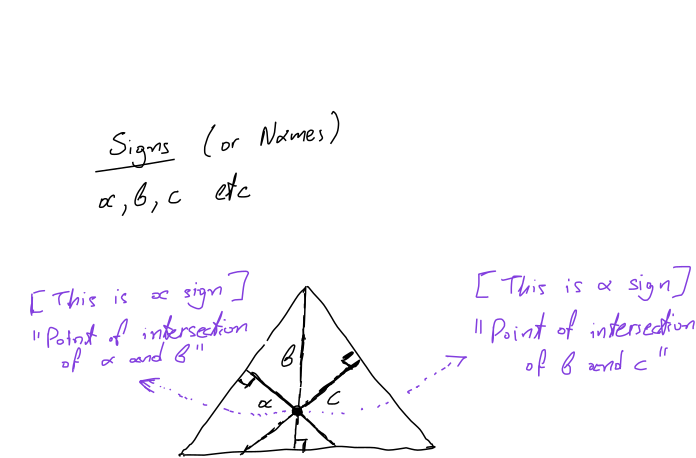
They are signs or names as long as they name or designate something.
- The referent of both signs above is the same (the intersection point)
- The sense of the signs is different (although their referent is the same)
In a similar manner, Venus is referred to as both “evening star” and “morning star”. The sense of the two signs is different but the referent the same.
The fact that the two signs refer to the same object is true knowledge (as is the truth of the statement “The point of intersection of a and b is the same as the point of intersection of b and c”.
The sense of a proper name is grasped by everybody who is sufficiently familiar with the language or totality of designations to which it belongs.
Frege, on Sense and Reference, p. 210
Comprehensive knowledge of the referent would require us to be able to say immediately whether every given sense belongs to it. To such knowledge we never attain.
Frege, on Sense and Reference, p. 211
How is this thought connected to structuralism in linguistics?
If I know an object, then I also know all the possibilities of its occurrence in atomic facts. (Every such possibility must lie in the nature of the object.) A new possibility cannot subsequently be found.
Wittgenstein’s TLP 2.0123
The referent and sense of a sign are to be distinguished from the associated conception. If the referent of the sign is an object perceivable by the senses, my conception of it is an internal image, arising from memories or sense impressions I have had and activities, both internal and external, which I have performed. Such a conception is often saturated with a feeling; the clarity of its separate parts varies and oscillates. The same sense is not always connected, even in the same man, with the same conception. The conception is subjective: One man’s conception is not that of another. There result, as a matter of course, a variety of differences in the conceptions associated with the same sense. A painter, a horseman, and a zoologist will probably connect different conceptions with the name “Bucephalus”. This constitutes an essential distinction between the conception and the sign’s sense, which may be the common property of many and therefore is not a part or a mode of the individual mind. For one can hardly deny that mankind has a common store of thoughts which is transmitted from one generation to another. […]
If two persons conceive the same, each still has his own conception. It is indeed sometimes possible to establish differences in the conceptions, or even in the sensations, of different men; but an exact comparison is not possible, because we cannot have both conceptions together in the same consciousness.
Frege, On Sense and Reference, p.212-213
The referent of a proper name is the object itself which we designate by its means; the conception, which we thereby have, is wholly subjective; in between lies the sense, which is indeed no longer subjective like the conception, but is yet not the object itself. The following analogy will perhaps clarify these relationships. Somebody observes the moon through a telescope. I compare the moon itself to the referent; it is the object of the observation, mediated by the real image projected by the object glass in the interior of the telescope, and by the retinal image of the observer. The former I compare to the sense, the latter to the conception or experience. The optical image in the telescope is indeed one-sided and dependent upon the standpoint of observation; but it is still objective, in as much it can be used by several observers. At any rate it could be arranged for several to use simultaneously. But each one would have his own retinal image. On account of the diverse shapes of the observers’ eyes, even a geometrical congruence could hardly be achieved, and a true coincidence would be out of the question.
Frege, On Sense and Reference, p.213
A proper name (word, sign, sign combination, expression) expresses its sense, refers to or designates its referent. By means of a sign we express its sense and designate the referent.
Frege, On Sense and Reference, p.214
[…] A thought is contained in a declarative sentence. By a thought I understand not the subjective performance of thinking but its objective content, which is capable of being the common property of several thinkers.
[…] the thought of the sentence “The morning star is a body illuminated by the sun” differs from that of the sentence “The evening star is a body illuminated by the sun”. Anybody who did not know that the evening star is the morning star might hold one to be true, the other false. The thought, accordingly, cannot be the referent of the sentence, but must be considered as the sense.
Frege, on Sense and Reference, p.214-215
The thought loses value for us as soon as we recognize that the referent of one of its parts is missing. We are therefore justified in not being satisfied with the sense of a sentence, and in inquiring also as to its referent. But now why do we want every proper name to have not only a sense, but also a referent? Why is the thought not enough to us? Because, and to the extent that, we are concerned with its truth value. This is not always the case. In hearing an epic poem, for instance, apart from the euphony of the language we are interested only in the sense of the sentences and the images and feelings thereby aroused. The question of truth would cause us to abandon aesthetic delight for an attitude of scientific investigation. […] It is the striving of truth that drives us always to advance from the sense to the referent.
Frege, on Sense and Reference, p.215-216
We are therefore driven into accepting the truth value of a sentence as its referent. By the truth value of a sentence I understand the circumstance that it is true or false. There are no further truth values. For brevity I call the one the true, the other the false. Every declarative sentence concerned with the referents of its words is therefore to be regarded as a proper name, and its referent, if it exists, is either the true or the false. These two objects are recognized, if only implicitly, by everybody who judges something to be true […]. In every judgement, no matter how trivial, the step from the level of thoughts to the level of referents (the objective) has already been taken. [A judgement, for me, is not the mere comprehension of a thought, but the recognition of its truth.]
Frege, On Sense and Reference, p.216
If now the truth value of a sentence is its referent, then on the one hand all true sentences have the same referent and so, on the other hand, do all false sentences. From this we see that in the referent of the sentence all that is specific is obliterated. We can never be concerned only with the referent of a sentence; but again the mere thought alone yields no knowledge, but only the thought together with its referent, i.e., its truth value.
Frege, On Sense and Reference, p.217
“Reference” is often referred to as “Denotation”
Frege suggested that the terms of a language have both a sense and a denotation, i.e., that at least two semantic relationships are required to explain the significance or meaning of the terms of a language.
Stanford Encyclopedia of Philosophy
https://plato.stanford.edu/archives/spr2024/entries/frege/#FrePuz
Frege noticed that this account of truth (‘a=b’ is true if and only if the object a just is (identical to) the object b) can’t be all there is to the meaning of identity statements. The statement ‘a=a’ has a cognitive significance (or meaning) that must be different from the cognitive significance of ‘a=b’. We can learn that ‘Mark Twain = Mark Twain’ is true simply by inspecting it; but we can’t learn the truth of ‘Mark Twain = Samuel Clemens’ simply by inspecting it — you have to examine the world to see whether the two persons are the same.
So the puzzle Frege discovered is: how do we account for the difference in cognitive significance between ‘a=b’ and ‘a=a’ when they are true?
Stanford Encyclopedia of Philosophy
https://plato.stanford.edu/archives/spr2024/entries/frege/#FrePuz
Frege, in effect, noticed the following counterexample to the Principle of Identity Substitution. Consider the following argument:
John believes that Mark Twain wrote Huckleberry Finn.
Mark Twain = Samuel Clemens.
Therefore, John believes that Samuel Clemens wrote Huckleberry Finn.
This argument is not valid. There are circumstances in which the premises are true and the conclusion false. We have already described such circumstances, namely, one in which John learns the name ‘Mark Twain’ by reading Huckleberry Finn but learns the name ‘Samuel Clemens’ in the context of learning about 19th century American authors (without learning that the name ‘Mark Twain’ was a pseudonym for Samuel Clemens). John may not believe that Samuel Clemens wrote Huckleberry Finn. The premises of the above argument, therefore, do not logically entail the conclusion.
So the Principle of Identity Substitution appears to break down in the context of propositional attitude reports. The puzzle, then, is to say what causes the principle to fail in these contexts. Why aren’t we still saying something true about the man in question if all we have done is changed the name by which we refer to him?
Stanford Encyclopedia of Philosophy
https://plato.stanford.edu/archives/spr2024/entries/frege/#FrePuz
Even though the names ‘Mark Twain’ and ‘Samuel Clemens’ denote the same individual, they express different senses. (See May 2006b for a nice discussion of the question of whether Frege believed that the sense of a name varies from person to person.) Using the distinction between sense and denotation, Frege can account for the difference in cognitive significance between identity statements of the form ‘a=a’ and those of the form ‘a=b’. Since the sense of ‘a’ differs from the sense of ‘b’, the components of the sense of ‘a=a’ and the sense of ‘a=b’ are different. Frege can claim that the sense of the whole expression is different in the two cases. Since the sense of an expression accounts for its cognitive significance, Frege has an explanation of the difference in cognitive significance between ‘a=a’ and ‘a=b’, and thus a solution to the first puzzle.
Stanford Encyclopedia of Philosophy
https://plato.stanford.edu/archives/spr2024/entries/frege/#FreTheSenDen
Moreover, Frege proposed that when a term (name or description) follows a propositional attitude verb, it no longer denotes what it ordinarily denotes. Instead, Frege claims that in such contexts, a term denotes its ordinary sense. This explains why the Principle of Identity Substitution fails for terms following the propositional attitude verbs in propositional attitude reports. The Principle asserts that truth is preserved when we substitute one name for another having the same denotation. But, according to Frege’s theory, the names ‘Mark Twain’ and ‘Samuel Clemens’ denote different senses when they occur in the following sentences:
John believes that Mark Twain wrote Huckleberry Finn.
John believes that Samuel Clemens wrote Huckleberry Finn.
If they don’t denote the same object, then there is no reason to think that substitution of one name for another would preserve truth.
Stanford Encyclopedia of Philosophy
https://plato.stanford.edu/archives/spr2024/entries/frege/#FreTheSenDen
Frege - On Sense and ReferencePDF
Frege - On Sense and Reference
Truth Values as the Referents of Sentences
Frege’s Puzzle About Identity Statements
Frege’s Puzzle About Propositional Attitude Reports