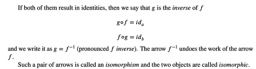
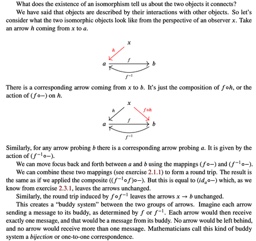
So what is category theory about? In every other aspect, either mathematics or physics or programming, we always look at the structure of things, right? In order to understand something, we want to decompose it and find what’s inside, right? It’s like you get a watch and you want to see like, how does it work? Why is it ticking, right? So you open it, you find the little parts, and then you decompose it into tiny little bits. Maybe you decompose it into atoms and then quartz, depending on how far you want to get to understand it. And category theory is very different from this. In category theory, you say I want to learn about this object, but I’m not going to look inside of this object at all. This object is black box. It’s a point. It has no structure. The structure of this object is given by how it interacts with other similar objects. So you always have a whole category of things. You want to talk about groups? Okay, what’s a category of groups? And in the category of groups, you don’t talk about what a group is like, what’s inside the group. No, you say, how is this group related to other groups, right?
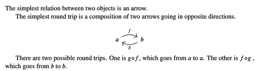
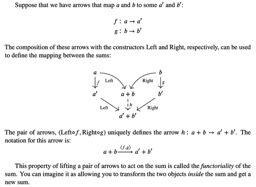
It’s more about understanding structure. I mean, it’s an amazing thing what category theory does, that it says, “Here’s a structure, it’s just objects and arrows. That’s it.” There’s nothing else. There’s just objects and arrows. And then you can study it and you can discover that these arrows can move in weird ways and combine in such crazy ways. And if you want to describe objects using just arrows, because arrows tell you how they interact with other objects, right? So there is a completely new way of talking about structure by saying how the arrows arrange themselves, right? And there is this stuff, for instance, called universal construction. Most of the things in category theory are defined using universal construction. A universal construction says, in order to understand this object, you have to tell me how it interacts with the whole universe, with every other object, not just a few objects, okay? No, with every object. That’s the universality of it, right? So this is so philosophical. You can’t be more philosophical than that, right? Make me whole with the universe, right?
Bartosz Milewski, https://haskell.foundation/podcast/30/, 38:32