Communalism, in contrast to anarchism, decidedly calls for decision-making by majority voting as the only equitable way for a large number of people to make decisions. Authentic anarchists claim that this principle—the “rule” of the minority by the majority—is authoritarian and propose instead to make decisions by consensus. Consensus, in which single individuals can veto majority decisions, threatens to abolish society as such. A free society is not one in which its members, like Homer’s lotus-eaters, live in a state of bliss without memory, temptation, or knowledge. Like it or not, humanity has eaten of the fruit of knowledge, and its memories are laden with history and experience. In a lived mode of freedom—contrary to mere café chatter—the rights of minorities to express their dissenting views will always be protected as fully as the rights of majorities. Any abridgements of those rights would be instantly corrected by the community—hopefully gently, but if unavoidable, forcefully—lest social life collapse into sheer chaos. Indeed, the views of a minority would be treasured as a potential source of new insights and nascent truths that, if abridged, would deny society the sources of creativity and developmental advances—for new ideas generally emerge from inspired minorities that gradually gain the centrality they deserve at a given time and place—until, again, they too are challenged as the conventional wisdom of a period that is beginning to pass away and requires new (minority) views to replace frozen orthodoxies.
Bookchin, The Next Revolution: Popular Assemblies and the Promise of Direct Democracy, p.25
The concrete political dimension of Communalism is known as libertarian municipalism. In its libertarian municipalist program, Communalism resolutely seeks to eliminate statist municipal structures and replace them with the institutions of a libertarian polity. It seeks to radically restructure cities’ governing institutions into popular democratic assemblies based on neighborhoods, towns, and villages. In these popular assemblies, citizens—including the middle classes as well as the working classes—deal with community affairs on a face-to-face basis, making policy decisions in a direct democracy and giving reality to the ideal of a humanistic, rational society.
Minimally, if we are to have the kind of free social life to which we aspire, democracy should be our form of a shared political life. To address problems and issues that transcend the boundaries of a single municipality, in turn, the democratized municipalities should join together to form a broader confederation. These assemblies and confederations, by their very existence, could then challenge the legitimacy of the state and statist forms of power. They could expressly be aimed at replacing state power and statecraft with popular power and a socially rational transformative politics. And they would become arenas where class conflicts could be played out and where classes could be eliminated.
[…]
Most importantly, in Communalist political life, workers of different occupations would take their seats in popular assemblies not as workers—printers, plumbers, foundry workers, and the like, with special occupational interests to advance—but as citizens, whose overriding concern should be the general interest of the society in which they live. Citizens should be freed of their particularistic identity as workers, specialists, and individuals concerned primarily with their own particularistic interests. Municipal life should become a school for the formation of citizens, both by absorbing new citizens and by educating the young, while the assemblies themselves should function not only as permanent decision-making institutions but as arenas for educating the people in handling complex civic and regional affairs.
Bookchin, The Next Revolution: Popular Assemblies and the Promise of Direct Democracy, p.16-17, 20
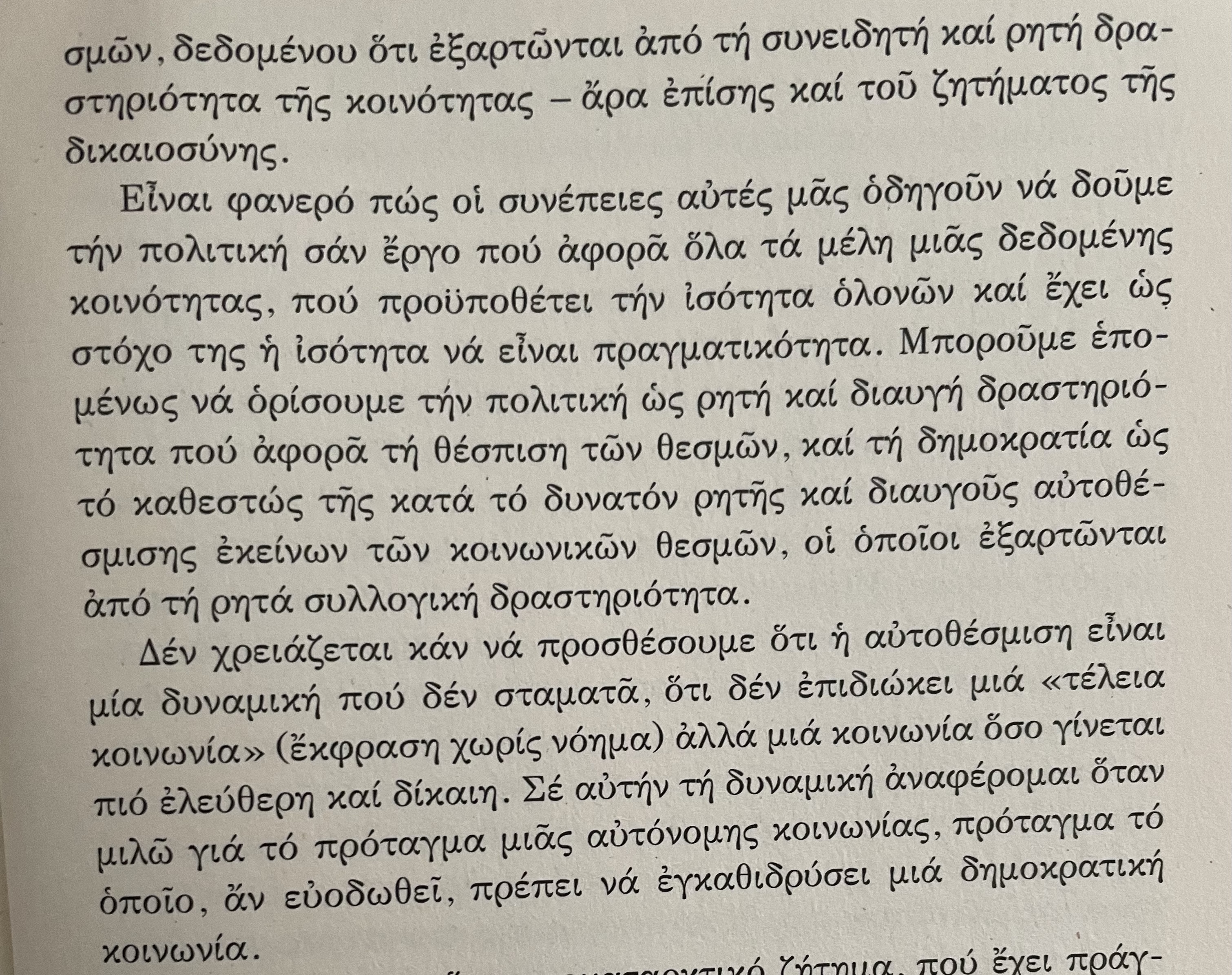
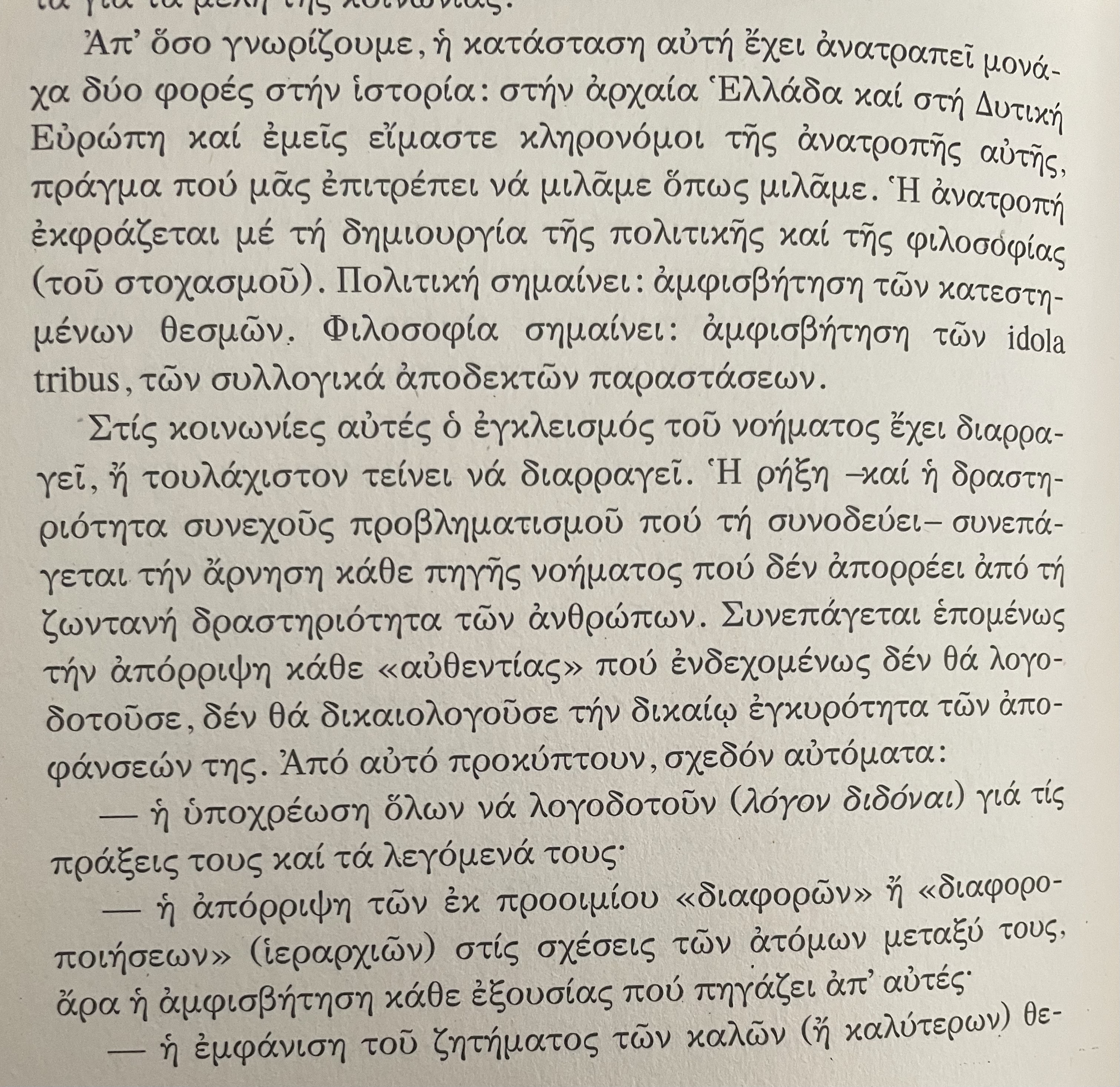
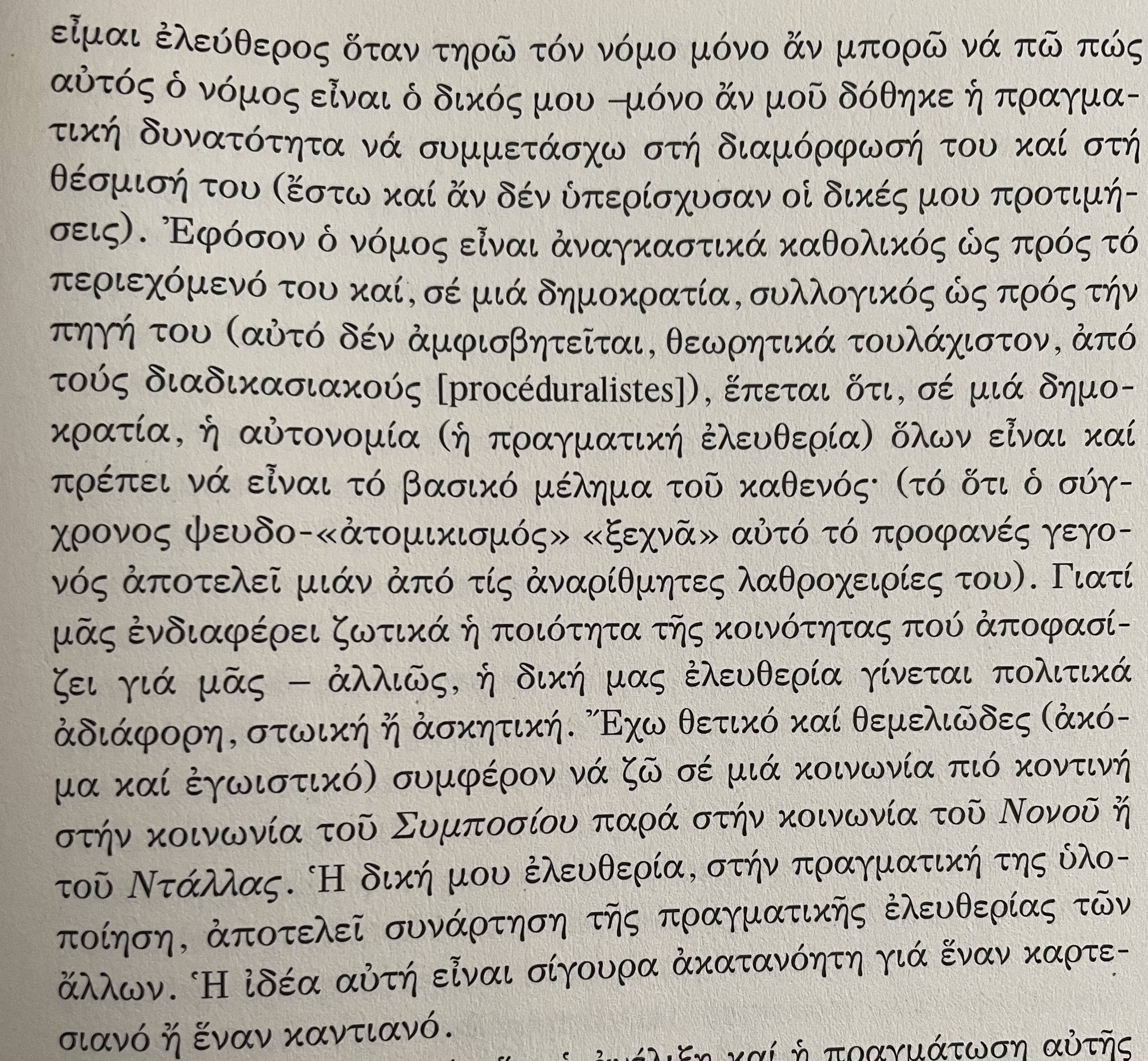
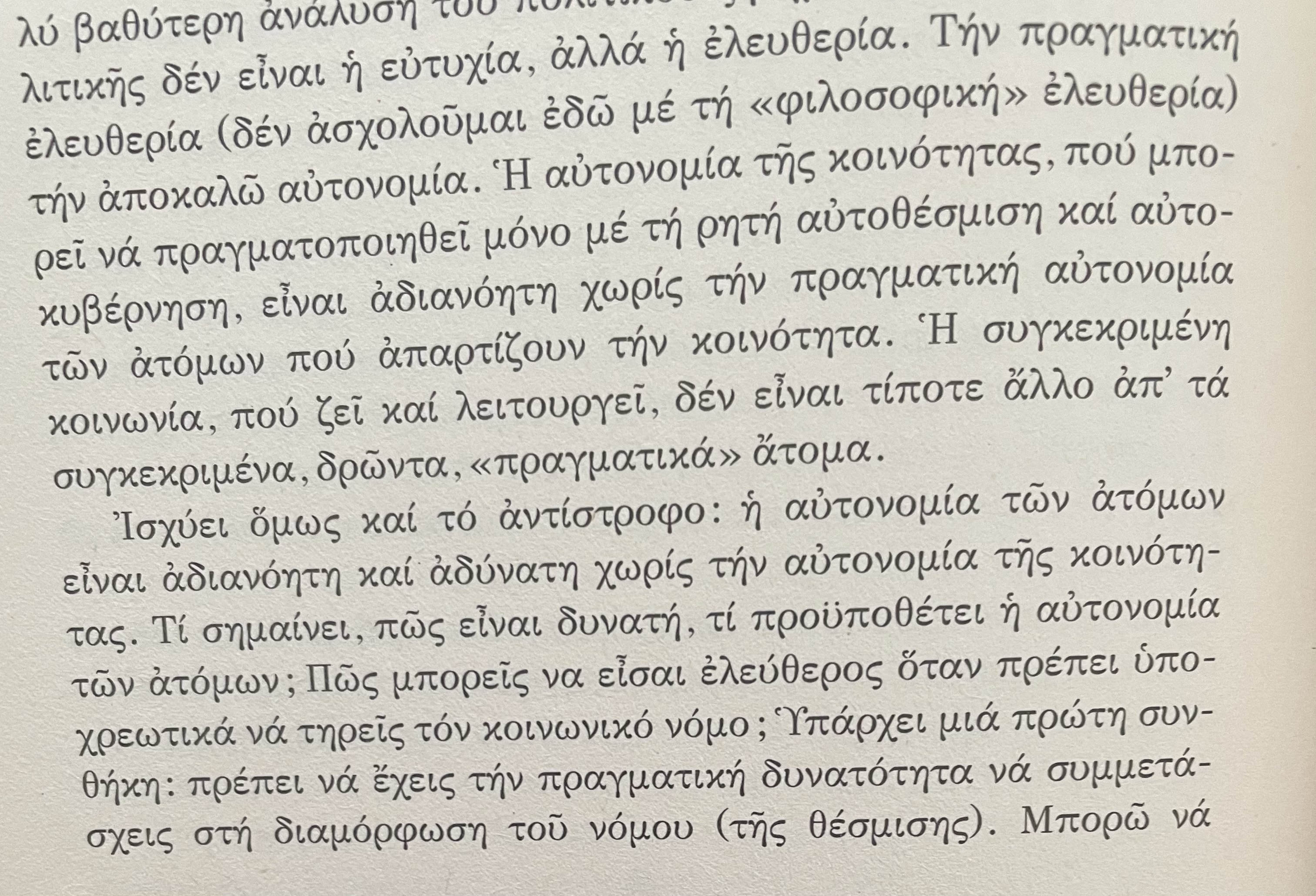
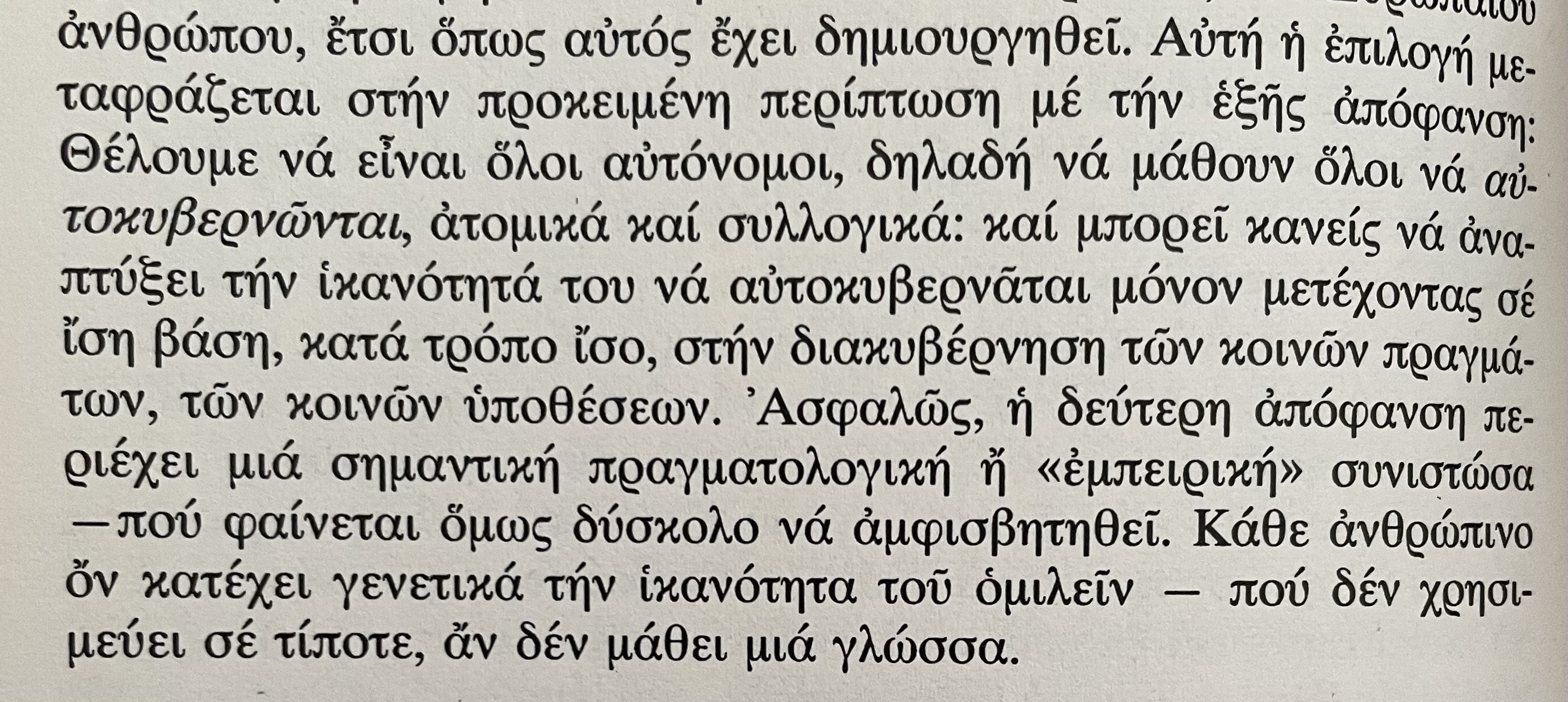
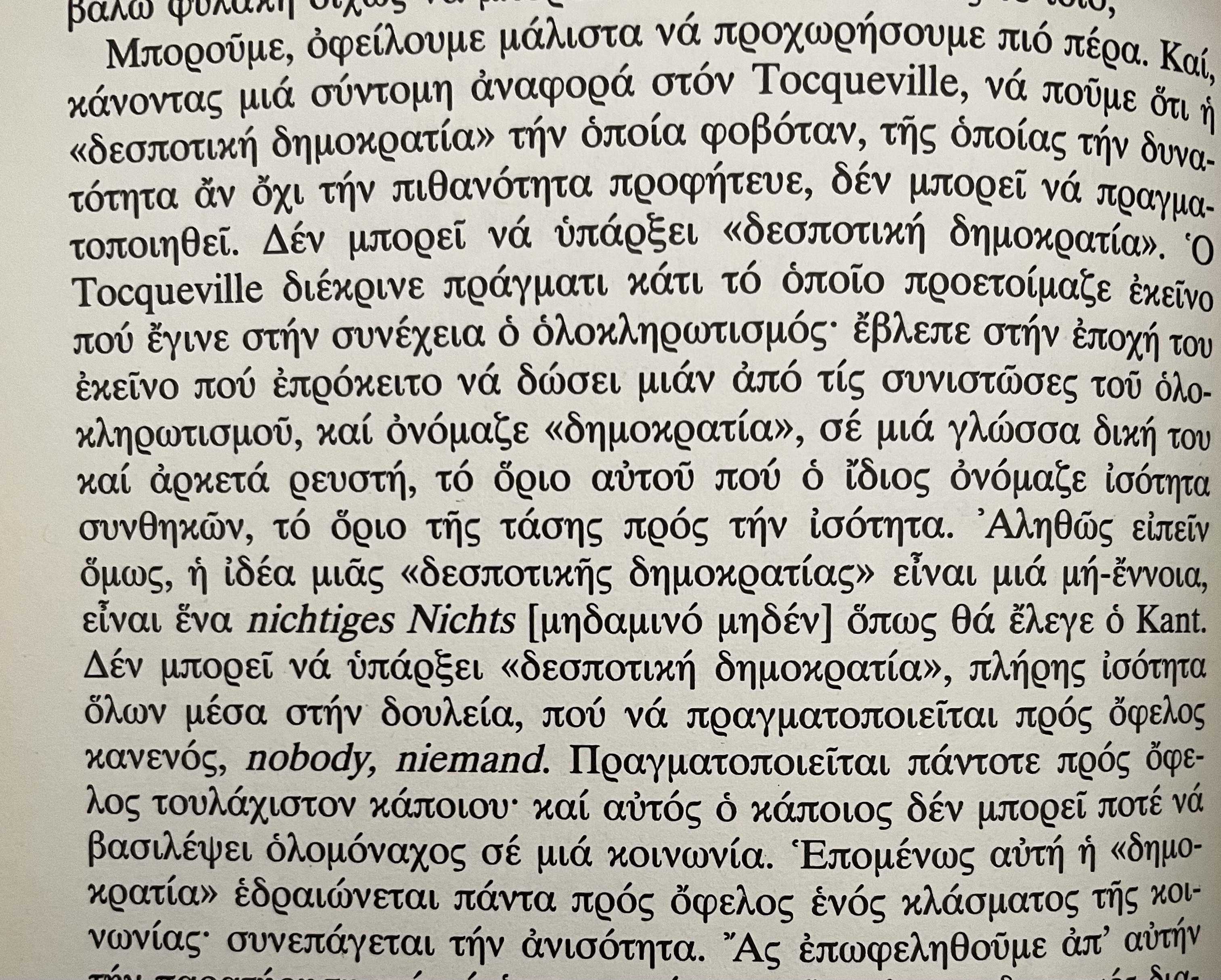
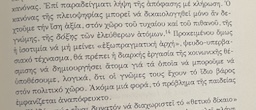
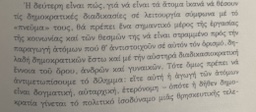
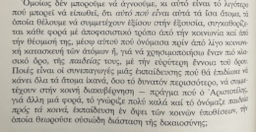
Castoriadis - Democracy and Paideia

There can therefore be no clear rules about how these principles should be translated into organisation, but on idea much emphasised in practice is that of 'horizontaJity'. Horizontality is part of the assertion of our own subjectivity,
the rejection of vertical structures, chains of command which tell us what to do, which make us the object of the decision making of others, whoever those others may be. The idea of horizontality is that all should be involved in decision-making processes on an equal basis and that there should be no leaders. In practice, it is difficult to make this work in absolute terms, since informal patterns of leadership often grow up even where there are no formal structures, so it is probably more helpful to think of horizontality not as an absolute rule but as a constant struggle against verticality. Raquel Gutierrez, in her study of the struggles in Bolivia (2009), emphasises that the important thing is not the adoption of any particular model, but the production of shared horizons of meaning through an effective process of collective deliberation.
Holloway, Crack Capitalism, p.43-44
A related, but slightly different idea is expressed in the Zapatista principle of mandar obedeciendo ('to command obeying'), the principle that those in a position of authority must always obey those over whom they exercise that authority. Here a degree of non-horizontality is accepted, but the classic council principle of accountability and instant recallability ensures that those who (temporarily) occupy positions of respon sibility should obey the wishes of the community. In many cases (in the tradition of indigenous communities, for example), this is supplemented by the idea of a rotation of responsibilities: part of belonging to a community is to accept that one may be called upon by the community to assume certain communal responsibilities for certain periods, but always in obedience to the wishes of the community.
All of this expresses the rejection of representative democracy as a form of organisation that excludes the represented. All the organisational forms that we have mentioned can be seen as developments of direct democracy, not as a set of rules but as a constant process of experimenting with democratic forms, ways of overcoming people's inhibitions, ways of controlling people's aggressions or sexist or racist assumptions. The central challenge is how to articulate effectively the we do that is the core of the cracks: how to articulate the we that is the subject of the movement, as a cohesive and yet open we, and how to articulate the do, the we as subject, as doer. The Zapatista mandar obedeciendo ('to command obeying') not only presents a solution to these questions but indicates oxymoronically a real field of tension and challenge. That the process must be understood as both exploratory and open is underlined by another central principle of the Zapatistas: preguntando caminamos, 'asking we walk'.
These can all be seen as examples of pre-figurative politics, the idea that the struggle for a different society must create that society through its forms of struggle. The term describes the idea that if you can embody the change you struggle for, you have already won - not by fighting but by becoming.
Holloway, Crack Capitalism, p.44-45
Under the intellectual leadership of Amadeo Bordiga, the Italian Left had long criticised council communism (which in “Left-wing Communism, an Infantile Disorder” Lenin lumped together with the Italian Left) for its championing of form over content, and its uncritical conception of democracy.8 It is this position, filtered through the influence of the dissident Bordigist journal Invariance, which underlies Gilles Dauvé's critique of council communism in “Leninism and the Ultraleft”, one of the foundational texts of the tendency we are describing.9 Dauvé accuses council communism of formalism on two counts: their approach to the question of organisation sees the form of organisation as the decisive factor (an “inverted Leninism”), and their conception of post-revolutionary society transforms the form (the councils) into the content of socialism, through depicting the latter as fundamentally a question of management. For Dauvé, as for Bordiga, this was a false question, for capitalism is not a mode of management but a mode of production, in which “managers” of any sort (capitalists, bureaucrats, or even workers) are merely the functionaries through which the law of value is articulated. As Pierre Nashua (La Vielle Taupe) and Carsten Juhl (Invariance) would also later argue, such a preoccupation with form over content effectively replaces the communist goal of the destruction of the economy with a mere opposition to its management by the bourgeoisie.
Endnotes, Bring out your Dead, Endnotes #1, https://endnotes.org.uk/articles/bring-out-your-dead