Marx, Capital, Volume 1, Chapter 1, Section 1: The Two Factors of a Commodity: Use Value and Value
Every product of labour is, in all states of society, a use value; but it is only at a definite historical epoch in a society's development that such a product becomes a commodity, viz., at the epoch when the labour spent on the production of a useful article becomes expressed as one of the objective qualities of that article, i.e., as its value. It therefore follows that the elementary value form is also the primitive form under which a product of labour appears historically as a commodity, and that the gradual transformation of such products into commodities, proceeds pari passu (side by side) with the development of the value form. Marx, Capital, Volume 1, Marx Engels Collected Works Volume 35 (International Publishers), p.72
A commodity is, in the first place, an object outside us, a thing that by its properties satisfies human wants of some sort or another. The nature of such wants, whether, for instance, they spring from the stomach or from fancy, makes no difference. Marx, Capital, Volume 1, Marx Engels Collected Works Volume 35 (International Publishers), p.45
The wealth of those societies in which the capitalist mode of production prevails, presents itself as "an immense accumulation of commodities", '' its unit being a single commodity. Our investigation must therefore begin with the analysis of a commodity. Marx, Capital, Volume 1, Marx Engels Collected Works Volume 35 (International Publishers), p.45
Value (Marx’s Labour Theory of Value)
[…] 1 quarter corn = x cwt. iron. What does this equation tell us? It tells us that in two different things — in 1 quarter of corn and x cwt. of iron, there exists in equal quantities something common to both. The two things must therefore be equal to a third, which in itself is neither the one nor the other. Each of them, so far as it is exchange value, must therefore be reducible to this third. […] the exchange of commodities is evidently an act characterised by a total abstraction from use value. Then one use value is just as good as another, provided only it be present in sufficient quantity. If then we leave out of consideration the use value of commodities, they have only one common property left, that of being products of labour. But even the product of labour itself has undergone a change in our hands. If we make abstraction from its use value, we make abstraction at the same time from the material elements and shapes that make the product a use value; we see in it no longer a table, a house, yarn, or any other useful thing. Its existence as a material thing is put out of sight. Neither can it any longer be regarded as the product of the labour of the joiner, the mason, the spinner, or of any other definite kind of productive labour. Along with the useful qualities of the products themselves, we put out of sight both the useful character of the various kinds of labour embodied in them, and the concrete forms of that labour; there is nothing left but what is common to them all; all are reduced to one and the same sort of labour, human labour in the abstract. Let us now consider the residue of each of these products; it consists of the same unsubstantial reality in each, a mere congelation of homogeneous human labour, of labour power expended without regard to the mode of its expenditure. All that these things now tell us is, that human labour power has been expended in their production, that human labour is embodied in them. When looked at as crystals of this social substance, common to them all, they are — Values. […] Therefore, the common substance that manifests itself in the exchange value of commodities, whenever they are exchanged, is their value. Marx, Capital, Volume 1, Marx Engels Collected Works Volume 35 (International Publishers), p.47-48
A use value, or useful article, therefore, has value only because human labour in the abstract has been embodied or materialised in it. How, then, is the magnitude of this value to be measured? Plainly, by the quantity of the value-creating substance, the labour, contained in the article. Some people might think that if the value of a commodity is determined by the quantity of labour spent on it, the more idle and unskilful the labourer, the more valuable would his commodity be, because more time would be required in its production. The labour, however, that forms the substance of value, is homogeneous human labour, expenditure of one uniform labour power. The total labour power of society, which is embodied in the sum total of the values of all commodities produced by that society, counts here as one homogeneous mass of human labour power, composed though it be of innumerable individual units. Each of these units is the same as any other, so far as it has the character of the average labour power of society, and takes effect as such; that is, so far as it requires for producing a commodity, no more time than is needed on an average, no more than is socially necessary. The labour time socially necessary is that required to produce an article under the normal conditions of production, and with the average degree of skill and intensity prevalent at the time. We see then that that which determines the magnitude of the value of any article is the amount of labour socially necessary, or the labour time socially necessary for its production." Each individual commodity, in this connection, is to be considered as an average sample of its class. Commodities, therefore, in which equal quantities of labour are embodied, or which can be produced in the same time, have the same value. The value of one commodity is to the value of any other, as the labour time necessary for the production of the one is to that necessary for the production of the other. "As values, all commodities are only definite masses of congealed labour time." Marx, Capital, Volume 1, Marx Engels Collected Works Volume 35 (International Publishers), p.48-50
In general, the greater the productiveness of labour, the less is the labour time required for the production of an article, the less is the amount of labour crystallised in that article, and the less is its value; and vice versa, the less the productiveness of labour, the greater is the labour time required for the production of an article, and the greater is its value. The value of a commodity, therefore, varies directly as the quantity, and inversely as the productiveness, of the labour incorporated in it. Marx, Capital, Volume 1, Marx Engels Collected Works Volume 35 (International Publishers), p.50
A thing can be a use value, without having value. This is the case whenever its utility to man is not due to labour. Such are air, virgin soil, natural meadows, etc. Marx, Capital, Volume 1, Marx Engels Collected Works Volume 35 (International Publishers), p.50
A thing can be useful, and the product of human labour, without being a commodity. Whoever directly satisfies his wants with the produce of his own labour, creates, indeed, use values, but not commodities. In order to produce the latter, he must not only produce use values, but use values for others, social use values. […] To become a commodity a product must be transferred to another, whom it will serve as a use value, by means of an exchange Marx, Capital, Volume 1, Marx Engels Collected Works Volume 35 (International Publishers), p.50-51
nothing can have value, without being an object of utility. If the thing is useless, so is the labour contained in it; the labour does not count as labour, and therefore creates no value. Marx, Capital, Volume 1, Marx Engels Collected Works Volume 35 (International Publishers), p.51
The value of commodities is the very opposite of the coarse materiality of their substance, not an atom of matter enters into its composition. Turn and examine a single commodity, by itself, as we will, yet in so far as it remains an object of value, it seems impossible to grasp it. If, however, we bear in mind that the value of commodities has a purely social reality, and that they acquire this reality only in so far as they are expressions or embodiments of one identical social substance, viz., human labour, it follows as a matter of course, that value can only manifest itself in the social relation of commodity to commodity. Marx, Capital, Volume 1, Marx Engels Collected Works Volume 35 (International Publishers), p.57
Exchange value, at first sight, presents itself as a quantitative relation, as the proportion in which values in use of one sort are exchanged for those of another sort, a relation constantly changing with time and place. […] A given commodity, e.g., a quarter of wheat is exchanged for x blacking, y silk, or z gold, etc.— in short, for other commodities in the most different proportions. Instead of one exchange value, the wheat has, therefore, a great many. But since x blacking, y silk, or z gold, & c , each represents the exchange value of one quarter of wheat, x blacking, y silk, z gold, & c , must, as exchange values, be re- placeable by each other, or equal to each other. Therefore, first: the valid exchange values of a given commodity express something equal; secondly, exchange value, generally, is only the mode of expression, the phenomenal form, of something contained in it, yet distinguishable from it. […] The progress of our investigation will show that exchange value is the only form in which the value of commodities can manifest itself or be expressed. Marx, Capital, Volume 1, Marx Engels Collected Works Volume 35 (International Publishers), p.46-48
The utility of a thing makes it a use value. But this utility is not a thing of air. Being limited by the physical properties of the commodity, it has no existence apart from that commodity. A commodity, such as iron, corn, or a diamond, is therefore, so far as it is a material thing, a use value, something useful. […] Use values become a reality only by use or consumption: they also constitute the substance of all wealth, whatever may be the social form of that wealth. Marx, Capital, Volume 1, Marx Engels Collected Works Volume 35 (International Publishers), p.46
Marx, Capital, Volume 1, Chapter 1, Section 3: The Form of Value or Exchange Value
The value of commodities is the very opposite of the coarse materiality of their substance, not an atom of matter enters into its composition. Turn and examine a single commodity, by itself, as we will, yet in so far as it remains an object of value, it seems impossible to grasp it. If, however, we bear in mind that the value of commodities has a purely social reality, and that they acquire this reality only in so far as they are expressions or embodiments of one identical social substance, viz., human labour, it follows as a matter of course, that value can only manifest itself in the social relation of commodity to commodity. Marx, Capital, Volume 1, Marx Engels Collected Works Volume 35 (International Publishers), p.57
Every one knows, if he knows nothing else, that commodities have a value form common to them all, and presenting a marked contrast with the varied bodily forms of their use values. I mean their money form. Here, however, a task is set us, the performance of which has never yet even been attempted by bourgeois economy, the task of tracing the genesis of this money form, of developing the expression of value implied in the value relation of commodities, from its simplest, almost imperceptible outline, to the dazzling money form. By doing this we shall, at the same time, solve the riddle presented by money. Marx, Capital, Volume 1, Marx Engels Collected Works Volume 35 (International Publishers), p.57-58
Elementary or Accidental Form of Value
x commodity A = y commodity B, or x commodity A is worth y commodity B. 20 yards of linen = 1 coat, or 20 yards of linen are worth 1 coat.
The value of the linen is represented as relative value, or appears in relative form. The coat officiates as equivalent, or appears in equivalent form. Marx, Capital, Volume 1, Marx Engels Collected Works Volume 35 (International Publishers), p.58
The first peculiarity that strikes us, in considering the form of the equivalent, is this: use value becomes the form of manifestation, the phenomenal form of its opposite, value. The bodily form of the commodity becomes its value form. But, mark well, that this quid pro quo exists in the case of any commodity B, only when some other commodity A enters into a value relation with it, and then only within the limits of this relation. Since no commodity can stand in the relation of equivalent to itself, and thus turn its own bodily shape into the expression of its own value, every commodity is compelled to choose some other commodity for its equivalent, and to accept the use value, that is to say, the bodily shape of that other commodity as the form of its own value. Marx, Capital, Volume 1, Marx Engels Collected Works Volume 35 (International Publishers), p.66
In tailoring, as well as in weaving, human labour power is expended. Both, therefore, possess the general property of being human labour, and may, therefore, in certain cases, such as in the production of value, have to be considered under this aspect alone. There is nothing mysterious in this. But in the expression of value there is a complete turn of the tables. For instance, how is the fact to be expressed that weaving creates the value of the linen, not by virtue of being weaving, as such, but by reason of its general property of being human labour? Simply by opposing to weaving that other particular form of concrete labour (in this instance tailoring) which produces the equivalent of the product of weaving. Just as the coat in its bodily form became a direct expression of value, so now does tailoring, a concrete form of labour, appear as the direct and palpable embodiment of human labour generally. Hence, the second peculiarity of the equivalent form is, that concrete labour becomes the form under which its opposite, abstract human labour, manifests itself. Marx, Capital, Volume 1, Marx Engels Collected Works Volume 35 (International Publishers), p.68-69
But because this concrete labour, tailoring in our case, ranks as, and is directly identified with, undifferentiated human labour, it also ranks as identical with any other sort of labour, and therefore with that embodied in the linen. Consequently, although, like all other commodity-producing labour, it is the labour of private individuals, yet, at the same time, it ranks as labour directly social in its character. This is the reason why it results in a product directly exchangeable with other commodities. We have then a third peculiarity of the equivalent form, namely, that the labour of private individuals takes the form of its opposite, labour directly social in its form. Marx, Capital, Volume 1, Marx Engels Collected Works Volume 35 (International Publishers), p.69
Since the relative form of value of a commodity — the linen, for example — expresses the value of that commodity, as being something wholly different from its substance and properties, as being, for instance, coat-like, we see that this expression itself indicates that some social relation lies at the bottom of it. With the equivalent form it is just the contrary. The very essence of this form is that the material commodity itself—the coat—just as it is, expresses value, and is endowed with the form of value by Nature itself. Of course this holds good only so long as the value relation exists, in which the coat stands in the position of equivalent to the linen." Since, however, the properties of a thing are not the result of its relations to other things, but only manifest themselves in such relations, the coat seems to be endowed with its equivalent form, its property of being directly exchangeable, just as much by Nature as it is endowed with the property of being heavy, or the capacity to keep us warm. Hence the enigmatical character of the equivalent form which escapes the notice of the bourgeois political economist, until this form, completely developed, confronts him in the shape of money. He then seeks to explain away the mystical character of gold and silver, by substituting for them less dazzling commodities, and by reciting, with ever renewed satisfaction, the catalogue of all possible commodities which at one time or another have played the part of equivalent. He has not the least suspicion that the most simple expression of value, such as 20 yds of linen = 1 coat, already propounds the riddle of the equivalent form for our solution. Marx, Capital, Volume 1, Marx Engels Collected Works Volume 35 (International Publishers), p.67-68
Every product of labour is, in all states of society, a use value; but it is only at a definite historical epoch in a society's development that such a product becomes a commodity, viz., at the epoch when the labour spent on the production of a useful article becomes expressed as one of the objective qualities of that article, i.e., as its value. It therefore follows that the elementary value form is also the primitive form under which a product of labour appears historically as a commodity, and that the gradual transformation of such products into commodities, proceeds pari passu (side by side) with the development of the value form. Marx, Capital, Volume 1, Marx Engels Collected Works Volume 35 (International Publishers), p.72
Total or Expanded Form of Value
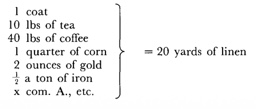
z Com. A = u Com. B or = v Com. C or = w Com. D or = x Com.E or = etc. (20 yards of linen = 1 coat or = 10 lbs tea or = 40 lbs coffee or = 1 quarter corn or = 2 ounces gold or = Jr ton iron or = etc.)
The value of a single commodity, the linen, for example, is now expressed in terms of numberless other elements of the world of commodities. Every other commodity now becomes a mirror of the linen's value. It is thus, that for the first time, this value shows itself in its true light as a congelation of undifferentiated human labour. For the labour that creates it, now stands expressly revealed, as labour that ranks equally with every other sort of human labour, no matter what its form, whether tailoring, ploughing, mining, etc , and no matter, therefore, whether it is realised in coats, corn, iron, or gold. The linen, by virtue of the form of its value, now stands in a social relation, no longer with only one other kind of commodity, but with the whole world of commodities. As a commodity, it is a citizen of that world. At the same time, the interminable series of value equations implies, that as regards the value of a commodity, it is a matter of indifference under what particular form, or kind, of use value it appears. […] The value of the linen remains unaltered in magnitude, whether expressed in coats, coffee, or iron, or in numberless different commodities, the property of as many different owners. The accidental relation between two individual commodity-owners disappears. It becomes plain, that it is not the exchange of commodities which regulates the magnitude of their value; but, on the contrary, that it is the magnitude of their value which controls their exchange proportions. Marx, Capital, Volume 1, Marx Engels Collected Works Volume 35 (International Publishers), p.73-74
The General Form of Value
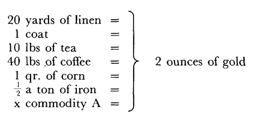
[…] expresses the values of the whole world of commodities in terms of a single commodity set apart for the purpose, namely, the linen, and thus represents to us their values by means of their equality with linen. The value of every commodity is now, by being equated to linen, not only differentiated from its own use value, but from all other use values generally, and is, by that very fact, expressed as that which is common to all commodities. A commodity can acquire a general expression of its value only by all other commodities, simultaneously with it, expressing their values in the same equivalent; and every new commodity must follow suit. It thus becomes evident that, since the existence of commodities as values is purely social, this social existence can be expressed by the totality of their social relations alone, and consequently that the form of their value must be a socially recognised form. […] The general form of relative value, embracing the whole world of commodities, converts the single commodity that is excluded from the rest, and made to play the part of equivalent — here the linen — into the universal equivalent. The bodily form of the linen is now the form assumed in common by the values of all commodities; it therefore becomes directly exchangeable with all and every of them. The substance linen becomes the visible incarnation, the social chrysalis state of every kind of human labour. Weaving, which is the labour of certain private individuals producing a particular article, linen, acquires in consequence a social character, the character of equality with all other kinds of labour. […] The general value form, which represents all products of labour as mere congelations of undifferentiated human labour, shows by its very structure that it is the social resume of the world of commodities. That form consequently makes it indisputably evident that in the world of commodities the character possessed by all labour of being human labour constitutes its specific social character. Marx, Capital, Volume 1, Marx Engels Collected Works Volume 35 (International Publishers), p.76-77
The universal equivalent form is a form of value in general. It can, therefore, be assumed by any commodity. On the other hand, if a commodity be found to have assumed the universal equivalent form (form C), this is only because and in so far as it has been excluded from the rest of all other commodities as their equivalent, and that by their own act. And from the moment that this exclusion becomes finally restricted to one particular commodity, from that moment only, the general form of relative value of the world of commodities obtains real consistence and general social validity. The particular commodity, with whose bodily form the equivalent form is thus socially identified, now becomes the money commodity, or serves as money. It becomes the special social function of that commodity, and consequently its social monopoly, to play within the world of commodities the part of the universal equivalent. Amongst the commodities which, in form B, figure as particular equivalents of the linen, and, in form C, express in common their relative values in linen, this foremost place has been attained by one in particular— namely, gold. Marx, Capital, Volume 1, Marx Engels Collected Works Volume 35 (International Publishers), p.80
The Money Form of Value
The universal equivalent form is a form of value in general. It can, therefore, be assumed by any commodity. On the other hand, if a commodity be found to have assumed the universal equivalent form (form C), this is only because and in so far as it has been excluded from the rest of all other commodities as their equivalent, and that by their own act. And from the moment that this exclusion becomes finally restricted to one particular commodity, from that moment only, the general form of relative value of the world of commodities obtains real consistence and general social validity. The particular commodity, with whose bodily form the equivalent form is thus socially identified, now becomes the money commodity, or serves as money. It becomes the special social function of that commodity, and consequently its social monopoly, to play within the world of commodities the part of the universal equivalent. Amongst the commodities which, in form B, figure as particular equivalents of the linen, and, in form C, express in common their relative values in linen, this foremost place has been attained by one in particular— namely, gold. Marx, Capital, Volume 1, Marx Engels Collected Works Volume 35 (International Publishers), p.80
The elementary expression of the relative value of a single commodity, such as linen, in terms of the commodity, such as gold, that plays the part of money, is the price form of that commodity. The price form of the linen is therefore 20 yards of linen = 2 ounces of gold, or, if 2 ounces of gold when coined are £2, 20 yards of linen = £2. Marx, Capital, Volume 1, Marx Engels Collected Works Volume 35 (International Publishers), p.81
Marx, Capital, Volume 1, Chapter 1, Section 2: The Twofold Character of Labour Embodied in Commodities
Let us take two commodities such as a coat and 10 yards of linen, and let the former be double the value of the latter, so that, if 10 yards of linen = W, the coat = 2W.
The coat is a use value that satisfies a particular want. Its existence is the result of a special sort of productive activity, the nature of which is determined by its aim, mode of operation, subject, means, and result. The labour, whose utility is thus represented by the value in use of its product, or which manifests itself by making its product a use value, we call useful labour. In this connection we consider only its useful effect. As the coat and the linen are two qualitatively different use values, so also are the two forms of labour that produce them, tailoring and weaving. […] In the use value of each commodity there is contained useful labour, i. e., productive activity of a definite kind and exercised with a definite aim. Use values cannot confront each other as commodities, unless the useful labour embodied in them is qualitatively different in each of them. In a community, the produce of which in general takes the form of commodities, i. e., in a community of commodity producers, this qualitative difference between the useful forms of labour that are carried on independently by individual producers, each on their own account, develops into a complex system, a social division of labour. Marx, Capital, Volume 1, Marx Engels Collected Works Volume 35 (International Publishers), p.51-52
So far therefore as labour is a creator of use value, is useful labour, it is a necessary condition, independent of all forms of society, for the existence of the human race; it is an eternal nature- imposed necessity, without which there can be no material exchanges between man and Nature, and therefore no life. Marx, Capital, Volume 1, Marx Engels Collected Works Volume 35 (International Publishers), p.53
Productive activity, if we leave out of sight its special form, viz., the useful character of the labour, is nothing but the expenditure of human labour power. Tailoring and weaving, though qualitatively different productive activities, are each a productive expenditure of human brains, nerves, and muscles, and in this sense are human labour. They are but two different modes of expending human labour power. Of course, this labour power, which remains the same under all its modifications, must have attained a certain pitch of development before it can be expended in a multiplicity of modes. But the value of a commodity represents human labour in the abstract, the expenditure of human labour in general. Marx, Capital, Volume 1, Marx Engels Collected Works Volume 35 (International Publishers), p.54
Simple average labour, it is true, varies in character in different countries and at different times, but in a particular society it is given. Skilled labour counts only as simple labour intensified, or rather, as multiplied simple labour, a given quantity of skilled being considered equal to a greater quantity of simple labour. Experience shows that this reduction is constantly being made. A commodity may be the product of the most skilled labour, but its value, by equating it to the product of simple unskilled labour, represents a definite quantity of the latter labour alone. The different proportions in which different sorts of labour are reduced to unskilled labour as their standard, are established by a social process that goes on behind the backs of the producers, and, consequently, appear to be fixed by custom. Marx, Capital, Volume 1, Marx Engels Collected Works Volume 35 (International Publishers), p.54
Just as, therefore, in viewing the coat and linen as values, we abstract from their different use values, so it is with the labour represented by those values: we disregard the difference between its useful forms, weaving and tailoring. As the use values, coat and linen, are combinations of special productive activities with cloth and yarn, while the values, coat and linen, are, on the other hand, mere homogeneous congelations of undifferentiated labour, so the labour embodied in these latter values does not count by virtue of its productive relation to cloth and yarn, but only as being expenditure of human labour power. Tailoring and weaving are necessary factors in the creation of the use values, coat and linen, precisely because these two kinds of labour are of different qualities; but only in so far as abstraction is made from their special qualities, only in so far as both possess the same quality of being human labour, do tailoring and weaving form the substance of the values of the same articles. Marx, Capital, Volume 1, Marx Engels Collected Works Volume 35 (International Publishers), p.55
Coats and linen, however, are not merely values, but values of definite magnitude, and according to our assumption, the coat is worth twice as much as the ten yards of linen. Whence this difference in their values? It is owing to the fact that the linen contains only half as much labour as the coat, and consequently, that in the production of the latter, labour power must have been expended during twice the time necessary for the production of the former. While, therefore, with reference to use value, the labour contained in a commodity counts only qualitatively, with reference to value it counts only quantitatively, and must first be reduced to human labour pure and simple. Marx, Capital, Volume 1, Marx Engels Collected Works Volume 35 (International Publishers), p.55
Marx, Capital, Volume 1, Chapter 1, Section 4: The Fetishism of Commodities and the Secret Thereof