The value of commodities is the very opposite of the coarse materiality of their substance, not an atom of matter enters into its composition. Turn and examine a single commodity, by itself, as we will, yet in so far as it remains an object of value, it seems impossible to grasp it. If, however, we bear in mind that the value of commodities has a purely social reality, and that they acquire this reality only in so far as they are expressions or embodiments of one identical social substance, viz., human labour, it follows as a matter of course, that value can only manifest itself in the social relation of commodity to commodity. Marx, Capital, Volume 1, Marx Engels Collected Works Volume 35 (International Publishers), p.57
Every one knows, if he knows nothing else, that commodities have a value form common to them all, and presenting a marked contrast with the varied bodily forms of their use values. I mean their money form. Here, however, a task is set us, the performance of which has never yet even been attempted by bourgeois economy, the task of tracing the genesis of this money form, of developing the expression of value implied in the value relation of commodities, from its simplest, almost imperceptible outline, to the dazzling money form. By doing this we shall, at the same time, solve the riddle presented by money. Marx, Capital, Volume 1, Marx Engels Collected Works Volume 35 (International Publishers), p.57-58
Elementary or Accidental Form of Value
x commodity A = y commodity B, or x commodity A is worth y commodity B. 20 yards of linen = 1 coat, or 20 yards of linen are worth 1 coat.
The value of the linen is represented as relative value, or appears in relative form. The coat officiates as equivalent, or appears in equivalent form. Marx, Capital, Volume 1, Marx Engels Collected Works Volume 35 (International Publishers), p.58
The first peculiarity that strikes us, in considering the form of the equivalent, is this: use value becomes the form of manifestation, the phenomenal form of its opposite, value. The bodily form of the commodity becomes its value form. But, mark well, that this quid pro quo exists in the case of any commodity B, only when some other commodity A enters into a value relation with it, and then only within the limits of this relation. Since no commodity can stand in the relation of equivalent to itself, and thus turn its own bodily shape into the expression of its own value, every commodity is compelled to choose some other commodity for its equivalent, and to accept the use value, that is to say, the bodily shape of that other commodity as the form of its own value. Marx, Capital, Volume 1, Marx Engels Collected Works Volume 35 (International Publishers), p.66
In tailoring, as well as in weaving, human labour power is expended. Both, therefore, possess the general property of being human labour, and may, therefore, in certain cases, such as in the production of value, have to be considered under this aspect alone. There is nothing mysterious in this. But in the expression of value there is a complete turn of the tables. For instance, how is the fact to be expressed that weaving creates the value of the linen, not by virtue of being weaving, as such, but by reason of its general property of being human labour? Simply by opposing to weaving that other particular form of concrete labour (in this instance tailoring) which produces the equivalent of the product of weaving. Just as the coat in its bodily form became a direct expression of value, so now does tailoring, a concrete form of labour, appear as the direct and palpable embodiment of human labour generally. Hence, the second peculiarity of the equivalent form is, that concrete labour becomes the form under which its opposite, abstract human labour, manifests itself. Marx, Capital, Volume 1, Marx Engels Collected Works Volume 35 (International Publishers), p.68-69
But because this concrete labour, tailoring in our case, ranks as, and is directly identified with, undifferentiated human labour, it also ranks as identical with any other sort of labour, and therefore with that embodied in the linen. Consequently, although, like all other commodity-producing labour, it is the labour of private individuals, yet, at the same time, it ranks as labour directly social in its character. This is the reason why it results in a product directly exchangeable with other commodities. We have then a third peculiarity of the equivalent form, namely, that the labour of private individuals takes the form of its opposite, labour directly social in its form. Marx, Capital, Volume 1, Marx Engels Collected Works Volume 35 (International Publishers), p.69
Since the relative form of value of a commodity — the linen, for example — expresses the value of that commodity, as being something wholly different from its substance and properties, as being, for instance, coat-like, we see that this expression itself indicates that some social relation lies at the bottom of it. With the equivalent form it is just the contrary. The very essence of this form is that the material commodity itself—the coat—just as it is, expresses value, and is endowed with the form of value by Nature itself. Of course this holds good only so long as the value relation exists, in which the coat stands in the position of equivalent to the linen." Since, however, the properties of a thing are not the result of its relations to other things, but only manifest themselves in such relations, the coat seems to be endowed with its equivalent form, its property of being directly exchangeable, just as much by Nature as it is endowed with the property of being heavy, or the capacity to keep us warm. Hence the enigmatical character of the equivalent form which escapes the notice of the bourgeois political economist, until this form, completely developed, confronts him in the shape of money. He then seeks to explain away the mystical character of gold and silver, by substituting for them less dazzling commodities, and by reciting, with ever renewed satisfaction, the catalogue of all possible commodities which at one time or another have played the part of equivalent. He has not the least suspicion that the most simple expression of value, such as 20 yds of linen = 1 coat, already propounds the riddle of the equivalent form for our solution. Marx, Capital, Volume 1, Marx Engels Collected Works Volume 35 (International Publishers), p.67-68
Every product of labour is, in all states of society, a use value; but it is only at a definite historical epoch in a society's development that such a product becomes a commodity, viz., at the epoch when the labour spent on the production of a useful article becomes expressed as one of the objective qualities of that article, i.e., as its value. It therefore follows that the elementary value form is also the primitive form under which a product of labour appears historically as a commodity, and that the gradual transformation of such products into commodities, proceeds pari passu (side by side) with the development of the value form. Marx, Capital, Volume 1, Marx Engels Collected Works Volume 35 (International Publishers), p.72
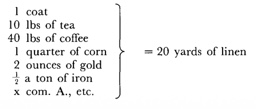
Total or Expanded Form of Value
z Com. A = u Com. B or = v Com. C or = w Com. D or = x Com.E or = etc. (20 yards of linen = 1 coat or = 10 lbs tea or = 40 lbs coffee or = 1 quarter corn or = 2 ounces gold or = Jr ton iron or = etc.)
The value of a single commodity, the linen, for example, is now expressed in terms of numberless other elements of the world of commodities. Every other commodity now becomes a mirror of the linen's value. It is thus, that for the first time, this value shows itself in its true light as a congelation of undifferentiated human labour. For the labour that creates it, now stands expressly revealed, as labour that ranks equally with every other sort of human labour, no matter what its form, whether tailoring, ploughing, mining, etc , and no matter, therefore, whether it is realised in coats, corn, iron, or gold. The linen, by virtue of the form of its value, now stands in a social relation, no longer with only one other kind of commodity, but with the whole world of commodities. As a commodity, it is a citizen of that world. At the same time, the interminable series of value equations implies, that as regards the value of a commodity, it is a matter of indifference under what particular form, or kind, of use value it appears. […] The value of the linen remains unaltered in magnitude, whether expressed in coats, coffee, or iron, or in numberless different commodities, the property of as many different owners. The accidental relation between two individual commodity-owners disappears. It becomes plain, that it is not the exchange of commodities which regulates the magnitude of their value; but, on the contrary, that it is the magnitude of their value which controls their exchange proportions. Marx, Capital, Volume 1, Marx Engels Collected Works Volume 35 (International Publishers), p.73-74
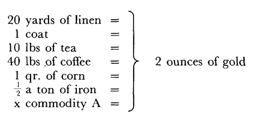
The General Form of Value
[…] expresses the values of the whole world of commodities in terms of a single commodity set apart for the purpose, namely, the linen, and thus represents to us their values by means of their equality with linen. The value of every commodity is now, by being equated to linen, not only differentiated from its own use value, but from all other use values generally, and is, by that very fact, expressed as that which is common to all commodities. A commodity can acquire a general expression of its value only by all other commodities, simultaneously with it, expressing their values in the same equivalent; and every new commodity must follow suit. It thus becomes evident that, since the existence of commodities as values is purely social, this social existence can be expressed by the totality of their social relations alone, and consequently that the form of their value must be a socially recognised form. […] The general form of relative value, embracing the whole world of commodities, converts the single commodity that is excluded from the rest, and made to play the part of equivalent — here the linen — into the universal equivalent. The bodily form of the linen is now the form assumed in common by the values of all commodities; it therefore becomes directly exchangeable with all and every of them. The substance linen becomes the visible incarnation, the social chrysalis state of every kind of human labour. Weaving, which is the labour of certain private individuals producing a particular article, linen, acquires in consequence a social character, the character of equality with all other kinds of labour. […] The general value form, which represents all products of labour as mere congelations of undifferentiated human labour, shows by its very structure that it is the social resume of the world of commodities. That form consequently makes it indisputably evident that in the world of commodities the character possessed by all labour of being human labour constitutes its specific social character. Marx, Capital, Volume 1, Marx Engels Collected Works Volume 35 (International Publishers), p.76-77
The universal equivalent form is a form of value in general. It can, therefore, be assumed by any commodity. On the other hand, if a commodity be found to have assumed the universal equivalent form (form C), this is only because and in so far as it has been excluded from the rest of all other commodities as their equivalent, and that by their own act. And from the moment that this exclusion becomes finally restricted to one particular commodity, from that moment only, the general form of relative value of the world of commodities obtains real consistence and general social validity. The particular commodity, with whose bodily form the equivalent form is thus socially identified, now becomes the money commodity, or serves as money. It becomes the special social function of that commodity, and consequently its social monopoly, to play within the world of commodities the part of the universal equivalent. Amongst the commodities which, in form B, figure as particular equivalents of the linen, and, in form C, express in common their relative values in linen, this foremost place has been attained by one in particular— namely, gold. Marx, Capital, Volume 1, Marx Engels Collected Works Volume 35 (International Publishers), p.80
The Money Form of Value
The universal equivalent form is a form of value in general. It can, therefore, be assumed by any commodity. On the other hand, if a commodity be found to have assumed the universal equivalent form (form C), this is only because and in so far as it has been excluded from the rest of all other commodities as their equivalent, and that by their own act. And from the moment that this exclusion becomes finally restricted to one particular commodity, from that moment only, the general form of relative value of the world of commodities obtains real consistence and general social validity. The particular commodity, with whose bodily form the equivalent form is thus socially identified, now becomes the money commodity, or serves as money. It becomes the special social function of that commodity, and consequently its social monopoly, to play within the world of commodities the part of the universal equivalent. Amongst the commodities which, in form B, figure as particular equivalents of the linen, and, in form C, express in common their relative values in linen, this foremost place has been attained by one in particular— namely, gold. Marx, Capital, Volume 1, Marx Engels Collected Works Volume 35 (International Publishers), p.80
The elementary expression of the relative value of a single commodity, such as linen, in terms of the commodity, such as gold, that plays the part of money, is the price form of that commodity. The price form of the linen is therefore 20 yards of linen = 2 ounces of gold, or, if 2 ounces of gold when coined are £2, 20 yards of linen = £2. Marx, Capital, Volume 1, Marx Engels Collected Works Volume 35 (International Publishers), p.81