Reciprocity, Gift and Exchange
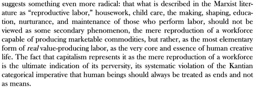
The modern ideal of the gift, then, becomes an impossible mirror of market behavior: an act of pure generosity untrammeled by any thought of personal gain. But as the members of the MAUSS group endlessly insist, this does not mean people no longer give gifts: even in modern, capitalist societies things are constantly changing hands without any immediate return or ex- plicit agreement about a future one. It does not even mean that gifts are no longer important. In fact, they argue, modern society could not function without them. The gift has become the “hidden face of modernity” (Nicolas 1991): “hidden” because one can always produce some reason to say any particular gift (money given to children, wedding presents, donations of blood, dinners for business associates, offering advice to friends or spending hours listening to their tedious problems) are not really gifts at all. So too in social theory. The result, as Godbout puts it, is a science that has “come to speak of social ties without using the words that are associated with them in daily life: surrender, forgiveness, renunciation, love, respect, dignity, redemption, salvation, redress, compassion, everything that is at the heart of relationships between people and that is nourished by the gift” Graeber, Toward an Anthropological Theory of Value, p.161
[…] the most valuable objects in gift economies are valued primarily because they embody some human quality, whether this be the creative potential of human action, or fertility, or the like, or particular histories and identities that have already been achieved. Of course, I’ve already argued something similar about market economies as well; but here, one can say that the ideal of the complete detachability of persons and things (which Mauss emphasized) is part of that same overall movement that led also to the separation of the spheres of production and consumption, emphasized by Marx, which allows these essential links to be obscured. In this sense it is not gift economies but market economies that deny “the true soil of their own life,” since they are constantly obscuring the fact that all “economic” activity is ultimately a means to the creation of certain sorts of person. Graeber, Toward an Antrhopological Theory of Value, p.211
As should be obvious by now, gifts do not always have to be repaid. The question should really be: When do they have to be repaid? What sort of gifts? In what circumstances? And what precisely can count as a repayment? The conclusion would have been impossible to avoid had Mauss made a serious effort to explore his own notion of the “total prestation” (which he also referred to as “total reciprocity”), instead of moving directly to “the pot- latch.” Because in the former, gifts do not have to be repaid. This is because unlike competitive gift exchange, “total prestations” created permanent relationships between individuals and groups, relations that were permanent precisely because there was no way to cancel them out by a repayment. The demands one side could make on the other were open ended because they were permanent; nothing would be more absurd than for the member of an Iroquois moiety to keep count of how many of the other’s side dead each had recently buried, to see which was ahead. This is why Mauss considered them “communistic”: they corresponded to Louis Blanc’s famous phrase “From each according to his abilities, to each according to his needs.” Most of us treat our closest friends this way. No accounts need be kept because the relation is not treated as if it will ever end. […] When do gifts have to be repaid? If one is speaking of strict equivalence, the answer is: Gifts have to be repaid when “communistic” relations are so identified with inequality that not doing so would place the recipient in the position of an inferior. Such forms of exchange then are about establishing a kind of fragile, competitive equality between actors who are almost always themselves hierarchical superiors to someone else. Graeber, Toward an Anthropological Theory of Value, p.217-218
Sahlins, on the other hand, defines “generalized reciprocity” as the kind of open-ended responsibility that prevails among close kin, all of whom will do whatever they can to help the other, not because they expect repayment, but simply because they know that in a similar crisis, the other would do the same. He contrasts it with the “balanced reciprocity” that prevails between people who, though less close, are nonetheless close enough that they feel obliged to deal with each other on a moral basis. “Balanced reciprocity,” in- terestingly enough, would thus include both classical gift exchange and the less cutthroat forms of trade or barter. […] Rather than “generalized” or “balanced” reciprocity, then, it might be better to think of reciprocity as relatively “open” and “closed”: open reciprocity keeps no accounts, because it implies a relation of permanent mutual commitment; it becomes closed reciprocity when a balancing of accounts closes the relationship off, or at least maintains the constant possibility of doing so. Phrasing it this way also makes it easier to see the relation as a matter of degree and not of kind: closed relations can become more open, open ones more closed. It seems difficult to avoid the impression, then, that the closed reciprocity of gift and countergift is in fact the form of gift exchange that least embodies what makes a “gift economy” different from one dominated by market exchange. It is competitive, individualistic, and can easily slip into something resembling barter. Graeber, Toward an Anthropological Theory of Value, p.218-220
While it is certainly true that tit-for-tat exchange of this sort can help create an ongoing, mutually supportive relationship, it has only really done so when it stops being strictly tit for tat. Graeber, Toward an Anthropological Theory of Value, p.219
To give a gift is to transfer something without any immediate return, or guarantee that there will ever be one. This is the definition adopted by the MAUSS group (e.g., Godbout and Caillé 1998), and it seems about as good a general definition as we’re going to get. It also makes it clear that the term can apply to an enormous variety of transactions, and that the term “gift economy” can apply to any not organized on market principles. Graeber, Toward an Anthropological Theory of Value, p.225
The notion of “total prestation” is in fact an excellent place to start, provided one is willing to break it down into its constituent elements. This means that timeless relations of open-ended, communistic reciprocity, whether they apply to groups like moieties or clans, or members of a family, or a network of individuals (as in Mauss’ “individualistic communism”) have to be distinguished from balanced gift-exchange. While the former can often slip into relations of patronage and exploitation (and it is often very hard to tell, from either the analyst’s or actor’s point of view, just when one definitively turns into the other), the latter has a tendency to degenerate into outright competition—most often the kinds of contest of generosity that Mauss labeled “the potlatch” but which should probably be best referred to just as “agonistic exchange.” Alternately, as it focuses more on the objects, it can become continuous with forms of exchange that look increasingly like barter. As structures of action, one is concerned with maintaining the value of a timeless human commitment; the other, that of a more ephemeral autonomy. Graeber, Toward an Anthropological Theory of Value, p.225
[A mode of relating] in which two parties act, or are disposed to act, toward one another in equivalent ways. Graeber, Toward an Anthropological Theory of Value, p.225
[…] we are not really dealing with reciprocity here-or at best, only with reciprocity in the broadest sense. What is equal on both sides is the knowledge that the other person would do the same for you, not that they necessarily will. The Iroquois example brings home clearly what makes this possible: that such relations are based on a presumption of eternity. Society will always exist. Therefore, there will always be a north and a south side of the village. This is why no accounts need be taken. In a similar way, people tend to treat their mothers and best friends as if they will always exist, however well they know it isn't true. Graeber, Debt, p.100
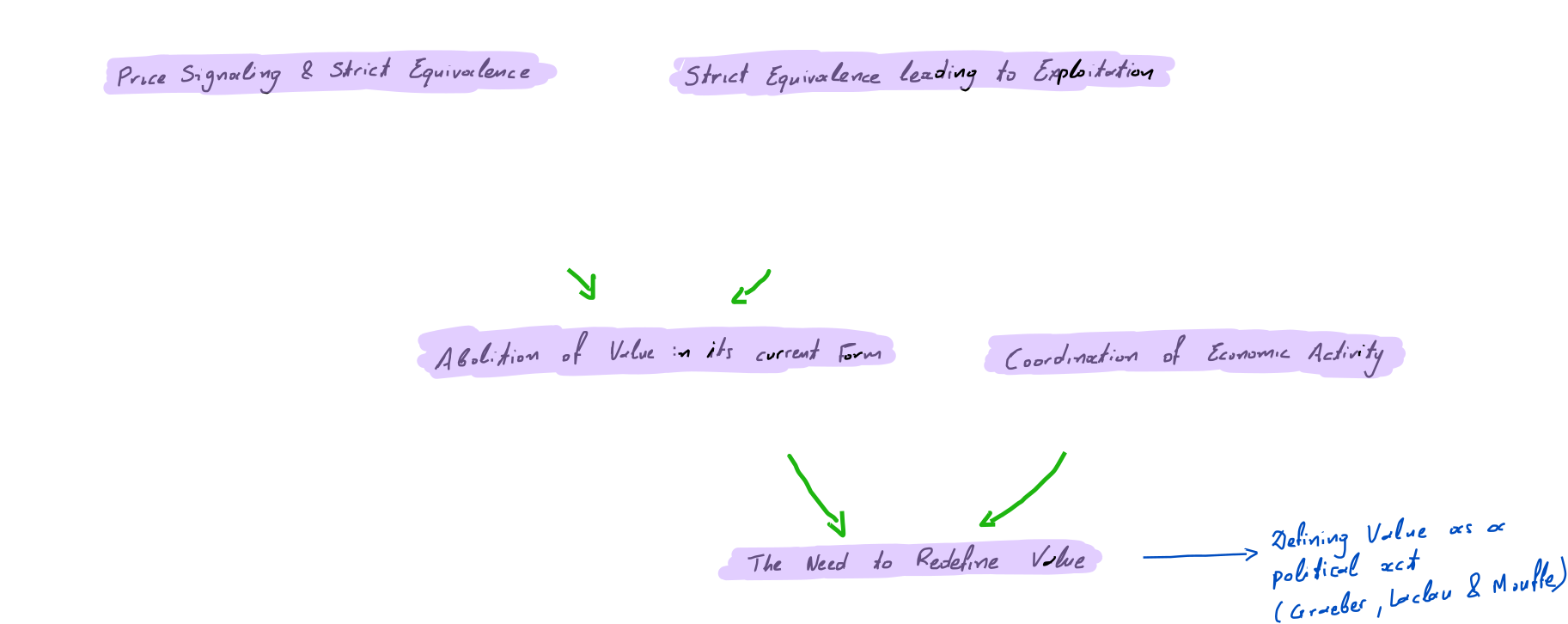
Exchange is all about equivalence. It's a back-and-forth process involving two sides in which each side gives as good as it gets. This is why one can speak of people exchanging words (if there's an argu­ment), blows, or even gunfire.25 In these examples, it's not that there is ever an exact equivalence--even if there were some way to measure an exact equivalence--but more a constant process of interaction tend­ing toward equivalence. Actually, there's something of a paradox here: each side in each case is trying to outdo the other, but, unless one side is utterly put to rout, it's easiest to break the whole thing off when both consider the outcome to be more or less even. When we move to the exchange of material goods, we find a similar tension. Often there is an element of competition; if nothing else, there's always that pos­sibility. But at the same time, there's a sense that both sides are keeping accounts, and that, unlike what happens in communism, which always partakes of a certain notion of eternity, the entire relationship can be canceled out, and either party can call an end to it at any time. Graeber, Debt, p.103
What marks commercial exchange is that it's "impersonal": who it is that is selling something to us, or buying something from us, should in principle be entirely irrelevant. We are simply comparing the value or two objects. Graeber, Debt, p.103
Exchange allows us to cancel out our debts. It gives us a way to call it even: hence, to end the relationship Graeber, Debt, p.104
What, then, is debt? Debt is a very specific thing, and it arises from very specific situ­ations. It first requires a relationship between two people who do not consider each other fundamentally different sorts of being, who are at least potential equals, who are equals in those ways that are really important, and who are not currently in a state of equality-but for whom there is some way to set matters straight. In the case of gift-giving, as we've seen, this requires a certain equality of status. […] During the time that the debt remains unpaid, the logic of hierar­chy takes hold. There is no reciprocity. […] A debt, then, is just an exchange that has not been brought to completion. It follows that debt is strictly a creature of reciprocity and has little to do with other sorts of morality (communism, with its needs and abilities; hierarchy, with its customs and qualities). True, if we were really determined, we could argue (as some do) that communism is a condition of permanent mutual indebtedness, or that hierarchy is con­ structed out of unpayable debts. But isn't this just the same old story, starting from the assumption that all human interactions must be, by definition, forms of exchange, and then performing whatever mental somersaults are required to prove it? No. All human interactions are not forms of exchange. Only some are. Exchange encourages a particular way of conceiving human rela­tions. This is because exchange implies equality, but it also implies separation. It's precisely when the money changes hands, when the debt is cancelled, that equality is restored and both parties can walk away and have nothing further to do with each other. Debt is what happens in between: when the two parties cannot yet walk away from each other, because they are not yet equal. But it is carried out in the shadow of eventual equality. Because achieving that equality, however, destroys the very reason for having a relation­ ship, just about everything interesting happens in between Graeber, Debt, p.120-122
Gentle Reciprocity

Challenges

Challenge: Gentle Reciprocity cannot be easily defined and is inherently resistant to abstraction and measurement

This element of competition can work in completely different ways. In cases of barter or commercial exchange, when both parties to the transaction are only interested in the value of goods being trans­ acted, they may well-as economists insist they should - try to seek the maximum material advantage. On the other hand, as anthropologists have long pointed out, when the exchange is of gifts, that is, the objects passing back and forth are mainly considered interesting in how they reflect on and rearrange relations between the people carrying out the transaction, then insofar as competition enters in, it is likely to work precisely the other way around-to become a matter of contests of generosity, of people showing off who can give more away. Graeber, Debt, p.103
To leave the economy is to bring out the plane of reality it covers over. Commodity exchange and all that it comprises in the way of harsh negotiation, mistrust, deceit, and wabu wabu, as the Melanesians say, is not exclusively Western. In places where people know how to live, one only practices this type of relations with outsiders, people one is not connected with, who are distant enough so that a mix-up cannot develop into a general conflict. To pay, in Latin, comes from pacare, "to satisfy, to calm," for example by distributing money to sol­diers so they can buy themselves some salt-thus a wage. One pays in order to have peace. The whole vocabulary of economy is basically a vocabulary of avoided war. "There is a link, a continuity, between hostile relations and the provision of reciprocal prestations: Exchanges are peacefully resolved wars, and wars are the result of unsuccessful transactions." (Levi-Strauss). Economy's defect is to reduce all possible relationships to hostile rela­tions, every distance to foreignness. What it covers over in this way is the entire gamut, all the grada­tion, all the heterogeneity among the different existing and imaginable relations. Depending on the degree of proximity between beings, there is a commonality of goods, a sharing of certain things, exchange with an adjusted reciprocity, mercantile exchange, or a total absence of exchange. And every form of life has its language and its notions for expressing this multiplicity of regimes. Making the bastards pay is good warfare. When you love you don't count the cost. Where money talks, words are worth nothing. Where words matter, money's worth nothing. Thus, exiting the economy is being able to dearly distinguish between the possible divisions and, from where one is, to deploy a whole art of distances. It's to push the hostile relations - and the sphere of money, accounting, measurement - as far away as possible. It's to banish to the margins of life that which is presently its norm, its core, its essential condition. The Invisible Committee, Now, p.107-108
Social Action & Rationality
Critique to Instumental Reason
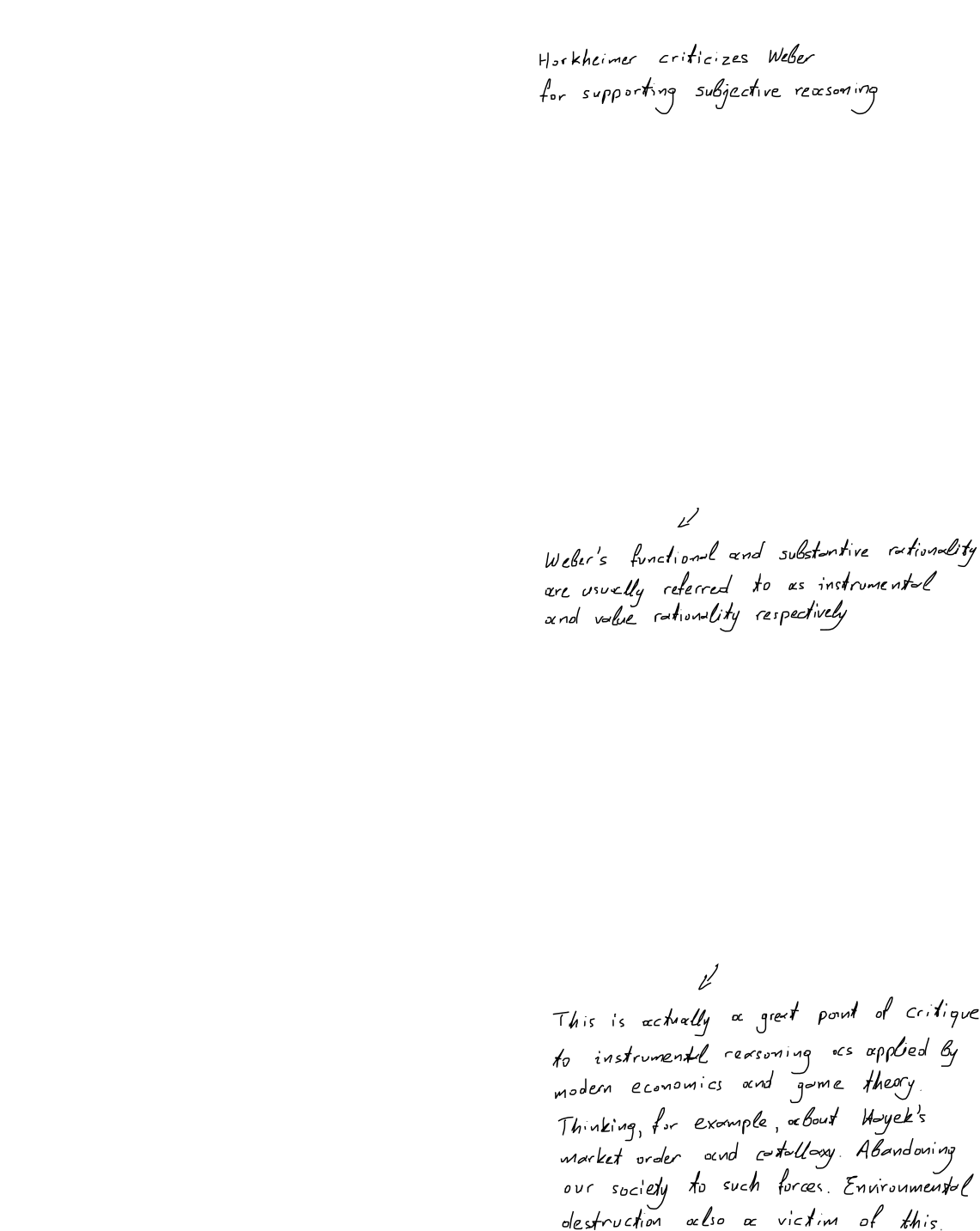
The subjective faculty of thinking was the critical agent that dissolved superstition. But in denouncing mythology as false objectivity, i.e. as a creation of the subject, it had to use concepts that it recognized as adequate. Thus it always developed an objectivity of its own. In Platonism, the Pythagorean theory of numbers, which originated in astral mythology, was transformed into the theory of ideas that attempts to define the supreme content of thinking as an absolute objectivity ultimately beyond, though related to, the faculty of thinking. The present crisis of reason consists fundamentally in the fact that at a certain point thinking either became incapable of conceiving such objectivity at all or began to negate it as a delusion. This process was gradually extended to include the objective content of every rational concept. In the end, no particular reality can seem reasonable per se; all the basic concepts, emptied of their content, have come to be only formal shells. As reason is subjectivized, it also becomes formalized. The formalization of reason has far-reaching theoretical and practical implications. If the subjectivist view holds true, thinking cannot be of any help in determining the desirability of any goal in itself. The acceptability of ideals, the criteria for our actions and beliefs, the leading principles of ethics and politics, all our ultimate decisions are made to depend upon factors other than reason. They are supposed to be matters of choice and predilection, and it has become meaningless to speak of truth in making practical, moral, or esthetic decisions. Horkheimer, Eclipse of Reason, Means and Ends, p.6
According to such theories, thought serves any particular endeavor, good or bad. It is a tool of all actions of society, but it must not try to set the patterns of social and individual life, which are assumed to be set by other forces. In lay discussion as well as in scientific, reason has come to be commonly regarded as an intellectual faculty of co-ordination, the efficiency of which can be increased by methodical use and by the removal of any non-intellectual factors, such as conscious or unconscious emotions. Reason has never really directed social reality, but now reason has been so thoroughly purged of any specific trend or preference that it has finally renounced even the task of passing judgment on man's actions and way of life. Reason has turned them over for ultimate sanction to the conflicting interests to which our world actually seems abandoned. Horkheimer, Eclipse of Reason, Means and Ends, p.7
In the subjectivist view, when 'reason' is used to connote a thing or an idea rather than an act, it refers exclusively to the relation of such an object or concept to a purpose, not to the object or concept itself. It means that the thing or the idea is good for something else. There is no reasonable aim as such, and to discuss the superiorityof one aim over another in terms of reason becomes meaningless. From the subjective approach, such a discussion is possible only if both aims serve a third and higher one, that is, if they are means, not ends. Horkheimer, Eclipse of Reason, Means and Ends, p.5
the force that ultimately makes reasonable actions possible is the faculty of classification, inference, and deduction, no matter what the specific content—the abstractfunctioning of the thinking mechanism. This type of reason may be called subjective reason. It is essentially concerned with means and ends, with the adequacy of procedures for purposes more or less taken for granted and supposedly self-explanatory. It attaches little importance to the question whether the purposes as such are reasonable. If it concerns itself at all with ends, it takes for granted that they too are reasonable in the subjective sense, i.e. that they serve the subject's interest in relation to self- preservation—be it that of the single individual, or of the community on whose maintenance that of the individual depends. The idea that an aim can be reasonable for its own sake—on the basis of virtues that insight reveals it to have in itself—without reference to some kind of subjective gain or advantage, is utterly alien to subjective reason, even where it rises above the consideration of immediate utilitarian values and devotes itself to reflections about the social order as a whole. […] Ultimately subjective reason proves to be the ability to calculate probabilities and thereby to co-ordinate the right means with a given end. Horkheimer, Eclipse of Reason, Means and Ends, p.3-4
The difference between this connotation of reason and the objectivistic conception resembles to a certain degree the difference between functional and substantial rationality as these words are used in the Max Weber school. Max Weber, however, adhered so definitely to the subjectivistic trend that he did not conceive of any rationality—not even a 'substantial' one by which man can discriminate one end from another. If our drives, intentions, and finally our ultimate decisions must a priori be irrational, substantial reason becomes an agency merely of correlation and is therefore itself essentially 'functional.' Although Weber's own and his followers' descriptions of the bureaucratization and monopolization of knowledge have illuminated much of the social aspect of the transition from objective to subjective reason (cl. particularly the analyses of Karl Mannheim in Man and Society, London, 1940). Max Weber's pessimism with regard to the possibility of rational insight and action, as expressed in his philosophy (cf., e.g., 'Wisscnschaft als Beruf,' in Gesammelte Aufodtze zur Wissenschaftslehre, Tubingen, 1922), is itself a stepping-stone in the renunciation of philosophy and science as regards their aspiration of defining man's goal. Horkheimer, Eclipse of Reason, Means and Ends, p.5
Horkheimer and Adorno are interested precisely in the ironic connection that the rationalization of society seems to establish between the transformation of traditional realms of life into subsystems of purposive-rational action, on the one hand, and the "atrophy of individuality," on the other. In Horkheimer's view the destruction of the identity that an individual gains from the orientation to "basic intellectual concepts" or principles is directly connected not only with bureaucratization but with the detachment of systems of purposive-rational action from "culture," from a horizon of the lifeworld experienced as rational. The more the economy and the state change into embodiments of cognitive-instrumental rationality and subordinate other departments of life to their imperatives, and the more they push to the fringes anything in which moral-practical and aesthetic-practical rationality can be embodied, the less support processes of individuation find in a domain of cultural reproduction that has been shunted into the irrational or wholly tailored to the pragmatic. Habermas, The Theory of Communicative Action, Vol.1, p.354
Individualism is the very heart of the theory and practice of bourgeois liberalism, which sees society as progressing through the automatic interaction of diverging interests in a free market. Horkheimer, Eclipse of Reason, p.138-139
The fact that the bourgeois has always defined "reason" through its relation to individual self-preservation seems to run counter to Locke's exemplary determination, according to which "reason" designates the management of intellectual activity, no matter which ends are served by this activity. But reason is far from leaving the jurisdiction of monadic self-interest with this dissociation from every particular end; rather, it merely develops procedures with which it can all the more obligingly serve any arbitrary monadic end. The growing formal universality of bourgeois reason does not mean a growing consciousness of universal solidarity. Max Horkheimer, "Vernunft und Selbsterhaltung," in Ebeling, ed., Subjektivitat und Selbsterhaltung, p.47-48 (in Habermas, The Theory of Communicative Action, p.388)
Rational action as such is the relating of ends to means; economic rationality, specifically, assumes means to be scarce. But human society involves more than that. What should be the end of man, and how should he choose his means? Economic rationalism, in the strict sense, has no answer to these questions, for they imply motivations and valuations of a moral and practical order that go beyond the logically irresistible, but otherwise empty exhortation to be ‘economi­cal’”. Karl Polanyi, The Livelihood of Man (New York: Academic Press, 1977), p. 13.
[…] Max Weber directly challenged all these tenets of the Enlightenment faith in reason and progress in ways that remain relevant for us today. In his view, the rationality that defines modernity is at bottom a Zweckrationalitat, a purposive or means/ends rationality, the inherent aim of which is the mastery of the world in the service of human interests. As a consequence, the growth and spread of reason does not, as Enlightenment thinkers supposed it would, furnish a new, nonillusory center of meaning to modern culture. It does, to be sure, gradually dissolve traditional superstitions, prejudices and errors; but this "dis- enchantment of the world," as Weber calls it, does not replace traditional religious worldviews with anything that could fulfill the functions of, for instance, giving meaning and unity to life. Rather, the disenchanted world is stripped of all ethical meaning; it is devalued and objectified as the material and setting for purposive-rational pursuit of interests. The gain in control is paid for with a loss of meaning. And the control that we gain is itself value- neutral—an instrumental potential that can be harnessed from any one of an unlimited number of value perspectives. This subjectivization of "ultimate" ends means that the unity of the world has fallen to pieces. In place of the one God or the unitary ground of being, we have an irreducible plurality of competing, often irreconcilable values, and as Weber says, "over these gods and their struggles it is fate, and certainly not any "science," that holds sway”. Because in the final analysis values cannot be rationally grounded but only chosen, there are at the core of life rationally unjustifiable commitments through which we give the dis- enchanted world meaning and unity. Correspondingly, the sphere of politics has to be understood as a sphere of decision and power and not of reason: Legitimacy is not a question of rational justification but of de facto acceptance of an order of authority by those subject to it; and law is not an expression of rational will but a product of enactment by duly constituted authorities according to established procedures. Weber's views on economy and society are equally antithetical to Enlightenment hopes regarding the institutionalization of reason. The progress of societal rationalization was indeed well along by the end of the nineteenth century; but what this progress turned out to be, according to Weber, was the ascendency of purposive rationality, of technique and calculation, of organization and administration. The triumph of reason brings with it not a reign of freedom but the dominion of impersonal economic forces and bureaucratically organized administrations—a "vast and mighty cosmos" that "determines with irresistible force the lifestyles of all the individuals who are born into (it)". Nor would the advent of socialism improve the situation; it would, says Weber, merely mean the final and complete victory of bureaucracy. The realization of reason that the eighteenth-century philosophers envisioned as a Kingdom of God on earth has turned out to be an "iron cage" in which we are henceforth condemned to live. Disenchantment and rationalization are irreversible, as are the loss of meaning and the loss of freedom that accompany them. The undeniable power of this analysis has, of course, often been harnessed for conservative purposes […]. McCarthy, Translator’s Introduction, The Theory of Communicative Action, Vol.1, p.xvii-xviii
Weber has at his disposal a complex concept of practical rationality that takes the coordination of purposive-rational and value-rational aspects of action as its point of departure. Nevertheless, on the other hand, Weber considers societal rationalization explicitly from the perspective of purposive-rationality. At the level of institutions, he does not apply the comprehensive concept of rationality upon which he bases his investigations of cultural tradition. Only the cognitive-instrumental complex of rationality acquires significance for the rationality of action systems. At the level of the economic and political subsystems, only the aspect of purposive-rational, and not that of value-rational action is supposed to have structure-forming effects. From Weber's sociology of the economy, state, and law, one gets the impression that in modern societies rationalization processes attach only to empirical-theoretical knowledge and to the instrumental and strategic aspects of action, whereas practical rationality cannot be institutionalized independently, that is, with an inner logic specific to a subsystem. Habermas, The Theory of Communicative Action, Vol.1, p.254
In analyzing this hopeless situation, Horkheimer and Adorno keyed in on a factor that Weber had singled out: the spread of formal, means/ends rationality, which they called instrumental reason. In doing so, they completely revised Marx's positive evaluation of scientific-technological progress. What for him represented an unambiguously emancipatory potential, for them was the core of a domination generalized to all spheres of life. Subjects who, in Horkheimer's words, "have to form themselves, body and soul, in relation to the technical apparatus" are no longer potential subjects of revolution (1:353). This was empirically borne out by the collapse of the revolutionary labor movement in all industrial societies and by the dis- appearance of the proletariat into the pores of consumer society. Thus the scientific-technological progress that Marx connected with the unleashing of productive forces and the overthrow of capitalism had for Horkheimer and Adorno the ironic effect of immobilizing the very subjective forces that were supposed to accomplish this overthrow. As Horkheimer put it, "All life today tends to be increasingly subjected to rationalization and planning… The individual's self-preservation presupposes his adjustment to the requirements for the preservation of the system". Given this pessimistic diagnosis, it is not surprising that they saw little hope of changing things. Critical theory became resignative, contemplative. It could, at best, disclose the unreason at the heart of what passes for reason, without offering any positive account of its own. McCarthy, Translator’s Introduction, The Theory of Communicative Action, Vol.1, p.xix
Durkheim first discusses the Kantian opposition between duty and inclination from the standpoint that the relation of moral precepts to the interests of the individual is one of tension. Imperatives of self-maintenance, interests in the satisfaction of private needs and desires - in short, action orientations that are utilitarian and related to oneself- are not as such in accord with moral requirements, which demand, rather, that the actor raise himself above himself. The selfiessness of the morally acting individual corresponds to the universality of morally normed expectations, which are directed to all the members of a community: "Morality begins with membership in a group, whatever that group may be.’ Habermas, The Theory of Communicative Action, Vol. 2, p.48
Horkheimer’s Support of Objective Reason
When the idea of reason was conceived, it was intended to achieve more than the mere regulation of the relation between means and ends: it was regarded as the instrument for understanding the ends, for determining them. Socrates died because he subjected the most sacred and most familiar ideas of his community and his country to the critique of the daimonion, or dialectical thought, as Plato called it. In doing so, he fought against both ideologic conservatism and relativism masked as progressiveness but actually subordinated to personal and professional interests. In other words, he fought against the subjective, formalistic reason advocated by the other Sophists. He undermined the sacred tradition of Greece, the Athenian way of life, thus preparing the soil for radically different forms of individual and social life. Socrates held that reason, conceived as universal insight, should determine beliefs, regulate relations between man and man, and between man and nature. Horkheimer, Eclipse of Reason, Means and Ends, p.7-8
The philosophical systems of objective reason implied the conviction that an all-embracing or fundamental structure of being could be discovered and a conception of human destination derived from it. They understood science, when worthy of this name, as an implementation of such reflection or speculation. They were opposed to any epistemology that would reduce the objective basis of our insight to a chaos of unco- ordinated data, and identify our scientific work as the mere organization, classification, or computation of such data. The latter activities, in which subjective reason tends to see the main function of science, are in the light of the classical systems of objective reason subordinate to speculation. Horkheimer, Eclipse of Reason, Means and Ends, p.9
For a long time, a diametrically opposite view of reason was prevalent. This view asserted the existence of reason as a force not only in the individual mind but also in the objective world—in relations among human beings and between social classes, in social institutions, and in nature and its manifestations. […] It aimed at evolving a comprehensive system, or hierarchy, of all beings, including man and his aims. The degree of reasonableness of a man's life could be determined according to its harmony with this totality. Its objective structure, and not just man and his purposes, was to be the measuring rod for individual thoughts and actions. This concept of reason never precluded subjective reason, but regarded the latter as only a partial, limited expression of a universal rationality from which criteria for all things and beings were derived. The emphasis was on ends rather than on means. The supreme endeavor of this kind of thinking was to reconcile the objective order of the 'reasonable’ as philosophy conceived it, with human existence, including self-interest and self-preservation. […] The theory of objective reason did not focus on the co-ordination of behavior and aim, but on concepts—however mythological they sound to us today—on the idea of the greatest good, on the problem of human destiny, and on the way of realization of ultimate goals. Horkheimer, Eclipse of Reason, Means and Ends, p.4
Social Action
We shall speak of "action" insofar as the acting individual attaches a subjective meaning to his behavior - be it overt or covert, omission or acquiescence. Action is "social" insofar as its subjective mean­ing takes account of the behavior of others and is thereby oriented in its course. Weber, Economy and Society, p.4
Examples of pure value-rational orientation would be the actions of persons who, regardless of posisble cost to themselves, act to put into practice their convictions, of what seems to them to be required by duty. honor, the pursuit of beauty, a religious call, personal loyalty, or the importance of some "cause" no matter in what it consists. In our terminology, value-rational action always involves “commands” or "demands" which, in the actor's opinion, are binding on him. It is only in where human action is motivated by the fulfillment of such uncondi­tional demands that it win be called value-rational. Weber, Economy and Society, p. 25
Social action, like all action, may be oriented in four ways. It may be: 1. Ιnstrumentally rational (zweckrational), that is, determined by expectations as to the behavior of objects in the environment and of other human beings; these expectations are used as "conditions" or "means" for the attainment of the actor's own rationally pursued and calculated ends; 2. Value-rational (wertrational), that is, determined by a conscious belief in the value for its own sake of some ethical, aesthetic, religious, or other form of behavior, independently of its prospects of success; 3. Affectual (especially emotional), that is, determined by the actor's specific affects and feeling states; 4. Traditional, that is, determined by ingrained habituation. Weber, Economy and Society, p. 24-25
The orientation of value-rational action is distinguished from the affectual type by its clearly self-conscious formulation, of the ultimate values governing the action and the consistently planned orientation of its detailed course to these values. Weber, Economy and Society, p. 25
Action is instrumentally rational (zweckrational) when the end, the means, and the secondary results are all rationally taken into account and weighed. This involves rational consideration of alternative means to the end, of the relations of the end to the secondary consequences, and finally of the relative importance of different possible ends. Weber, Economy and Society, p. 26
Choice between alternative and conflicting ends and results may well be determined in a value-rational manner. In that case, action is instrumentally rational only in respect to the choice of means. On the other hand, the actor may, instead of deciding between alternative and conflicting ends in terms of a rational orienta­tion to a system of values, simply take them as given subjective wants and arrange them in a scale of consciously as relative urgency. He may then orient his action to this scale in such a way that they are satisfied as far as possible in order of urgency. as formulated in the principle of "marginal utility." Value-rational action may thus have various different relations to the instrumentally rational action. From the latter point of view, however, value-rationality is always irrational. Indeed. the more the value to which action is oriented is elevated to the status of an absolute value. the more "irrational" in this sense the corre­sponding action is. For, the more unconditionally the actor devotes him­ self to this value for its own sake, to pure sentiment or beauty. to abso­lute goodness or devotion to duty, the Jess is he influenced by consider­ations of the consequences of his action. Weber, Economy and Society, p. 26
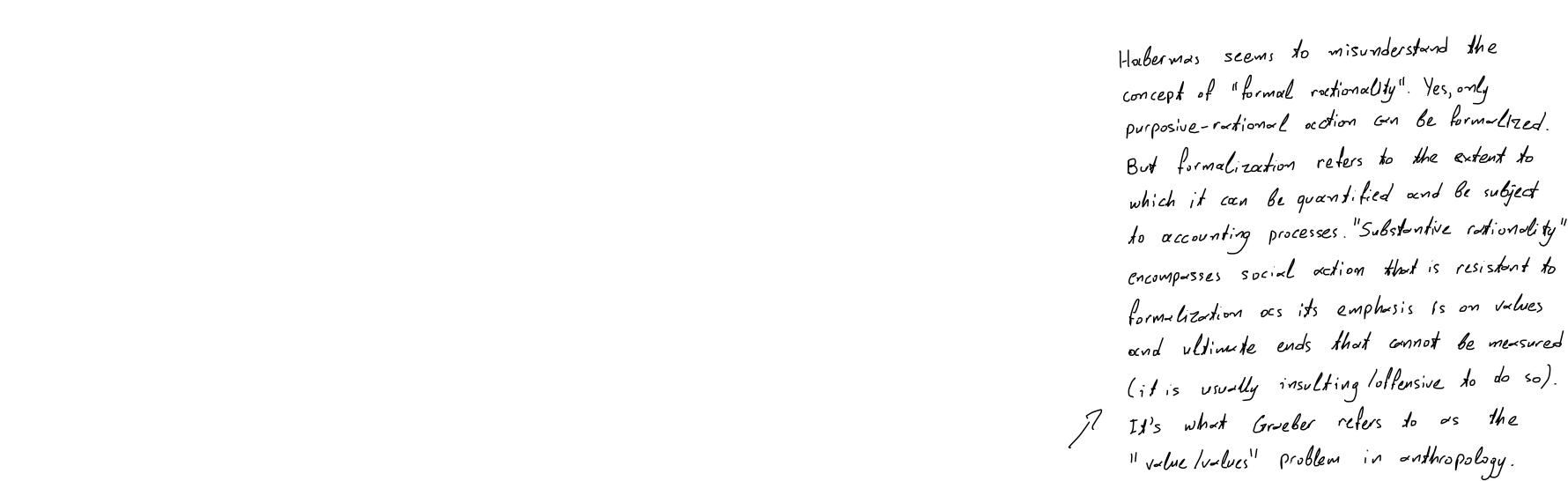
The term "formal rationality of economic action" will be used to designate the extent of quantitative calculation or accounting which is technically possible and which is actually applied. The "substantive rationality," on the other hand, is the degree to which the provisioning of given groups of persons (no matter how delimited) with goods is shaped by economically oriented social action under some criterion (past, present, or potential) of ultimate values (weriende Postulate), regardless of the nature of these ends. These may be of a great variety. […] A system of economic activity will be caned "formally” rational according to the degree in which the provision for needs, which is essential to every rational economy, is capable of being expressed in nu­merical, calculable terms, and is so expressed. The concept of "substantive rationality," on the other hand, is full of ambiguities. It conveys only one element common to all "substantive" analyses: namely, that they do not restrict themselves to note the purely formal and (relatively) unambiguous fact that action is based on "goal­ oriented" rational calculation with the technically most adequate availa­ble methods, but apply certain criteria of ultimate ends, whether they be ethical, political, utilitarian, hedonistic, feudal (stiindisch), egalitarian, or whatever, and measure the results of the economic action, however formally "rational" in the sense of correct calculation they may be, against these scales of "value rationality" or "substantive goal rationality”. Weber, Economy and Society, p. 85
A motive is a complex of subjective meaning which seems to the actor himself or to the observer an adequate ground for the conduct in question. The interpretation of a coherent course of, conduct is "sub­jectively adequate" (or "adequate on the level of meaning"), insofar as, according to our habitual modes' of thought and feeling, its component parts taken in their mutual relation are recognized to constitute a "typical" complex of meaning. It is more common to say “correct”. The interpretation of a sequence of events will on the other hand be called causally adequate insofar as, according to established generalizations from experience, there is a probability that it will always actually occur in the same way. An example of adequacy on the level of meaning in this sense is what is, according to our current norms of calculation or thinking, the correct solution of an arithmetical problem. On the other hand, a causally adequate interpretation of the same phenomenon would concern the statistical probability that, according to verified generaliza­tions from experience. there would he a correct or an erroneous solution of the same problem. This also refers to currently accepted norms but includes taking account of typical errors or of typical confusions. Thus causal explanation depends on being able to determine that there is a probability, which in the rare ideal case can be numerically stated, but is always in some sense calculable, that a given observable event (overt or subjective) will be followed. or accompanied by another event. A correct causal interpretation of a concrete course of action is arrived at when the overt action and the motives have both bene correctly appre­hended and at the same time their relation has become meaningfully comprehensible. […] Weber, Economy and Society, p.11-12
Weber’s Focus on the Individual/Subjective Orientation of Social Action
Action in the sense of subjectively understandable orientation of behavior exists only as the behavior of one or more individual human beings. For other cognitive purposes it may he useful or necessary to consider the individual, for instance, as a collection of cells. as a complex of bio-chemical reactions, or to conceive his psychic life as made up of a variety of different elements, however these may be defined. Undoubt­edly such procedures yield valuable knowledge of causal relationships. But the behavior of these elements, as expressed in such uniformities, is not subjectively understandable. This is true even of psychic elements because the more precisely they are formulated from a point of view of natural science, the less they are accessible to subjective understanding. ,This is never the road to interpretation in terms of subjective meaning. On the contrary, both for sociology in the present sense, and for history, the object of cognition is the subjective meaning-complex of action. Weber, Economy and Society, p.13
For still other cognitive purposes - for instance, juristic ones - or for practical ends, it may an the other hand be convenient or even indispensa­ble to treat social collectivities, such as states, associations. business corpora­tions, foundations, as if they were individual persons. Thus they may he treated as the subjects of rights and duties or as the performers of legally significant actions. But for the subjective interpretation of action in socio­ logical work these collectivities must be treated as solely the resultants and modes of organization of the particular acts of individual persons, since these alone can be treated as agents in a course of subjectively understandable action. Nevertheless, the sociologist cannot for his pur­poses afford to ignore these collective concepts derived. from other disciplines. Secondly, the subjective interpretation of action must take account of a fundamentally important fact. These concepts of collective entities which are found both in common sense and in juristic and other technical forms of thought. have a meaning in the minds of individual per­ sons, partly as of something actually existing. partly as something with normative authority. This is true not only of judges and officials, but of ordinary private individuals as well. Actors thus in part orient their action to them, and in this role such ideas have a powerful, often a decisive, causal influence on the course of action of real individuals. This is above all true where the ideas involve normative prescription or pro­hibition. Thus, for instance, one of the important aspects of the existence of a modem state, precisely as a complex of social interaction of individual persons. consists in the fact that the action of various individuals is oriented to the belief that it exists or should exist, thus that its acts and laws are valid in the legal sense. Weber, Economy and Society, p.13
[…] it is the method of the so-called "organic" school of sociology - classical example: Schaffle's brilliant work, Bau und Leben des sozialen Korpers - to attempt to understand social interaction by using as a point of departure the "whole" within which the individual acts. His action and behavior are then interpreted somewhat in the way that a physiologist would treat the role of an organ of the body in the "economy" of the organism, that is from the point of view of the survival of the latter. […] For purposes of sociological analysis two things can be said. First this functional frame of reference is convenient for purposes of practical illustration and for provisional orientation. In these respects. it is not only useful but indispensable. But at the same time if its cognitive value is overestimated and its concepts illegitimately “reified," it can be highly dangerous. Secondly, in certain circumstances this is the only available way of determining just what processes of social action it is important to understand in order to explain a given phenomenon. But this is only the beginning of sociological analysis as here understood. In the case of social collectivities, precisely as distinguished from organisms, we are in a position to go beyond merely demonstrating functional relationships and uniformities. We can accomplish something which is never attain­ able in the natural sciences, namely the subjective understanding of the action of the component individuals. The natural sciences on the other hand cannot do this, being limited to the formulation of causal uniformities in objects and events and the explanation of individual facts by applying them. We do not "understand" the behavior of cells, but can only observe the relevant functional relationships and generalize on the basis of these observations. This additional achievement of explanation by interpretive understanding, as distinguished from 'external observation, is of course attained only at a price - the more hypothetical and fragmentary character of its results. Nevertheless, subjective understand­ ing is the specific characteristic of sociological knowledge. Weber, Economy and Society, p.14-15
A verifiable conception of the state of mind of these social animals accessible to meaningful understanding, would seem to be attainable even as an ideal goal only within narrow limits. How­ ever that may be, a contribution to the understanding of human social action is hardly to be expected from this quarter, On the contrary, in the field of animal psychology, human analogies are and must be continually employed. The most that can be hoped for is, then, that these biological analogies may some day be useful in suggesting significant problems. Weber, Economy and Society, p.17
It is a tremendous misunderstanding to think that an "individualistic" method should involve what is in any conceivable sense an individualistic system of values. It is as important to avoid this error as the related one which confuses the unavoidable tendency of sociological concepts to as­sume a rationalistic character with a belief in the predominance of rational motives, or even a positive valuation of rationalism. Even a socialistic economy would have to be understood sociologically in exactly the same kind of "individualistic" terms; that is, in terms of the action of individuals, the types of officials found in it, as would be the case with a system of free exchange analysed in terms of the theory of mar­ginal utility or a "better," but in this respect similar theory). The real empirical sociological investigation begins with the question: What motives determine and lead the individual members and participants in this socialistic community to behave in such a way that the community came into being in the first place and that it continues to exist? Any form of functional analysis which proceeds from the whole to the parts can accomplish only a preliminary preparation for this investigation­ a preparation, the utility and indispensability of which, if properly car­ried out, is naturalIy beyond question. Weber, Economy and Society, p.18
Social Relationship
The term "social relationship” will be used to denote the behavior of a plurality of actors insofar as, in its meaningful content, the action of each takes account of that of the others and is oriented in these terms. The social relationship thus consists entirely and exclusively in the existence of a probability that there will be a meaningful course of social action - irrespective, for the time being, of the basis for this probability. Thus, as a defining criterion, it is essential that there should be at least a minimum of mutual orientation of the action of each to that of the others. Its content may be of the most varied nature: conflict, hostility, sexual attraction, friendship, loyalty, or economic exchange. It may involve the fulfillment, the evasion, or the violation of- the terms of an agreement; economic, erotic, or some other form of "competition"; common membership in status, national or class groups (provided it leads to social action). Hence, the definition does not specify whether the relation of the actors is co-operative or the opposite. The "meaning" relevant in this context is always a case of the meaning imputed to the parties in a given concrete case, on the average, or in a theoretically formulated pure type - it is never a normatively "correct" or a metaphysically "true" meaning. Weber, Economy and Society, p.26-27
The subjective meaning need not necessarily be the same for all the parties who are mutually oriented in a given social relationship; there need not in this sense be "reciprocity." "Friendship," "love," ‘loyalty," "fidelity to contracts," "patriotism," on One side, may well be faced with an entirely different attitude on the other. In such cases the parties associate different meanings with their actions, and the social relationship is insofar objectively "asymmetrical" from the points of view of the two parties. It may nevertheless be a case of mutual orientation insofar as, even though partly or wholly erroneously, one party pre­sumes a particular attitude toward him on the part of the other and orients his action to this expectation. This can, and usually will, have consequences for the course of action and the form of the relationship. Weber, Economy and Society, p.27
A social relationship can be of a very fleeting character or of varying degrees of permanence. In the latter case there is a probability of the repeated recurrence of the behavior which corresponds to its sub­jective meaning and hence is expected. In order to avoid fallacious im­pressions, let it repeated that it is only the existence of the probability that, corresponding to a given subjective meaning, a certain type of action will take place which constitutes the "existence" of the social relationship. Thus that a "friendship" or a "state" exists or has existed means this and only this: that we, the observers, judge that there is or has been a probability that on the basis of certain kinds of known subjective attitude of certain individuals there will result in the average sense a certain specific type of action. The subjective meaning of a social relationship may change, thus a political relationship once based on solidarity may develop into a conflict of interests. In that case it is only a matter of terminological convenience and of the degree of continuity of the change whether we say that a new relationship has come into existence or that the old one continues but has acquired a new meaning. It is also possible for the meaning to he partly constant, partIy changing. Weber, Economy and Society, p.28
The meaning of a social relationship may be agreed upon by mutual consent. This implies that the parties make promises covering their future behavior, whether toward each other or toward third per­sons. In such cases each party then normally counts, so far as he acts rationally, in some degree on the fact that the other will orient his ac­tion to the meaning of the agreement. as he (the first actor) under­ stands it. In part he orients his action rationally (zweckrational) to these expectations as given facts with, to be sure, varying degrees of subjec­tively "loyal" intention of doing his part, But in part also he is motivated value-rationally by a sense of duty, which makes him adhere to the agreement as he understands it. This much may be anticipated. Weber, Economy and Society, p.28
Habermas’ Reconstruction of Weber’s Rationality
Weber reminds us again and again that "rationalism" may mean very different things. "It means one thing if we think of the kind of rationalization the systematic thinker performs on the image of the world: an increasing theoretical mastery of reality by means of increasingly precise abstract concepts. Rationalism means another thing if we think of the methodical attainment of a definite, given, practical end by way of an increasingly precise calculation of the adequate means. These types of rationalism are very different, in spite of the fact that ultimately they belong inseparably together. To begin with, then, Weber draws a distinction between theoretical and practical mastery of reality. Of course, he is chiefly interested in practical rationality, in the sense of the standards according to which acting subjects learn to control their environment. Habermas, The Theory of Communicative Action, vol 1, p.168
Weber starts with a broad concept of "technique" [Technik] in order to make clear that the aspect of regulated employment of means, in a very abstract sense, is relevant to the rationality of behavior. "Rational technique" is a use of means "consciously and systematically oriented to experience and reflection. […] Every rule or system of rules that permits reliably reproducible action, whether methodical or customary, that can be predicted by participants in interaction and calculated from the perspective of the observer, is a technique in this sense. "Thus there are techniques of every conceivable type of action: techniques of prayer, of asceticism, of thought and research, of memorizing, of education, of exercising political or hierocratic domination, of administration, of making love, of making war, of musical performances, of sculpture and painting, of arriving at legal decisions. And all these are capable of the widest variation in degree of rationality. The presence of a "technical question always means there is some doubt over the choice of the most rational means to an end”. In this sense, then, even mystical illumination, which is objectively not testable, and the ascetic mastery of desires and emotions have been "rationalized." The only criterion by which "technical" rationalization in the broadest sense is measured is the rule-governedness of reproducible behavior to which others can adapt themselves in a calculating manner. Weber qualifies this broad meaning of "technique" and "rationalization of means" by way of specifying the means. If we consider only means with which an acting subject can realize set ends through intervention in the objective world, the evaluative criterion of success comes into play. The rationality of employing means is measured by the objectively testable efficacy of an intervention (or of a purposeful omission). This permits us to distinguish between "subjectively purposive-rational" and "objectively correct" actions. We can also speak of a "progressive rationality of means" in an objective sense. "If human behavior (of whatever kind) becomes in any respect 'more correctly' oriented from a technical point of view, then we have a 'technical advance.'" This concept of technique is also a broad one; it extends not only to instrumental rules for mastering nature, but also to rules for artistically mastering materials, or, for example, to techniques for 'dealing with human beings politically, socially, educationally, propagandistically.’ We can speak of techniques in this sense whenever the ends that can be causally realized with their help are conceived as elements of the objective world. Even social techniques can apply to social relations, interactions, arrangements, and symbols only if these are presupposed in an objectivating attitude as items of possible manipulation. 'In the special area usually referred to as 'technology,' but also in the areas of commercial techniques and legal techniques, we can speak of 'progress' (in the sense of the progressive technical rationality of means), if we take as our starting point a clearly determined state of a concrete structure." Habermas, The Theory of Communicative Action, vol 1, p.169-170
So far Weber is considering rationality only from the standpoint of employing means. He then differentiates this concept by distinguishing two aspects of the rationality of goal-directed actions: not only the means and the way they are applied can be more or less rational, i.e., effective in relation to given ends; even the ends themselves can be more or less rational, i.e., chosen correctly, in an objective sense, in view of given values, means, and boundary conditions. To the conditions of purposive-rational action there belongs not only an instrumental rationality of means, but a rationality of choice in setting ends selected in accord with values. From this standpoint an action can be rational only to the degree that it is not blindly controlled by affects or guided by sheer tradition. "One essential aspect of the 'rationalization' of action is the replacement of the unthinking acceptance of ancient customs by deliberate adaptation to situations in terms of self-interest." Such rationalization can take place at the expense of affectual as well as of traditional action. Habermas, The Theory of Communicative Action, vol 1, p.170
The important distinction between formal and substantive rationality belongs in this context. Weber's own formulations are not very clear. Formal rationality relates to the decisions of subjects acting rationally as regards choice, subjects who try to pursue their interests in accord with clear preferences and given decision maxims, paradigmatically in economic action. "The term "formal rationality of economic action" will be used to designate the extent of calculation that is technically possible and actually applied… The concept of "substantive-rationality," on the other hand … conveys only … that certain demands are made, be they ethical, political, utilitarian, hedonistic, feudal [standisch], egalitarian, or whatever, and that the results of the economic action—however formally "rational," i.e., calculated, it may be - are measured against these in respect to value-rationality or substantive purposive rationality.” As soon as subjects are released from the bonds of tradition or from control by affects, to the extent that they become con- scious of their preferences and can choose their goals on the basis of clarified preferences, action can be evaluated from two points of view: from the instrumental standpoint of efficacy of means and from the standpoint of the correctness with which goals are inferred in view of given preferences, means, and boundary conditions. Weber calls these two aspects of instrumental ration- ality and the rationality of choice, taken together, "formal rationality," in contradistinction to substantive evaluation of the value systems underlying the preferences. From the standpoint of formal rationality, we can demand only that the actor be aware of his preferences, that he make precise the underlying values and check them for consistency, that he place them, if possible, in a transitive ordering, and so on. In normative questions Weber is a sceptic; he is convinced that the decision between different value systems (however clarified analytically) cannot be grounded, cannot be rationally justified. Strictly speaking there is no rationality of value postulates or belief systems as regards their content. Nevertheless, the way in which the actor grounds his preferences, in which he is oriented to values, is for Weber an aspect under which an action can be viewed as rationalizable. "Actions are purely value-rational when the agents, regardless of foreseeable consequences, act according to their convictions of what seems to them to be required by duty, honor, beauty, a religious call, piety, or the importance of some 'cause,' no matter in what it consists. Value-rational action is always action in accordance with 'commands' or 'demands' which the actor believes himself to be placed under." The rationality of the values underlying action preferences is not measured by their material content but by formal properties, that is, by whether they are so fundamental that they can ground a mode of life based on principles. Only values that can be abstracted and generalized into principles, internalized largely as formal principles, and applied procedurally, have so intensive a power to orient action that they can cut across various particular situations and, in the extreme case, systematically penetrate all spheres of life and bring an entire biography, or even the history of social groups, under a unifying idea. Habermas, The Theory of Communicative Action, vol 1, p.170-172
Weber differentiates the concept of practical rationality from the three perspectives of employing means, setting ends, and being oriented to values. The instrumental rationality of an action is measured by effective planning of the application of means for given ends; the rationality of choice of an action is measured by the correctness of the calculation of ends in the light of precisely conceived values, available means, and boundary conditions; and the normative rationality of an action is measured by the unifying, systematizing power and penetration of the value standards and the principles that underlie action preferences. Weber calls actions that satisfy the conditions of rationality of means and choice "purposive-rational," and those that satisfy the conditions of normative rationality "value-rational." These two aspects can vary independently. Advances in the dimension of purposive rationality can "take place in favor of a morally sceptical, purely purposive-rational type of action, [and] at the expense of action tied to value-rationality." In fact it is in this direction that rationalized Western culture seems to be developing. The combination of purposive-rational and value-rational action yields a type of action that satisfies the conditions for practical rationality in its entirety. When persons and groups generalize this type over time and across social spheres, Weber speaks of a methodical-rational conduct of life. […] The methodically rational conduct of life is distinguished by the fact that it establishes the complex type of action which aims at rationality and its increase under all three aspects and that combines these rationality structures with one another so that they are mutually stabilizing, in that successes in one dimension in part presuppose, in part stimulate, successes in the other dimensions. Methodically rational conduct of life makes possible and places a premium upon the success of action simultaneously 1. From the standpoint of instrumental rationality, in the solution of technical tasks and in the construction of effective means; 2. From the standpoint of the rationality of choice, in the consistent choice among alternative lines of action (we speak of strategic rationality when the decisions of rational opponents must be considered in the process); and finally 3. From the standpoint of normative rationality, in the solution of moral-practical tasks within the framework of an ethic of principle. Different categories of knowledge can be coordinated with these three aspects of the rationality of action. Both empirical and analytical knowledge enter into the orientations of purposive-rational action via techniques and strategies; this knowledge can in principle take the precise form of scientifi-cally corroborated knowledge. On the other hand, moral- practical knowledge (as well as aesthetic-expressive knowledge) enter into the orientations of value-rational action through competences and motives; this knowledge is rendered precise and improved at two stages of development: first within religious worldviews, later within the framework of the autonomous value spheres of law, morality, and art. Habermas, The Theory of Communicative Action, vol 1, p.172-173
The term "formal rationality of economic action" will be used to designate the extent of quantitative calculation or accounting which is technically possible and which is actually applied. The "substantive rationality," on the other hand, is the degree to which the provisioning of given groups of persons (no matter how delimited) with goods is shaped by economically oriented social action under some criterion (past, present, or potential) of ultimate values (weriende Postulate), regardless of the nature of these ends. These may be of a great variety. […] A system of economic activity will be caned "formally” rational according to the degree in which the provision for needs, which is essential to every rational economy, is capable of being expressed in nu­merical, calculable terms, and is so expressed. The concept of "substantive rationality," on the other hand, is full of ambiguities. It conveys only one element common to all "substantive" analyses: namely, that they do not restrict themselves to note the purely formal and (relatively) unambiguous fact that action is based on "goal­ oriented" rational calculation with the technically most adequate availa­ble methods, but apply certain criteria of ultimate ends, whether they be ethical, political, utilitarian, hedonistic, feudal (stiindisch), egalitarian, or whatever, and measure the results of the economic action, however formally "rational" in the sense of correct calculation they may be, against these scales of "value rationality" or "substantive goal rationality”. Weber, Economy and Society, p. 85
Weber has at his disposal a complex concept of practical rationality that takes the coordination of purposive-rational and value-rational aspects of action as its point of departure. Nevertheless, on the other hand, Weber considers societal rationalization explicitly from the perspective of purposive-rationality. At the level of institutions, he does not apply the comprehensive concept of rationality upon which he bases his investigations of cultural tradition. Only the cognitive-instrumental complex of rationality acquires significance for the rationality of action systems. At the level of the economic and political subsystems, only the aspect of purposive-rational, and not that of value-rational action is supposed to have structure-forming effects. From Weber's sociology of the economy, state, and law, one gets the impression that in modern societies rationalization processes attach only to empirical-theoretical knowledge and to the instrumental and strategic aspects of action, whereas practical rationality cannot be institutionalized independently, that is, with an inner logic specific to a subsystem. Habermas, The Theory of Communicative Action, Vol.1, p.254
Habermas’ Communicative Rationality
Adorno describes reconciliation in terms of an intact intersubjectivity that is only established and maintained in the reciprocity of mutual understanding based on free recognition. George Herbert Mead had already elevated symbolically mediated interaction to the new paradigm of reason and had based reason on the communicative relation between subjects, which is rooted in the mimetic act of role-taking—that is, in ego's making his own the expectations that alter directs to him. Habermas, The Theory of Communicative Action, Vol 1, p.390
The situation with the complementary concept of freedom is similar to that with the idea of a reconciliation made possible through intersubjectivity free of coercion. Like Mead, Horkheimer and Adorno start from the idea that individuation is possible only by way of socialization, so that the “emancipation of the individual" would not be an emancipation from society, but "the deliverance of society from atomization," that is, from an isolation of subjects that "may reach its peak in periods of collectivization and mass culture. Habermas, The Theory of Communicative Action, Vol 1, p.390-391
Adorno cannot elucidate the mimetic capacity by means of an abstract opposition to instrumental reason. The structures of reason to which Adorno merely alludes first become accessible to analysis when the ideas of reconciliation and freedom are deciphered as codes for a form of intersubjectivity, however Utopian it may be, that makes possible a mutual and constraint-free understanding among individuals in their dealings with one another, as well as the identity of individuals who come to a compulsion-free understanding with themselves—sociation without repression. This means, on the one hand, a change of paradigm within action theory, from goal-directed to communicative action, and, on the other hand, a change of strategy in an effort to reconstruct the modern concept of rationality that became possible with the decentration of our understanding of the world. The phenomena in need of explication are no longer, in and of themselves, the knowledge and mastery of an objective nature, but the intersubjectivity of possible understanding and agreement—at both the interpersonal and intra-psychic levels. The focus of investigation thereby shifts from cognitive-instrumental rationality to communicative rationality. And what is paradigmatic for the latter is not the relation of a solitary subject to something in the objective world that can be represented and manipulated, but the intersubjective relation that speaking and acting subjects take up when they come to an understanding with one another about something. In doing so, communicative actors move in the medium of a natural language, draw upon culturally transmitted interpretations, and relate simultaneously to something in the one objective world, something in their common social world, and something in each's own subjective world. Habermas, The Theory of Communicative Action, Vol 1, p.391-392
In contrast to representation or cognition, coming to an understanding requires the rider uncoerced, because the expression is meant to be used here as a normative concept. From the perspective of the participants, coming to an understanding is not an empirical event that causes de facto agreement; it is a process of mutually convincing one another in which the actions of participants are coordinated on the basis of motivation by reasons. "Coming to an understanding" refers to communication aimed at achieving a valid agreement. It is only for this reason that we may hope to obtain a concept of rationality by clarifying the formal properties of action oriented to reaching understanding […]. Habermas, The Theory of Communicative Action, Vol 1, p.392
If we assume that the human species maintains itself through the socially coordinated activities of its members and that this coordination has to be established through communication—and in certain central spheres through communication aimed at reaching agreement—then the reproduction of the species also requires satisfying the conditions of a rationality that is inherent in communicative action. Habermas, The Theory of Communicative Action, Vol 1, p.397
A subjectivity that is characterized by communicative reason resists the denaturing of the self for the sake of self-preservation. Unlike instrumental reason, communicative reason cannot be subsumed without resistance under a blind self-preservation. It refers neither to a subject that preserves itself in relating to objects via representation and action, nor to a self-maintaining system that demarcates itself from an environment, but to a symbolically structured lifeworld that is constituted in the interpretive accomplishments of its members and only reproduced through communication. Thus communicative reason does not simply encounter ready-made subjects and systems; rather, it takes part in structuring what is to be preserved. The Utopian perspective of reconciliation and freedom is ingrained in the conditions for the communicative sociation of individuals; it is built into the linguistic mechanism of the reproduction of the species. Habermas, The Theory of Communicative Action, Vol 1, p.398
In communicative action, beyond the function of achieving understanding, language plays the role of coordinating the goal-directed activities of different subjects, as well as the role of a medium in the socialization of these very subjects. Mead views linguistic communication almost exclusively under these last two aspects: the social integration of goal-directed actors, and the socialization of subjects capable of acting. Habermas, The Theory of Communicative Action, Vol. 2, p.5
Mead traces the emergence of linguistic forms of communication using as his guideline the step-by-step transformation of obiective or natural meanings of systemically ordered mean-ends relations between observed behavioral responses into the meanings that these modes of behavior take on for the participating organisms themselves. Symbolic meanings arise from a subjectivizing or internalizing of objective structures of meaning. As these structures are mainly found in the social behavior of animals, Mead tries to explain the emergence of language through the fact that the semantic potential residing in gesture-mediated interaction becomes symbolically available to participants through an internalization of the language of gestures. Habermas, The Theory of Communicative Action, Vol 2, p.7-8
It is not the differentiation and independent development of cultural value spheres that lead to the cultural impoverishment of everyday communicative practice, but an elitist splitting-off of expert cultures from contexts of communicative action in daily life. It is not the uncoupling of media-steered subsystems and of their organizational forms from the lifeworld that leads to the one-sided rationalization or reification of everyday communicative practice, but only the penetration of forms of economic and administrative rationality into areas of action that resist being converted over to the media of money and power because they are specialized in cultural transmission, social integration, and child rearing, and remain dependent on mutual understanding as a mechanism for coordinating action. If we assume, further, that the phenomena of a loss of meaning and freedom do not turn up by chance but are structurally generated, we must try to explain why media-steered subsystems develop irresistible inner dynamics that bring about both the colonization of the lifeworld and its segmentation from science, morality, and art. Habermas, The Theory of Communicative Action, Vol 2, p.330-331
[…] the theory of late-capitalist reification, reformulated in terms of system and lifeworld, has to be supplemented by an analysis of cultural modernity, which replaces the now superseded theory of consciousness. Rather than serving a critique of ideology, this analysis would have to explain the cultural impoverishment and fragmentation of everyday consciousness. Rather than hunting after the scattered traces of revolutionary consciousness, it would have to examine the conditions for re-coupling a rationalized culture with an everyday communication dependent on vital traditions. Habermas, The Theory of Communicative Action, Vol 2, p.355-356
If one studies the paradoxical structure of juridification in such areas as the family, the schools, social-welfare policy, and the like, the meaning of the demands that regularly result from these analyses is easy to decipher. The point is to protect areas of life that are functionally dependent on social integration through values, norms, and consensus formation, to preserve them from falling prey to the systemic imperatives of economic and administrative subsystems growing with dynamics of their own, and to defend them from becoming converted over, through the steering medium of the law, to a principle of sociation that is, for them, dysfunctional. Habermas, The Theory of Communicative Action, Vol 2, p.372-373
I gave a systematic presentation of Mead's attempt to explain, by way of reconstructing. symbolically mediated interaction and action in social roles. The first of these two stages of interaction is characterized by the emergence of a new medium of communication, the second by the norming of behavioral expectations. In the first phase, communication switches over from expressive gestures that stimulate behavior to the use of symbols; in the second, the transition to normatively regulated action means a shift to a symbolic basis for steering behavior: it is no longer only the means of communication that are symbolically restructured, but behavioral schemes and dispositions as well. Habermas, The Theory of Communicative Action, Vol 2, p.43
If S learns to adopt toward himself the negative positions that T, U, V... take toward him when he goes wrong "semantically" (and if T, U, V, for their part, deal with similar disappointments in like manner), the members of this tribe learn to address calls to one another in such a way that they anticipate critical responses in cases where q0 (the expression / utterance) is used inappropriately to the context. And on the basis of this anticipation, expectations of a new type can take shape, behavioral expectations (c) based on the convention that a vocal gesture is to be understood as "g" only if it is uttered under specific contextual conditions. With this we have reached the state of symbolically mediated interaction in which the employment of symbols is fixed by meaning conventions. Participants in interaction produce symbolic expressions guided by rules, that is, with the implicit expectation that they can be recognized by others as expressions conforming to a rule. Habermas, The Theory of Communicative Action, Vol 2, p.22
The key is the transition from symbolically mediated interaction to grammatical speech. We can at least make plausible the idea that the familiar structures of speech acts are, from a genetic standpoint, the result of integrating three, prelinguistically rooted, cognitive, moral, and expressive relations to external nature, to collective identity, and to inner nature […]. With these steps we will have recovered at the phylogenetic level the structures that Mead presupposed at the level of socializing interaction: normed expectations and grammatical speech. They supplement one another to yield the structure of linguistically mediated, normatively guided interaction, which is the starting point for sociocultural development. Mead and Durkheim agree in characterizing the latter as a trend toward the linguistification of the sacred […]. To the degree that the rationality potential ingrained in communicative action is released, the archaic core of the normative dissolves and gives way to the rationalization of worldviews, to the universalization of law and morality, and to an acceleration of processes of individuation. It is upon this evolutionary trend that Mead bases in the end his idealistic projection of a communicatively rationalized society. Habermas, The Theory of Communicative Action, Vol 2, p.46
In that talk he defined his task as follows: "We shall show that moral rules are invested with a special authority by virtue of which they are obeyed simply because they command. We shall reaffirm, as a result of a purely empirical analysis, the notion of duty and nevertheless give a definition of it closely resembling that already given by Kant. Obligation is, then, one of the primary characteristics of the moral rule.” Violations of these norms are punished because they claim validity in virtue of moral authority; this validity does not accrue to them because external sanctions compel their observance. "The term 'moral authority' is opposed to material authority or physical supremacy.'' The aspect of the validity of moral rules calling for explanation is precisely that they possess a binding power that, rather than itself presupposing sanctions, justifies the applications of sanctions when they are violated. This is what Durkheim is driving at with his comparison between technical and moral rules: "Thus there are rules that present this particular characteristic: we refrain from performing the acts they forbid simply because they are forbidden. This is what is meant by the obligatory character of the moral rule.” Habermas, The Theory of Communicative Action, Vol 2, p.48
This neglect of the dimension of linguistic understanding also explains the unsatisfactory dualism Durkheim maintains in regard to the relation between the individual and society. As he sees it, the individual is divided into two heterogeneous components: one part that is subject to nonsocialized self-interest and the imperatives of self-preservation, and a second - moral - part that is stamped by group identity, or, in Durkheim's words: "an individual being which has its foundation in the organism, and the circle of whose activities is therefore limited, and a social being which represents the highest reality in the intellectual and moral order that we can know by observation - I mean society.'' The split of the social universe into the domains of the profane and the sacred is repeated psychologically in the antithesis of body and soul or body and spirit, in the antagonisms between inclination and duty, sensibility and understanding. Durkheim remains tied here, more clearly than anywhere else in his work, to the mentalistic conceptualizations of the philosophy of consciousness. Habermas, The Theory of Communicative Action, Vol 2, p.57
When communicative acts take the shape of grammatical speech, the symbolic structure has penetrated all components of interaction; the cognitive-instrumental grasp of reality and the steering mechanism that attunes the behavior of different interaction partners to one another, as well as the actors and their behavior dispositions, get connected to linguistic communication and are symbolically restructured. At the same time, this transposition of cognitions, obligations, and expressions onto a linguistic basis makes it possible in turn for the means of communication to take on new functions-in addition to the function of reaching understanding, those of coordinating action and socializing actors as well. Under the aspect of reaching understanding, communicative acts serve the transmission of culturally stored knowledge-as shown above, cultural tradition reproduces itself through the medium of action oriented to reaching understanding. Under the aspect of coordinating action, the same communicative acts serve the fulfillment of norms appropriate to a given context; social integration also takes place via this medium. Under the aspect of socialization, finally, communicative acts serve the construction of internal controls on behavior, in general, the formation of personality structures; one of Mead's fundamental insights is that socialization processes take place via linguistically mediated interaction. Habermas, The Theory of Communicative Action, Vol 2, p.63
The scope for freedom is characterized by the fact that under the presuppositions of communicative action a hearer can reject the utterance of a speaker only by denying its validity. Assent means then that the negation of the invalidity of the utterance is affirmed. Whenever participants in interactions are pursuing mutual understanding by means of whatever symbols, there are alternative possibilities of understanding, not understanding, or misunderstanding; on this basis, cooperation and conflict already assume a different character. But it is only at the level of grammatical speech that an agreement can take on the form of communicatively achieved consensus. Linguistic communication presupposes understanding and taking positions on criticizable validity claims. Any explicit agreement thereby has something of the nature of a disagreement that has been avoided, excluded; it is mediated through an at least implicit rejection of a contradictory utterance, that is, through a negation. Habermas, The Theory of Communicative Action, Vol 2, p.72
If the rejection of an assertion 'p' means that the statement 'p' is untrue, the affirmation of 'p' implies a negation of this rejection, that is, of the sentence: 'It is untrue that p’. Habermas, The Theory of Communicative Action, Vol 2, p.73
If the rejection of the command 'q' (where 'q' stands for an action that is to be carried out or refrained from) means that in the given situation the command is not justified by the norm N invoked to authorized it, and is to this extent not right, the affirmation of 'q' implies the negation of this rejection, that is, of the sentence: 'It is not right for the one commanding to utter q in s with reference to N: If, finally, the rejection of the avowal 'r means that ego does not mean what he says, the affirmation of'r implies the negation of this rejection, that is, of the sentence: 'Ego's utterance r is insincere’. The binding effect of illocutionary forces comes about, ironically, through the fact that participants can say "no" to speech-act offers. The critical character of this saying "no" distinguishes taking a position in this way from a reaction based solely on caprice. A hearer can be "bound" by speech-act offers because he is not permitted arbitrarily to refuse them but only to say "no" to them, that is, to reject them for reasons. We are already familiar with two consequences for the structure of communication that flow from this "being able to say no’. Habermas, The Theory of Communicative Action, Vol 2, p.73
A further consequence of being able to say "no” which was merely suggested above, concerns the actors themselves. If one aims to reconstruct how participants learn to orient their actions explicitly to validity claims, and wants to do so by means of the mechanism of taking the attitude of the other, the model of inner dialogue, which Mead used rather too unspecifically, turns out in fact to be helpful. In anticipating from alter a negative answer to his own speech act, and raising against himself an objection that alter might raise, ego understands what it means to make a criticizable validity claim. As soon, then, as ego masters the orientation to validity claims, he can repeat the internalization of discursive relations once more. Now alter already encounters him with the expectation that ego is not assuming the communicative role of the first person only in a naive manner, but will expand it, if necessary, to the role of a proponent in argumentation. If ego makes this attitude of alter his own, that is to say, if he views himself through the eyes of an arguing opponent and considers how he will answer to his critique, he gains a reflective relation to himself. By internalizing the role of a participant in argumentation, ego becomes capable of self-criticism. It is the relation- to-self established by this model of self-criticism that we shall call "reflective:” Knowing that one does not know has, since Socrates, rightly been regarded as the basis for self-knowledge. The reflective relation-to-self takes on different shadings according to the modes of language use. Ego can take up a relation to himself by way of a critique of his own statement, his own action, or his own self-presentation. The self to which he then relates is not a mysterious something; it is familiar to him from the communicative practice of daily life; it is ego himself in the communicative role of the first person, as he asserts the existence of states of affairs in an objectivating attitude, or enters into an interpersonal relation regarded as legitimate in the norm-conformative attitude, or makes a subjective experience accessible to a public in an expressive attitude. Correspondingly, ego can relate to himself according to the model of self-criticism: as an epistemic subject who is capable of learning and has already acquired a certain knowledge in his cognitive-instrumental dealings with reality, or as a practical subject who is capable of acting and has already formed a certain character or a superego in interactions with his reference persons, or as an affective subject who is sensitive, "passionate" in Feuerbach's sense, and has already demarcated from the external world of facts and norms a special domain of subjectivity marked by privileged access and intuitive presence. The reflective relation to self is the ground of the actor's accountability. A responsible actor behaves self-critically not only in his directly moralizable actions but also in his cognitive and expressive utterances. Although accountability is at bottom a moral-practical category, it also extends to the cognitions and expressions included in the validity spectrum of action oriented to reaching understanding. Habermas, The Theory of Communicative Action, Vol 2, p.74-75
Because communicative action demands an orientation to validity claims, it points from the start to the possibility of settling disagreements by adducing reasons. […] In the second place, I am referring to the demarcation of action oriented to understanding from action oriented to consequences. Generally, alter is moved to link up his actions with ego's actions by a complicated mix of empirical and rational motives. Because communicative action demands an orientation to validity claims, it points from the start to the possibility that participants will distinguish more or less sharply between having an influence upon one another and reaching an understanding with one another. Habermas, The Theory of Communicative Action, Vol 2, p.74
Conversation is a domain particularly dis­posed to communism. Lies, insults, put-downs, and other sorts of ver­bal aggression are important-but they derive most of their power from the shared assumption that people do not ordinarily act this way: an insult does not sting unless one assumes that others will normally be considerate of one's feelings, and it's impossible to lie to someone who does not assume you would ordinarily tell the truth. Graeber, Debt, p.97
For the communicative model of action, language is relevant only from the pragmatic viewpoint that speakers, in employing sentences with an orientation to reaching understanding, take up relations to the world, not only directly as in teleological, normatively regulated, or dramaturgical action, but in a reflective way. Speakers integrate the three formal world-concepts, which appear in the other models of action either singly or in pairs, into a system and presuppose this system in common as a framework of interpretation within which they can reach an understanding. They no longer relate straightaway to something in the objective, social, or subjective worlds; instead they relativize their utterances against the possibility that their validity will be contested by other actors. Reaching an understanding functions as a mechanism for coordinating actions only through the participants in interaction coming to an agreement concerning the claimed validity of their utterances, that is, through intersubjectively recognizing the validity claims they reciprocally raise. A speaker puts forward a criticizable claim in relating with his utterance to at least one "world"; he thereby uses the fact that this relation between actor and world is in principle open to objective appraisal in order to call upon his opposite number to take a rationally motivated position. The concept of communicative action presupposes language as the medium for a kind of reaching understanding, in the course of which participants, through relating to a world, reciprocally raise validity claims that can be accepted or contested. Habermas, The Theory of Communicative Action, Vol 1, p.98-99
For both parties the interpretive task consists in incorporating the other's interpretation of the situation into one's own in such a way that in the revised version "his" external world and "my" external world can—against the background of "our" lifeworld—be relativized in relation to "the" world, and the divergent situation definitions can be brought to coincide sufficiently. Naturally this does not mean that interpretation must lead in every case to a stable and unambiguously differentiated assignment. Stability and absence of ambiguity are rather the exception in the communicative practice of everyday life. A more realistic picture is that drawn by ethnomethodologists—of a diffuse, fragile, continuously revised and only momentarily successful communication in which participants rely on problematic and unclarified presuppositions and feel their way from one occasional commonality to the next. Habermas, The Theory of Communicative Action, Vol 1, p.100-101
This very strong claim, which supports the methodological thesis that "communicative action requires an interpretation that is rational in approach," is grounded at another level in Chapter III. There Habermas attempts to expand the truth-conditional approach to semantics into a general theory of the internal relationships between meaning and validity. This involves shifting the level of analysis from semantics to pragmatics, extending the concept of validity to include types of claims other than truth, identifying the validity conditions for the different types of claims, and establishing that, in these other cases as well, the meaning of an utterance is inherently connected with the conditions for redeeming the validity claims raised by it. If these methodological and language-theoretical arguments for the inseparability of meaning, intelligibility, and understanding from validity, rationality, and assessment could be sustained, Habermas would have gone a long way toward setting the foundations of a critical social theory. McCarthy, Translator’s Introduction, The Theory of Communicative Action, Vol 1, p.xiv
Limitations of the critique of instrumental reason
Adorno's despair derives precisely from the fact that nothing more than instrumental reason is retained when we think through "the basic process of conscious life" radically enough in the categories provided by the philosophy of consciousness. Habermas, The Theory of Communicative Action, Vol 1, p.396
In the atomistic perspective of much of modern thought, the subject stands over against a world of objects to which it has two basic relations: representation and action. Accordingly, the type of rationality associated with this model is the "cognitive-instru- mental" rationality of a subject capable of gaining knowledge about a contingent environment and putting it to effective use in intelligently adapting to and manipulating that environment. By stressing the fact that the goal-directed actions of different individuals are socially coordinated, Habermas shifts our attention to the broader context of individual purposive actions, to the structures of social interaction in which teleological actions are located. McCarthy, Translator’s Introduction in The Theory of Communicative Action, p.ix
His [Weber’s] hierarchy of concepts of action is designed with an eye to the type of purposive- rational action, so that all other actions can be classified as specific deviations from this type. Weber also analyzes the method of Sinnverstehen in such a way that complex cases can be related to the limit case of understanding purposive-rational action; understanding action that is subjectively oriented to success requires at the same time that it be objectively evaluated as to its correctness […] Habermas, The Theory of Communicative Action, Vol 1, p.6
They solved the problem of connecting Marx and Weber by leaning all the more heavily on Weber. If, following Weber, one conceives of the rationalization of life's orders as the institutionalization of purposive rational action, it is only a small step to generalizing the reification of consciousness into an expression of instrumental reason. And if, like him, one sees the subsystems of purposive rational action irresistibly congealing into an iron cage, it is only a small step from Lukacs's theory of reification to the critique of instrumental reason, that is, to the vision of an administered, totally reified world in which means-ends rationality and domination are merged. This theory has the advantage of directing our attention to the symptoms of the systemically induced deformation of communicatively structured life- contexts, which is no longer localizable in any class-specific way. Its weakness consists in deriving the erosion of the lifeworld from the spell of a means-ends rationality that has been demonized as instrumental reason. The critique of instrumental reason thereby falls into the same error as the Weberian theory and, in addition, forfeits the fruits of an approach nonetheless directed to systemic effects. The concept of instrumental reason suggests that the rationality of knowing and acting subjects is systemically expanded into a purposive rationality of a higher order. Thus the rationality of self-regulating systems, whose imperatives override the consciousness of the members integrated into them, appears in the shape of a totalized purposive rationality. This confusion of system rationality and action rationality prevented Horkheimer and Adorno, as it did Weber before them, from adequately separating the rationalization of action orientations within the framework of a structurally differentiated lifeworld from the expansion of the steering capacity of differentiated social systems. As a result, they could locate the spontaneity that was not yet in the grips of the reifying force of systemic rationalization only in irrational powers in the charismatic power of the leader or in the mimetic power of art and love. Horkheimer and Adorno failed to recognize the communicative rationality of the lifeworld that had to develop out of the rationalization of worldviews before there could be any development of formally organized domains of action at all. It is only this communicative rationality, reflected in the self-understanding of modernity, that gives an inner logic - and not merely the impotent rage of nature in revolt - to resistance against the colonization of the lifeworld by the inner dynamics of autonomous systems. Horkheimer and Adorno were unable to appropriate the systematic content of Weber's diagnosis of the times and to make it fruitful for social-scientific inquiry, because they did not take seriously enough Weber's studies on the rationalization of worldviews, or the independent logic of cultural modernity; but also because they were uncritical in two directions; - vis-à-vis Marx, in that they held fast to the basic assumptions of the theory of value as the core of their tacit orthodoxy, and in this way they blinded themselves to the realities of a developed capitalism based on the pacification of class conflict through welfare-state mea- sures; - vis-à-vis Weber, in that they remained fixated on the model of purposive rationality and, for that reason, did not expand the critique of instrumental reason into a critique of functionalist reason.
The critique of instrumental reason, which remains bound to the conditions of the philosophy of the subject, denounces as a defect something that it cannot explain in its defectiveness because it lacks a conceptual framework sufficiently flexible to capture the integrity of what is destroyed through instrumental reason. To be sure, Horkheimer and Adorno do have a name for it: mimesis. And even though they cannot provide a theory of mimesis, the very name calls forth associations—and they are intended: Imitation designates a relation between persons in which the one accommodates to the other, identifies with the other, empathizes with the other. There is an allusion here to a relation in which the surrender of the one to the example of the other does not mean a loss of self but a gain and an enrichment. Because the mimetic capacity escapes the conceptual framework of cognitive-instrumentally determined subject-object relations, it counts as the sheer opposite of reason, as impulse. Adorno does not simply deny to the latter any cognitive function. In his aesthetics he attempts to show what the work of art owes to the power of mimesis to unlock, to open up. But the rational core of mimetic achievements can be laid open only if we give up the paradigm of the philosophy of consciousness—namely, a subject that represents objects and toils with them—in favor of the paradigm of linguistic philosophy—namely, that of intersubjective understanding or communication—and puts the cognitive-instrumental aspect of reason in its proper place as part of a more encompassing communicative rationality. Habermas, The Theory of Communicative Action, Vol 1, p.389-390
Weber 'parts company with a theory of communicative action' when he defines action in terms of the actor attaching a subjective meaning to it. He does not elucidate "meaning" in connection with the model of speech; he does not relate it to the linguistic medium of possible understanding, but to the beliefs and intentions of an acting subject, taken to being with in isolation. This leads him to his familiar distinction between value-rational, purposive-rational, traditional and affectual action. What Weber should have done instead was to concentrate not on orientations of action but on the general structures of the lifeworld to which acting subjects belong.  William Outhwaite, Habermas: Key Contemporary Thinkers, 1988 in https://en.wikipedia.org/wiki/Rationalization_(sociology)
In analyzing this hopeless situation, Horkheimer and Adorno keyed in on a factor that Weber had singled out: the spread of formal, means/ends rationality, which they called instrumental reason. In doing so, they completely revised Marx's positive evaluation of scientific-technological progress. What for him represented an unambiguously emancipatory potential, for them was the core of a domination generalized to all spheres of life. Subjects who, in Horkheimer's words, "have to form themselves, body and soul, in relation to the technical apparatus" are no longer potential subjects of revolution (1:353). This was empirically borne out by the collapse of the revolutionary labor movement in all industrial societies and by the dis- appearance of the proletariat into the pores of consumer society. Thus the scientific-technological progress that Marx connected with the unleashing of productive forces and the overthrow of capitalism had for Horkheimer and Adorno the ironic effect of immobilizing the very subjective forces that were supposed to accomplish this overthrow. As Horkheimer put it, "All life today tends to be increasingly subjected to rationalization and planning… The individual's self-preservation presupposes his adjustment to the requirements for the preservation of the system". Given this pessimistic diagnosis, it is not surprising that they saw little hope of changing things. Critical theory became resignative, contemplative. It could, at best, disclose the unreason at the heart of what passes for reason, without offering any positive account of its own. McCarthy, Translator’s Introduction, The Theory of Communicative Action, Vol.1, p.xix
In Habermas's view, the dead end in which critical theory thus found itself is by no means unavoidable. To avoid it requires, however, a fundamental shift of paradigm away from the philosophy of consciousness, in which the critique of rationalization as reification from Lukacs to Adorno remained rooted in spite of itself. There are two steps to this shift: first a move from the (monological) teleological concept of action to the concepts of communicative action and lifeworld; and second a joining of the lifeworld perspective to that of systems theory. In Chapter V, which opens Volume 2, Habermas approaches these tasks through a consideration of the work of George Herbert Mead and Emile Durkheim. In the former he finds the essential elements of a communications-theoretic reformulation of social-action theory; in the latter, the lineaments of a theory that links social integration with system integration. McCarthy, Translator’s Introduction, The Theory of Communicative Action, Vol.1, p.xix
he [Habermas] uses the theory of communication developed in Volume 1 to reconstruct Mead's account of the conceptual or logical genesis of self and society; and this reconstruction in turn makes that theory serviceable for sociological analysis. Along the way, one finds another twist in the critique of strictly individualistic models of social action. Habermas argues that individuation processes are simultaneously socialization processes (and conversely), that motivations and repertoires of behavior are symbolically restructured in the course of identity formation, that individual intentions and interests, desires and feelings are not essentially private but tied to language and culture and thus inherently susceptible of interpretation, discussion and change. At the end, one finds an attempt to explicate the ideas of freedom and reconciliation that Adorno alluded to without being able to elaborate in a categorial framework still tied to the philosophy of the subject. The explication draws heavily upon the theory of communicative rationality, particularly on the ideas of a rationally binding force that accrues to illocutionary acts by virtue of their internal connection with reasons, and the corresponding possibility of intersubjective recognition based on insight rather than on external force. Habermas maintains that this Utopian perspective is ingrained in the very conditions of the communicative sociation of individuals, is built into the linguistic medium of the reproduction of the species. McCarthy, Translator’s Introduction, The Theory of Communicative Action, Vol 1, p.xx
Price Signaling and the Market
But why is continuous ‘change’ necessary? In the presence of Hayek’s rejection of a ‘hierarchy of ends’ to evaluate human societies, the criteria brought forward by Hayek that justify this continuous compulsion are the identification of an abstractly defined ‘progress’ as an end in itself: ‘Progress is movement for movement’s sake’ (Hayek 1960: 41). This idealisation of movement for movement’s sake, irrespective of the direction of the movement, its social outcome, what is produced and how needs are formed and met, and irrespective of the nature of social interaction, makes Hayek the quintessential capitalist apologist. [Note] This philosophical stand is in fact close to what Marx identifies as the nature of the capitalist movement, i.e., ‘production for production’s sake’ or ‘accumulation for accumulation’s sake’. The continuous process of accumulation implies the continuous need for individual private agents to blindly adapt to its movement. De Angelis, The Beginning of History, Chapter 14: Market freedom and the prison: Hayek and Bentham: The Market
The price system is a communication system. Knowledge that is widely dispersed throughout society can thus become effectively utilised (Hayek 1978:181–2, 188), not simply as the know-how necessary for the production of individual commodities, but as a social force that makes it necessary to produce in certain ways and for certain purposes. De Angelis, The Beginning of History, Chapter 14: Market freedom and the prison: Hayek and Bentham: The Market
Freedom and Coercion in Hayek
[…] freedom as a relation between individuals as defined by private property. For Hayek, liberty has nothing to do with social individuals being able to define the conditions of their interaction. Freedom is defined negatively, as the state of ‘independence of the arbitrary will of another’ (Hayek 1960: 12). Freedom is taken away from an individual when ‘in order to avoid greater evil, he is forced to act not according to a coherent plan of his own but to serve the ends of another’ (ibid.: 12). In this sense, freedom is to be free to choose from a given menu, in which the emphasis is not so much on the range of choices listed on the menu, but on the ‘given character’ of the menu: "‘freedom’ refers solely to a relation of men to other men, and the only infringement on it is coercion by men. This means, in particular, that the range of physical possibilities from which a person can choose at a given moment has no relevance to freedom.” (Ibid.: 12) Coercion exists in Hayek when a specific individual bends another to his will; when it is done by impersonal market forces, it is not coercion, by definition. De Angelis, The Beginning of History, Chapter 14: Market freedom and the prison: Hayek and Bentham: Market and Panopticism: Two Overlapping Orders
The economic problem of society is thus not merely a problem of how to allocate "given" resources - if "given” is taken to mean given to a single mind which deliberately solves the problem set by these "data." It is rather a problem of how to secure the best use of resources known to any of the members of society, for ends whose relative importance only these individuals know. Or, to put it briefly, it is a problem of the utilization of knowledge not given to anyone in its totality. Hayek, The Use of Knowledge in Society (The American Economic Review, p.519-520)
If we can agree that the economic problem of society is mainly one of rapid adaptation to changes in the particular circumstances of time and place, it would seem to follow that the ultimate decisions must be left to the people who are familiar with these circumstances, who know directly of the relevant changes and of the resources immediately available to meet them. We cannot expect that this problem will be solved by first communicating all this knowledge to a central board which, after integrating all knowledge, issues its orders. We must solve it by some form of decentralization. But this answers only part of our problem. We need decentralization because only thus can we ensure that the knowledge of the particular circumstances of time and place will be promptly used. But the "man on the spot" cannot decide solely on the basis of his limited but intimate knowledge of the facts of his immediate surroundings. There still remains the problem of communicating to him such further information as he needs to fit his decisions into the whole pattern of changes of the larger economic system. Hayek, The Use of Knowledge in Society (The American Economic Review, p.524)
We must look at the price system as such a mechanism for communicating information if we want to understand its real function. […] The most significant fact about this system is the economy of knowledge with which it operates, or how little the individual participants need to know in order to be able to take the right action. In abbreviated form, by a kind of symbol, only the most essential information is passed on, and passed on only to those concerned. Hayek, The Use of Knowledge in Society (The American Economic Review, p.526-527)
The marvel is that in a case like that of a scarcity of one raw material, without an order being issued, without more than perhaps a handful of people knowing the cause, tens of thousands of people whose identity could not be ascertained by months of investigation, are made to use the material or its products more sparingly; i.e., they move in the right direction. This is enough of a marvel even if, in a constantly changing world, not all will hit it off so perfectly that their profit rates will always be maintained at the same constant or "normal" level. I have deliberately used the word "marvel" to shock the reader out of the complacency with which we often take the working of this mechanism for granted. I am convinced that if it were the result of deliberate human design, and if the people guided by the price changes understood that their decisions have significance far beyond their immediate aim, this mechanism would have been acclaimed as one of the greatest triumphs of the human mind. Its misfortune is the double one that it is not the product of human design and that the people guided by it usually do not know why they are made to do what they do. But those who clamor for "conscious direction" and who cannot believe that anything which has evolved without design (and even without our understanding it) should solve problems which we should not be able to solve consciously should remember this: The problem is precisely how to extend the span of our utilization of resources beyond the span of the control of any one mind; and, therefore, how to dispense with the need of conscious control and how to provide inducements which will make the individuals do the desirable things without anyone having to tell them what to do. Hayek, The Use of Knowledge in Society (The American Economic Review, p.527)
The price system is just one of those formations which man has learned to use (though he is still very far from having learned to make the best use of it) after he had stumbled upon it without understanding it. Through it not only a division of labor but also a coordinated utilization of resources based on an equally divided knowledge has become possible. The people who like to deride any suggestion that this may be so usually distort the argument by insinuating that it asserts that by some miracle just that sort of system has spontaneously grown up which is best suited to modern civilization. It is the other way round: man has been able to develop that division of labor on which our civilization is based because he happened to stumble upon a method which made it possible. Had he not done so he might still have developed some other, altogether different, type of civilization, something like the "state" of the termite ants, or some other altogether unimaginable type. All that we can say is that nobody has yet succeeded in designing an alternative system in which certain features of the existing one can be preserved which are dear even to those who most violently assail it - such as particularly the extent to which the individual can choose his pursuits and consequently freely use his own knowledge and skill. Hayek, The Use of Knowledge in Society (The American Economic Review, p.528)
If the market cannot be said to have a ‘unitary order of ends’, it prioritises a unitary rationale for human social interaction: the endless promotion of efficiency, the endless unqualified ‘progress’, the never-ending rat race, the competitive compulsion that ‘goes on all the time’. This is not an external ‘end product’ of Hayek’s market order, but its raison d’être. De Angelis, The Beginning of History, Chapter 14: Market freedom and the prison: Hayek and Bentham: Market and Panopticism: Two Overlapping Orders
It is always a question of the relative importance of the particular things with which he is concerned […]. Even the single controlling mind, in possession of all the data for some small, self-contained economic system, would not every time some small adjustment in the allocation of resources had to be made - go explicitly through all the relations between ends and means which might possibly be affected. It is indeed the great contribution of the pure logic of choice that it has demonstrated conclusively that even such a single mind could solve this kind of problem only by constructing and constantly using rates of equivalence (or "values," or "marginal rates of substitution"), i.e., by attaching to each kind of scarce resource a numerical index which cannot be derived from any property possessed by that particular thing, but which reflects, or in which is condensed, its significance in view of the whole means-end structure. In any small change he will have to consider only these quantitative indices (or "values") in which all the relevant information is concentrated; and by adjusting the quantities one by one, he can appropriately rearrange his dispositions without having to solve the whole puzzle ab initio, or without needing at any stage to survey it at once in all its ramifications. Fundamentally, in a system where the knowledge of the relevant facts is dispersed among many people, prices can act to coordinate the separate actions of different people in the same way as subjective values help the individual to coordinate the parts of his plan. Hayek, The Use of Knowledge in Society (The American Economic Review, p.525)
Concerning our modern economic system, understanding of the principles by which its order forms itself shows us that it rests on the use of knowledge (and of skills in obtaining relevant information), which no one possesses in its entirety, and that it is brought about because individuals are in their actions guided by certain general rules. Certainly, we ought not to succumb to the false belief, or delusion, that we can replace it with a different kind of order, which presupposes that all this knowledge can be concentrated in a central brain, or group of brains of any practicable size. The fact, however, that in spite of all the advance of our knowledge, the results of our endeavours remain dependent on circumstances about which we know little or nothing, and on ordering forces we cannot control, is precisely what so many people regard as intolerable. Constructivists ascribe this interdependence to still allowing ourselves to be guided by values which are not rationally demonstrated or given positive proof as justification for them. They assert that we no longer need to entrust our fate to a system, the results of which we do not determine beforehand, although it opens up vast new opportunities for the efforts of individuals, but at the same time resembles a game of chance in some respects, since no single person bears responsibility for the ultimate outcome. The anthropomorphic hypostatisation of a personified mankind, who pursue aims they have consciously chosen, thus leads to the demand that all those grown values not visibly serving approved ends, but which are conditions for the formation of an abstract order, should be discarded to offer individuals improved prospects of achieving their different and often conflicting goals. Scientific error of this kind tends to discredit values, on the observance of which the survival of our civilisation may depend. Hayek - New studies in philosophy, politics, economics and the history of ideas, p.13
So long as we cannot yet agree on crucial questions, such as whether a competitive market order is possible without the recognition of private several property in the instruments of production, it is clear that we still understand only very imperfectly the fundamental principles on which the existing order is based. Hayek - New studies in philosophy, politics, economics and the history of ideas, p.20
Catallaxy vs Economy & Hayek’s Opposition to a Needs-Based Arrangement
For Hayek, the end result of the market order (say a particular distribution of income, or any other particular ‘snapshot’ of the socio-economic condition) cannot be judged ‘by criteria which are appropriate only to a single organised community serving a given hierarchy of ends’, because such a hierarchy of ends is not relevant to the ‘complex structure composed of countless individual economic arrangements’ (Hayek 1978: 183). The word ‘economy’ is in fact inadequate to describe a multitude of individual ends, because it refers to ‘an organisation or arrangement in which someone deliberately allocates resources to a unitary order of ends’. Instead, the market order, or catallaxy, does not have any particular end. De Angelis, The Beginning of History, Chapter 14: Market freedom and the prison: Hayek and Bentham: Market and Panopticism: Two Overlapping Orders
An economy, in the strict sense of the word, is an organisation or arrangement in which someone deliberately allocates resources to a unitary order of ends. Spontaneous order produced by the market is nothing of the kind; and in important respects it does not behave like an economy proper. In particular, such spontaneous order differs because it does not ensure that what general opinion regards as more important needs are always satisfied before the less important ones. This is the chief reason why people object to it. Indeed, the whole of socialism is nothing but a demand that the market order (or catallaxy, as I like to call it, to prevent confusion with an economy proper) should be turned into an economy in the strict sense, in which a common scale of importance determines which of the various needs are to be satisfied, and which are not to be satisfied. The trouble with this socialist aim is a double one. As is true of every deliberate organisation, only the knowledge of the organiser can enter into the design of the economy proper, and all the members of such an economy, conceived as a deliberate organisation, must be guided in their actions by the unitary hierarchy of ends which it serves. On the other hand, advantages of the spontaneous order of the market, or the catallaxy, are correspondingly two. Knowledge that is used in it is that of all of its members. Ends that it serves are the separate ends of those individuals, in all their variety and contrariness. Out of this fact arise certain intellectual difficulties which worry not only socialists, but all economists who want to assess the accomplishments of the market order; because, if the market order does not serve a definite order of ends, indeed if, like any spontaneously formed order, it cannot legitimately be said to have particular ends, it is also not possible to express the value of the results as a sum of its particular individual products. What, then, do we mean when we claim that the market order produces in some sense a maximum or optimum? The fact is, that, though the existence of a spontaneous order not made for a particular purpose cannot be properly said to have a purpose, it may yet be highly conducive to the achievement of many different individual purposes not known as a whole to any single person, or relatively small group of persons. Indeed, rational action is possible only in a fairly orderly world. Therefore it clearly makes sense to try to produce conditions under which the chances for any individual taken at random to achieve his ends as effectively as possible will be very high - even if it cannot be predicted which particular aims will be favoured, and which not. As we have seen, the results of a discovery procedure are in their nature unpredictable; and all we can expect from the adoption of an effective discovery procedure is to improve the chances for unknown people. The only common aim whicll we can pursue by tIle choice of this technique ofordering social affairs is the general kind of pattern, or the abstract character, of the order that will form itself. Hayek - New studies in philosophy, politics, economics and the history of ideas, p.183-184
When communicative acts take the shape of grammatical speech, the symbolic structure has penetrated all components of interaction; the cognitive-instrumental grasp of reality and the steering mechanism that attunes the behavior of different interaction partners to one another, as well as the actors and their behavior dispositions, get connected to linguistic communication and are symbolically restructured. At the same time, this transposition of cognitions, obligations, and expressions onto a linguistic basis makes it possible in turn for the means of communication to take on new functions-in addition to the function of reaching understanding, those of coordinating action and socializing actors as well. Under the aspect of reaching understanding, communicative acts serve the transmission of culturally stored knowledge-as shown above, cultural tradition reproduces itself through the medium of action oriented to reaching understanding. Under the aspect of coordinating action, the same communicative acts serve the fulfillment of norms appropriate to a given context; social integration also takes place via this medium. Under the aspect of socialization, finally, communicative acts serve the construction of internal controls on behavior, in general, the formation of personality structures; one of Mead's fundamental insights is that socialization processes take place via linguistically mediated interaction. Habermas, The Theory of Communicative Action, Vol 2, p.63

Whereas the word economy suggests that people in a community possess a common and congruent set of values and goals, catallaxy suggests that the emergent properties of a market (prices, division of labor, growth, etc.) are the outgrowths of the diverse and disparate goals of the individuals in a community.

After being discussed by Ludwig von Mises the term catallaxy was later made popular by Friedrich Hayek who defines it as "the order brought about by the mutual adjustment of many individual economies in a market".

https://en.wikipedia.org/wiki/Catallaxy

Property and Usufruct
Private property can be abolished only on condition of an all-round development of individuals, because the existing character of intercourse and productive forces is an all-round one, and only individuals that are developing in an all-round fashion can appropriate them, i.e. can turn them into free manifestations of their lives. Marx, The German Ideology, p. 483
The word property connotes an individual ap­propriation of goods, a personal claim to tools, land, and other resources. Conceived in this loose sense, property is fairly common in organic societies, even in groups that have a very simple, undeveloped technology. By the same token, cooperative work and the sharing of resources on a scale that could be called communistic is also fairly com­ mon. On both the productive side of economic life and the consumptive, appropriation of tools, weapons, food, and even clothing may range widely - often idiosyncratically, in western eyes - from the possessive and seemingly individualistic to the most meticulous, often ritualistic, parceling out of a harvest or a hunt among members of a community. But primary to both of these seemingly contrasting relationships is the practice of usufruct, the freedom of individuals in a community to appropriate resources merely by virtue of the fact that they are using them. Such resources belong to the user as long as they are being used. Function, in effect, replaces our hallowed concept of possession-not merely as a loan or even "mutual aid," but as an unconscious emphasis on use itself, on need that is free of psychological entanglements with proprietorship, work, and even reciprocity. The western identification of individuality with ownership and personality with craft - the latter laden with a metaphysics of selfhood as expressed in a crafted object wrested by human powers from an intractable nature-has yet to emerge from the notion of use itself and the guileless enjoyment of needed things. Need, in effect, still orchestrates work to the point where property of any kind, communal or otherwise, has yet to acquire independence from the claims of satisfaction. A collective need subtly orchestrates work, not personal need alone, for the collective claim is implicit in the primacy of usufruct over proprietorship. Hence, even the work performed in one's own dwelling has an underlying collective dimension in the potential availability of its products to the entire community. Bookchin, The Ecology of Freedom, p.50
Among Liberal tenets is behaving like an owner, even towards your own experiences. This is why not behaving like a Liberal individual means primarily not valuing your properties. Or really another meaning should be given to “properties”: not what belongs to me in particular, but what connects me to the world, and what is therefore not reserved for me, has nothing to do with private property, nor with what is supposed to define an identity (the “that’s just the way I am,” and its confirmation “that’s just like you!”). While we reject the idea of individual property, we have nothing against commitments. The question of appropriation or re-appropriation comes down to the question of knowing what is appropriate for us, that is to say adequate, in terms of use, in terms of need, in terms of relation to a place, to a moment of the world. Anonymous, Call, p.13-14
Ανάμεσα στα προφανή του φιλελευθερισμού, είναι και το να συμπεριφέρεσαι, ακόμα και με τις εμπειρίες σου, ως ιδιοκτήτης. Γι’ αυτό και το να μη φέρεσαι σαν φιλελεύθερο άτομο, σημαίνει κατ’ αρχήν να μην κλείνεσαι μέσα στις ιδιοκτησίες σου. Διαφορετικά πρέπει να δοθεί άλλο νόημα στις “ιδιοκτησίες”: όχι αυτό που μου ανήκει, αλλά αυτό που με δένει με τον κόσμο, και ως εκ τούτου δεν είναι αποκλειστικότητά μου, δεν έχει καμία σχέση ούτε με ατομική ιδιοκτησία ούτε με αυτό που θεωρείται ότι ορίζει μια ταυτότητα (το “έτσι είμαι εγώ” και η επιβεβαίωσή του, “αυτό είσαι!”). Μπορεί να απορρίπτουμε την ιδέα της ατομικής ιδιοκτησίας, δεν έχουμε όμως τίποτα εναντίον των δεσμών. Η απαίτηση οικειοποίησης ή επανοικειοποίησης περιορίζεται για εμάς στο ερώτημα τι είναι οικείο, δηλαδή κατάλληλο ως προς τη χρήση, ως προς την ανάγκη, ως προς τη σχέση με έναν τόπο, με μια στιγμή του κόσμου. Anonymes, Κάλεσμα, σ.32
It is obvious, as they claim, that the question of what suits me, of what I need, of what makes up my world has been reduced to the legally enforced fiction of private property, of what belongs to me, of what is mine. Something belongs to me insofar as it joins the realm of my usage — not by virtue of any juridical title. Ultimately, private property has no other reality than the forces that protect it. So the question of communism is, on one hand, to do away with the police, and on the other, to elaborate modes of sharing and uses, among those who live with each other. Anonymous, Call, p.21
So, the construction of the Party, in its most visible aspect, consists of the sharing or communization of what we have at our disposal. Communizing a place means this: setting free its use, and on the basis of this liberation, experimenting with refined, intensified, and complexified relations. If private property is essentially the discretionary power of depriving any person of the use of the possessed thing, communization can only mean depriving the agents of Empire of that possession. Anonymous, Call, p.23
In so far as each single transaction invariably conforms to the laws of the exchange of commodities, the capitalist buying labor-power, the laborer selling it, and we will assume at its real value; in so far as all of this is true, it is evident that the laws of appropriation or of private property, laws that are based on the production and circulation of commodities, become by their own inner and inexorable dialectic changed into their very opposite. The exchange of equivalents, the original operation with which we started, has now become turned round in such a way that there is only an apparent exchange. This is owing to the fact, first, that the capital which is exchanged for labor-power is itself but a portion of the product of other’s labor appropriated without an equivalent; and, secondly, that this capital must not only be replaced by its producer, but replaced together with an added surplus. The relation of exchange subsisting between capitalist and laborer becomes a mere semblance appertaining to the process of circulation, a mere form, foreign to the real nature of the transaction, and only mystifying it. The ever-repeated purchase and sale of labor-power is now the mere form; what really takes place is this – the capitalist again and again appropriates, without equivalent, a portion of the previously materialized labor of others, and exchanges it for a greater quantity of living labor. At first the rights of property seemed to us to be based on a man’s own labor. [...] Now, however, property turns out to be the right, on the part of the capitalist, to appropriate the unpaid labor of others or its products, and to be the impossibility, on the part of the laborer, of appropriating his own product. The separation of property from labor has become the necessary consequence of a law that apparently originated in their identity. Marx, Capital, Volume 1 (Progress Publishers, 1887), p.412-413
Private property thus results by analysis from the concept of alienated labour, i.e., of alienated man, of estranged labour, of estranged life, of estranged man. True, it is as a result of the movement of private property that we have obtained the concept of alienated labour (of alienated life) in political economy. But analysis of this concept shows that though private property appears to be the reason, the cause of alienated labour, it is rather its consequence, just as the gods are originally not the cause but the effect of man's intellectual confusion. Later this relationship becomes reciprocal. Only at the culmination of the development of private property does this, its secret, appear again, namely, that on the one hand it is the product of alienated labour, and that on the other it is the means by which labour alienates itself, the realisation of this alienation. Marx, Economic and Philosophic Manuscripts, Marx Engels Collected Works Volume 3 (International Publishers), p.279-280
Value as a Social Relation
Value arising from relationships - the need for a relational theory of value
Value and the Totalities we Operate in
The ultimate stakes of politics, according to Turner, is not even the struggle to appropriate value; it is the struggle to establish what value is Graeber, Toward an Anthropological theory of value, p.88
if there’s one thing that almost all the classic traditions of the study of meaning agree on—dialectical, hermeneutic, and structuralist alike—it is that for human beings, meaning is a matter of comparison. Parts take on meaning in relation to each other, and that process always involves reference to some sort of whole: whether it be a matter of words in a language, episodes in a story, or “goods and services” on the market. So too for value. The realization of value is always, necessarily, a process of comparison; for this reason it always, necessarily, implies an at least imagined audience. As I’ve already suggested, for the actor, that’s all that “society” usually is. Graeber, Toward an Anthropological theory of value, p.86-87
Really, society is not a thing at all: it is the total process through which all this activity is coordinated, and value, in turn, the way that actors see their own activity as meaningful as part of it. Doing so always, necessarily, involves some sort of public recognition and comparison. This is why economic models, which see those actions as aimed primarily at individual gratification, fall so obviously short: they fail to see that in any society—even within a market system—solitary pleasures are relatively few. The most important ends are ones that can only be realized in the eyes of some collective audience. In fact, one might go so far as to say that while from an analytical perspective “society” is a notoriously fluid, open-ended set of processes, from the perspective of the actors, it is much more easily defined: “society” simply consists of that potential audience, of everyone whose opinion of you matters in some way, as opposed to those whose opinion of you, you would never think about at all. But value is not created in that public recognition. Rather, what is being recognized is something that was, in a sense, already there. Graeber, Toward an Anthropological theory of value, p.76-77
Value is inherently contrastive; thus it can only be made into a reality (“realized”) in a relatively public context, as part of some larger social whole. Graeber, Toward an Anthropological theory of value, p.70
Similarly, the ultimate freedom is not the freedom to create or accumulate value, but the freedom to decide (collectively or individually) what it is that makes life worth living. In the end, then, politics is about the meaning of life. Any such project of constructing meanings necessarily involves imagining totalities (since this is the stuff of meaning), even if no such project can ever be completely translated into reality—reality being, by definition, that which is always more complicated than any construction we can put on it. Graeber, Toward an Anthropological theory of value, p.88

Graeber seems to support something close to Laclau and Mouffe’s theory of Hegemony. His arguments are constructivist and he really seems to be concerned with the hegemonization of the “value” as a concept

Value needs to have some objective form (legitimacy maybe?)

Value and the totalities we operate in

The political significance of Value as a concept and field of struggle
In fact, the notion of value implies a critical reversal. On the one hand, values appear or are given as principles: and evaluation presupposes values on the basis of which phenomena are appraised. But, on the other hand and more pro­foundly, it is values which presuppose evaluations, "perspectives of appraisal", from which their own value is derived. The problem of critique is that of the value of values, of the evaluation from which their value arises, thus the problem of their creation . Evaluation is defined as the differential element of corresponding values, an element which is both critical and creative. Evaluations, in essence, are not values but ways of being, modes of existence of those who judge and evaluate, serving as principles for the values on the basis of which they judge. […] This is the crucial point; high and low,noble and base, are not values but represent the differential element from which the value of values themselves derives. Deleuze, Nietzsche and Philosophy, p.1-2
The struggle for alternatives to this must find a way to go beyond that struggle, the struggle the subsumption of which gives rise to the mechanisms described in the last chapter, the constitution of norms of production throughout the social body behind the backs of the producers themselves. To overcome this is to go beyond the value-generating powers of the system and pose new social relations on the basis of new values and new ways of articulating values. The search for new value practices however, cannot be defined in abstract. The issue of alternatives to a mode of articulation is not an ‘ethical’ question that can be addressed with the correct application of abstract principles and norms. Abstract principles must be seen as the emergent properties of concrete subjects positing their concrete values in different contexts. Values of this kind, I would argue, can only emerge from communities in struggle constituting their own measures, their own commons. De Angelis, The Beginning of History, Chapter 13: Measuring and Struggles
Why Value? Definition of Value
it is by pursuing value that we reproduce societies. Therefore, different types of value pursuit, hence of value practices, reproduce different types of societies, of wholes, of self-organising systems, of forms of social cooperation. Hence the study of how we reproduce capitalist social rela­tions is a study of how we pursue the values that are characteristic of it. The politics of alternatives is ultimately a politics of value, that is a politics of establishing what the value is that connects individuals and wholes. De Angelis, The Beginning of History, p.176
To introduce the question of measures is thus to introduce the question of process and feedback in the articulation between social body and body sub­jects. This articulation can be conceptualised as in a feedback relation: this is a modern way of looking at an old insight, namely that we are social individuals (or subjects), and that we change the world, but in conditions that we do not choose (yet it is we who change it!). To introduce the problematic of measur­ing is to open up the question: how do we measure what we measure? Who or what sets the standard for the measurement? What forms of measurement are used in different discourses? What powers have been deployed and/or repressed with this or that measuring processes? And what loops articulate human practices to practices of measuring? De Angelis, The Beginning of History, p.178
Marxists start by asking how what we call “society” is continually being re-created through various sorts of productive action, and how a society’s most basic forms of exploitation and inequality are thus rooted in the social relations through which people do so. Graeber, Toward an Anthropological Theory of Value, p.24
Marx himself did develop a theory of value. In Capital, and elsewhere, he argued that the value of commodities is derived from the human labor that went into producing them, but that this fact tends to be forgotten when the object is bought and sold on the market, so that it seems that its value somehow arises naturally from the qualities of the object itself. This is of course a very famous argument that has generated a vast literature. But there were few explicit attempts to see how it might be applied to non-capitalist systems, or if indeed it could be. Graeber, Toward an Anthropological Theory of Value, p.26
Value, then, is the way people represent the importance of their own actions to themselves - though […] we are not talking about something that could occur in isolation: […] it can only happen through that importance being recognized by someone else. Graeber, Toward an Anthropological Theory of Value, p.45
Commodities have to be produced (and yes, they also have to be moved around, exchanged, consumed…), social relations have to be created and maintained; all of this requires an investment of human time and energy, intelligence, concern. If one sees value as a matter of the relative distribution of that, then one has a common denominator. One invests one’s energies in those things one considers most important, or most meaningful. […] We are clearly dealing with something along the lines of a labor theory of value. But only if we define “labor” much more broadly than almost anyone working in the Marxist tradition ever has. […] creative action exists everywhere, and one would be justified in being highly suspicious of anyone who claims that a given society completely fails to recognize this fact. The problem is that if you define action this broadly, there’s clearly no way to make any exact count of how much of it has been invested in any given object or relation. Even the outside analyst can at best make an extremely rough estimate. Graeber, Toward an Anthropological Theory of Value, p.45
Capitalist Value according to Marx: How do we measure/compare our doing (concrete labor performed) in a quantified manner assuming cultural/societal measurement norms (SNLT)
We shall speak of "action" insofar as the acting individual attaches a subjective meaning to his behavior - be it overt or covert, omission or acquiescence. Action is "social" insofar as its subjective mean­ing takes account of the behavior of others and is thereby oriented in its course. Weber, Economy and Society, p.4
Social action, like all action, may be oriented in four ways. It may be: 1. Ιnstrumentally rational (zweckrational), that is, determined by expectations as to the behavior of objects in the environment and of other human beings; these expectations are used as "conditions" or "means" for the attainment of the actor's own rationally pursued and calculated ends; 2. Value-rational (wertrational), that is, determined by a conscious belief in the value for its own sake of some ethical, aesthetic, religious, or other form of behavior, independently of its prospects of success; 3. Affectual (especially emotional), that is, determined by the actor's specific affects and feeling states; 4. Traditional, that is, determined by ingrained habituation. Weber, Economy and Society, p. 24-25
It is always a question of the relative importance of the particular things with which he is concerned […]. Even the single controlling mind, in possession of all the data for some small, self-contained economic system, would not every time some small adjustment in the allocation of resources had to be made - go explicitly through all the relations between ends and means which might possibly be affected. It is indeed the great contribution of the pure logic of choice that it has demonstrated conclusively that even such a single mind could solve this kind of problem only by constructing and constantly using rates of equivalence (or "values," or "marginal rates of substitution"), i.e., by attaching to each kind of scarce resource a numerical index which cannot be derived from any property possessed by that particular thing, but which reflects, or in which is condensed, its significance in view of the whole means-end structure. In any small change he will have to consider only these quantitative indices (or "values") in which all the relevant information is concentrated; and by adjusting the quantities one by one, he can appropriately rearrange his dispositions without having to solve the whole puzzle ab initio, or without needing at any stage to survey it at once in all its ramifications. Fundamentally, in a system where the knowledge of the relevant facts is dispersed among many people, prices can act to coordinate the separate actions of different people in the same way as subjective values help the individual to coordinate the parts of his plan. Hayek, The Use of Knowledge in Society (The American Economic Review, p.525)
The Need to Redefine Value
Untitled board
Labour time as the measure of value posits wealth itself as founded on poverty, and disposable time as existing in and because of the antithesis to surplus labour time; or, the positing of an individual's entire time as labour time, and his degradation therefore to mere worker, subsumption under labour. The most developed machinery thus forces the worker to work longer than the savage does, or than he himself did with the simplest, crudest tools. Marx, Grundrisse (Penguin Classics), p.708-709

This strict and quantified equivalence is turned into its opposite (exploitation) (Marx)

Blindness to care-work (reproductive work)

Price signaling and strict equivalence
Money is the purely quantitative representation of social wealth Agnes Heller, The Theory of Need in Marx, Chapter 2
Objections to Value Being an Important Concept
There are in principle three ways of defining value norms of production for society as a whole. First, through administrative decree, a ‘state body’ or a management body that decrees what must be standard. Second, through community’s consensus, that is the community of the co-producers defining ways of setting standards. Third, through ongoing homeostatic mechanisms, such as market forces, that force individual producers to catch up with or surpass the norm. In reality, all these three are present in capitalist-dominated societies and the question is how they are articulated. While the second type, however, presupposes individual producers’ definitions of their own standards, in the first and the third types discipline come from outside the individual producers. In the first case, the outside is represented by a ‘foreman’, a ‘line manager’, a person holding the whip. In the second case, disciplinary forces of norm creation come from a mechanism, a dispositif, that hides, rather than highlights, particular types of relations among people. There is nobody in particular holding the whip – or at least so it appears for most of us – but still the whip is cracked: restructuring, flexibility, cuts in social spending, debt repayment, structural adjustment, ongoing scarcity, competition, the rat race; and the carrots are distributed: promotions, new cars, credit lines, debt forgiveness. It is this impersonal disciplinary mechanism (re)producing the norms of our social cooperation that must be tackled. There are, however, actual designers of the mechanism, as we have seen in Chapters 10 and 11 on enclosures, and as we shall see in Chapter 14 on Hayek. De Angelis, The Beginning of History, Note 3 of Chapter 3 - The Valuing and Measuring of Capital
Price Signaling and the Market
In a capitalist system, in which what has worth, 'wealth', takes the form of commodities, the reproduction of people's livelihoods and corresponding value practices is largely subordinated to the production of commodities. De Angelis, The Beginning of History, p.179
As we have seen, value is the importance people attribute to action and as such is measured using discursively and culturally given units of measurement. Commodity value is this importance turned upside down: it is the importance people attribute to the products of their action, in so far as these products are objects of market exchange and the production is production for profit. When things have a price tag, it is these things that have value, not the human labour that has produced them. The importance of all commodities here is measured through money, i.e., units of a particular commodity (gold, silver, etc.) or, in modem times, signs of value (dollars, euros, etc.). We call this the external measure of value, and this is the most obvious measure of value with which we are all familiar. De Angelis, The Beginning of History, p.179
Capitalist Value according to Marx: How do we measure/compare our doing (concrete labor performed) in a quantified manner assuming cultural/societal measurement norms (SNLT)
But benchmarks here are not only informational flows; rather, they are concrete socially defIned norms of production that describe how we produce, what we produce, and how much we produce. It is also clear that individual parts of the social body might deviate from this social definition of norms. Indeed, in disciplinary markets the ongo­ing opposition among these deviations - constitutes what Marx calls socially necessary labour time (SNLT) the norm that emerges from this ongoing opposition across the social body in the production of commodities. SNLT has a double meaning, depending on whether we look at it from the perspective of the whole of a co-producing social body or its parts . From the perspective of the whole, this is an average, the average labour time, which is necessary for the production of a particular commodity. But from the perspective of individual productive nodes, the same average is a benchmark, a discursive device that signals a particular type of information, an aid to decision making and action with respect to conditions of production and working rhythms. But as we have seen, these two perspectives, the perspective of the part and of the whole, are articulated by a process, a feedback loop that constitutes the value norm and that captures Our life activities within it. De Angelis, The Beginning of History, p.186-187
Not until hierar­chy had scored its triumph in the early world and begun its journey into class society did equivalence, "equity," and contract begin to form the context for human social relationships. The quid pro quo of exchange and its ethical balance sheets were simply irreJevant to a community guided by the customs of usufruct, complementarity, and the irreducible mini­mum. The means of life and community support were there to be had rather than apportioned, and even where apportionment did exist, it was guided by egalitarian traditions that respected age, acknowledged infirmities, and fostered a loving care for children. Only "civilization" was to put the figure of Justitia on a pedestal and place its purely quanti­tative weights on her scale. Her blindfold may have very well been a token of her shame rather than her indifference to the realities of inequality. The treaties that existed between preliterate communities were more procedural than distributive in their intent; they were meant to establish agreement in decision-making processes and ways of coordinating com­mon actions, not to apportion power and things. And under conditions of general reciprocity, personal alliances were simply a way of breaking out of the kinship nexus and broadening support systems beyond the perimeter of the tribe. Hence the "commodities" that were exchanged between people seemingly as "gifts" were actually tokens of mutual loy­ alty. By no means did they necessarily have an intrinsic "value" of their own beyond a symbolic one, much less ratios or "price tags" that gave them exchange value. Bookchin, The Ecology of Freedom, p.320-321
Exchange is all about equivalence. It's a back-and-forth process involving two sides in which each side gives as good as it gets. This is why one can speak of people exchanging words (if there's an argu­ ment), blows, or even gunfire.25 In these examples, it's not that there is ever an exact equivalence--even if there were some way to measure an exact equivalence--but more a constant process of interaction tend­ ing toward equivalence. Actually, there's something of a paradox here: each side in each case is trying to outdo the other, but, unless one side is utterly put to rout, it's easiest to break the whole thing off when both consider the outcome to be more or less even. When we move to the exchange of material goods, we find a similar tension. Often there is an element of competition; if nothing else, there's always that pos­ sibility. But at the same time, there's a sense that both sides are keeping accounts, and that, unlike what happens in communism, which always partakes of a certain notion of eternity, the entire relationship can be canceled out, and either party can call an end to it at any time. Graeber, Debt, p.103

Price signaling is the coordinating activity in capitalism (Hayek)

Price is simply a form of Value (Marx)

Value is based on strict and quantified equivalence

Therefore, price signaling is rooted on strict and quantified equivalence

Untitled board
The main weakness of Holloway’s approach, also revealed in his reply to my intervention (Holloway 2005), is the one-sided privileging of negativity, the no, the limit to capital, while judging the constituent processes, the ‘yeses’, with what can be described as a deflating ‘also important for revolution … but’. What I have tried to emphasise in this book is that we should be able to grasp the problematic of the NO to capital’s value and the articulation of the ‘yeses’, of other values, as both being complementary aspects of the constitution of a new world. De Angelis, The Beginning of History, Note 5 of Chapter 13 (The Value and Measuring of Capital)
It is within these conditions, which are not outside our own daily practices, but that we reproduce through our actions and daily struggles to the extent that they are recuperated, that we must conceive the problematisation of the overcoming of capitalism. The fact that capital depends on recuperating struggles through homeostatic mechanisms does not mean that we must give up fighting. This is impossible, since social conflict understood as value struggles has been our ontological starting point: we are agents of social conflict either as individuals facing in isolation the struggles for our survival and sanity, or as part of networks of collective action. And the fact that we recognise our own implication in the reproduction of the system does not mean we should stop blaming them (states, transnational corporations and other elites of economic, political and ideological powers) for designing, promoting and enforcing conditions within which livelihoods are reproduced in alienating and exploitative forms. The acknowledgment of our being implicated means only and simply this: there is no changing the world without changing our own lives, and there is no changing our own lives without changing our modes of relations to others. The plurality of existing struggles needs to be reconfigured and recoded as a force of social transformation beyond capital’s value practices rather than as the driving engine of its development. We need to decouple from the mechanism of capital’s self-preservation, from the mechanism of homeostasis through which capital derives its oxygen, and ground the reproduction of our livelihoods on a different terrain. This process of decoupling and constitution coincides with the problematisation of the outside. In a word, we must ask again and again how do we (re)produce, sustain and extend an outside to capital’s value practices? De Angelis, The Beginning of History, Chapter 16 (The Beginning of History)
We shouldn’t be looking for an objective measure of value. Value is found in the synthesis of reflecting upon how things should be for the better. Pazaitis, https://soundcloud.com/jivetalking/241-alex-pazaitis-wants-to-replace-the-cult-of-selfishness-with-life-after-growth, 50:54 - 51:06
Communicative Rationality

Therefore, free societies should seek to redefine value and experiment on coordination strategies

Human activity must still somehow be guided and coordinated in a society liberated from its capitalist bonds

Price signaling mechanism leading to exploitation

Value and its underlying logic of strict equivalence must be abolished

Capitalist Value and Measurement
In the final analysis, capitalism consists of nothing more than a reduction of all relations into relations of production. From business to the family, consumption itself appears as another episode in the general production, the production of society. The overthrowing of capitalism will come from those who are able to create the conditions for other types of relations. Therefore the communism we are talking about is the exact opposite of what has been historically termed “communism,” which was mostly nothing but socialism, a form of monopolist state capitalism. Communism is not made through the expansion of new relations of production, but rather in their abolition. Not having relations of production within our milieu or among ourselves means never letting the search for results become more important than paying attention to the process, bankrupting all conventions of value, and watching that we do not disconnect affection and co-operation. Being attentive to worlds, to their perceptible configurations, is exactly what renders the isolation of something like relations of production impossible. In the places we open, around the means we share, it is this favor that we seek, that we experience. To name this experience, we often hear about everything being free. Instead of free, we prefer to speak of communism — for we cannot possibly forget what the practice of this freedom implies in terms of organization, and in the short term, of political antagonism. Anonymous, Call, p.22-23
It's necessary above all to maintain the reign of the economy beyond the extinction of the wage system. This has to do with the fact that if there is less and less work, everything is all the more mediated by money, be it in very small amounts. Given the absence of work, the need to earn money in order to survive must be maintained. Even if a universal basic income is established one day, as so many liberal economists recommend, its amount would need to be large enough to keep a person from dying of hunger, but utterly insufficient to live on, even fru­ gally. We are witnessing a change of regime within economy. The majestic figure of the Worker is being succeeded by the puny figure of the Needy Opportunist [le Crevard]-because if money and control are to infiltrate everywhere, it's necessary for money to be lacking everywhere. Henceforth, everything must be an occasion for generating a little money, a little value, for earning "a little cash." The present technological offensive should also be understood as a way to occupy and valorize those who can no longer be exploited through waged labor. What is too quickly described as the uberization of the world, unfolds in two different ways. Thus on the one hand you have Uber, Deliveroo and the like, that unskilled job opportu­nity requiring only one's old machine as capital. Every driver is free to self-exploit as much as they like, knowing that they must roll around fifty hours a week to earn the equivalent of the minimum wage. And then there are Airbnb, BlaBlaCar, dating sites, "coworking," and now even "cohoming" or "costorage," and all the applications that enable the sphere of the valorizable to be extended to infinity. What is involved with the "collaborative economy," with its inexhaustible possibilities of valorization, is not just a mutation of life-it's a mutation of the possible, a mutation of the norm. Before Airbnb, an unoccupied room was a "guest room" or a room available for a new use; now it's a loss of income. Before BlaBlaCar, a solo drive in one's car was an occasion to daydream, or pick up a hitchhiker, or whatever, but now it's a missed chance to make a little money, and hence a scandal, economically speaking. What one gave to recycling or to friends one now sells on Le bon coin. It's expected that always and from every point of view one will be engaged in calculating. That the fear of "missing an opportunity" will goad us forward in life. The important thing is not working for one euro an hour or making a few pennies by scanning contents for Amazon Mechanical Turk, but where this participation might lead someday. Henceforth everything must enter into the sphere ofprofitability. Everything in life becomes valorizable, even its trash. And we ourselves are becoming needy opportunists, human trash, who exploit each other under the pretext of a "sharing economy." If a growing share of the population is destined to be excluded from the wage system this is not in order to allow it the leisure to go hunt Pokemons in the morning and to fish in the afternoon. The inven­tion of new markets where one didn't imagine them to be the year before illustrates this fact that is so difficult to explain to a Marxist: capitalism doesn't so much consist in selling what is produced as in rendering accountable whatever is not yet accountable, in assigning a measureable worth to what seemed to be absolutely unsusceptible to that the day before, in creating new markets. That is its oceanic reserve of accumulation. Capitalism is the universal expansion of measurement. The Invisible Committee, Now, p.96-98
With the theory of human capital, man is less the possessor of an indefinite duster of capitals-cultural, relational, professional, financial, symbolic, sexual, health­ than he is himselfthat duster. He is capital. He constantly arbitrates between increasing what he is as capital, and the fact of selling it in some market or other. He is inseparably the producer, the product, and the seller of the product. Football players, actors, stars, and popular YouTubers are logically the heroes of the era of human capital, people whose value fully coincides with what they are. Micro-economics thus becomes the general science of behaviors, whether this is in commerce, at church, or in love. Everyone becomes an enterprise guided by a constant concern with self­ valorization, by a vital imperative of self-promotion. In essence man becomes the optimizing creature­ the Needy Opportunist. The Invisible Committee, Now, p.99-100
The folly of evaluation obviously dominates every aspect of contemporary work, but it also rules as a mistress over everything that escapes that sphere. It determines even the solitary jogger's relationship with themselves, the jogger who, in order to improve their performances, needs to know them in detail. Measurement has become the obligatory mode of being of all that intends to exist socially. The Invisible Committee, Now, p.101
Price signaling and strict equivalence
Money is the purely quantitative representation of social wealth Agnes Heller, The Theory of Need in Marx, Chapter 2
Objections to Value Being an Important Concept
There are in principle three ways of defining value norms of production for society as a whole. First, through administrative decree, a ‘state body’ or a management body that decrees what must be standard. Second, through community’s consensus, that is the community of the co-producers defining ways of setting standards. Third, through ongoing homeostatic mechanisms, such as market forces, that force individual producers to catch up with or surpass the norm. In reality, all these three are present in capitalist-dominated societies and the question is how they are articulated. While the second type, however, presupposes individual producers’ definitions of their own standards, in the first and the third types discipline come from outside the individual producers. In the first case, the outside is represented by a ‘foreman’, a ‘line manager’, a person holding the whip. In the second case, disciplinary forces of norm creation come from a mechanism, a dispositif, that hides, rather than highlights, particular types of relations among people. There is nobody in particular holding the whip – or at least so it appears for most of us – but still the whip is cracked: restructuring, flexibility, cuts in social spending, debt repayment, structural adjustment, ongoing scarcity, competition, the rat race; and the carrots are distributed: promotions, new cars, credit lines, debt forgiveness. It is this impersonal disciplinary mechanism (re)producing the norms of our social cooperation that must be tackled. There are, however, actual designers of the mechanism, as we have seen in Chapters 10 and 11 on enclosures, and as we shall see in Chapter 14 on Hayek. De Angelis, The Beginning of History, Note 3 of Chapter 3 - The Valuing and Measuring of Capital
Price Signaling and the Market
In a capitalist system, in which what has worth, 'wealth', takes the form of commodities, the reproduction of people's livelihoods and corresponding value practices is largely subordinated to the production of commodities. De Angelis, The Beginning of History, p.179
As we have seen, value is the importance people attribute to action and as such is measured using discursively and culturally given units of measurement. Commodity value is this importance turned upside down: it is the importance people attribute to the products of their action, in so far as these products are objects of market exchange and the production is production for profit. When things have a price tag, it is these things that have value, not the human labour that has produced them. The importance of all commodities here is measured through money, i.e., units of a particular commodity (gold, silver, etc.) or, in modem times, signs of value (dollars, euros, etc.). We call this the external measure of value, and this is the most obvious measure of value with which we are all familiar. De Angelis, The Beginning of History, p.179
Capitalist Value according to Marx: How do we measure/compare our doing (concrete labor performed) in a quantified manner assuming cultural/societal measurement norms (SNLT)
But benchmarks here are not only informational flows; rather, they are concrete socially defIned norms of production that describe how we produce, what we produce, and how much we produce. It is also clear that individual parts of the social body might deviate from this social definition of norms. Indeed, in disciplinary markets the ongo­ing opposition among these deviations - constitutes what Marx calls socially necessary labour time (SNLT) the norm that emerges from this ongoing opposition across the social body in the production of commodities. SNLT has a double meaning, depending on whether we look at it from the perspective of the whole of a co-producing social body or its parts . From the perspective of the whole, this is an average, the average labour time, which is necessary for the production of a particular commodity. But from the perspective of individual productive nodes, the same average is a benchmark, a discursive device that signals a particular type of information, an aid to decision making and action with respect to conditions of production and working rhythms. But as we have seen, these two perspectives, the perspective of the part and of the whole, are articulated by a process, a feedback loop that constitutes the value norm and that captures Our life activities within it. De Angelis, The Beginning of History, p.186-187
Not until hierar­chy had scored its triumph in the early world and begun its journey into class society did equivalence, "equity," and contract begin to form the context for human social relationships. The quid pro quo of exchange and its ethical balance sheets were simply irreJevant to a community guided by the customs of usufruct, complementarity, and the irreducible mini­mum. The means of life and community support were there to be had rather than apportioned, and even where apportionment did exist, it was guided by egalitarian traditions that respected age, acknowledged infirmities, and fostered a loving care for children. Only "civilization" was to put the figure of Justitia on a pedestal and place its purely quanti­tative weights on her scale. Her blindfold may have very well been a token of her shame rather than her indifference to the realities of inequality. The treaties that existed between preliterate communities were more procedural than distributive in their intent; they were meant to establish agreement in decision-making processes and ways of coordinating com­mon actions, not to apportion power and things. And under conditions of general reciprocity, personal alliances were simply a way of breaking out of the kinship nexus and broadening support systems beyond the perimeter of the tribe. Hence the "commodities" that were exchanged between people seemingly as "gifts" were actually tokens of mutual loy­ alty. By no means did they necessarily have an intrinsic "value" of their own beyond a symbolic one, much less ratios or "price tags" that gave them exchange value. Bookchin, The Ecology of Freedom, p.320-321
Exchange is all about equivalence. It's a back-and-forth process involving two sides in which each side gives as good as it gets. This is why one can speak of people exchanging words (if there's an argu­ ment), blows, or even gunfire.25 In these examples, it's not that there is ever an exact equivalence--even if there were some way to measure an exact equivalence--but more a constant process of interaction tend­ ing toward equivalence. Actually, there's something of a paradox here: each side in each case is trying to outdo the other, but, unless one side is utterly put to rout, it's easiest to break the whole thing off when both consider the outcome to be more or less even. When we move to the exchange of material goods, we find a similar tension. Often there is an element of competition; if nothing else, there's always that pos­ sibility. But at the same time, there's a sense that both sides are keeping accounts, and that, unlike what happens in communism, which always partakes of a certain notion of eternity, the entire relationship can be canceled out, and either party can call an end to it at any time. Graeber, Debt, p.103

Price signaling is the coordinating activity in capitalism (Hayek)

Price is simply a form of Value (Marx)

Value is based on strict and quantified equivalence

Therefore, price signaling is rooted on strict and quantified equivalence

Currently the employer federation MEDEF is proposing that a SIRET number, a business identification number, be assigned to every French citizen at their birth. The value of beings becomes the set of their "individual characteristics"-their health, their humor, their beauty, their know-how, their relations, their "social skills," their imagination, their creativity, and so on. That's the theory, and the reality, of "human capital." The value field has incorporated so many dimensions that it has become a complex space. It's become the whole ensemble of the socially sayable, legible, and visible. The Invisible Committee, Now, p.104
To leave the economy is to bring out the plane of reality it covers over. Commodity exchange and all that it comprises in the way of harsh negotiation, mistrust, deceit, and wabu wabu, as the Melanesians say, is not exclusively Western. In places where people know how to live, one only practices this type of relations with outsiders, people one is not connected with, who are distant enough so that a mix-up cannot develop into a general conflict. To pay, in Latin, comes from pacare, "to satisfy, to calm," for example by distributing money to sol­diers so they can buy themselves some salt-thus a wage. One pays in order to have peace. The whole vocabulary of economy is basically a vocabulary of avoided war. "There is a link, a continuity, between hostile relations and the provision of reciprocal prestations: Exchanges are peacefully resolved wars, and wars are the result of unsuccessful transactions." (Levi-Strauss). Economy's defect is to reduce all possible relationships to hostile rela­tions, every distance to foreignness. What it covers over in this way is the entire gamut, all the grada­tion, all the heterogeneity among the different existing and imaginable relations. Depending on the degree of proximity between beings, there is a commonality of goods, a sharing of certain things, exchange with an adjusted reciprocity, mercantile exchange, or a total absence of exchange. And every form of life has its language and its notions for expressing this multiplicity of regimes. Making the bastards pay is good warfare. When you love you don't count the cost. Where money talks, words are worth nothing. Where words matter, money's worth nothing. Thus, exiting the economy is being able to dearly distinguish between the possible divisions and, from where one is, to deploy a whole art of distances. It's to push the hostile relations - and the sphere of money, accounting, measurement - as far away as possible. It's to banish to the margins of life that which is presently its norm, its core, its essential condition. The Invisible Committee, Now, p.107-108
Dynamics of the generalization of capitalist value as the dominant social relation
However much the capitalist mode of appropriation may seem to fly in the face of the original laws of commodity production, it nevertheless arises, not from a violation, but, on the contrary, from the application of these laws. Let us make this clear once more by briefly reviewing the consecutive phases of motion whose culminating point is capitalist accumulation. We saw, in the first place, that the original conversion of a sum of values into capital was achieved in complete accordance with the laws of exchange. One party to the contract sells his labor-power, the other buys it. The former receives the value of his commodity, whose use value – labor – is thereby alienated to the buyer. Means of production which already belong to the latter are then transformed by him, with the aid of labor equally belonging to him, into a new product which is likewise lawfully his. The value of the product includes: first, the value of the used-up means of production. Useful labor cannot consume these means of production without transferring their value to the new product, but, to be saleable, labor-power must be capable of supplying useful labor in the branch of industry in which it is to be employed. The value of the new product further includes: the equivalent of the value of labor-power together with a surplus-value. This is so because the value of labor-power – sold for a definite length of time, say a day, a week etc – is less than the value created by its use during that time. But the worker has received payment for the exchange-value of his labor-power and by so doing has alienated its use value – this being the case in every sale and purchase. The fact that this particular commodity, labor-power, possesses the peculiar use value of supplying labor, and therefore, of creating value, cannot affect the general law of commodity production. If, therefore, the magnitude of the value advanced in wages is not merely found again in the product, but is found there augmented by a surplus-value, this is not because the seller has been defrauded, for he has really received the value of his commodity; it is due solely to the fact that this commodity has been used up by the buyer. The law of exchange requires equality only between the exchange-values of the commodities given in exchange for one another. From the very outset, it presupposes even a difference between their use-values and it has nothing whatever to do with their consumption, which only begins after the deal is closed and executed. Thus the original conversion of money into capital is achieved in the most exact accordance with the economic laws of commodity production and with the right of property derived from them. Nevertheless, the result is: 1. That the product belongs to the capitalist and not to the worker 2. That the value of this product includes, besides the value of the capital originally advanced, a surplus-value which costs the worker labor but the capitalist nothing, and which nonetheless becomes the legitimate property of the capitalist 3. That the worker has retained his labor-power and can sell it anew if he can find a buyer. Simple reproduction is only the periodical repetition of this first operation; each time money is converted afresh into capital. Thus the law is not broken; on the contrary, it is merely enabled to operate continuously. [...] Nor does it matter if simple reproduction is replaced by reproduction on an extended scale, by accumulation. In the former case the capitalist squanders the whole surplus-value in dissipation, in the latter he demonstrates his bourgeois virtue by consuming only a portion of it and converting the rest into money. Marx, Capital, Volume 1 (Progress Publishers, 1887), p.413-414
To be sure, the matter looks quite different if we consider capitalist production in the uninterrupted flow of its renewal, and if, in place of the individual capitalist and the individual worker, we view in their totality, the capitalist class and the working class confronting each other. But in so doing we should be applying standards entirely foreign to commodity production. Only buyer and seller, mutually independent, face each other in commodity production. The relations between them cease on the day when the term stipulated in the contract they concluded expires. If the transaction is repeated, it is repeated as the result of a new agreement which has nothing to do with the previous one and which only by chance brings the same seller together again with the same buyer. If, therefore, commodity production, or one of its associated processes, is to be judged according to its own economic laws, we must consider each act of exchange by itself, apart from any connexion with the act of exchange preceding it and that following it. And since sales and purchases are negotiated solely between particular individuals, it is not admissible to seek here for relations between whole social classes. However long a series of periodical reproductions and preceding accumulations the capital functioning today may have passed through, it always preserves its original virginity. So long as the laws of exchange are observed in every single act of exchange the mode of appropriation can be completely revolutionised without in any way affecting the property rights which correspond to commodity production. These same rights remain in force both at the outset, when the product belongs to its producer, who, exchanging equivalent for equivalent, can enrich himself only by his own labour, and also in the period of capitalism, when social wealth becomes to an ever- increasing degree the property of those who are in a position to appropriate continually and ever afresh the unpaid labour of others. This result becomes inevitable from the moment there is a free sale, by the labourer himself, of labour-power as a commodity. But it is also only from then onwards that commodity production is generalised and becomes the typical form of production; it is only from then onwards that, from the first, every product is produced for sale and all wealth produced goes through the sphere of circulation. Only when and where wage labour is its basis does commodity production impose itself upon society as a whole; but only then and there also does it unfold all its hidden potentialities. To say that the supervention of wage labour adulterates commodity production is to say that commodity production must not develop if it is to remain unadulterated. To the extent that commodity production, in accordance with its own inherent laws, develops further, into capitalist production, the property laws of commodity production change into the laws of capitalist appropriation. Marx, Capital, Volume 1, p.414-415