The modern ideal of the gift, then, becomes an impossible mirror of market behavior: an act of pure generosity untrammeled by any thought of personal gain. But as the members of the MAUSS group endlessly insist, this does not mean people no longer give gifts: even in modern, capitalist societies things are constantly changing hands without any immediate return or ex- plicit agreement about a future one. It does not even mean that gifts are no longer important. In fact, they argue, modern society could not function without them. The gift has become the “hidden face of modernity” (Nicolas 1991): “hidden” because one can always produce some reason to say any particular gift (money given to children, wedding presents, donations of blood, dinners for business associates, offering advice to friends or spending hours listening to their tedious problems) are not really gifts at all. So too in social theory. The result, as Godbout puts it, is a science that has “come to speak of social ties without using the words that are associated with them in daily life: surrender, forgiveness, renunciation, love, respect, dignity, redemption, salvation, redress, compassion, everything that is at the heart of relationships between people and that is nourished by the gift”
Graeber, Toward an Anthropological Theory of Value, p.161
[…] the most valuable objects in gift economies are valued primarily because they embody some human quality, whether this be the creative potential of human action, or fertility, or the like, or particular histories and identities that have already been achieved.
Of course, I’ve already argued something similar about market economies as well; but here, one can say that the ideal of the complete detachability of persons and things (which Mauss emphasized) is part of that same overall movement that led also to the separation of the spheres of production and consumption, emphasized by Marx, which allows these essential links to be obscured. In this sense it is not gift economies but market economies that deny “the true soil of their own life,” since they are constantly obscuring the fact that all “economic” activity is ultimately a means to the creation of certain sorts of person.
Graeber, Toward an Antrhopological Theory of Value, p.211
As should be obvious by now, gifts do not always have to be repaid. The question should really be: When do they have to be repaid? What sort of gifts? In what circumstances? And what precisely can count as a repayment?
The conclusion would have been impossible to avoid had Mauss made a serious effort to explore his own notion of the “total prestation” (which he also referred to as “total reciprocity”), instead of moving directly to “the pot- latch.” Because in the former, gifts do not have to be repaid. This is because unlike competitive gift exchange, “total prestations” created permanent relationships between individuals and groups, relations that were permanent precisely because there was no way to cancel them out by a repayment. The demands one side could make on the other were open ended because they were permanent; nothing would be more absurd than for the member of an Iroquois moiety to keep count of how many of the other’s side dead each had recently buried, to see which was ahead. This is why Mauss considered them “communistic”: they corresponded to Louis Blanc’s famous phrase “From each according to his abilities, to each according to his needs.” Most of us treat our closest friends this way. No accounts need be kept because the relation is not treated as if it will ever end.
[…]
When do gifts have to be repaid? If one is speaking of strict equivalence, the answer is: Gifts have to be repaid when “communistic” relations are so identified with inequality that not doing so would place the recipient in the position of an inferior. Such forms of exchange then are about establishing a kind of fragile, competitive equality between actors who are almost always themselves hierarchical superiors to someone else.
Graeber, Toward an Anthropological Theory of Value, p.217-218
Sahlins, on the other hand, defines “generalized reciprocity” as the kind of open-ended responsibility that prevails among close kin, all of whom will do whatever they can to help the other, not because they expect repayment, but simply because they know that in a similar crisis, the other would do the same. He contrasts it with the “balanced reciprocity” that prevails between people who, though less close, are nonetheless close enough that they feel obliged to deal with each other on a moral basis. “Balanced reciprocity,” in- terestingly enough, would thus include both classical gift exchange and the less cutthroat forms of trade or barter.
[…]
Rather than “generalized” or “balanced” reciprocity, then, it might be better to think of reciprocity as relatively “open” and “closed”: open reciprocity keeps no accounts, because it implies a relation of permanent mutual commitment; it becomes closed reciprocity when a balancing of accounts closes the relationship off, or at least maintains the constant possibility of doing so. Phrasing it this way also makes it easier to see the relation as a matter of degree and not of kind: closed relations can become more open, open ones more closed.
It seems difficult to avoid the impression, then, that the closed reciprocity of gift and countergift is in fact the form of gift exchange that least embodies what makes a “gift economy” different from one dominated by market exchange. It is competitive, individualistic, and can easily slip into something resembling barter.
Graeber, Toward an Anthropological Theory of Value, p.218-220
While it is certainly true that tit-for-tat exchange of this sort can help create an ongoing, mutually supportive relationship, it has only really done so when it stops being strictly tit for tat.
Graeber, Toward an Anthropological Theory of Value, p.219
To give a gift is to transfer something without any immediate return, or guarantee that there will ever be one. This is the definition adopted by the MAUSS group (e.g., Godbout and Caillé 1998), and it seems about as good a general definition as we’re going to get. It also makes it clear that the term can apply to an enormous variety of transactions, and that the term “gift economy” can apply to any not organized on market principles.
Graeber, Toward an Anthropological Theory of Value, p.225
The notion of “total prestation” is in fact an excellent place to start, provided one is willing to break it down into its constituent elements. This means that timeless relations of open-ended, communistic reciprocity, whether they apply to groups like moieties or clans, or members of a family, or a network of individuals (as in Mauss’ “individualistic communism”) have to be distinguished from balanced gift-exchange. While the former can often slip into relations of patronage and exploitation (and it is often very hard to tell, from either the analyst’s or actor’s point of view, just when one definitively turns into the other), the latter has a tendency to degenerate into outright competition—most often the kinds of contest of generosity that Mauss labeled “the potlatch” but which should probably be best referred to just as “agonistic exchange.” Alternately, as it focuses more on the objects, it can become continuous with forms of exchange that look increasingly like barter. As structures of action, one is concerned with maintaining the value of a timeless human commitment; the other, that of a more ephemeral autonomy.
Graeber, Toward an Anthropological Theory of Value, p.225
[A mode of relating] in which two parties act, or are disposed to act, toward one another in equivalent ways.
Graeber, Toward an Anthropological Theory of Value, p.225
[…] we are not really dealing with reciprocity here-or at best, only with reciprocity in the broadest sense. What is equal on both sides is the knowledge that the other person would do the same for you, not that they necessarily will. The Iroquois example brings home clearly what makes this possible: that such relations are based on a presumption of eternity. Society will always exist. Therefore, there will always be a north and a south side of the village. This is why no accounts need be taken. In a similar way, people tend to treat their mothers and best friends as if they will always exist, however well they know it isn't true.
Graeber, Debt, p.100
Exchange is all about equivalence. It's a back-and-forth process involving two sides in which each side gives as good as it gets. This is why one can speak of people exchanging words (if there's an argument), blows, or even gunfire.25 In these examples, it's not that there is ever an exact equivalence--even if there were some way to measure an exact equivalence--but more a constant process of interaction tending toward equivalence. Actually, there's something of a paradox here: each side in each case is trying to outdo the other, but, unless one side is utterly put to rout, it's easiest to break the whole thing off when both consider the outcome to be more or less even. When we move to the exchange of material goods, we find a similar tension. Often there is an element of competition; if nothing else, there's always that possibility. But at the same time, there's a sense that both sides are keeping accounts, and that, unlike what happens in communism, which always partakes of a certain notion of eternity, the entire relationship can be canceled out, and either party can call an end to it at any time.
Graeber, Debt, p.103
What marks commercial exchange is that it's "impersonal": who it is that is selling something to us, or buying something from us, should in principle be entirely irrelevant. We are simply comparing the value or two objects.
Graeber, Debt, p.103
Exchange allows us to cancel out our debts. It gives us a way to
call it even: hence, to end the relationship
Graeber, Debt, p.104
What, then, is debt?
Debt is a very specific thing, and it arises from very specific situations. It first requires a relationship between two people who do not consider each other fundamentally different sorts of being, who are at least potential equals, who are equals in those ways that are really important, and who are not currently in a state of equality-but for whom there is some way to set matters straight. In the case of gift-giving, as we've seen, this requires a certain equality of status.
[…]
During the time that the debt remains unpaid, the logic of hierarchy takes hold. There is no reciprocity.
[…]
A debt, then, is just an exchange that has not been brought to completion.
It follows that debt is strictly a creature of reciprocity and has little to do with other sorts of morality (communism, with its needs and abilities; hierarchy, with its customs and qualities). True, if we were really determined, we could argue (as some do) that communism is a condition of permanent mutual indebtedness, or that hierarchy is con structed out of unpayable debts. But isn't this just the same old story, starting from the assumption that all human interactions must be, by definition, forms of exchange, and then performing whatever mental somersaults are required to prove it?
No. All human interactions are not forms of exchange. Only some are. Exchange encourages a particular way of conceiving human relations. This is because exchange implies equality, but it also implies separation. It's precisely when the money changes hands, when the debt is cancelled, that equality is restored and both parties can walk away and have nothing further to do with each other.
Debt is what happens in between: when the two parties cannot yet walk away from each other, because they are not yet equal. But it is carried out in the shadow of eventual equality. Because achieving that equality, however, destroys the very reason for having a relation ship, just about everything interesting happens in between
Graeber, Debt, p.120-122
Gentle Reciprocity

Challenges
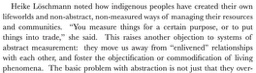
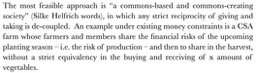
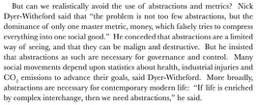
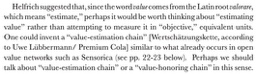
Challenge: Gentle Reciprocity cannot be easily defined and is inherently resistant to abstraction and measurement

This element of competition can work in completely different ways. In cases of barter or commercial exchange, when both parties to the transaction are only interested in the value of goods being trans acted, they may well-as economists insist they should - try to seek the maximum material advantage. On the other hand, as anthropologists have long pointed out, when the exchange is of gifts, that is, the objects passing back and forth are mainly considered interesting in how they reflect on and rearrange relations between the people carrying out the transaction, then insofar as competition enters in, it is likely to work precisely the other way around-to become a matter of contests of generosity, of people showing off who can give more away.
Graeber, Debt, p.103
To leave the economy is to bring out the plane of reality it covers over. Commodity exchange and all that it comprises in the way of harsh negotiation, mistrust, deceit, and wabu wabu, as the Melanesians say, is not exclusively Western. In places where people know how to live, one only practices this type of relations with outsiders, people one is not connected with, who are distant enough so that a mix-up cannot develop into a general conflict. To pay, in Latin, comes from pacare, "to satisfy, to calm," for example by distributing money to soldiers so they can buy themselves some salt-thus a wage. One pays in order to have peace. The whole vocabulary of economy is basically a vocabulary of avoided war. "There is a link, a continuity, between hostile relations and the provision of reciprocal prestations: Exchanges are peacefully resolved wars, and wars are the result of unsuccessful transactions." (Levi-Strauss). Economy's defect is to reduce all possible relationships to hostile relations, every distance to foreignness. What it covers over in this way is the entire gamut, all the gradation, all the heterogeneity among the different existing and imaginable relations. Depending on the degree of proximity between beings, there is a commonality of goods, a sharing of certain things, exchange with an adjusted reciprocity, mercantile exchange, or a total absence of exchange. And every form of life has its language and its notions for expressing this multiplicity of regimes. Making the bastards pay is good warfare. When you love you don't count the cost. Where money talks, words are worth nothing. Where words matter, money's worth nothing. Thus, exiting the economy is being able to dearly distinguish between the possible divisions and, from where one is, to deploy a whole art of distances. It's to push the hostile relations - and the sphere of money, accounting, measurement - as far away as possible. It's to banish to the margins of life that which is presently its norm, its core, its essential condition.
The Invisible Committee, Now, p.107-108