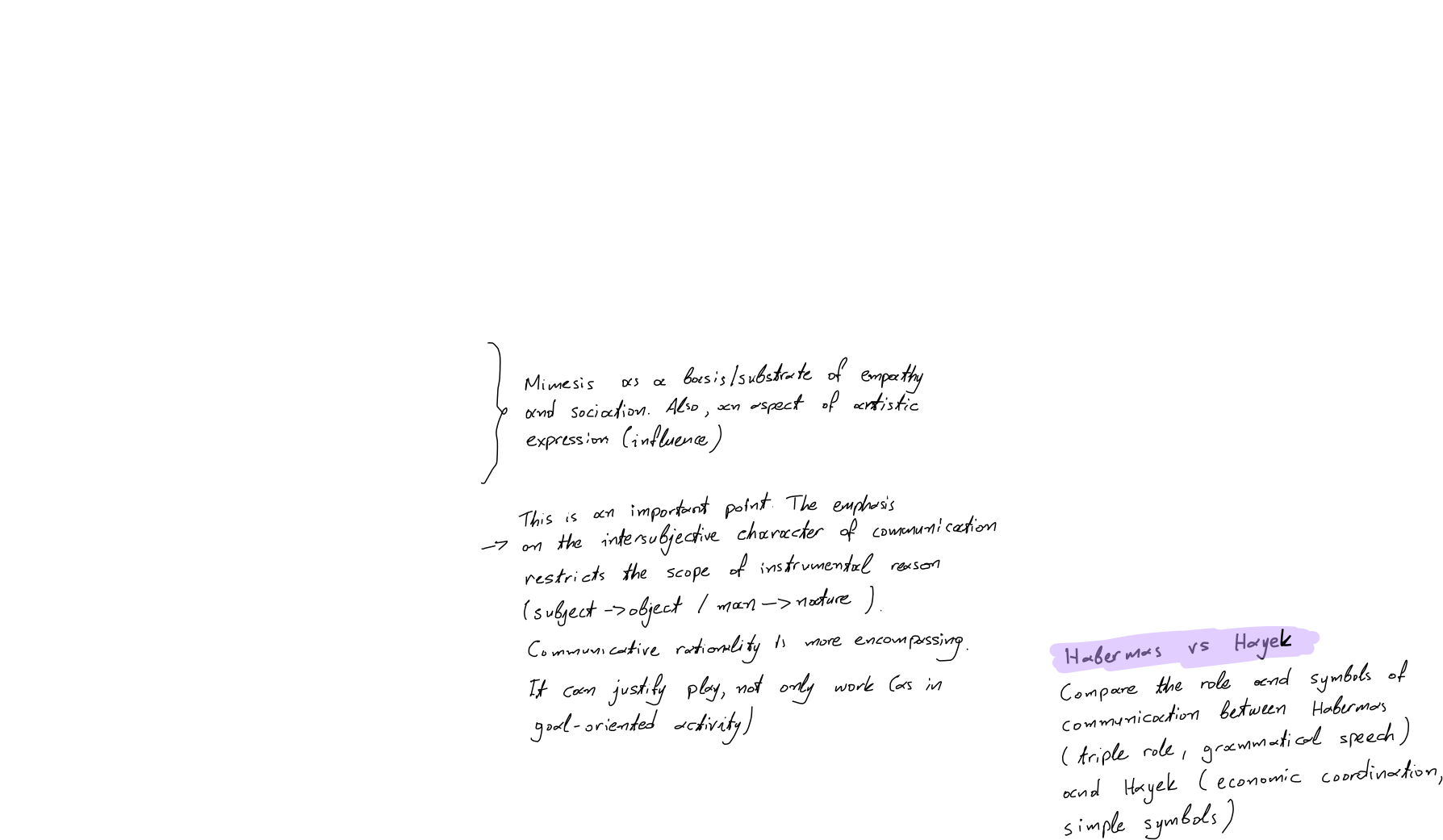
The critique of instrumental reason, which remains bound to the conditions of the philosophy of the subject, denounces as a defect something that it cannot explain in its defectiveness because it lacks a conceptual framework sufficiently flexible to capture the integrity of what is destroyed through instrumental reason. To be sure, Horkheimer and Adorno do have a name for it: mimesis. And even though they cannot provide a theory of mimesis, the very name calls forth associations—and they are intended: Imitation designates a relation between persons in which the one accommodates to the other, identifies with the other, empathizes with the other. There is an allusion here to a relation in which the surrender of the one to the example of the other does not mean a loss of self but a gain and an enrichment. Because the mimetic capacity escapes the conceptual framework of cognitive-instrumentally determined subject-object relations, it counts as the sheer opposite of reason, as impulse. Adorno does not simply deny to the latter any cognitive function. In his aesthetics he attempts to show what the work of art owes to the power of mimesis to unlock, to open up. But the rational core of mimetic achievements can be laid open only if we give up the paradigm of the philosophy of consciousness—namely, a subject that represents objects and toils with them—in favor of the paradigm of linguistic philosophy—namely, that of intersubjective understanding or communication—and puts the cognitive-instrumental aspect of reason in its proper place as part of a more encompassing communicative rationality.
Habermas, The Theory of Communicative Action, Vol 1, p.389-390
If we assume that the human species maintains itself through the socially coordinated activities of its members and that this coordination has to be established through communication—and in certain central spheres through communication aimed at reaching agreement—then the reproduction of the species also requires satisfying the conditions of a rationality that is inherent in communicative action.
Habermas, The Theory of Communicative Action, Vol 1, p.397
A subjectivity that is characterized by communicative reason resists the denaturing of the self for the sake of self-preservation. Unlike instrumental reason, communicative reason cannot be subsumed without resistance under a blind self-preservation. It refers neither to a subject that preserves itself in relating to objects via representation and action, nor to a self-maintaining system that demarcates itself from an environment, but to a symbolically structured lifeworld that is constituted in the interpretive accomplishments of its members and only reproduced through communication. Thus communicative reason does not simply encounter ready-made subjects and systems; rather, it takes part in structuring what is to be preserved. The Utopian perspective of reconciliation and freedom is ingrained in the conditions for the communicative sociation of individuals; it is built into the linguistic mechanism of the reproduction of the species.
Habermas, The Theory of Communicative Action, Vol 1, p.398
I gave a systematic presentation of Mead's attempt to explain, by way of reconstructing. symbolically mediated interaction and action in social roles. The first of these two stages of interaction is characterized by the emergence of a new medium of communication, the second by the norming of behavioral expectations. In the first phase, communication switches over from expressive gestures that stimulate behavior to the use of symbols; in the second, the transition to normatively regulated action means a shift to a symbolic basis for steering behavior: it is no longer only the means of communication that are symbolically restructured, but behavioral schemes and dispositions as well.
Habermas, The Theory of Communicative Action, Vol 2, p.43
When communicative acts take the shape of grammatical speech, the symbolic structure has penetrated all components of interaction; the cognitive-instrumental grasp of reality and the steering mechanism that attunes the behavior of different interaction partners to one another, as well as the actors and their behavior dispositions, get connected to linguistic communication and are symbolically restructured. At the same time, this transposition of cognitions, obligations, and expressions onto a linguistic basis makes it possible in turn for the means of communication to take on new functions-in addition to the function of reaching understanding, those of coordinating action and socializing actors as well. Under the aspect of reaching understanding, communicative acts serve the transmission of culturally stored knowledge-as shown above, cultural tradition reproduces itself through the medium of action oriented to reaching understanding. Under the aspect of coordinating action, the same communicative acts serve the fulfillment of norms appropriate to a given context; social integration also takes place via this medium. Under the aspect of socialization, finally, communicative acts serve the construction of internal controls on behavior, in general, the formation of personality structures; one of Mead's fundamental insights is that socialization processes take place via linguistically mediated interaction.
Habermas, The Theory of Communicative Action, Vol 2, p.63
A further consequence of being able to say "no” which was merely suggested above, concerns the actors themselves. If one aims to reconstruct how participants learn to orient their actions explicitly to validity claims, and wants to do so by means of the mechanism of taking the attitude of the other, the model of inner dialogue, which Mead used rather too unspecifically, turns out in fact to be helpful. In anticipating from alter a negative answer to his own speech act, and raising against himself an objection that alter might raise, ego understands what it means to make a criticizable validity claim. As soon, then, as ego masters the orientation to validity claims, he can repeat the internalization of discursive relations once more. Now alter already encounters him with the expectation that ego is not assuming the communicative role of the first person only in a naive manner, but will expand it, if necessary, to the role of a proponent in argumentation. If ego makes this attitude of alter his own, that is to say, if he views himself through the eyes of an arguing opponent and considers how he will answer to his critique, he gains a reflective relation to himself. By internalizing the role of a participant in argumentation, ego becomes capable of self-criticism. It is the relation- to-self established by this model of self-criticism that we shall call "reflective:” Knowing that one does not know has, since Socrates, rightly been regarded as the basis for self-knowledge.
The reflective relation-to-self takes on different shadings according to the modes of language use. Ego can take up a relation to himself by way of a critique of his own statement, his own action, or his own self-presentation. The self to which he then relates is not a mysterious something; it is familiar to him from the communicative practice of daily life; it is ego himself in the communicative role of the first person, as he asserts the existence of states of affairs in an objectivating attitude, or enters into an interpersonal relation regarded as legitimate in the norm-conformative attitude, or makes a subjective experience accessible to a public in an expressive attitude. Correspondingly, ego can relate to himself according to the model of self-criticism: as an epistemic subject who is capable of learning and has already acquired a certain knowledge in his cognitive-instrumental dealings with reality, or as a practical subject who is capable of acting and has already formed a certain character or a superego in interactions with his reference persons, or as an affective subject who is sensitive, "passionate" in Feuerbach's sense, and has already demarcated from the external world of facts and norms a special domain of subjectivity marked by privileged access and intuitive presence.
The reflective relation to self is the ground of the actor's accountability. A responsible actor behaves self-critically not only in his directly moralizable actions but also in his cognitive and expressive utterances. Although accountability is at bottom a moral-practical category, it also extends to the cognitions and expressions included in the validity spectrum of action oriented to reaching understanding.
Habermas, The Theory of Communicative Action, Vol 2, p.74-75