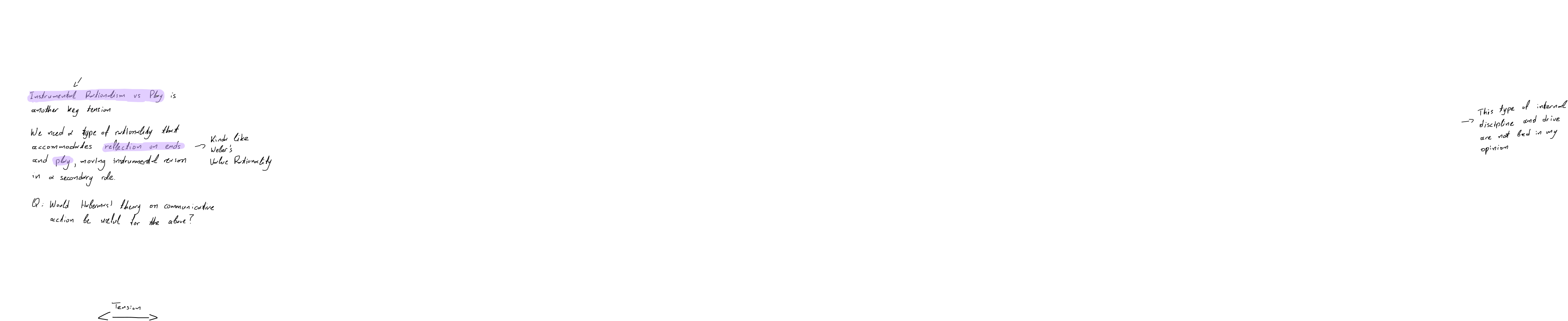
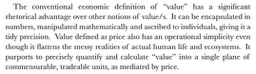
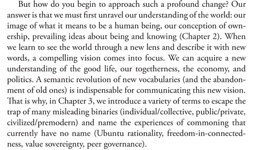
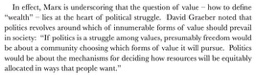
Instrumental and value rationality - Wikipediaen.wikipedia.org
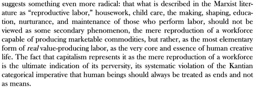
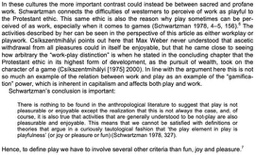
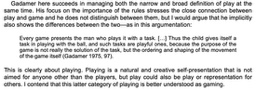
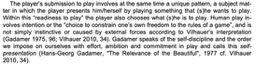
What’s the Point If We Can’t Have Fun?thebaffler.com
In light of the freedom to choose products and needs, both as producer and consumer, one can envision a higher ideal of freedom one that removes the taint of economism and restores the ethical basis of past times, and that is infused with the options opened by technical achievement. Potentially, at least, we are faced with the broadest conception of freedom known thus far: the autonomous individual's freedom to shape material life in a form that is neither ascetic nor hedonistic, but a blend of the best in both-one that is ecological, national, and artistic.
Bookchin, The Ecology of Freedom, p.218
Labor, perhaps even more than technics, must recover its own creative voice. Its form, its deployment in the framework of linear time as a res temporalis, its cruel objectification as mere, homogeneous energy, must yield to the concreteness of skill, to the festiveness of communal activity, to a recognition of its own subjectivity.
Bookchin, The Ecology of Freedom, p.266
 View of Work and Labour as Metonymy and Metaphor | tripleC: Communication, Capitalism & Critique. Open Access Journal for a Global Sustainable Information Societytriple-c.at
The exaltation of a hard-working ethos, whether it is salaried work (viz. the stigma attached to unemployment) or working out in a gym point to the internalization of the demand made by capital that every human being maximizes his or her productive effort, whatever the circumstances, and the word work ends up encompassing all human activities that can directly or indirectly be turned into a profit.
Olivier Frayssé, Work and Labour as Metonymy and Metaphor (triple-C)
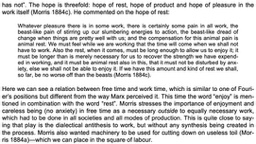
Marx’s ideal workday, when I am able “to hunt in the morning, fish in the afternoon, rear cattle in the evening, criticise after dinner, just as I have a mind, without ever becoming hunter, fisherman, shepherd or critic” (Marx and Engels 1845/46, 53), points to a crucial characteristic of work from a eudemonistic perspective: if a change of work is a holiday, then what makes work an especially painful activity is its continuation through an over-extended period of time […].
The repetition of the same, even innocuous per se, becomes a torment, as in the “Chinese water torture” where the pain comes from a steady dripping of water droplets on the same part of the body. And the classical image of the Fordist worker, chained to the assembly line so that he/she must repeat the same motion relentlessly, resembles that of the galley slave who does nothing but work the oars. Relentless repetition of the same is what Thanatos (the death impulse identified by Freud) is about. Relentlessness and endlessness are the two things that make hell hellish […]
All in all, man is living through and craving for variety, alternation and diversity. Just as we alternate inhaling and exhaling, chewing and swallowing, sleeping and waking, we need to alternate our activities. Post-Fordist human resources specialists of Internet work, who have understood this, would allow private Internet surfing (cyberloafing) to employees while at their workstation to increase productivity by lowering stress Chen and Lim 2011). This raises the issue of rhythm. Autonomous work (when I choose to work) is set to individual bio-rhythms, heteronomous work (when I have work imposed on me from outside, whether by necessity or violence) is set to extraneous rhythms: slaves on a galley pulling on the oars to the drum’s rhythm, marching soldiers, workers on the assembly-line, Internet slaves desperately trying to catch up with incoming emails are all subject to a form of torture. In moderate doses, the extraneous rhythm energizes, as when dancing to a tune, while it becomes painful and even lethal in excessive doses, as any stimulus.
Olivier Frayssé, Work and Labour as Metonymy and Metaphor (triple-C)
Even in the absence of an actual master, the very nature of work involves a certain form of subordination. As a matter of fact, both the goal of the freely chosen work activity, and the specificities of the chosen work material themselves, impose their irreducible strangeness on the worker. When “I’m committed to my work”, the goal, the end in view becomes my master, imposes a discipline, and, when I carve wood, I have to obey the dictates of the wood grain at the very moment when I transform nature. “Nature to be commanded must be obeyed” wrote Francis Bacon (Bacon 1960, 39).
Olivier Frayssé, Work and Labour as Metonymy and Metaphor (triple-C)
The factory was not born from a need to integrate labor with modern machinery. On the contrary, this building block of what we call "industrial society" arose from a need to rationalize the labor process - to intensify and exploit it more effectively than employers could ever hope to achieve with early cottage industries based on a self-regulated system of artisanship. Sidney Pollard, quoting an observer of the prefactory era, notes that workers who were free to regulate their own time as domestic craftpersons rarely worked the modern eight-hour day and five-day week. "The weavers were used to 'play frequently all day on Monday and the greater part of Tuesday, and work very late on Thursday night, and frequently all night on Friday' " to ready their cloth for the Saturday market day. This irregularity, or "naturalness," in the rhythm and intensity of traditional systems of work contributed more toward the bourgeoisie's craze for social control and its savagely antinaturalistic outlook than did the prices or earnings demanded by its employees. More than any single technical factor, this irregularity led to the rationalization of labor under a single ensemble of rule, to a discipline of work and regulation of time that yielded the modern factory, often with none of the technical developments we impute to the "Industrial Revolution." Before the steam engine, power loom, and flying shuttle came into use indeed, before some of these machines were even invented - the traditional spinning wheel, hand loom, and dyeing vat that once filled the working areas of cottagers were assembled in large sheds primarily to mobilize the workers themselves, to regulate them harshly, and to intensify the exploitation of their labor.
Bookchin, The Ecology of Freedom, p.311
Lund - Playing, Gaming, Working and LabouringPDF
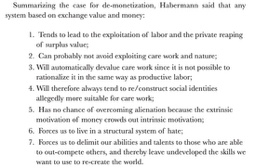
Play, Work and Communicative Action
Carework and Feminist Conceptions of Work
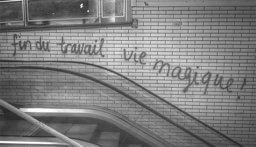
Our central idea is the construction of situations, that is to say, the concrete construction of momentary ambiences of life and their transformation into a superior passional quality.
[…]
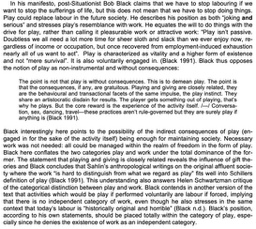
Our action on behavior, linked with other desirable aspects of a revolution in mores, can be briefly defined as the invention of games of an essentially new type. The most general goal must be to expand the nonmediocre part of life, to reduce the empty moments of life as much as possible. One could thus speak of our enterprise as a project of quantitatively increasing human life, an enterprise more serious than the biological methods currently being investigated, and one that automatically implies a qualitative increase whose developments are unpredictable. The situationist game is distinguished from the classic notion of games by its radical negation of the element of competition and of separation from everyday life. On the other hand, it is not distinct from a moral choice, since it implies taking a stand in favor of what will bring about the future reign of freedom and play.
Debord, Report on the Creation of Situations, theanarchistlibrary.org, p.12
To transform the world and to change life are one and the same thing for the proletariat, the inseparable passwords to its suppression as a class, the dissolution of the present reign of necessity, and the finally possible accession to the reign of freedom. The radical critique and free reconstruction of all the values and patterns of behavior imposed by alienated reality are its maximum program. Free creativity in the construction of all moments and events of life is the only poetry it can acknowledge, the poetry made by all, the beginning of the revolutionary festival. Proletarian revolutions will be festivals or nothing, for festivity is the very keynote of the life they announce. Play (*) is the ultimate principle of this festival, and the only rules it can recognize are to live without dead time and to enjoy without restraints.
(*) [The ending is stronger and more scandalous in the original: the French word jouir (“to enjoy”) also means “to come” in the sexual sense.]
On the Poverty of Student Life - Members of Situationist International and Students of Strasbourg University (1966), theanarchistlibrary.org, p.19
The next phase of play’s advance seems to require the disappearance of any element of competition. The question of winning or losing, which has to date been nearly inseparable of ludic activity, appears to be tied to every other expression of competition between people in the appropriation of goods. The sense of importance in winning, which concerns concrete (or more frequently illusory) satisfactions, is the wretched product of a wretched society. The feeling [of winning] is, of course, exploited by every conservative force to conceal the monotony and the brutality of the conditions of life they impose. Simply consider the [social] demands détourned by competitive sports, which was most clearly established in its modern form in Great Britain, alongside the rise of factories. Not only do the crowds identify with professional players or clubs (which assume the same mythic role as the movie stars who live, and the statesmen who make decisions, in their place), but the endless sequence of match results also keeps hold over the passions of the spectators . Direct participation in a game, even in those requiring a certain degree of intellectual exertion, becomes uninteresting as soon as the established rules of play involve the acceptance of competition for its own sake.
Contribution to a Situationist Definition of Play, Internationale Situationniste #1, https://libcom.org/article/contribution-situationist-definition-play
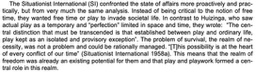
The element of competition must vanish in favour of a more authentically collective concept of play: the communal creation of selected ludic ambiences. The central distinction made between play and everyday life, which keeps play as an isolated and temporary anomaly, must be surpassed. Johan Huizinga writes, “Into an imperfect world and into the confusion of life, [play] brings a temporary, a limited perfection.” Everyday life, which was previously determined by the question of survival, can now be rationally controlled (this possibility is at the heart of every conflict of our time). Play, radically breaking with a delimited ludic time and space, must invade the whole of life. Perfection cannot be its endpoint, insofar as this perfection signifies a static construction opposed to life. However one can propose to push the beautiful chaos of life to its perfection. […]
In this historical perspective, play — the constant experimentation with ludic innovations — only comes into being alongside ethics and questions of life’s meaning. The only success which we can appreciate in play is the immediate success of its ambience, and the constant increase of its powers. In its present co-existence with the residues of the phase of decline, play cannot completely free itself from a competitive aspect, it must at least aim to provoke conditions favourable to living directly. In this sense it is still both a struggle and a representation: a struggle for a life measured by desire, and a concrete representation of such a life.
Play often feels imaginary, owing to its fringe existence in comparison to the oppressive reality of work, but the Situationists’ work is precisely the preparation of the ludic possibilities to come.
Contribution to a Situationist Definition of Play, Internationale Situationniste #1, https://libcom.org/article/contribution-situationist-definition-play
The traditional goal of aesthetics is to produce, by means of art, impressions of certain past elements of life in circumstances where those elements are lacking or absent, in such a way that those elements escape the disorder of appearances subject to the ravages of time. The degree of aesthetic success is thus measured by a beauty that is inseparable from duration, and that even goes so far as pretensions of eternity. The goal of the situationists is immediate participation in a passionate abundance of life by means of deliberately arranged variations of ephemeral moments. The success of these moments can reside in nothing other than their fleeting effect. The situationists consider cultural activity in its totality as an experimental method for constructing everyday life, a method that can and should be continually developed with the extension of leisure and the withering away of the division of labor (beginning with the division of artistic labor).
Debord, Theses on Cultural Revolution, Internationale Situationniste #1, https://libcom.org/article/theses-cultural-revolution-guy-debord
Mascolo is right in saying (in Le Communisme) that the reduction of the work day by the dictatorship of the proletariat is “the most certain sign of the latter’s revolutionary authenticity.” Indeed, “if man is a commodity, if he is treated as a thing, if human relations are relations of thing to thing, this is because it is possible to buy his time.” But Mascolo is too quick to conclude that “the time of a man freely employed” is always well spent, and that “the purchase of time is the sole evil.” There can be no freely spent time until we possess the modern tools for the construction of everyday life. The use of such tools will mark the leap from a utopian revolutionary art to an experimental revolutionary art.
Debord, Theses on Cultural Revolution, Internationale Situationniste #1, https://libcom.org/article/theses-cultural-revolution-guy-debord
There is no revolutionary problem of leisure — of an emptiness to be filled — but a problem of free time. As we have already said: “There can be no free use of time until we possess the modern tools for the construction of everyday life. The use of such tools will mark the leap from a utopian revolutionary art to an experimental revolutionary art” (Debord, “Theses on Cultural Revolution,” Internationale Situationniste #1). The supersession of leisure through the development of an activity of free creation-consumption can only be understood in relation with the dissolution of the traditional arts — with their transformation into superior modes of action which do not refuse or abolish art, but fulfill it. In this way art will be superseded, conserved and surmounted within a more complex activity. Its traditional elements may still be partially present, but transformed, integrated and modified by the totality.
The Use of Free Time, Internationale Situationniste #4, https://libcom.org/article/use-free-time-0
What are the organisational perspectives of life in a society which authentically "reorganises production on the basis of the free and equal association of the producers"? Work would more and more be reduced as an exterior necessity through the automation of production and the socialisation of vital goods, which would finally give complete liberty to the individual. Thus liberated from all economic responsibility, liberated from all the debts and responsibilities from the past and other people, humankind will exude a new surplus value, incalculable in money because it would be impossible to reduce it to the measure of waged work. The guarantee of the liberty of each and of all is in the value of the game, of life freely constructed. The exercise of this ludic recreation is the framework of the only guaranteed equality with non-exploitation of man by man. The liberation of the game, its creative autonomy, supersedes the ancient division between imposed work and passive leisure.
Situationist Manifesto, Internationale Situationniste #4, https://libcom.org/article/situationist-manifesto
What would be the principle characteristics of the new culture and how would it compare with ancient art? Against the spectacle, the realised situationist culture introduces total participation.
Against preserved art, it is the organisation of the directly lived moment.
Against particularised art, it will be a global practice with a bearing, each moment, on all the usable elements. Naturally this would tend to collective production which would be without doubt anonymous (at least to the extent where the works are no longer stocked as commodities, this culture will not be dominated by the need to leave traces.) The minimum proposals of these experiences will be a revolution in behaviour and a dynamic unitary urbanism capable of extension to the entire planet, and of being further extensible to all habitable planets.
Against unilateral art, situationist culture will be an art of dialogue, an art of interaction. Today artists - with all culture visible - have become entirely separated from society, just as they are separated from each other by competition. But faced with this impasse of capitalism, art has remained essentially unilateral in response. This enclosed era of primitivism must be superseded by complete communication.
At a higher stage, everyone will become an artist, i.e., inseparably a producer-consumer of total culture creation, which will help the rapid dissolution of the linear criteria of novelty. Everyone will be a situationist so to speak, with a multidimensional inflation of tendencies, experiences, or radically different "schools" - not successively, but simultaneously.
We will inaugurate what will historically be the last of the crafts. The role of amateur-professional situationist - of anti-specialist - is again a specialisation up to the point of economic and mental abundance, when everyone becomes an "artist," in the sense that the artists have not attained the construction of their own life. However, the last craft of history is so close to the society without a permanent division of labour, that when it appeared amongst the S.I., its status as a craft was generally denied.
Situationist Manifesto, Internationale Situationniste #4, https://libcom.org/article/situationist-manifesto
The next form of society will not be based on industrial production. It will be a society of realized art.
Situationist International, The Bad Days will End, Internationale Situationniste #7, https://libcom.org/article/bad-days-will-end-0
The Situationist International (SI) inherited the surrealists’ opposition between the concrete political means of the liberation of work and the utopian end of its abolition. In this sense the SI's theory represents the last sincere gesture of faith in a revolutionary conception of self-management integral to the programmee that propelled their conception of revolutionary activity. This latter consisted of a radical rethinking of the liberation of work, along lines which emphasised the refusal of any separation between revolutionary action and the total transformation of life — an idea expressed implicitly in their original project of “creating situations”. The importance of this development should not be underestimated, for the “critique of separation” here implied a negation of any temporal hiatus between means and ends (thus of any period of transition), as well as a refusal of any synchronic mediations — insisting on universal (direct democratic) participation in revolutionary action.
[…]
It was thus on the basis of an existing workers’ power at the points of production that they saw the abolition of work as becoming possible, both from a technical and organisational standpoint. In transposing the techniques of the cyberneticians and the gestures of the bohemian anti-artist into the trusted, calloused hands of the organised working class, the situationists were able to imagine the abolition of work as the direct result of its liberation; that is, to imagine the overcoming of alienation as a result of an immediate technical-creative restructuring of the workplace by the workers themselves.
In this sense the SI's theory represents the last sincere gesture of faith in a revolutionary conception of self-management integral to the programme of the liberation of work.
Endnotes, Bring out your Dead, Endnotes #1, https://endnotes.org.uk/articles/bring-out-your-dead
The neoliberal gambit was that the destruction of social security would have a dynamic effect on culture and the economy, liberating an entrepreneurial spirit that was inhibited by the red tape of bureaucratic social democratic institutions. The reality, however, is that innovation requires certain forms of stability. The disintegration of social democracy has had a dampening, rather than a dynamic, effect on culture in highly neoliberalised countries such as the UK. Fredric Jameson’s claims that late-capitalist culture would be given over to pastiche and retrospection have turned out to be extraordinarily prophetic.
We’ve grown so accustomed to repetition and recycling that we no longer notice them. Yet it’s no surprise that this is the case. New cultural production requires a use of time that communicative capitalism is profoundly hostile towards. Most social energy is sucked into the vortex of late-capitalist labour and its vast simulation of productivity. Innovation depends upon an absorbed (rather than distracted) drift; but it is increasingly difficult to muster the attentional resources necessary for such immersion. Cyberspatial urgencies — the smartphone’s flashing red light, the siren call of its alert — function like trance-inhibitors or alarm clocks that keep waking us out of collective dreaming. In these conditions, intellectual work can only be undertaken on a short-term basis. Only prisoners have time to read, and if you want to engage in a twenty-year-long research project funded by the state, you will have to kill someone.
To understand the time-crisis, we only have to compare the current situation with the height of punk and post-punk in the UK and the US. It’s no accident that the efflorescence of punk and post-punk culture happened at a time when cheap and squatted property was available in London and New York. Now, simply to afford to pay rent in either city entails giving up most of your time and energy to work. The delirious rise in property prices over the last twenty years is probably the single most important cause of cultural conservatism in the UK and the US. In the UK, much of the infrastructure which indirectly supported cultural production has been systematically dismantled by successive neoliberal governments. Most of the innovations in British popular music which happened between the Sixties and the Nineties would have been unthinkable without the indirect funding provided by social housing, unemployment benefit and student grants.
These developments precisely opened up a kind of time that is now increasingly difficult to access: a time temporarily freed from the pressure to pay rent or the mortgage; an experimental time, in which the outcomes of activities could neither be predicted nor guaranteed; a time which might turn out to be wasted, but which might equally yield new concepts, perceptions, ways of being. It is this kind of time, not the harassed time of the business entrepreneur, which gives rise to the new. This kind of time, where the collective mind can unfurl, also allows the social imagination to flourish. The neoliberal era — the time when, we were repeatedly told, there was no alternative — has been characterised by a massive deterioration of social imagination, an incapacity to even conceive of different ways to work, produce and consume. It’s now clear that, from the start (and with good reason) neoliberalism declared war on this alternative mode of time. It remains tireless in its propagation of resentment against those few fugitives who can still escape the treadmill of debt and endless work, promising to ensure that soon, they too will be condemned to performing interminable, meaningless labour — as if the solution to the current stagnation lay in more work, rather than an escape from the cult of work. If there is to be any kind of future, it will depend on our winning back the uses of time that neoliberalism has sought to close off and make us forget.
Mark Fisher & Darren Ambrose, Time-Wars: Towards an Alternative for the Neo-Capitalist Era, K-Punk: The Collected and Unpublished Writings of Mark Fisher, 2018, p.521-522
We suggest two principles here: shadow and time. Shadow is an unintended consequence, an event vacuum, which remains invisible for passers-by. It does not register on the development maps of the managerial class. Time is needed in order for the substantially different to grow. Maturation, which is creative growth, requires time. Don’t be afraid of the cycle. Who’s afraid of the longue durée? The time of creativity is that of idleness and procrastination, indeed otium. This turns out to be the opposite of frantic entrepreneurship and instant valorization. This is why creative industries policy can only propose fixed formats and known concepts: template capitalism. Maker labs, with their standard 3D printers and software, can only produce more of the same. Open source is not the solution to this problem. Neither is it sufficient to place the wild, weird bohème at the helm.
https://networkcultures.org/geert/2014/11/20/the-creative-question-nine-theses/
The pressure of the instantaneous — of what, in their new manifesto, “On the Creative Question — Nine Theses”, Geert Lovink, Sebastian Olma and Ned Rossiter call “frantic entrepreneurship and instant valorisation” — inevitably weighs heavy on cultural producers. In an enigmatic but suggestive formulation, Lovink, Olma and Rossiter argue that the urgencies of the immediate need to be replaced by principles of “shadow and time”. “Shadow,” they write,
"is an unintended consequence, an event vacuum, which remains invisible for passers by. It does not register on the development maps of the managerial class. Time is needed in order for the substantially different to grow. Maturation, which is creative growth, requires time.
It is imperative that we carve out some spaces beyond the hyper-bright instant. This instant is insomniac, amnesiac; it locks us into a reactive time, which is always full (of outrage and pseudo-novelty). "
There is no continuous time in which shadows can grow, only a time that is simultaneously seamless (without gaps: there is always “new” content streaming in) and discontinuous (each new compulsion makes us forget what preceded it). The result is a mechanical and unacknowledged repetition. Is it still possible for us to cultivate shadows?
Mark Fisher & Darren Ambrose, A Time for Shadows, K-Punk: The Collected and Unpublished Writings of Mark Fisher, 2018, p.560-561
So far therefore as labour is a creator of use value, is useful labour, it is a necessary condition, independent of all forms of society, for the existence of the human race; it is an eternal nature-
imposed necessity, without which there can be no material exchanges between man and Nature, and therefore no life.
Marx, Capital, Volume 1, Marx Engels Collected Works Volume 35 (International Publishers), p.53
For us, labour will be defined, in its opposition to non-labour, as an activity that is socially validated as such, because of its specific function, its specific social character in a given mode of production. Other bases for definitions of labour are also possible, to cite a few: exchange between man and nature, expense of energy, distinction between pleasant/unpleasant activities. However, we think that none of these definitions can help us understand anything about the character of unwaged IMM activities. These definitions only take into account their concrete characteristics, and in the case of unwaged IMM activities, this leads to banal or absurd descriptions. Is comforting a child an exchange with nature? Is sleeping a labour that reproduces labour-power? Is brushing one’s teeth labour? Brushing somebody else’s teeth? We think that our definition of labour, while it may seem banal at first glance, is the only one capable of passing over these meaningless questions, and that it constitutes the right starting-point for research into the specific character of these activities.
Endnotes, The Logic of Gender, Endnotes #3 (2013), https://endnotes.org.uk/articles/the-logic-of-gender
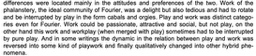
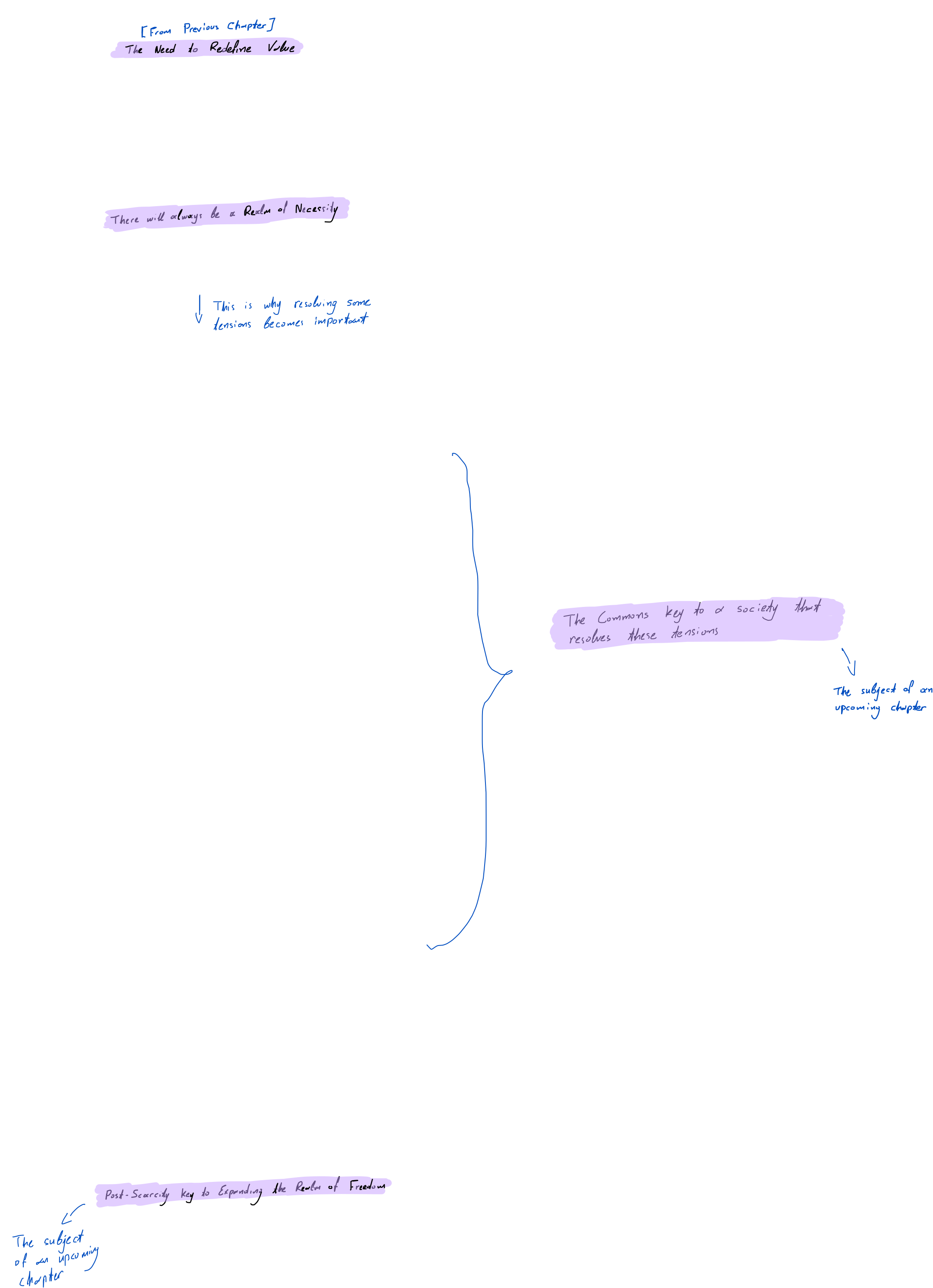
In the Grundrisse it is made clear that the new human being who develops with communist society does so through the expansion of ‘free time which is both leisure and time for higher activity’, which transforms ‘its possessor into another subject’. Work remains a realm of necessity in contrast with the realm of freedom outside work, where human development is an end in itself. This does not mean, however, as one commentator has suggested, that the problem of freedom is in the Grundrisse reduced to the problem of free time, nor does it mean that the realm of work consists of alienated labour. Work does not become ‘pure fun, pure amusement, as in Fourier’s ... childishly naive conception’, since ‘really free work ... is also the most damnably difficult, demanding the most intensive effort’. But if ‘labour cannot become a game, as desired by Fourier’, it remains to his great credit that he ‘stated that the ULTIMATE OBJECT is the raising of the mode of production itself, not [that] of distribution, to a higher form’. And the nature and conditions of work are to be transformed so that work, while necessary, is nevertheless free:
"Work involved in material production can achieve this character only if (1) its social character is posited; (2) if it is of a scientific character and simultaneously general [in its application], and not the exertion of the worker as a natural force drilled in a particular way, as a subject, which appears in the production process not in a merely natural, spontaneous form, but as an activity controlling all natural forces.” (Marx, Grundrisse, Collected Works of Marx and Engels (Lawrence & Wishart: London), Vol. 28, p. 530; Collected Works of Marx and Engels (Lawrence & Wishart: London), Vol. 29, p. 97)
Work in communist society is both greatly reduced and transformed in character. These features depend upon the expansion of productive powers, made possible in the first instance by capitalism but then exponentially so by its demise. Abundance is a necessary condition for communism. These four key features – the abolition of the division of labour, the development of individual potential, the transformation of work and the increase in material prosperity (made possible by the social ownership of the means of production) – are summed up in the Critique of the Gotha Programme:
"In a higher phase of a communist society, after the enslaving subordination of the individual to the division of labour, and therewith also the antithesis between mental and physical labour, has vanished; after labour has become not only a means of life but life’s prime want; after the productive forces have also increased with the all-round development of the individual, and all the springs of common wealth flow more abundantly – only then can the narrow horizon of bourgeois right be crossed in its entirety and society inscribe on its banners: From each according to his ability, to each according to his needs!“ (Marx, Critique of the Gotha Programme, Collected Works of Marx and Engels (Lawrence & Wishart: London), Vol. 24, p. 87.)
Levitas, The Concept of Utopia, p.49-50
Till now we have been considering the estrangement; the alienation of the worker only in one of its aspects, i.e., the worker's relationship to the products of his labour. But the estrangement is manifested not only in the result but in the act of production, within the producing activity itself. How could the worker come to face the product of his activity as a stranger, were it not that in the very act of production he was estranging himself from himself? The product is after all but the summary of the activity, of production. If then the product of labour is alienation, production itself must be active alienation, the alienation of activity, the activity of alienation. In the estrangement of the object of labour is merely summarised the estrangement, the alienation, in the activity of labour itself.
What, then, constitutes the alienation of labour?
First, the fact that labour is external to the worker, i.e., it does not belong to his intrinsic nature; that in his work, therefore, he does not affirm himself but denies himself, does not feel content but unhappy, does not develop freely his physical and mental energy but mortifies his body and ruins his mind. The worker therefore only feels himself outside his work, and in his work feels outside himself. He feels at home when he is not working, and when he is working he does not feel at home. His labour is therefore not voluntary, but coerced; it is forced labour. It is therefore not the satisfaction of a need; it is merely a means to satisfy needs external to it. Its alien character emerges clearly in the fact that as soon as no physical or other compulsion exists, labour is shunned like the plague. External labour, labour in which man alienates himself, is a labour of self-sacrifice, of mortification. Lastly, the external character of labour for the worker appears in the fact that it is not his own, but someone else's, that it does not belong to him, that in it he belongs, not to himself, but to another. Just as in religion the spontaneous activity of the human imagination, of the human brain and the human heart, operates on the individual independently of him—that is, operates as an alien, divine or diabolical activity—so is the worker's activity not his spontaneous activity. It belongs to another; it is the loss of his self.
[…]
This relation [the relation of labour to the act of production] is the relation of the worker to his own activity as an alien activity not belonging to him; it is activity as suffering, strength as weakness, begetting as emasculating, the worker's own physical and mental energy, his personal life—for what is life but activity?—as an activity which is turned against him, independent of him and not belonging to him. Here we have self-estrangement, as previously we had the estrangement of the thing.
Marx, Economic and Philosophic Manuscripts, Marx Engels Collected Works Volume 3 (International Publishers), p.274-275
Play
Exploration
Curiosity
Alteration
Work
Goal
Discipline
Repetition
Work: Goal-oriented activity
Thinking about this as a spectrum between 2 opposing types of activity