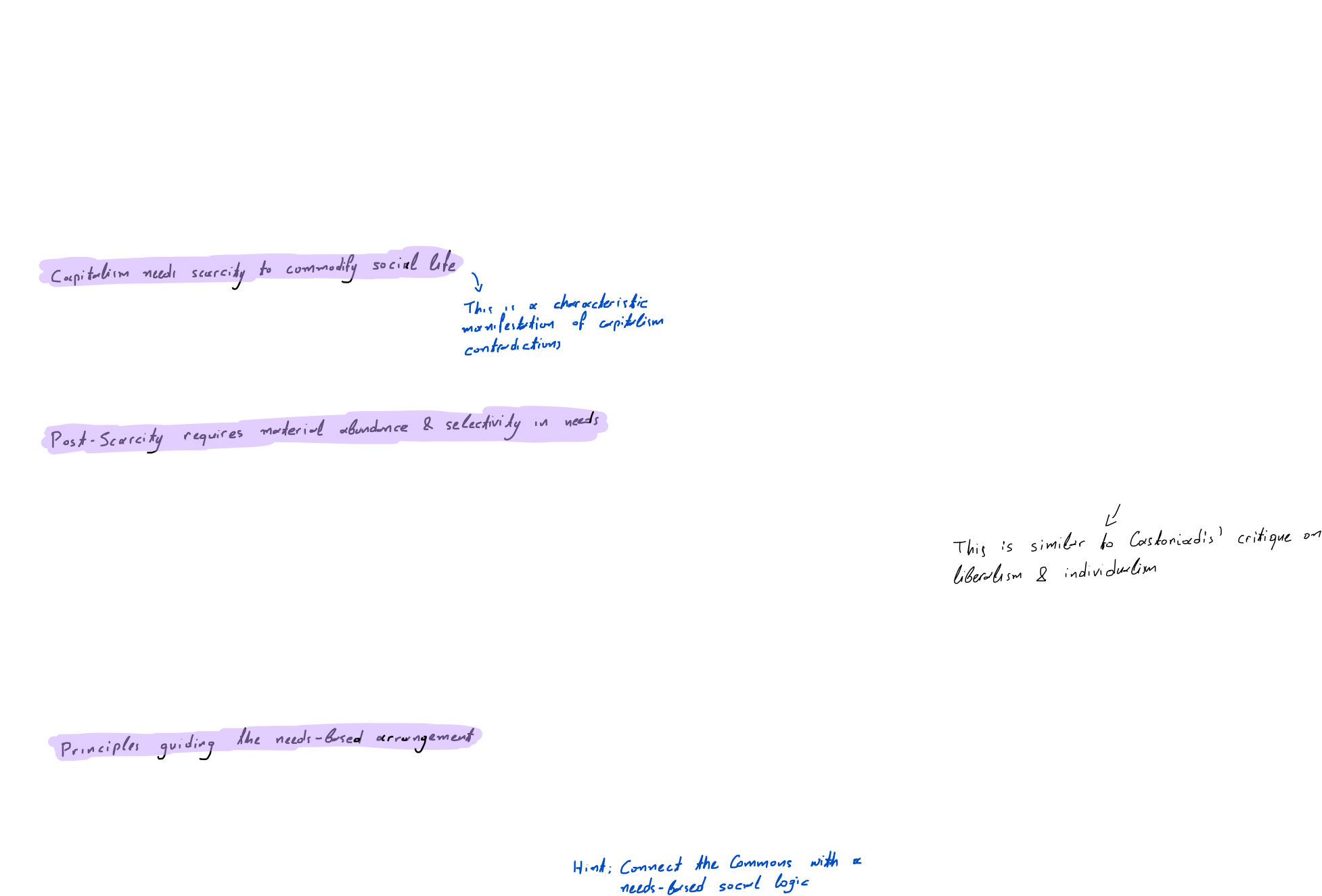
The concept of scarcity plays an important role in delineating the Realm of Necessity with the Realm of Freedom, therefore in any evaluation of our needs. This is why it is key to analyze when thinking about needs.
There is a point at which society begins to intervene in the formation of needs to produce a special kind of scarcity: a socially induced scarcity that expresses social contradictions. Such scarcity may occur even when technical development seems to render material scarcity completely unwarranted.
(Bookchin, The Ecology of Freedom, p. 68)
The problems of needs and scarcity, in short, must be seen as a problem of selectivity - of choice. [...] Although choice presupposes a sufficiency in the means of life, it does not imply the existence of a mindless abundance of goods that smothers the individual's capacity to select use-values rationally, to define his or her needs in terms of qualitative, ecological, humanistic, indeed, philosophical criteria. Rational choice presupposes not only a sufficiency in the means of life with minimal labor to acquire them; it presupposes above all a rational society.
Freedom from scarcity, or post-scarcity, must be seen in this light if it is to have any liberatory meaning. The concept presupposes that individuals have the material possibility of choosing what they need-not only a sufficiency of available goods from which to choose but a transformation of work, both qualitatively and quantitatively. But none of these achievements is adequate to the idea of post-scarcity if the individual does not have the autonomy, moral insight, and wisdom to choose rationally.
(Bookchin, The Ecology of Freedom, p. 69)
Important question set by this thesis: What would be a theory on needs suitable for the Commons?
For Hayek, the end result of the market order (say a particular distribution of income, or any other particular ‘snapshot’ of the socio-economic condition) cannot be judged ‘by criteria which are appropriate only to a single organised community serving a given hierarchy of ends’, because such a hierarchy of ends is not relevant to the ‘complex structure composed of countless individual economic arrangements’ (Hayek 1978: 183). The word ‘economy’ is in fact inadequate to describe a multitude of individual ends, because it refers to ‘an organisation or arrangement in which someone deliberately allocates resources to a unitary order of ends’. Instead, the market order, or catallaxy, does not have any particular end.
De Angelis, The Beginning of History, Chapter 14: Market freedom and the prison: Hayek and Bentham: Market and Panopticism: Two Overlapping Orders
Since even the most apparently bland and factual descriptions turn out to be based on all sorts of a priori assumptions about what is important and relevant, and these, on what human beings, or human society, are fundamentally about, the real choice then is between thinking about such questions explicitly, or leaving them implicit—in which case, one will inevitably end up drawing on one’s own culture’s unstated folk beliefs.
Graeber, Toward an Anthropological Theory of Value, p.20-21
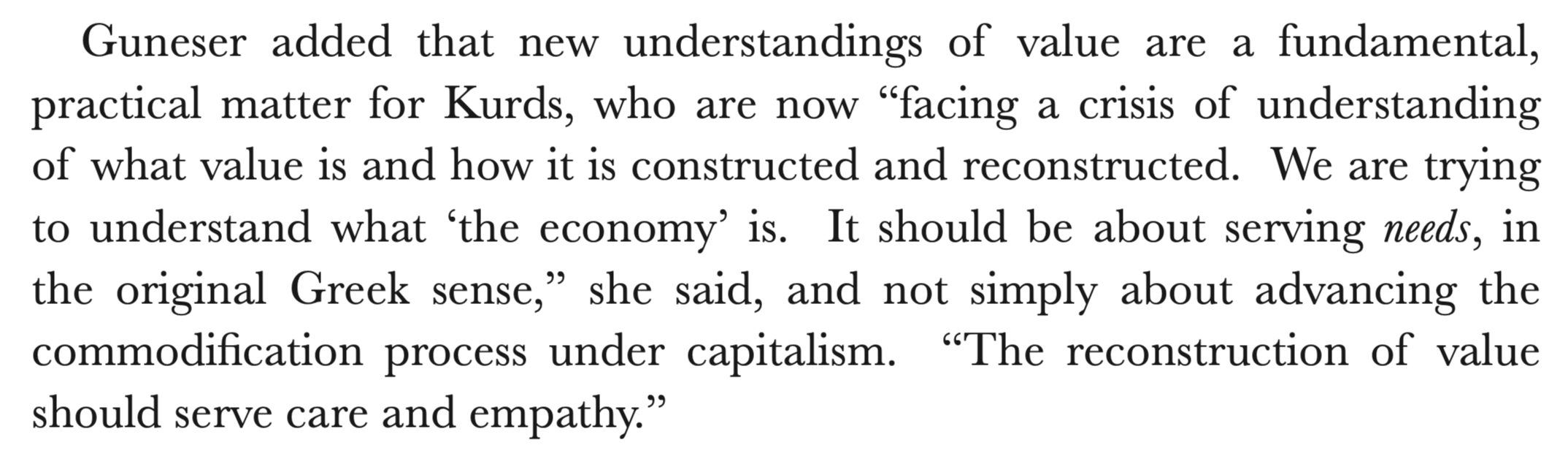
Decommodification of social life
Expand on needs: selectivity of needs, towards a theory of needs
Thesis: A society of associated producers will adopt a needs-based economic arrangement (“from each according to his abilities to each according to his needs”)
Irreducible minimum (Bookchin)
Free-time as a measure of wealth
Needs evaluation made in citizen councils
Argument against Hayek’s “no single mind can understand society’s needs etc”: This is the bet of collectivism and democracy: to collectively reach an arrangement that best suits everyone’s needs. Resigning and delegating to a mechanism like the market leads to all these problems like poverty and environmental destruction