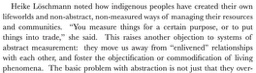
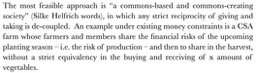
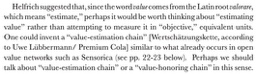
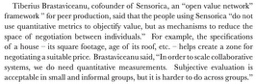
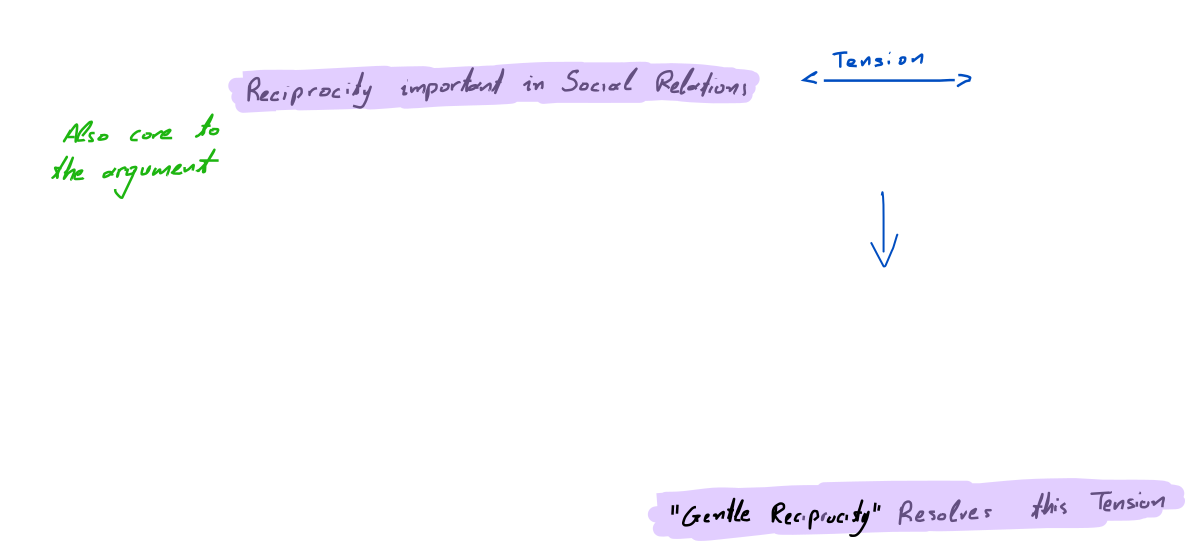
How this tension between reciprocity and a need-based arrrangement is resolved is key to redefining value.
Needs-Based Politico-Economic Arrangement
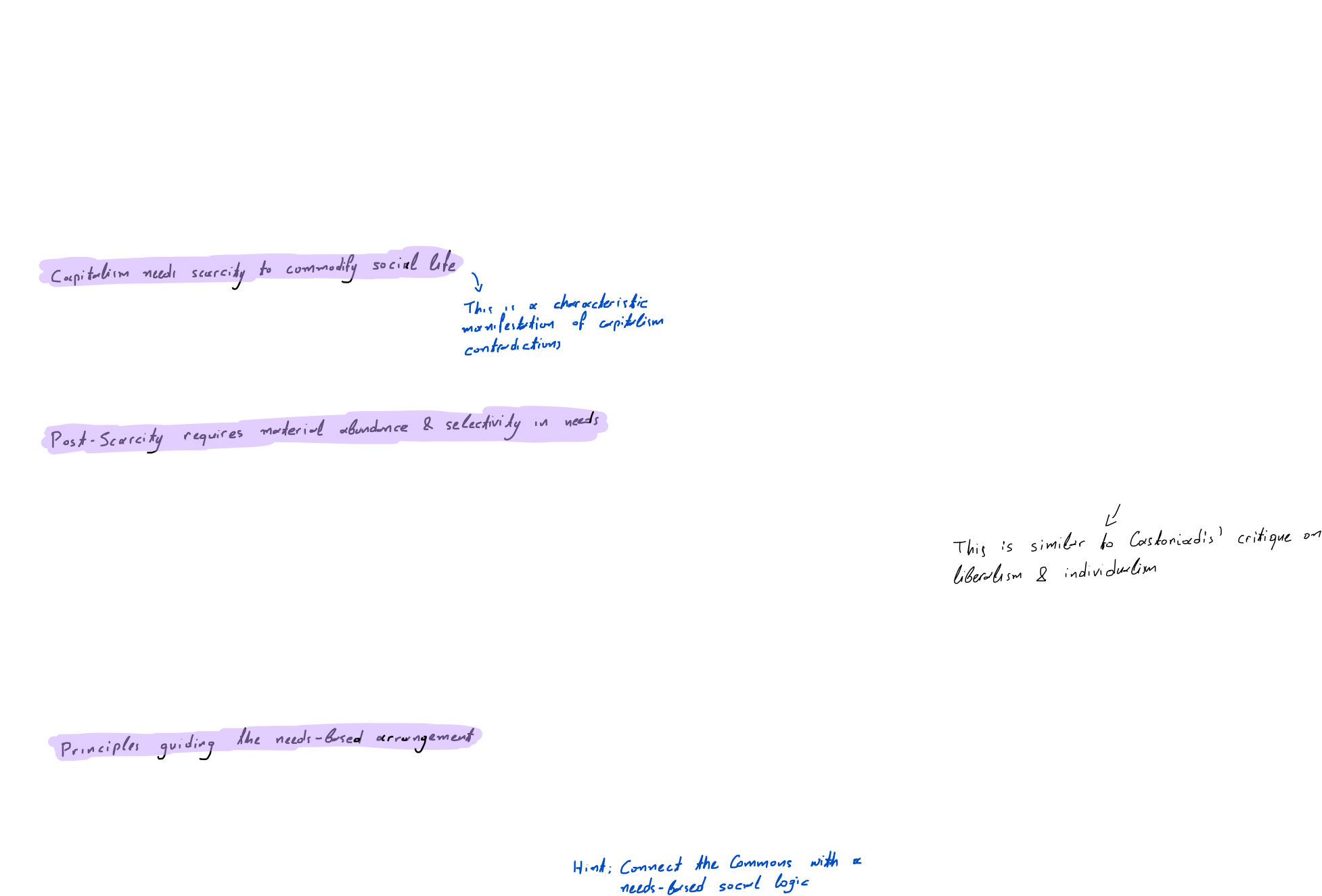
The concept of scarcity plays an important role in delineating the Realm of Necessity with the Realm of Freedom, therefore in any evaluation of our needs. This is why it is key to analyze when thinking about needs.
There is a point at which society begins to intervene in the formation of needs to produce a special kind of scarcity: a socially induced scarcity that expresses social contradictions. Such scarcity may occur even when technical development seems to render material scarcity completely unwarranted. (Bookchin, The Ecology of Freedom, p. 68)
The problems of needs and scarcity, in short, must be seen as a problem of selectivity - of choice. [...] Although choice presupposes a sufficiency in the means of life, it does not imply the existence of a mindless abundance of goods that smothers the individual's capacity to select use-values rationally, to define his or her needs in terms of qualitative, ecological, humanistic, indeed, philosophical criteria. Rational choice presupposes not only a sufficiency in the means of life with minimal labor to acquire them; it presupposes above all a rational society. Freedom from scarcity, or post-scarcity, must be seen in this light if it is to have any liberatory meaning. The concept presupposes that individuals have the material possibility of choosing what they need-not only a sufficiency of available goods from which to choose but a transformation of work, both qualitatively and quantitatively. But none of these achievements is adequate to the idea of post-scarcity if the individual does not have the autonomy, moral insight, and wisdom to choose rationally. (Bookchin, The Ecology of Freedom, p. 69)
Important question set by this thesis: What would be a theory on needs suitable for the Commons?
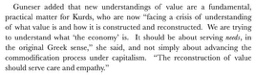
For Hayek, the end result of the market order (say a particular distribution of income, or any other particular ‘snapshot’ of the socio-economic condition) cannot be judged ‘by criteria which are appropriate only to a single organised community serving a given hierarchy of ends’, because such a hierarchy of ends is not relevant to the ‘complex structure composed of countless individual economic arrangements’ (Hayek 1978: 183). The word ‘economy’ is in fact inadequate to describe a multitude of individual ends, because it refers to ‘an organisation or arrangement in which someone deliberately allocates resources to a unitary order of ends’. Instead, the market order, or catallaxy, does not have any particular end. De Angelis, The Beginning of History, Chapter 14: Market freedom and the prison: Hayek and Bentham: Market and Panopticism: Two Overlapping Orders
Since even the most apparently bland and factual descriptions turn out to be based on all sorts of a priori assumptions about what is important and relevant, and these, on what human beings, or human society, are fundamentally about, the real choice then is between thinking about such questions explicitly, or leaving them implicit—in which case, one will inevitably end up drawing on one’s own culture’s unstated folk beliefs. Graeber, Toward an Anthropological Theory of Value, p.20-21

Decommodification of social life

Expand on needs: selectivity of needs, towards a theory of needs

Thesis: A society of associated producers will adopt a needs-based economic arrangement (“from each according to his abilities to each according to his needs”)

Irreducible minimum (Bookchin)

Free-time as a measure of wealth

Needs evaluation made in citizen councils

Argument against Hayek’s “no single mind can understand society’s needs etc”: This is the bet of collectivism and democracy: to collectively reach an arrangement that best suits everyone’s needs. Resigning and delegating to a mechanism like the market leads to all these problems like poverty and environmental destruction
Untitled board
While it is certainly true that tit-for-tat exchange of this sort can help create an ongoing, mutually supportive relationship, it has only really done so when it stops being strictly tit for tat. Graeber, Toward an Anthropological Theory of Value, p.219
Sahlins, on the other hand, defines “generalized reciprocity” as the kind of open-ended responsibility that prevails among close kin, all of whom will do whatever they can to help the other, not because they expect repayment, but simply because they know that in a similar crisis, the other would do the same. He contrasts it with the “balanced reciprocity” that prevails between people who, though less close, are nonetheless close enough that they feel obliged to deal with each other on a moral basis. “Balanced reciprocity,” in- terestingly enough, would thus include both classical gift exchange and the less cutthroat forms of trade or barter. […] Rather than “generalized” or “balanced” reciprocity, then, it might be better to think of reciprocity as relatively “open” and “closed”: open reciprocity keeps no accounts, because it implies a relation of permanent mutual commitment; it becomes closed reciprocity when a balancing of accounts closes the relationship off, or at least maintains the constant possibility of doing so. Phrasing it this way also makes it easier to see the relation as a matter of degree and not of kind: closed relations can become more open, open ones more closed. It seems difficult to avoid the impression, then, that the closed reciprocity of gift and countergift is in fact the form of gift exchange that least embodies what makes a “gift economy” different from one dominated by market exchange. It is competitive, individualistic, and can easily slip into something resembling barter. Graeber, Toward an Anthropological Theory of Value, p.218-220
Gentle Reciprocity

Challenges

Challenge: Gentle Reciprocity cannot be easily defined and is inherently resistant to abstraction and measurement

Durkheim first discusses the Kantian opposition between duty and inclination from the standpoint that the relation of moral precepts to the interests of the individual is one of tension. Imperatives of self-maintenance, interests in the satisfaction of private needs and desires - in short, action orientations that are utilitarian and related to oneself- are not as such in accord with moral requirements, which demand, rather, that the actor raise himself above himself. The selfiessness of the morally acting individual corresponds to the universality of morally normed expectations, which are directed to all the members of a community: "Morality begins with membership in a group, whatever that group may be.’ Habermas, The Theory of Communicative Action, Vol. 2, p.48
Reciprocity
[A mode of relating] in which two parties act, or are disposed to act, toward one another in equivalent ways. Graeber, Toward an Anthropological Theory of Value, p.225
[…] we are not really dealing with reciprocity here-or at best, only with reciprocity in the broadest sense. What is equal on both sides is the knowledge that the other person would do the same for you, not that they necessarily will. The Iroquois example brings home clearly what makes this possible: that such relations are based on a presumption of eternity. Society will always exist. Therefore, there will always be a north and a south side of the village. This is why no accounts need be taken. In a similar way, people tend to treat their mothers and best friends as if they will always exist, however well they know it isn't true. Graeber, Debt, p.100
This element of competition can work in completely different ways. In cases of barter or commercial exchange, when both parties to the transaction are only interested in the value of goods being trans­ acted, they may well-as economists insist they should - try to seek the maximum material advantage. On the other hand, as anthropologists have long pointed out, when the exchange is of gifts, that is, the objects passing back and forth are mainly considered interesting in how they reflect on and rearrange relations between the people carrying out the transaction, then insofar as competition enters in, it is likely to work precisely the other way around-to become a matter of contests of generosity, of people showing off who can give more away. Graeber, Debt, p.103
The surest way to know that one is in the presence of commu­nistic relations is that not only are no accounts taken, but it would be considered offensive, or simply bizarre, to even consider doing so. Graeber, Debt, p.99

Some degree of reciprocity is indeed expected in social relations

That’s not inherently bad