We shall speak of "action" insofar as the acting individual attaches a subjective meaning to his behavior - be it overt or covert, omission or acquiescence. Action is "social" insofar as its subjective mean­ing takes account of the behavior of others and is thereby oriented in its course. Weber, Economy and Society, p.4
Examples of pure value-rational orientation would be the actions of persons who, regardless of posisble cost to themselves, act to put into practice their convictions, of what seems to them to be required by duty. honor, the pursuit of beauty, a religious call, personal loyalty, or the importance of some "cause" no matter in what it consists. In our terminology, value-rational action always involves “commands” or "demands" which, in the actor's opinion, are binding on him. It is only in where human action is motivated by the fulfillment of such uncondi­tional demands that it win be called value-rational. Weber, Economy and Society, p. 25
Social action, like all action, may be oriented in four ways. It may be: 1. Ιnstrumentally rational (zweckrational), that is, determined by expectations as to the behavior of objects in the environment and of other human beings; these expectations are used as "conditions" or "means" for the attainment of the actor's own rationally pursued and calculated ends; 2. Value-rational (wertrational), that is, determined by a conscious belief in the value for its own sake of some ethical, aesthetic, religious, or other form of behavior, independently of its prospects of success; 3. Affectual (especially emotional), that is, determined by the actor's specific affects and feeling states; 4. Traditional, that is, determined by ingrained habituation. Weber, Economy and Society, p. 24-25
The orientation of value-rational action is distinguished from the affectual type by its clearly self-conscious formulation, of the ultimate values governing the action and the consistently planned orientation of its detailed course to these values. Weber, Economy and Society, p. 25
Action is instrumentally rational (zweckrational) when the end, the means, and the secondary results are all rationally taken into account and weighed. This involves rational consideration of alternative means to the end, of the relations of the end to the secondary consequences, and finally of the relative importance of different possible ends. Weber, Economy and Society, p. 26
Choice between alternative and conflicting ends and results may well be determined in a value-rational manner. In that case, action is instrumentally rational only in respect to the choice of means. On the other hand, the actor may, instead of deciding between alternative and conflicting ends in terms of a rational orienta­tion to a system of values, simply take them as given subjective wants and arrange them in a scale of consciously as relative urgency. He may then orient his action to this scale in such a way that they are satisfied as far as possible in order of urgency. as formulated in the principle of "marginal utility." Value-rational action may thus have various different relations to the instrumentally rational action. From the latter point of view, however, value-rationality is always irrational. Indeed. the more the value to which action is oriented is elevated to the status of an absolute value. the more "irrational" in this sense the corre­sponding action is. For, the more unconditionally the actor devotes him­ self to this value for its own sake, to pure sentiment or beauty. to abso­lute goodness or devotion to duty, the Jess is he influenced by consider­ations of the consequences of his action. Weber, Economy and Society, p. 26
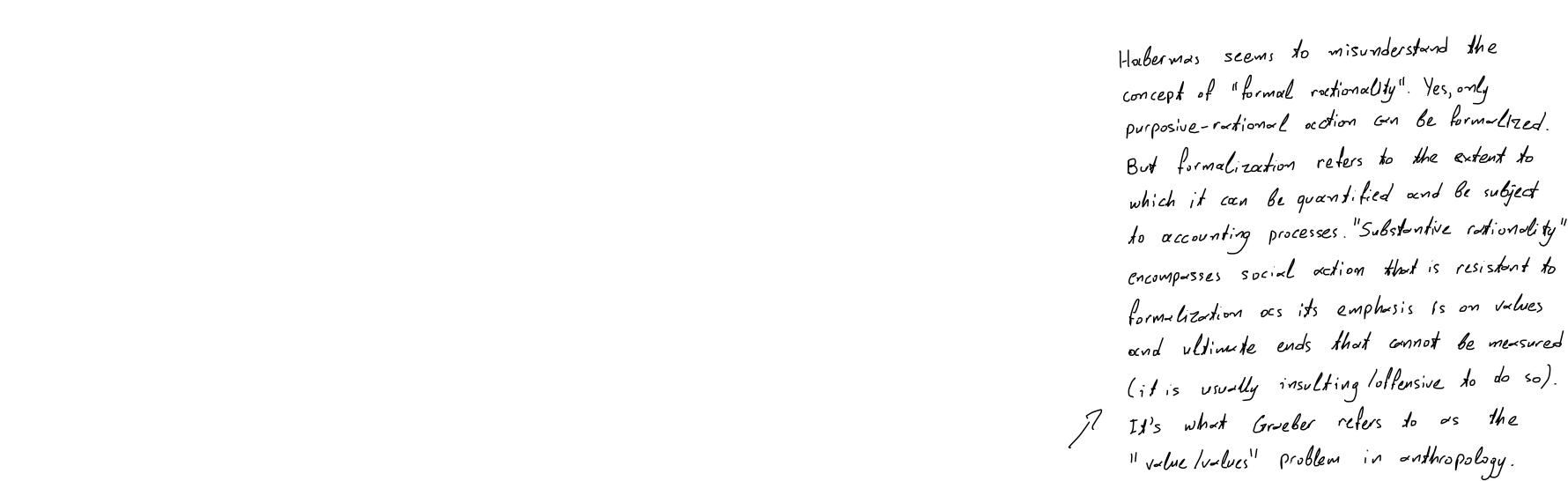
The term "formal rationality of economic action" will be used to designate the extent of quantitative calculation or accounting which is technically possible and which is actually applied. The "substantive rationality," on the other hand, is the degree to which the provisioning of given groups of persons (no matter how delimited) with goods is shaped by economically oriented social action under some criterion (past, present, or potential) of ultimate values (weriende Postulate), regardless of the nature of these ends. These may be of a great variety. […] A system of economic activity will be caned "formally” rational according to the degree in which the provision for needs, which is essential to every rational economy, is capable of being expressed in nu­merical, calculable terms, and is so expressed. The concept of "substantive rationality," on the other hand, is full of ambiguities. It conveys only one element common to all "substantive" analyses: namely, that they do not restrict themselves to note the purely formal and (relatively) unambiguous fact that action is based on "goal­ oriented" rational calculation with the technically most adequate availa­ble methods, but apply certain criteria of ultimate ends, whether they be ethical, political, utilitarian, hedonistic, feudal (stiindisch), egalitarian, or whatever, and measure the results of the economic action, however formally "rational" in the sense of correct calculation they may be, against these scales of "value rationality" or "substantive goal rationality”. Weber, Economy and Society, p. 85
A motive is a complex of subjective meaning which seems to the actor himself or to the observer an adequate ground for the conduct in question. The interpretation of a coherent course of, conduct is "sub­jectively adequate" (or "adequate on the level of meaning"), insofar as, according to our habitual modes' of thought and feeling, its component parts taken in their mutual relation are recognized to constitute a "typical" complex of meaning. It is more common to say “correct”. The interpretation of a sequence of events will on the other hand be called causally adequate insofar as, according to established generalizations from experience, there is a probability that it will always actually occur in the same way. An example of adequacy on the level of meaning in this sense is what is, according to our current norms of calculation or thinking, the correct solution of an arithmetical problem. On the other hand, a causally adequate interpretation of the same phenomenon would concern the statistical probability that, according to verified generaliza­tions from experience. there would he a correct or an erroneous solution of the same problem. This also refers to currently accepted norms but includes taking account of typical errors or of typical confusions. Thus causal explanation depends on being able to determine that there is a probability, which in the rare ideal case can be numerically stated, but is always in some sense calculable, that a given observable event (overt or subjective) will be followed. or accompanied by another event. A correct causal interpretation of a concrete course of action is arrived at when the overt action and the motives have both bene correctly appre­hended and at the same time their relation has become meaningfully comprehensible. […] Weber, Economy and Society, p.11-12
Weber’s Focus on the Individual/Subjective Orientation of Social Action
Action in the sense of subjectively understandable orientation of behavior exists only as the behavior of one or more individual human beings. For other cognitive purposes it may he useful or necessary to consider the individual, for instance, as a collection of cells. as a complex of bio-chemical reactions, or to conceive his psychic life as made up of a variety of different elements, however these may be defined. Undoubt­edly such procedures yield valuable knowledge of causal relationships. But the behavior of these elements, as expressed in such uniformities, is not subjectively understandable. This is true even of psychic elements because the more precisely they are formulated from a point of view of natural science, the less they are accessible to subjective understanding. ,This is never the road to interpretation in terms of subjective meaning. On the contrary, both for sociology in the present sense, and for history, the object of cognition is the subjective meaning-complex of action. Weber, Economy and Society, p.13
For still other cognitive purposes - for instance, juristic ones - or for practical ends, it may an the other hand be convenient or even indispensa­ble to treat social collectivities, such as states, associations. business corpora­tions, foundations, as if they were individual persons. Thus they may he treated as the subjects of rights and duties or as the performers of legally significant actions. But for the subjective interpretation of action in socio­ logical work these collectivities must be treated as solely the resultants and modes of organization of the particular acts of individual persons, since these alone can be treated as agents in a course of subjectively understandable action. Nevertheless, the sociologist cannot for his pur­poses afford to ignore these collective concepts derived. from other disciplines. Secondly, the subjective interpretation of action must take account of a fundamentally important fact. These concepts of collective entities which are found both in common sense and in juristic and other technical forms of thought. have a meaning in the minds of individual per­ sons, partly as of something actually existing. partly as something with normative authority. This is true not only of judges and officials, but of ordinary private individuals as well. Actors thus in part orient their action to them, and in this role such ideas have a powerful, often a decisive, causal influence on the course of action of real individuals. This is above all true where the ideas involve normative prescription or pro­hibition. Thus, for instance, one of the important aspects of the existence of a modem state, precisely as a complex of social interaction of individual persons. consists in the fact that the action of various individuals is oriented to the belief that it exists or should exist, thus that its acts and laws are valid in the legal sense. Weber, Economy and Society, p.13
[…] it is the method of the so-called "organic" school of sociology - classical example: Schaffle's brilliant work, Bau und Leben des sozialen Korpers - to attempt to understand social interaction by using as a point of departure the "whole" within which the individual acts. His action and behavior are then interpreted somewhat in the way that a physiologist would treat the role of an organ of the body in the "economy" of the organism, that is from the point of view of the survival of the latter. […] For purposes of sociological analysis two things can be said. First this functional frame of reference is convenient for purposes of practical illustration and for provisional orientation. In these respects. it is not only useful but indispensable. But at the same time if its cognitive value is overestimated and its concepts illegitimately “reified," it can be highly dangerous. Secondly, in certain circumstances this is the only available way of determining just what processes of social action it is important to understand in order to explain a given phenomenon. But this is only the beginning of sociological analysis as here understood. In the case of social collectivities, precisely as distinguished from organisms, we are in a position to go beyond merely demonstrating functional relationships and uniformities. We can accomplish something which is never attain­ able in the natural sciences, namely the subjective understanding of the action of the component individuals. The natural sciences on the other hand cannot do this, being limited to the formulation of causal uniformities in objects and events and the explanation of individual facts by applying them. We do not "understand" the behavior of cells, but can only observe the relevant functional relationships and generalize on the basis of these observations. This additional achievement of explanation by interpretive understanding, as distinguished from 'external observation, is of course attained only at a price - the more hypothetical and fragmentary character of its results. Nevertheless, subjective understand­ ing is the specific characteristic of sociological knowledge. Weber, Economy and Society, p.14-15
A verifiable conception of the state of mind of these social animals accessible to meaningful understanding, would seem to be attainable even as an ideal goal only within narrow limits. How­ ever that may be, a contribution to the understanding of human social action is hardly to be expected from this quarter, On the contrary, in the field of animal psychology, human analogies are and must be continually employed. The most that can be hoped for is, then, that these biological analogies may some day be useful in suggesting significant problems. Weber, Economy and Society, p.17
It is a tremendous misunderstanding to think that an "individualistic" method should involve what is in any conceivable sense an individualistic system of values. It is as important to avoid this error as the related one which confuses the unavoidable tendency of sociological concepts to as­sume a rationalistic character with a belief in the predominance of rational motives, or even a positive valuation of rationalism. Even a socialistic economy would have to be understood sociologically in exactly the same kind of "individualistic" terms; that is, in terms of the action of individuals, the types of officials found in it, as would be the case with a system of free exchange analysed in terms of the theory of mar­ginal utility or a "better," but in this respect similar theory). The real empirical sociological investigation begins with the question: What motives determine and lead the individual members and participants in this socialistic community to behave in such a way that the community came into being in the first place and that it continues to exist? Any form of functional analysis which proceeds from the whole to the parts can accomplish only a preliminary preparation for this investigation­ a preparation, the utility and indispensability of which, if properly car­ried out, is naturalIy beyond question. Weber, Economy and Society, p.18
Social Relationship
The term "social relationship” will be used to denote the behavior of a plurality of actors insofar as, in its meaningful content, the action of each takes account of that of the others and is oriented in these terms. The social relationship thus consists entirely and exclusively in the existence of a probability that there will be a meaningful course of social action - irrespective, for the time being, of the basis for this probability. Thus, as a defining criterion, it is essential that there should be at least a minimum of mutual orientation of the action of each to that of the others. Its content may be of the most varied nature: conflict, hostility, sexual attraction, friendship, loyalty, or economic exchange. It may involve the fulfillment, the evasion, or the violation of- the terms of an agreement; economic, erotic, or some other form of "competition"; common membership in status, national or class groups (provided it leads to social action). Hence, the definition does not specify whether the relation of the actors is co-operative or the opposite. The "meaning" relevant in this context is always a case of the meaning imputed to the parties in a given concrete case, on the average, or in a theoretically formulated pure type - it is never a normatively "correct" or a metaphysically "true" meaning. Weber, Economy and Society, p.26-27
The subjective meaning need not necessarily be the same for all the parties who are mutually oriented in a given social relationship; there need not in this sense be "reciprocity." "Friendship," "love," ‘loyalty," "fidelity to contracts," "patriotism," on One side, may well be faced with an entirely different attitude on the other. In such cases the parties associate different meanings with their actions, and the social relationship is insofar objectively "asymmetrical" from the points of view of the two parties. It may nevertheless be a case of mutual orientation insofar as, even though partly or wholly erroneously, one party pre­sumes a particular attitude toward him on the part of the other and orients his action to this expectation. This can, and usually will, have consequences for the course of action and the form of the relationship. Weber, Economy and Society, p.27
A social relationship can be of a very fleeting character or of varying degrees of permanence. In the latter case there is a probability of the repeated recurrence of the behavior which corresponds to its sub­jective meaning and hence is expected. In order to avoid fallacious im­pressions, let it repeated that it is only the existence of the probability that, corresponding to a given subjective meaning, a certain type of action will take place which constitutes the "existence" of the social relationship. Thus that a "friendship" or a "state" exists or has existed means this and only this: that we, the observers, judge that there is or has been a probability that on the basis of certain kinds of known subjective attitude of certain individuals there will result in the average sense a certain specific type of action. The subjective meaning of a social relationship may change, thus a political relationship once based on solidarity may develop into a conflict of interests. In that case it is only a matter of terminological convenience and of the degree of continuity of the change whether we say that a new relationship has come into existence or that the old one continues but has acquired a new meaning. It is also possible for the meaning to he partly constant, partIy changing. Weber, Economy and Society, p.28
The meaning of a social relationship may be agreed upon by mutual consent. This implies that the parties make promises covering their future behavior, whether toward each other or toward third per­sons. In such cases each party then normally counts, so far as he acts rationally, in some degree on the fact that the other will orient his ac­tion to the meaning of the agreement. as he (the first actor) under­ stands it. In part he orients his action rationally (zweckrational) to these expectations as given facts with, to be sure, varying degrees of subjec­tively "loyal" intention of doing his part, But in part also he is motivated value-rationally by a sense of duty, which makes him adhere to the agreement as he understands it. This much may be anticipated. Weber, Economy and Society, p.28
Habermas’ Reconstruction of Weber’s Rationality
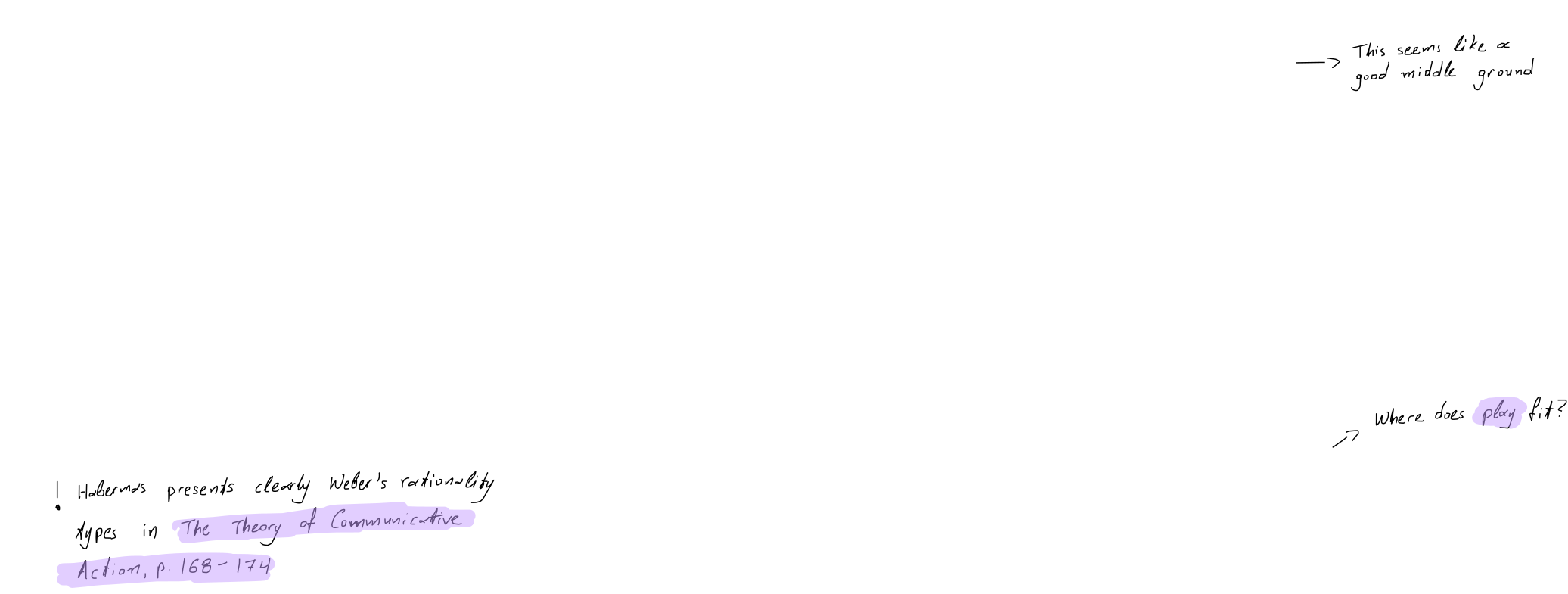
Weber reminds us again and again that "rationalism" may mean very different things. "It means one thing if we think of the kind of rationalization the systematic thinker performs on the image of the world: an increasing theoretical mastery of reality by means of increasingly precise abstract concepts. Rationalism means another thing if we think of the methodical attainment of a definite, given, practical end by way of an increasingly precise calculation of the adequate means. These types of rationalism are very different, in spite of the fact that ultimately they belong inseparably together. To begin with, then, Weber draws a distinction between theoretical and practical mastery of reality. Of course, he is chiefly interested in practical rationality, in the sense of the standards according to which acting subjects learn to control their environment. Habermas, The Theory of Communicative Action, vol 1, p.168
Weber starts with a broad concept of "technique" [Technik] in order to make clear that the aspect of regulated employment of means, in a very abstract sense, is relevant to the rationality of behavior. "Rational technique" is a use of means "consciously and systematically oriented to experience and reflection. […] Every rule or system of rules that permits reliably reproducible action, whether methodical or customary, that can be predicted by participants in interaction and calculated from the perspective of the observer, is a technique in this sense. "Thus there are techniques of every conceivable type of action: techniques of prayer, of asceticism, of thought and research, of memorizing, of education, of exercising political or hierocratic domination, of administration, of making love, of making war, of musical performances, of sculpture and painting, of arriving at legal decisions. And all these are capable of the widest variation in degree of rationality. The presence of a "technical question always means there is some doubt over the choice of the most rational means to an end”. In this sense, then, even mystical illumination, which is objectively not testable, and the ascetic mastery of desires and emotions have been "rationalized." The only criterion by which "technical" rationalization in the broadest sense is measured is the rule-governedness of reproducible behavior to which others can adapt themselves in a calculating manner. Weber qualifies this broad meaning of "technique" and "rationalization of means" by way of specifying the means. If we consider only means with which an acting subject can realize set ends through intervention in the objective world, the evaluative criterion of success comes into play. The rationality of employing means is measured by the objectively testable efficacy of an intervention (or of a purposeful omission). This permits us to distinguish between "subjectively purposive-rational" and "objectively correct" actions. We can also speak of a "progressive rationality of means" in an objective sense. "If human behavior (of whatever kind) becomes in any respect 'more correctly' oriented from a technical point of view, then we have a 'technical advance.'" This concept of technique is also a broad one; it extends not only to instrumental rules for mastering nature, but also to rules for artistically mastering materials, or, for example, to techniques for 'dealing with human beings politically, socially, educationally, propagandistically.’ We can speak of techniques in this sense whenever the ends that can be causally realized with their help are conceived as elements of the objective world. Even social techniques can apply to social relations, interactions, arrangements, and symbols only if these are presupposed in an objectivating attitude as items of possible manipulation. 'In the special area usually referred to as 'technology,' but also in the areas of commercial techniques and legal techniques, we can speak of 'progress' (in the sense of the progressive technical rationality of means), if we take as our starting point a clearly determined state of a concrete structure." Habermas, The Theory of Communicative Action, vol 1, p.169-170
So far Weber is considering rationality only from the standpoint of employing means. He then differentiates this concept by distinguishing two aspects of the rationality of goal-directed actions: not only the means and the way they are applied can be more or less rational, i.e., effective in relation to given ends; even the ends themselves can be more or less rational, i.e., chosen correctly, in an objective sense, in view of given values, means, and boundary conditions. To the conditions of purposive-rational action there belongs not only an instrumental rationality of means, but a rationality of choice in setting ends selected in accord with values. From this standpoint an action can be rational only to the degree that it is not blindly controlled by affects or guided by sheer tradition. "One essential aspect of the 'rationalization' of action is the replacement of the unthinking acceptance of ancient customs by deliberate adaptation to situations in terms of self-interest." Such rationalization can take place at the expense of affectual as well as of traditional action. Habermas, The Theory of Communicative Action, vol 1, p.170
The important distinction between formal and substantive rationality belongs in this context. Weber's own formulations are not very clear. Formal rationality relates to the decisions of subjects acting rationally as regards choice, subjects who try to pursue their interests in accord with clear preferences and given decision maxims, paradigmatically in economic action. "The term "formal rationality of economic action" will be used to designate the extent of calculation that is technically possible and actually applied… The concept of "substantive-rationality," on the other hand … conveys only … that certain demands are made, be they ethical, political, utilitarian, hedonistic, feudal [standisch], egalitarian, or whatever, and that the results of the economic action—however formally "rational," i.e., calculated, it may be - are measured against these in respect to value-rationality or substantive purposive rationality.” As soon as subjects are released from the bonds of tradition or from control by affects, to the extent that they become con- scious of their preferences and can choose their goals on the basis of clarified preferences, action can be evaluated from two points of view: from the instrumental standpoint of efficacy of means and from the standpoint of the correctness with which goals are inferred in view of given preferences, means, and boundary conditions. Weber calls these two aspects of instrumental ration- ality and the rationality of choice, taken together, "formal rationality," in contradistinction to substantive evaluation of the value systems underlying the preferences. From the standpoint of formal rationality, we can demand only that the actor be aware of his preferences, that he make precise the underlying values and check them for consistency, that he place them, if possible, in a transitive ordering, and so on. In normative questions Weber is a sceptic; he is convinced that the decision between different value systems (however clarified analytically) cannot be grounded, cannot be rationally justified. Strictly speaking there is no rationality of value postulates or belief systems as regards their content. Nevertheless, the way in which the actor grounds his preferences, in which he is oriented to values, is for Weber an aspect under which an action can be viewed as rationalizable. "Actions are purely value-rational when the agents, regardless of foreseeable consequences, act according to their convictions of what seems to them to be required by duty, honor, beauty, a religious call, piety, or the importance of some 'cause,' no matter in what it consists. Value-rational action is always action in accordance with 'commands' or 'demands' which the actor believes himself to be placed under." The rationality of the values underlying action preferences is not measured by their material content but by formal properties, that is, by whether they are so fundamental that they can ground a mode of life based on principles. Only values that can be abstracted and generalized into principles, internalized largely as formal principles, and applied procedurally, have so intensive a power to orient action that they can cut across various particular situations and, in the extreme case, systematically penetrate all spheres of life and bring an entire biography, or even the history of social groups, under a unifying idea. Habermas, The Theory of Communicative Action, vol 1, p.170-172
Weber differentiates the concept of practical rationality from the three perspectives of employing means, setting ends, and being oriented to values. The instrumental rationality of an action is measured by effective planning of the application of means for given ends; the rationality of choice of an action is measured by the correctness of the calculation of ends in the light of precisely conceived values, available means, and boundary conditions; and the normative rationality of an action is measured by the unifying, systematizing power and penetration of the value standards and the principles that underlie action preferences. Weber calls actions that satisfy the conditions of rationality of means and choice "purposive-rational," and those that satisfy the conditions of normative rationality "value-rational." These two aspects can vary independently. Advances in the dimension of purposive rationality can "take place in favor of a morally sceptical, purely purposive-rational type of action, [and] at the expense of action tied to value-rationality." In fact it is in this direction that rationalized Western culture seems to be developing. The combination of purposive-rational and value-rational action yields a type of action that satisfies the conditions for practical rationality in its entirety. When persons and groups generalize this type over time and across social spheres, Weber speaks of a methodical-rational conduct of life. […] The methodically rational conduct of life is distinguished by the fact that it establishes the complex type of action which aims at rationality and its increase under all three aspects and that combines these rationality structures with one another so that they are mutually stabilizing, in that successes in one dimension in part presuppose, in part stimulate, successes in the other dimensions. Methodically rational conduct of life makes possible and places a premium upon the success of action simultaneously 1. From the standpoint of instrumental rationality, in the solution of technical tasks and in the construction of effective means; 2. From the standpoint of the rationality of choice, in the consistent choice among alternative lines of action (we speak of strategic rationality when the decisions of rational opponents must be considered in the process); and finally 3. From the standpoint of normative rationality, in the solution of moral-practical tasks within the framework of an ethic of principle. Different categories of knowledge can be coordinated with these three aspects of the rationality of action. Both empirical and analytical knowledge enter into the orientations of purposive-rational action via techniques and strategies; this knowledge can in principle take the precise form of scientifi-cally corroborated knowledge. On the other hand, moral- practical knowledge (as well as aesthetic-expressive knowledge) enter into the orientations of value-rational action through competences and motives; this knowledge is rendered precise and improved at two stages of development: first within religious worldviews, later within the framework of the autonomous value spheres of law, morality, and art. Habermas, The Theory of Communicative Action, vol 1, p.172-173
The term "formal rationality of economic action" will be used to designate the extent of quantitative calculation or accounting which is technically possible and which is actually applied. The "substantive rationality," on the other hand, is the degree to which the provisioning of given groups of persons (no matter how delimited) with goods is shaped by economically oriented social action under some criterion (past, present, or potential) of ultimate values (weriende Postulate), regardless of the nature of these ends. These may be of a great variety. […] A system of economic activity will be caned "formally” rational according to the degree in which the provision for needs, which is essential to every rational economy, is capable of being expressed in nu­merical, calculable terms, and is so expressed. The concept of "substantive rationality," on the other hand, is full of ambiguities. It conveys only one element common to all "substantive" analyses: namely, that they do not restrict themselves to note the purely formal and (relatively) unambiguous fact that action is based on "goal­ oriented" rational calculation with the technically most adequate availa­ble methods, but apply certain criteria of ultimate ends, whether they be ethical, political, utilitarian, hedonistic, feudal (stiindisch), egalitarian, or whatever, and measure the results of the economic action, however formally "rational" in the sense of correct calculation they may be, against these scales of "value rationality" or "substantive goal rationality”. Weber, Economy and Society, p. 85
Weber has at his disposal a complex concept of practical rationality that takes the coordination of purposive-rational and value-rational aspects of action as its point of departure. Nevertheless, on the other hand, Weber considers societal rationalization explicitly from the perspective of purposive-rationality. At the level of institutions, he does not apply the comprehensive concept of rationality upon which he bases his investigations of cultural tradition. Only the cognitive-instrumental complex of rationality acquires significance for the rationality of action systems. At the level of the economic and political subsystems, only the aspect of purposive-rational, and not that of value-rational action is supposed to have structure-forming effects. From Weber's sociology of the economy, state, and law, one gets the impression that in modern societies rationalization processes attach only to empirical-theoretical knowledge and to the instrumental and strategic aspects of action, whereas practical rationality cannot be institutionalized independently, that is, with an inner logic specific to a subsystem. Habermas, The Theory of Communicative Action, Vol.1, p.254