The difference between Marxism and utopian socialism does not, then, rest on the existence or otherwise of an image of the socialist society to be attained, nor even on the content of that image. It rests upon disagreements about the process of transition. Even here the question of who is most utopian in the sense of unrealistic is a matter of dispute. Martin Buber, in Paths in Utopia, defends the orientation of utopian socialism (including not just Saint-Simon, Fourier and Owen, but Proudhon, Kropotkin and Landauer) to this problem. Buber’s argument is that a ‘society is naturally composed not of disparate individuals but of associative units’, and that the health of a society depends on the density of voluntary associations that constitute it; capitalist society is thus ‘a society inherently poor in structure and growing visibly poorer every day’. The strength of utopian socialism is that it addressed itself to the issue of ‘a renewal of society through a renewal of its cell-tissue’, and aimed to ‘substitute society for State to the greatest degree possible’. Buber argues that neither Marx nor Engels gave sufficient attention to the process of social restructuring, in spite of the assertion that the new society matures in the womb of the old. Organic restructuring necessitates the development of a network of cooperative settlements which go beyond simple consumer or producer cooperatives – as in the Israeli kibbutzim.
[…]
His arguments in favour of cooperative settlements rest upon a recognition that the social relations of production lie at the root of the character of society. His claim, however, is that the post-revolutionary leap and the dictatorship of the proletariat involve a contradiction between means and ends which is not present in utopian socialism. The so-called utopian does not believe in this post-revolutionary leap, but in ‘continuity within which revolution is only the accomplishment, the setting free and extension of a reality that has already grown to its true possibilities’. In Buber’s view the ‘utopian’ approach to the problem is more realistic, since it is difficult to see how the centralisation of the first phase of socialism will give way to full communism. In other words, the expectation that the state will somehow wither away is itself utopian, i.e. unrealistic.
Levitas, The Concept of Utopia, p.53
But what is most striking, for the time being, is not the arrogance of empire, but rather the weakness of the counter-attack. Like a colossal paralysis. A mass paralysis, which will sometimes cause people to say that nothing can be done, but who will sometimes concede, when pushed to their limit, that “there is so much to do” — which isn’t any different.
Anonymous, Call, p.3
The We that speaks here is not a definable, isolated We, the We of a group. It is the We of a position. This position is asserted currently as a double secession: first a secession from the process of capitalist valorization, then secession from all the sterility imposed by a mere opposition to empire (extra-parliamentary or otherwise); a secession therefore from the Left. Here secession means less a practical refusal to communicate than a disposition to forms of communication so intense that, when put into practice, they snatch from the enemy most of its power. To put it briefly, such a position borrows sudden force from the Black Panthers, collective dining halls from the German Autonomen, tree houses and the art of sabotage from the British neo-Luddites, the careful choice of words from radical feminists, mass self-reductions from the Italian autonomists, and armed joy from the June 2nd Movement.
Anonymous, Call, p.5
Nothing that is expressed in the known distribution of political identities is able to lead beyond the disaster.
Therefore, we begin by withdrawing from them. We contest nothing, we demand nothing. We constitute ourselves as a force, as a material force, as an autonomous material force within the Global Civil War.
Anonymous, Call, p.6
When they see us withdraw from the painful rituals of classical politics — the general assembly, the meeting, the negotiation, the protest, the demand — when they hear us speak about the perceptible realm rather than about work, IDs, pensions, or freedom of movement, militants give us a pitying look. “Poor guys,” they seem to say, “they are resigning themselves to minority politics, they have retreated into their ghetto, and renounced any widening of the struggle. They will never be part of a movement.” But we believe exactly the opposite: it is they who resign themselves to minority politics by speaking their language of false objectivity, whose gravity consists of nothing more than repetition and rhetoric. Nobody is fooled by the veiled contempt with which they talk about the worries of The People, and which allows them to go from the unemployed person to the illegal immigrant, from the striker to the prostitute without ever putting themselves at risk — their contempt is that obvious. Their will to widen the struggle is nothing but a way to flee from those who are already there, and, above all, from those they would dread living with. And finally, it is they who are loath to admit the political meaning of sensitivity, who have to rely on sentimentality as their pitiful driving force. All in all, we prefer to start from small and dense nuclei than from a vast and loose network. We are familiar enough with that spinelessness.
Anonymous, Call, p. 8
Those who would respond to the urgency of the situation with the urgency of their reaction only add to the suffocation.
Their manner of intervention, of their agitation, points to the rest of their politics.
That it might take a generation to build a victorious revolutionary movement in all its breadth does not cause us to retreat. We think about this with serenity.
Anonymous, Call, p.9
We know that building a power of any scale will take time. There are many things that we no longer know how to do. In fact, those of us who benefit from the modernization and the education dispensed in our developed lands barely know how to make anything ourselves. Even gathering plants for cooking or medicine — rather than merely for decoration — is regarded as archaic at best, at worst as a nice hobby.
We make a simple observation: everyone has access to a certain quantity of resources and knowledge made available by the simple fact of living in these lands of the old world, and we can communize them.
The question is not whether to live with or without money, to steal or to buy, to work or not, but how to use the money we have to increase our autonomy from the commodity sphere. And if we prefer to steal instead of working, or produce for ourselves instead of stealing, it is not due to a concern with purity. It is because the flows of power that accompany the flows of commodities, the subjective submission that conditions our access to survival, have become too expensive.
There would be many inappropriate ways to express what we envision: we neither want to leave for the countryside nor reappropriate and accumulate ancient knowledge. We are not merely concerned with a reappropriation of methods. Nor with a reappropriation of knowledge. If we put together all that knowledge, those techniques, and all the inventiveness displayed in the field of activism, we would still not get a revolutionary movement. It is a question of temporality. A question of creating the conditions where an offensive can sustain itself without fading away, of establishing the material solidarities that allow us to maintain it.
We believe there is no revolution without the constitution of a common material force. We do not ignore the anachronism of this belief. We know it is both too early and too late, which is why we have time. We have stopped waiting.
Anonymous, Call, p.11-12
We set the point of reversal, the way out of the desert, the end of Capital, in the intensity of the link that each person manages to establish between what she thinks and how she lives. Contrary to the upholders of Existential Liberalism, we refuse to view this as a private matter, an individual issue, a question of character. On the contrary, we start from the certainty that this link depends on the construction of shared realms, of placing effective methods in common.
Anonymous, Call, p.13
These are so-called ethical questions which must of course be asked and above all, they are those that we find at the very heart of the political: how to respond to emotional neutralization and to the potential effects of decisive thoughts? And also: how do modern societies work with these neutralizations, or rather, how are they made into essential cogs in its continual functioning? How does the material effectiveness of the empire relate to our predisposition toward giving up, regardless of our collective experiences?
Anonymous, Call, p.15
On the subject of strategy, we have learned all the lessons from the tradition of the defeated. We remember the beginnings of the labor movement. The lessons are near to us.
Because what was put into practice in its initial phase relates directly to how we are living, to what we want to put into practice today. The building up of what was to be in force called the labor movement first rested on the sharing of criminal practices. The secret strike funds, the acts of sabotage, the secret societies, the class violence, the first forms of unemployment insurance seen in the recovery of individual clearheadedness, that were developed with the consciousness of their illegal and antagonistic nature.
Anonymous, Call, p.18
In Europe, the integration of workers’ organizations into the state management apparatus — the foundation of social democracy — was paid for with the renunciation of the least ability to be a nuisance. Here too the emergence of the labor movement was a matter of material solidarities, of an urgent need for communism. The Maisons du Peuple were the last refuges for this confusion between the need for immediate communization and the strategic requirements of a practical implementation of the revolutionary process. The labor movement then developed as a progressive separation between the co-operative current, an economic niche cut off from its strategic raison d’être, and the political and union forms working on the terrain of electoralism or joint management. It is from the abandonment of any secessionist aim that this absurdity was born: the Left. The climax is reached when unionists denounce any resort to violence, loudly proclaiming to all who wish to hear it, that they will collaborate with the cops to control rioters.
Anonymous, Call, p.18
There is a general context — capitalism, civilization, empire, as you wish — a general context that not only intends to control each situation but, even worse, seeks a way to make sure as often as possible, that there is no situation. They have planned out streets and homes, language and emotions, even the global tempo that drives all of it, only for that purpose. Everywhere different realms are made to slide by each other and be ignored. The normal situation is this absence of a situation.
To get organized means: to get out of the situation and not merely challenge it. To take sides within it. Weaving the necessary material, emotional, and political solidarities. This is what any strike does in any office, in any factory. This is what any gang does. Any underground; any revolutionary or counter-revolutionary party. To get organized means: to give substance to the situation. Making it real, tangible.
Reality is not capitalist.
Our position within a situation determines our need to become allies, and for that reason to establish some lines of communication, some wider current or tendency. In turn those new links reconfigure the situation.
Anonymous, Call, p.5
The practice of communism, as we live it, we call The Party. When we overcome an obstacle together or when we reach a higher level of sharing, we say that we are “building the Party.” Certainly others, unknown to us at present, are building the Party elsewhere. This call is addressed to them. No experience of communism at the present time can survive without getting organized, tying oneself to others, taking sides in crises, waging war. “For the oases that dispense life are wiped out when we seek refuge in them.”
As we understand it, the process of instituting communism can only take the form of a collection of acts of communization, of making common such-and-such space, such-and-such contraption, such and-such knowledge. That is to say, the elaboration of the mode of sharing that attaches to them. Insurrection itself is merely an accelerator, a decisive moment in this process. As we intend it, the Party is not an organization — where everything becomes insubstantial by dint of transparency, and it is not a family — where everything smells like a con by dint of opacity.
The Party is a collection of places, infrastructures, communized methods, and the dreams, bodies, murmurs, thoughts, desires that circulate among those places; the use of those methods, the sharing of those infrastructures.
Anonymous, Call, p.22
From every side we oppose the extortion of having to choose between the offensive and the constructive, negativity and positivity, life and survival, war and the everyday. We will not respond to it. We understand only too well how this dismembering alternative splits and re-splits all existing collectives. For a force which is deployed, it is impossible to say if the annihilation of a device that harms it is a constructive or offensive matter, if achieving dietary or medical autonomy constitutes an act of war or subtraction. There are circumstances, like in a riot, in which the ability to heal our comrades considerably augments our ability to wreak havoc. Who can say that arming ourselves would not be part of the material constitution of a collectivity? When we agree on a common strategy, there is no choice between the offensive and the constructive; obviously there exists, in every situation, what increases our power and what harms it, what is opportune and what is not. And when the evidence is lacking, there is discussion, and in the worst case, there is gambling.
In a general way, we do not see how anything else but a force, a reality able to survive the total dislocation of capitalism could truly attack it, up to the very moment of its dislocation.
When that moment comes, it will be a matter of actually turning the generalized social collapse to our advantage, to transform a collapse (like the Argentine or the Soviet) into a revolutionary situation. Those who pretend to separate material autonomy from the sabotage of the Imperial machine show that they want neither.
Anonymous, Call, p.23
As social cybernetization progresses, the normal situation becomes more urgent. As a consequence, situations of crisis and malfunction multiply in a completely logical way. From the point of view of Empire, a power failure, a hurricane, or a social movement are all the same. They are disturbances. They must be managed. For now, meaning on account of our weakness, these situations of interruption appear as moments in which Empire pops up, takes its place in the materiality of worlds, experiments with new managerial procedures. It is precisely there that it attaches itself more firmly to the populations it claims to assist. Empire always devotes itself to being the agent of returning the situation to normal. Our task, conversely, is to make the situation of exception livable. We will genuinely succeed in blocking corporate society only on condition that such a blockage is filled with desires other than those for a return to normal.
What takes place during a strike or during a natural disaster is, in a way, quite similar: a in- terruption of the organized stability of our dependencies. The existence of need (the communist essence) — that which essentially binds us and essentially separates us — is laid bare during each of them. The blanket of shame that normally covers it is torn up. Receptiveness for encounters, for experimentation with other relations to the world, to others, to oneself, as it manifests in these moments, is enough to sweep away any doubt about the possibility of communism. About the need for communism as well. What is now required is our ability to self-organize, our ability (by immediately organizing ourselves on the basis of our needs) to prolong, extend, and ultimately render the situation of exception effective, against the terror upon which Imerial power rests.
Anonymous, Call, p.26
Up till now in all social movements, there has been a prejudice to avoid seizing the time, which explains why they are never able to get together; rather they seem to chase each other away. Hence the particular texture, so volatile, of their sociality, where any commitment appears revocable. Hence also their invariable dramatic arc: a quick ascent thanks to some popular resonance highlighted in the media; next, due to this hasty aggregation, a slow but inevitable erosion; and finally, the dried up movement, the last handful of diehards who get a card from this or that union, found this or that association, thereby hoping to find an organizational continuity to their commitment. But we are not looking for such continuity: having premises where we might meet, and a photocopier to print leaflets. The continuity we seek is the one which allows us, after having struggled for months, not to go back to work, not to start working again as before, to keep doing harm. And this can only be built during movements. It is a matter of putting into place an immediate, material sharing, the construction of a real revolutionary war machine, the construction of the Party.
We must, as we were saying, organize ourselves on the basis of our needs — to manage to answer in turn the collective questions of eating, sleeping, thinking, loving, creating forms, coordinating our forces — and conceive all this as an opportunity in the war against Empire.
It is only in this way, by inhabiting the disturbances of its very program, that we will be able to counter that economic liberalism which is only the strict consequence, the logical application, of the Existential Liberalism that is accepted and practiced everywhere. To which each one is attached as if it were the most basic right, including those who would like to challenge Neo- Liberalism. This is the way the Party will be built; as a trail of habitable places left behind by each situation of exception that Empire encounters. We will not fail to notice, then, how the subjectivities and the revolutionary collectives become less flakey, as they show what they’re really made of.
Anonymous, Call, p.26-27
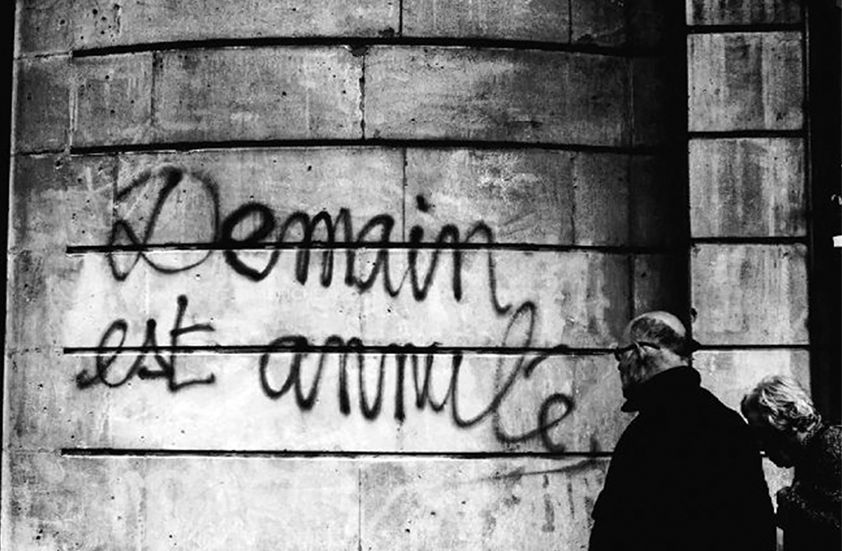
Hope. Now there's at least one disease this civilization has not infected us with. We're not despairing for all that. No one has ever acted out of hope. Hope is of a piece with waiting, with the refusal to see what is there, with the fear of breaking into the present - in short, with the fear of living. To hope is to declare one self in advance to be without any hold on that from which something is expected nonetheless. It's to remove oneself from the process so as to avoid any connection with its outcome. It's wanting things to be different without embracing the means for this to come about. It's a kind of cowardice. One has to know what to commit to and then commit to it. Even if it means making enemies. Or making friends. Once we know what we want, we're no longer alone, the world repopulates. Everywhere there are allies, closenesses, and an infinite gradation of possible friendships. Nothing is close for someone who floats. Hope, that very slight but constant impetus toward tomorrow that is communicated to us day by day, is the best agent of the maintenance of order. We're daily informed of problems we can do nothing about, but to which there will surely be solutions tomorrow. The whole oppressive feeling of powerlessness that this social organization cultivates in everyone is only an immense pedagogy of waiting. It's an avoidance of now. But there isn't, there's never been, and there never will be anything but now. And even if the past can act upon the now, this is because it has itself never been anything but a now. Just as our tomorrow will be. The only way to understand something in the past is to under stand that it too used to be a now. It's to feel the faint breath of the air in which the human beings of yesterday lived their lives. If we are so much inclined to flee from now, it's because now is the time of decision. It's the locus of the "I accept" or the "I refuse," of ''I'll pass on that" or ''I'll go with that." It's the locus of the logical act that immediately follows the perception. It is the present, and hence the locus ofpresence. It is the moment, endlessly renewed, of the taking of sides. Thinking in distant terms is always more comfortable. "In the end," things will change; "in the end," beings will be transfigured. Meanwhile, let's go on this way, let's remain what we are. A mind that thinks in terms of the future is incapable of acting in the present. It doesn't seek transformation; it avoids it. The current disaster is like a monstrous accumulation of all the deferrals of the past, to which are added those of each day and each moment, in a continuous time slide. But life is always decided now, and now, and now.
Everyone can see that this civilization is like a train rolling toward the abyss, and picking up speed. The faster it goes, the more one hears the hysterical cheers of the boozers in the discotheque car. You have to listen carefully to make out the paralyzed silence of the rational minds that no longer understand anything, that of the worriers who bite their nails, and the accent of false calm in the exclamations of the card players who wait. Inwardly, many people have chosen to leap off the train, but they hesitate on the footboard. They're still restrained by so many things. They feel held back because they've made the choice, but the decision is lacking. Decision is what traces in the present the manner and possibility of acting, of making a leap that is not into the void. We mean the decision to desert, to desert the ranks, to organize, to undertake a secession, be it imperceptibly, but in any case, now.
The epoch belongs to the determined.
The Invisible Committee, Now, p.16-18
Against the possibility of communism, against any possibility of happiness, there stands a hydra with two heads. On the public stage each one of them makes a show of being the sworn enemy of the other. On one side, there is the program for a fascistic restoration of unity, and on the other, there is the global power of the merchants of infrastructure-Google as much as Vinci, Amazon as much as Veolia. Those who believe that it's one or the other will have them both. Because the great builders of infrastructure have the means for which the fascists only have the folkloric discourse. For the former, the crisis of the old unities is primarily the opportunity for a new unification. In the contemporary chaos, in the crumbling of institutions, in the death of politics, there is a perfectly profitable market for the infrastructural powers and for the giants of the Internet. A totally fragmented world remains completely manageable cybernetically. A shattered world is even the precondition for the omnipotence of those who manage its channels of communication. The program of these powers is to deploy behind the cracked facades of the old hegemonies a new, purely operational, form of unity, which doesn't get bogged down in the ponderous production of an always shaky feeling of belonging, but operates directly on "the real," reconfiguring it. A form of unity without limits, and without pretentious, which aims to build absolute order under absolute fragmentation. An order that has no intention of fabricating a new phantasmal belonging, but is content to furnish, through its networks, its servers, its highways, a materiality that is imposed on everyone without any questions being asked. No other unity than the standardization of interfaces, cities, landscapes; no other continuity than that of information. The hypothesis of Silicon Valley and the great merchants of infrastructure is that there's no more need to tire oneself out by staging a unity of facade: the unity it intends to construct will be integral with the world, incorporated in its networks, poured into its concrete. Obviously we don't feel like we belong to a "Google humanity," but that's fine with Google so long as all our data belong to it. Basically, provided we accept being reduced to the sad ranks of"users," we all belong to the cloud, which does not need to proclaim it. To phrase it differently, fragmentation alone does not protect us from an attempt to reunify the world by the "rulers of tomorrow": fragmentation is even the prerequisite and the ideal texture for such an initiative. From their point of view, the symbolic fragmentation of the world opens up the space for its concrete unification; segregation is not contradictory to the ultimate networking. On the contrary, it gives it its raison d'etre.
The necessary condition for the reign of the GAFA (Google, Apple, Facebook, Amazon) is that beings, places, fragments of the world remain without any real contact. Where the GAFA claim to be "linking up the entire world" what they're actually doing is working toward the real isolation of everybody. By immobilizing bodies. By keeping everyone cloistered in their signifying bubble. The power play of cybernetic power is to give everyone the impression that they have access to the whole world when they are actually more and more separated, that they have more and more "friends" when they are more and more autistic. The serial crowd of public transportation was always a lonely crowd, but people didn't transport their personal bubble along with them, as they have done since smartphones appeared. A bubble that immunizes against any contact, in addition to constituting a perfect snitch. This separation engineered by cybernetics pushes in a non-accidental way in the direction of making each fragment into a little paranoid entity, towards a drifting of the existential continents where the estrangement that already reigns between individuals in this "society" collectivizes ferociously into a thousand delirious little aggregates. In the face of all that, the thing to do, it would seem, is to leave home, take to the road, go meet up with others, work towards forming connections, whether conflictual, prudent, or joyful, between the different parts of the world. Organizing ourselves has never been anything else than loving each other.
The Invisible Committee, Now, p. 46-49

For us, therefore, communism is not a finality. There is no "transition" towards it. It is transition entirely: it is en chemin, in transit. The different ways of living will never cease to chafe and move against each other, to clash with and occasionally combat each other. Everything will always have to be rethought. There are bound to be the usual Leninists who will reject an immanent conception of communism such as this, by citing the necessity of a vertical, strategic articulation of the struggle, and an instant later we're sure to hear the lumbering "question of organization." The "question of organization" is still and always the Leviathan. In a time when the apparent unity of the Self can no longer mask the chaos of forces, attachments, and participations that we are, how could we still believe in the fable of organic unity? The myth of "organization" owes everything to the depictions of the hierarchy of natural faculties that were handed down to us by ancient psychology and Christian theology. We are no longer nihilistic enough to think that inside us there is something like a stable psychic organ-a will, let's say-that directs our other faculties. This neat invention of the theologians, much more political than it appears, had a dual purpose: first, to make man, newly provided with a "free will," into a moral subject and to deliver him over in this way to the Last Judgment and the century's punishments; second, based on the theological idea of a God having "freely'' created the world and essentially standing apart from his action, to institute a formal separation between being and acting. For centuries, this separation, which was to mark Western political ideas in a durable way, made ethical realities illegible-the plane of forms-of-life being precisely that of a non differentiation between what one is and what one does. So "the question of organization" exists since those Bolsheviks of Late Antiquity, the Church Fathers. It was the instrument of legitimation of the Church just as it would later be that of the legitimation of the Party. Against this opportunistic question, against the postulated existence of the "will”, it's necessary to emphasize that what "wants" within us, what inclines us, is never the same thing. That it is a simple outcome, crucial at certain moments, of the combat waged within and outside us by a tangled network of forces, affects, and inclinations, resulting in a temporary assemblage in which some force has just as temporarily subdued other forces. That the sequence of these assemblages produces a kind of coherence that may culminate in a form is a fact. But to always label with the same noun something that in a contingent way finds itself in a position to dominate or give the decisive impetus, to convince oneself that it's always a matter of the same authority, to convince oneself finally that every form and every decision are dependent on a decision organ, is to perform quite a trick, but one that's been repeated all too long. By believing in such an organ for such a long time, by stimulating that imaginary muscle over and over again, one ends up in a fatal aboulia that seems nowadays to be afflicting the late offspring of the Christian Empire that we happen to be. In opposition to that, we propose paying careful attention to situations and to the forces that inhabit and traverse beings, in conjunction with an art of decisive assemblages.
The Invisible Committee, Now, p.154-157
The only thing capable of transversally uniting all the elements deserting this society into a historical party is an intelligence of the situation. It is everything that makes the situation gradually understandable, everything that tracks the movements of the adversary, everything that identifies the usable paths and the obstacles-the systematic character of the obstacles. Based on that intelligence, an occasional vertical expedient needed to tilt certain situations in the desired direction can well be improvised.
A strategic verticality of this kind can only emerge from a constant, generous discussion, undertaken in good faith. In this epoch, the means of communication are the forms of organization. It's our weakness, for the means aren't in our hands, and those who control them are not our friends. So there's no other choice but to deploy an art of conversation between worlds that is cruelly deficient, but from which, in contact with the situation, the right decision must emanate. Such a discussion can gain the center, from the periphery where it is currently contained, only through an offensive from the domain of sensibility, on the plane of perceptions, and not of discourse. We're talking about addressing bodies and not just the head.
The Invisible Committee, Now, p.158
[…] like the proletariat, we cannot claim to be unexploitable in the present conditions; the best we can do is to work to make any such exploitation entail the greatest possible risk for the exploiters.
Now, The SI, Internationale Situationniste #9, https://libcom.org/article/now-si
If one does not think of revolution as being a complete miracle, as something that proletarians will achieve in the heat of the moment, almost accidentally, spontaneously, and without any goal set in advance, and if one does not delegate the project of human eman- cipation to the machines, then it would appear reasonable to try and reach some sort of understanding concerning the basic features of a classless society. Several objections to this have been raised: it’s premature (“the struggles aren’t quite there yet, the time isn’t ripe”), unnecessary (“people will take care of it eventually”), pretentious (“you can’t just predetermine it”), or simply impossible (“you can’t anticipate that”). But there’s never been a continuous movement defying the existing order without an idea, however vague, of what could take its place. A purely negative critique of the status quo, which some radical leftists invoke, is ultimately impossible. For example, aiming for “a community of free individuals, carrying on their work with the means of production in common” (Capital) follows necessarily from the critique of private property. But because this leaves a lot of room for imagination — including scenarios that have little to do with freedom and happiness — revolutionaries should state clearly what they want. Not in order to peddle recipes for redemption, but as a contribution to the necessary discussion on how to leave the old world behind. The commune shouldn’t be conceived as something that will put an end to all of humanity’s problems. On the contrary, only after the relations of production have been revolutionized will everything that is today “solved” by blind mediation, domination, and force even begin to appear as a problem requiring a solution. It is in this sense that Walter Benjamin rejected the accusation that he absolutized communism as “the solution for humanity”. On the contrary, he soberly described it as the possibility to “abolish the unproductive pretensions of solutions for humanity by means of the feasible findings of this very system; indeed, to give up entirely the immodest prospect of ‘total’ systems and at least to make the attempt to construct the days of humanity in just as loose a fashion as a rational person who has had a good night’s sleep begins his day”.
Endnotes, Contours of the World Commune, Endnotes #5, p.164-165
Consciousness-raising opens up the possibility of living, not merely theorising about, a collective perspective. It can give us the resources to behave, think and act differently at work (if it makes any sense to talk about being “at” work anymore), where capitalist realism has become second nature. The roots of any successful struggle will come from people sharing their feelings, especially their feelings of misery and desperation, and together attributing the sources of these feelings to impersonal structures, albeit impersonal structures mediated by particular figures to which we must attach populist loathing.
In the harsh conditions of cyberspatialised capitalism — conditions that, as Jennifer M. Silva demonstrates, have produced a “hardening” of the self, especially in the young — consciousness-raising can produce a new compassion, for others and for ourselves. Neurotic-Oedipalising capitalism responsibilises, harshly blaming us, while — in its therapeutic mode — telling us that we have the power as individuals to change anything and everything: if we’re unhappy, it’s up to us to fix it. Consciousness-raising, meanwhile, is about positive depersonalisation: it’s not your fault, it’s capitalism. No individuals can change anything, not even themselves; but collective activation is already, immanently, overcoming individualised immiseration.
[…]
The chief obstruction […] is what, in a trenchant and clear-eyed analysis, Ewa Jasiewicz calls “time poverty”:
"Our time is under attack. Work will be intensified, worse paid, and more casualised — if we don’t have it, we’ll be working to have it; mandatory and supervised job searches and workfare will see people forced to spend their time locked into coerced, computerised distraction. A real, diverse, working class self-representative movement needs to include people facing and living these experiences, but how will that happen when we’re too tied up working?
Access to time and our own labour is key and will determine participation and the ability to organise. If we can’t have our own time to organise, we can’t organise, we can’t meet each other, we cannot find each other. Work and the benefits regime — which is work under different conditions and profit margins — are key sites of struggle. Solidarity will need to step up if we are to win workplace disputes and strikes, refusals of workfare and support for people getting sanctioned, so that people have more control over their time and labour.
All our commons are under attack. The condition of time poverty and its roots — intensification of labour, welfare repression, criminalisation and incarceration — have to be recognised as major obstacles to movement, diversity and power. These obstacles need to be tackled if we want to overcome the ideology of wage labour as a determinant of human value on a popular level.”
The problem is that, in order to struggle against time poverty, the main resource we require is time — a nasty vicious circle that capital, with its malevolent genius, now has... This problem is absolutely immanent — writing this and the other posts I have completed this week has meant that I have fallen enormously behind on my work, which is storing up stress for the next week or so.
The first thing we must do in response to all this is to put into practice what I outlined above: try not to blame ourselves. #Itsnotyourfault We must try to do everything we can to politicise time poverty rather than accept blame as individuals for failing to complete our work on time. The reason we feel overwhelmed is that we are overwhelmed — it isn’t an individual failing of ours; it isn’t because we haven’t “managed our time” properly. However, we can use the scarce resources we already have more effectively if we work together to codify practices of collective re-habituation (setting new rules for our engagement with social media and capitalist cyberspace in general for example).
Mark Fisher & Darren Ambrose, Abandon Hope (Summer is Coming) - Knowing Someone in this Life Feels as Desperate as Me, K-Punk: The Collected and Unpublished Writings of Mark Fisher, 2018, p.593-595

Anti-hegemonic argument: forming temporary assemblages and not more permanent hegemonic ones. Also, priority to affects and multiple “centers” of creating wants within us, as contrasted to the discursive approach of the theory of hegemony.