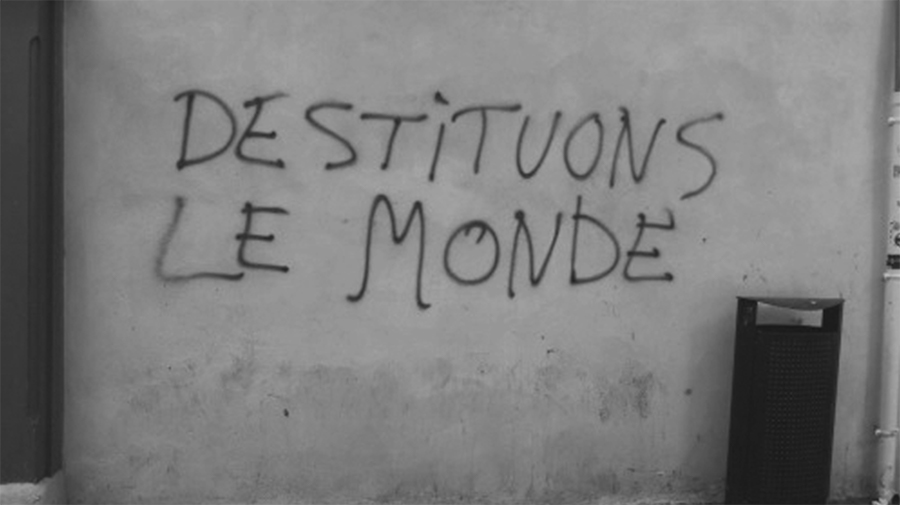
Breaking the circle that turns our contestation into a fuel for what dominates us, marking a rupture in the fatality that condemns revolutions to reproduce what they have driven out, shattering the iron cage of counter-revolution-this is the purpose of destitution. The notion of destitution is necessary in order to free the revolutionary imaginary of all the old constituent fantasies that weigh it down, of the whole deceptive legacy of the French Revolution. […]
Destituere in Latin means: to place standing separate, raise up in isolation; to abandon; put aside, let drop, knock down; to let down, deceive. Whereas constituent logic crashes against the power apparatus it means to take control of, a destituent potential is concerned instead with escaping from it, with removing any hold on it which the apparatus might have, as it increases its hold on the world in the separate space that it forms. Its characteristic gesture is exiting, just as the typical constituent gesture is taking by storm.
The Invisible Committee, Now, p.76, 78-79
Thus, where the "constituents" place themselves in a dialectical relation of struggle with the ruling authority in order to take possession of it, destituent logic obeys the vital need to disengage from it. It doesn't abandon the struggle, it fastens on to the struggles positivity. It doesn't adjust itself to the movements of the adversary but to what is required for the increase of its own potential. So it has little use for criticizing: "The choice is either to get out without delay, without wasting one's time criticizing, simply because one is placed elsewhere than in the region of the adversary, or else one criticizes, one keeps one foot in it, and has the other one outside. We need to leap outside and dance above it," as Jean-Francois Lyotard explained, by way of recognizing the gesture of Deleuze and Guattari's Anti-Oedipus. And Deleuze made this remark: "Roughly speaking, one recognizes a Marxist by their saying that a society contradicts itself, is defined by its contradictions, especially its class contradictions. We say rather is that in a society everything is escaping, that a society is defined by its lines of escape [ . . . ] Escape, but while escaping look for a weapon."
The Invisible Committee, Now, p.79-80
Typically, the operation that the cortege de tete causes the processional setup of union demonstrations to undergo is an operation of destitution. With the vital joy it expressed, the rightness of its gesture, its determination, with its affirmative as well as offensive character, the cortege de tete drew in all that was still lively in the militant ranks and it destituted demonstrations as an institution. Not with a critique of the rest of the march but something other than a symbolic use of capturing the street.
The Invisible Committee, Now, p.80
Withdrawing from the institutions is anything but leaving a void, it's suppressing them in a positive way.
To destitute is not primarily to attack the institution, but to attack the need we have of it. It's not to criticize it-the first critics of the state are the civil servants themselves; as to the militant, the more they criticize power the more they desire it and the more they refuse to acknowledge their desire - but to take to heart what the institution is meant to do, from outside it. To destitute the university is to establish, at a distance, the places of research, of education and thought, that are more vibrant and more demanding than it is-which would not be hard-and to greet the arrival of the last vigorous minds who are tired of frequenting the academic zombies, and only then to administer its death blow. To destitute the judicial system is to learn to settle our disputes ourselves, applying some method to this, paralyzing its faculty of judgment and driving its henchmen from our lives. To destitute medicine is to know what is good for us and what makes us sick, to rescue from the institu tion the passionate knowledges that survive there out of view, and never again to find oneself alone at the hospital, with one's body handed over to the artistic sovereignty of a disdainful surgeon. To destitute the government is to make ourselves ungovernable. Who said anything about winning? Overcoming is everything.
The destituent gesture does not oppose the institution. It doesn't even mount a frontal fight, it neutralizes it, empties it of its substance, then steps to the side and watches it expire. It reduces it down to the incoherent ensemble of its practices and makes decisions about them.
The Invisible Committee, Now, p.80-81
Fernand Deligny said: "In order to fight against language and the institution, the right phrase is perhaps not to fight against, but to take the most distance possible, even if this means signaling one's position.
The Invisible Committee, Now, p.83
Destitution makes it possible to rethink what we mean by revolution. The traditional revolutionary program involved a reclaiming of the world, an expropriation of the expropriators, a violent appropriation of that which is ours, but which we have been deprived of. But here's the problem: capital has taken hold of every detail and every dimension of existence. It has created a world in its image. From being an exploitation of the existing forms of life, it has transformed itself into a total universe. It has configured, equipped, and made desirable the ways of speaking, thinking, eating, working and vacationing, of obeying and rebelling, that suit its purpose. In doing so, it has reduced to very little the share of things in this world that one might want to reappropriate. Who would wish to reappropriate nuclear power plants, Amazon's warehouses, the expressways, ad agencies, high-speed trains, Dassault, La Defense business complex, auditing firms, nanotechnologies, supermarkets and their poisonous merchandise? Who imagines a people's takeover of industrial farming operations where a single man plows 400 hectares of eroded ground at the wheel of his megatractor piloted via satellite? No one with any sense.
The Invisible Committee, Now, p.84-85
The destituent gesture is thus desertion and attack, creation and wrecking, and all at once, in the same gesture. It defies the accepted logics of alternativism and activism at the same time. It forms a linkage between the extended time of construction and the spasmodic time of intervention, between the disposition to enjoy our piece of the world and the disposition to place it at stake.
The Invisible Committee, Now, p.88
During the conflict against the loi Travail, the emergence of what became the "cortege de tete," the lead contingent in marches, was the result of a vision. A few hundred "young people" saw, as early as the first demonstrations, that the union groups were marching like zombies, that they didn't believe a word of the slogans they were mouthing, that their security marshals were clubbing the high-school students, that there was no way to follow that big cadaver, and so it was necessary to claim the front of the demonstration at all costs. Which is what was done. And done again. And again. Until a limit was reached where, with the "cortege de tete" repeating itself, it was no longer a gesture in a situation, but a subject mirrored back in the media, the alternative media in particular. So it was time to desert that desertion, which was congealing and becoming a parody of itself. And to keep moving. That being said, for the whole time it was vibrant, the "cortege de tere" was the locus from which things became clear, the site of a contagion in the ability to see what was going down. From the simple fact that there was struggle, that different determinations were clashing, that forces were joining, allying, separating, that strategies were called into play, and that all this was manifesting in the streets and not just on tele vision, there was a situation.
The Invisible Committee, Now, p.150-151
Faced with capitalist organization, a destituent potential cannot confine itself to its own immanence, to all that grows under the ice in the absence of sunshine, to all the attempts at local construction, to a series of punctual attacks, even if this whole little world were to regularly find itself caught up in great turbulent demonstrations. And the insurrection will definitely not wait for every one to become insurrectionary. The mistake of the Leninists, Trotskyists, Negriists, and other sub politicians, a telling one fortunately, is to believe that a period that sees all the hegemonies lying broken on the ground could still tolerate a political hegemony, even a partisan one of the sort that Pablo Iglesias or Chantal Mouffe fantasize. What they don't see is that in a time of general horizontality, horizontality itself is the verticality. No one can expect to organize the autonomy of others any longer. The only verticality still possible is that of the situation, which commands all of its components because it exceeds them, because the sum of forces in presence is greater than each one of them. The only thing capable of transversally uniting all the elements deserting this society into a historical party is an intelligence of the situation. It is everything that makes the situation gradually understandable, everything that tracks the movements of the adversary, everything that identifies the usable paths and the obstacles-the systematic character of the obstacles. Based on that intelligence, an occasional vertical expedient needed to tilt certain situations in the desired direction can well be improvised.
The Invisible Committee, Now, p.157-158