The ultimate stakes of politics, according to Turner, is not even the struggle to appropriate value; it is the struggle to establish what value is
Graeber, Toward an Anthropological theory of value, p.88
if there’s one thing that almost all the classic traditions of the study of meaning agree on—dialectical, hermeneutic, and structuralist alike—it is that for human beings, meaning is a matter of comparison. Parts take on meaning in relation to each other, and that process always involves reference to some sort of whole: whether it be a matter of words in a language, episodes in a story, or “goods and services” on the market. So too for value. The realization of value is always, necessarily, a process of comparison; for this reason it always, necessarily, implies an at least imagined audience. As I’ve already suggested, for the actor, that’s all that “society” usually is.
Graeber, Toward an Anthropological theory of value, p.86-87
Really, society is not a thing at all: it is the total process through which all this activity is coordinated, and value, in turn, the way that actors see their own activity as meaningful as part of it. Doing so always, necessarily, involves some sort of public recognition and comparison. This is why economic models, which see those actions as aimed primarily at individual gratification, fall so obviously short: they fail to see that in any society—even within a market system—solitary pleasures are relatively few. The most important ends are ones that can only be realized in the eyes of some collective audience. In fact, one might go so far as to say that while from an analytical perspective “society” is a notoriously fluid, open-ended set of processes, from the perspective of the actors, it is much more easily defined: “society” simply consists of that potential audience, of everyone whose opinion of you matters in some way, as opposed to those whose opinion of you, you would never think about at all. But value is not created in that public recognition. Rather, what is being recognized is something that was, in a sense, already there.
Graeber, Toward an Anthropological theory of value, p.76-77
Value is inherently contrastive; thus it can only be made into a reality (“realized”) in a relatively public context, as part of some larger social whole.
Graeber, Toward an Anthropological theory of value, p.70

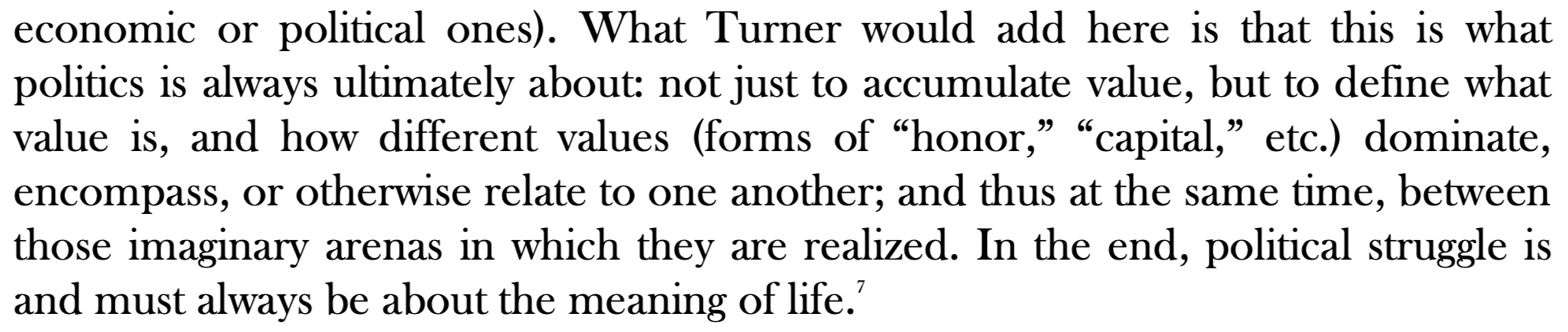


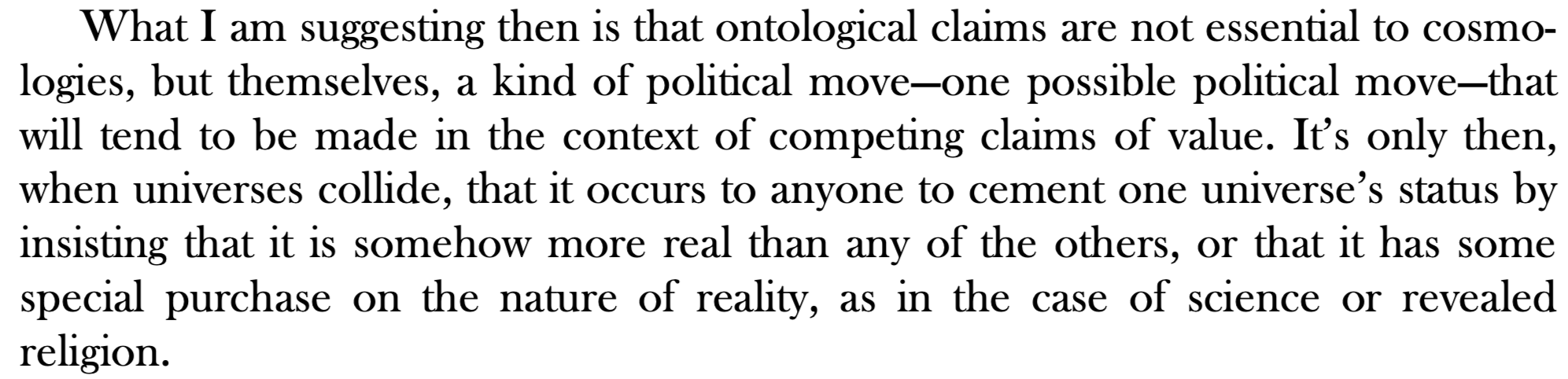
Similarly, the ultimate freedom is not the freedom to create or accumulate value, but the freedom to decide (collectively or individually) what it is that makes life worth living. In the end, then, politics is about the meaning of life. Any such project of constructing meanings necessarily involves imagining totalities (since this is the stuff of meaning), even if no such project can ever be completely translated into reality—reality being, by definition, that which is always more complicated than any construction we can put on it.
Graeber, Toward an Anthropological theory of value, p.88
Graeber seems to support something close to Laclau and Mouffe’s theory of Hegemony. His arguments are constructivist and he really seems to be concerned with the hegemonization of the “value” as a concept
Value needs to have some objective form (legitimacy maybe?)
Value and the totalities we operate in