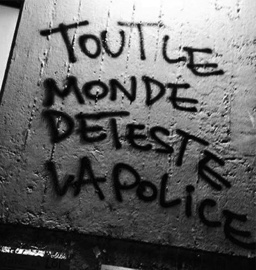
If one wishes to understand what is at stake in this eminently political question of policing, it's necessary to grasp the conjuring trick operating between policing as a means and policing as an end. On the other hand there is the ideal, legal, fictitious social order - policing as an end-and then there is its real order, or rather its real disorder. The function of policing as a means is to make sure that the desired external order appears to reign. It ensures the order of things by using the weapons of disorder and reigns over the visible through its elusive activity. Its daily practices-kidnapping, beating, spying, stealing, forcing, deceiving, lying, killing, being armed-cover the whole register of illegality, so that its very existence never ceases being basically unavowable. Being proof that what is legal is not what is real, that order does not reign, that society doesn't cohere since it's not held together by its own powers, policing is constantly pushed into the shadows, where it occupies one ofthe world's blind spots as far as thinking is concerned. For the ruling order, it's like a birthmark in the middle of the face. It is the persistent and constant expression of the state of exception-that which every sovereignty wishes it could hide, but which it is regularly forced to exhibit in order to make itself feared. If the state of exception is that momentary suspension of the law that makes it possible to reestablish the condi tions for the rule of law, through the most arbitrary and bloody measures, the police in their daily operation are what remains of the state of excep tion when those conditions have been restored. The police in their daily operation are what persists of the state ofexception in the normal situation. This is why their sovereign operation is itself so concealed. When the policeman faced with a recalcitrant arrestee lets loose with "The law, I am the law!" it's always out of earshot. Or when on a day of demonstration the riot cop dragging a comrade away for no valid reason waxes ironic: "I do as I like. You see, for me too it's anarchy today!" For political economy and cybernetics alike, the police remain like a shameful and unthinkable relic, a memento mori that reminds them that their order, which wants to think of itself as natural, is still not that and doubtless never will be. Thus the police oversee an apparent order that internally is only disorder. They are the truth of a world of lies, and hence a continuing lie themselves. They testify to the fact that the ruling order is artificial and will sooner or later be destroyed.
The Invisible Committee, Now, p.116-118
So it's no small matter that we live in a time when this obscene, opaque recourse which the police constitute is coming into the full light of day. That armed, hooded police officers calmly march as an unauthorized cortege on the Elysee, as they did last autumn, to the cry of "corrupt unions" and "Freemasons to prison," without any one daring to talk about a seditious activity […], hat the death penalty, abolished by the law, has manifestly been re-instituted by the police in the case of interventions against "terrorists" . . . that the police have succeeded in asserting a near total judicial impunity for their most indefensible sprees . . . that certain bodies within the police structure more and more openly declare their alignment with the National Front... […] taken together, these items outline the contours of a substantial shift. […]
In reality, what we're witnessing is a major turnaround in the relation between the government and the police. For a long time, the forces of order were those ignorant puppets, despised but brutal, that were brandished against the restive populations. Somewhere between a parachutist, a lighting rod, and a punching ball. The governing authorities have now reached such depths of discredit that the con tempt they elicit has surpassed that of the police, and the police know it. The police understood, albeit slowly, that it had become the precondition of government, its survival kit, its mobile respirator. So that their relationship has reversed itself. Henceforth the governing authorities are rattles in the hands of the police. They no longer have any other choice but to rush to the bedside of the lowest-grade cop with a pain and to yield to all the whims of the force. After the license to kill, anonymity, impunity, the latest weaponry, what can they still want to obtain? Even so, there is no lack of factions in the police force who imagine themselves growing wings and turning into an autonomous force with its own political agenda. In this regard, Russia looks like a paradise, where the secret services, the police, and the army have already taken power and govern the country to their benefit. While the police are certainly not in a position to go autonomous materially, that doesn't prevent them from waving the threat of their political autonomy to the sound of all their wailing sirens.
The police are thus torn between two contradictory tendencies. One of them, conservative, bureaucratic, "republican," would definitely prefer to remain just a means in the service of an order that is less and less respected, to be sure. The other is spoiling for a throwdown, wanting to "clear out the rabble" and no longer answer to anyone-to be their own end. Basically, only the coming to power of a party deter mined to "clear out the rabble" and to support the police apparatus one hundred percent could reconcile these two tendencies. But such a government would be in its turn a government of civil war.
The Invisible Committee, Now, p.118-121
The slogan "Everybody hates the police" doesn't express an observation, which would be false, but an affect, which is vital. Contrary to the cowardly worries of governing authorities and editorialists, there is no "gulf that deepens year by year between the police and the population," there is a deepening gulf between those-and they are countless-who have excellent reasons for hating the police and the fear-ridden mass of those who embrace the cause of the cops, when they are not hugging the cops themselves.
The Invisible Committee, Now, p.120
Strategies for destituting the police
In a country like France, that is, in a country that may very well be a police state on condition that it not declare it publicly, it would be foolish to seek a military victory over the police. Taking aim at a uniform with a paving stone is not the same thing as entering into close-quarters combat with an armed force. The police are a target and not an objective, an obstacle and not an opponent. Whoever takes the cops for an opponent prevents themselves from breaking through the obstacle the police constitute. To successfully sweep them aside, we must aim beyond them. Against the police, the only victory is political. Disorganizing their ranks, stripping them of all legitimacy, reducing them to powerlessness, keeping them at a good distance, giving oneself more room for maneuver at the right moment and at the places one chooses: this is how we destitute the police.
The Invisible Committee, Now, p.122-123
While, compared to the police, revolutionaries may currently present themselves as weak, unarmed, unorganized, and watch-listed, they have the strategic advantage, however, of being nobody's instrument, of having no order to main tain, and of not being a corps. We revolutionaries are not bound by any obedience, we are connected to all sorts of comrades, friends, forces, milieus, accomplices, and allies. This enables us to bring to bear on certain police interventions the threat that an operation to enforce order might trigger an unmanageable disorder in return. If since the failure of Operation Caesar, no government has dared to try and expel the ZAD, it's not out of a fear of losing the battle militarily, but because the reaction of tens of thousands of sympathizers could prove to be unmanageable. That a "blunder" in a banlieue sets off weeks of widespread riots is too high a price to pay for the Specialized Brigade's license to humiliate. When an intervention by the police causes more disorder than what it reestablishes in the way of order, it's their very reason for being that's in question. So, either they insist and end up emerging as a party with its own interests, or they go back into their kennel. Either way, they cease being a useful means. They are destituted.
The Invisible Committee, Now, p.123-124
There is a basic asymmetry between the police and revolutionaries. Whereas they take us as the target of their operations, our aims reach far beyond them - it's the general policing of society, its very organization, that we have in our line of sight. The outrageousness of police prerogatives and the incredible expansion of the technological means of control delineate a new tactical perspective. A purely public existence places revolutionaries before the alternative of a practical impotence or an immediate repression. A purely conspiratorial existence does allow a greater freedom of action, but makes one politically inoffensive and vulnerable to repression. So it's a matter of combining a capacity for mass dissemination and a necessary conspiratorial level. Organizing revolutionarily entails a subtle interplay between the visible and the invisible, the public and the clandestine, the legal and the illegal. We have to accept that our struggle is essentially criminal, since in this world everything has become criminalizable. Even the militants who go in aid of the migrants have to use clever tricks to evade the surveillance of which they are the object, before they can act freely. A revolutionary force can be constructed only as a network, a step at a time, by relying on sure friendships, by furtively establishing unanticipated ties even with in the enemy apparatus. This is how the "tanzikiyat" were formed in Syria, as a web oflittle autonomous pockets of revolutionaries that would later become the backbone of popular self-organization. In their day, the first French Resistance networks didn't do things differently. In the case of Syria as in the old maquis, by successfully reclaiming urban districts and areas of the countryside, by establishing relatively secure zones, it became possible to go beyond the stage of discrete, anonymous activity on the part of little groups. "Life is in the use, not in the time," as Manouchian put it.
The Invisible Committee, Now, p.124-125