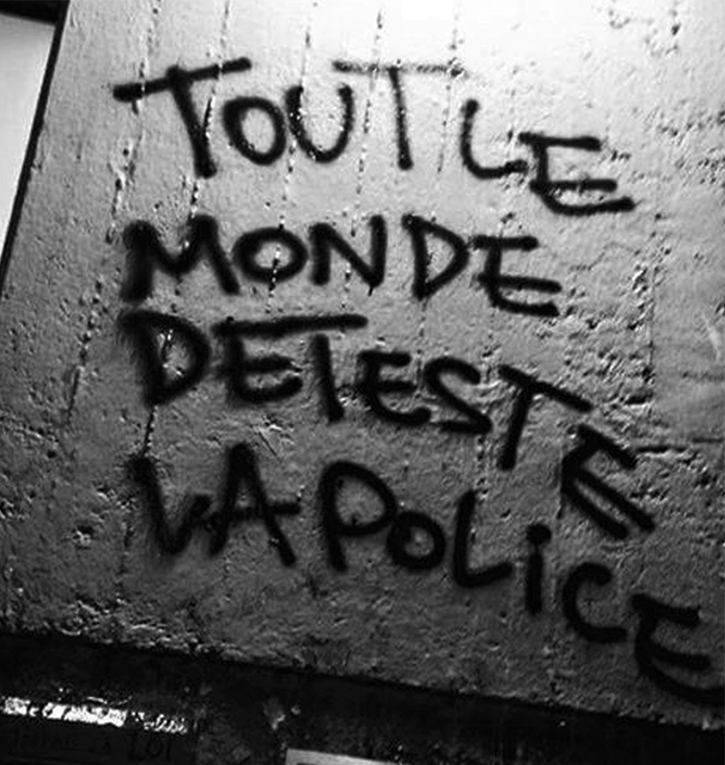
If one wishes to understand what is at stake in this eminently political question of policing, it's necessary to grasp the conjuring trick operating between policing as a means and policing as an end. On the other hand there is the ideal, legal, fictitious social order - policing as an end-and then there is its real order, or rather its real disorder. The function of policing as a means is to make sure that the desired external order appears to reign. It ensures the order of things by using the weapons of disorder and reigns over the visible through its elusive activity. Its daily practices-kidnapping, beating, spying, stealing, forcing, deceiving, lying, killing, being armed-cover the whole register of illegality, so that its very existence never ceases being basically unavowable. Being proof that what is legal is not what is real, that order does not reign, that society doesn't cohere since it's not held together by its own powers, policing is constantly pushed into the shadows, where it occupies one ofthe world's blind spots as far as thinking is concerned. For the ruling order, it's like a birthmark in the middle of the face. It is the persistent and constant expression of the state of exception-that which every sovereignty wishes it could hide, but which it is regularly forced to exhibit in order to make itself feared. If the state of exception is that momentary suspension of the law that makes it possible to reestablish the condi tions for the rule of law, through the most arbitrary and bloody measures, the police in their daily operation are what remains of the state of excep tion when those conditions have been restored. The police in their daily operation are what persists of the state ofexception in the normal situation. This is why their sovereign operation is itself so concealed. When the policeman faced with a recalcitrant arrestee lets loose with "The law, I am the law!" it's always out of earshot. Or when on a day of demonstration the riot cop dragging a comrade away for no valid reason waxes ironic: "I do as I like. You see, for me too it's anarchy today!" For political economy and cybernetics alike, the police remain like a shameful and unthinkable relic, a memento mori that reminds them that their order, which wants to think of itself as natural, is still not that and doubtless never will be. Thus the police oversee an apparent order that internally is only disorder. They are the truth of a world of lies, and hence a continuing lie themselves. They testify to the fact that the ruling order is artificial and will sooner or later be destroyed.
The Invisible Committee, Now, p.116-118
So it's no small matter that we live in a time when this obscene, opaque recourse which the police constitute is coming into the full light of day. That armed, hooded police officers calmly march as an unauthorized cortege on the Elysee, as they did last autumn, to the cry of "corrupt unions" and "Freemasons to prison," without any one daring to talk about a seditious activity […], hat the death penalty, abolished by the law, has manifestly been re-instituted by the police in the case of interventions against "terrorists" . . . that the police have succeeded in asserting a near total judicial impunity for their most indefensible sprees . . . that certain bodies within the police structure more and more openly declare their alignment with the National Front... […] taken together, these items outline the contours of a substantial shift. […]
In reality, what we're witnessing is a major turnaround in the relation between the government and the police. For a long time, the forces of order were those ignorant puppets, despised but brutal, that were brandished against the restive populations. Somewhere between a parachutist, a lighting rod, and a punching ball. The governing authorities have now reached such depths of discredit that the con tempt they elicit has surpassed that of the police, and the police know it. The police understood, albeit slowly, that it had become the precondition of government, its survival kit, its mobile respirator. So that their relationship has reversed itself. Henceforth the governing authorities are rattles in the hands of the police. They no longer have any other choice but to rush to the bedside of the lowest-grade cop with a pain and to yield to all the whims of the force. After the license to kill, anonymity, impunity, the latest weaponry, what can they still want to obtain? Even so, there is no lack of factions in the police force who imagine themselves growing wings and turning into an autonomous force with its own political agenda. In this regard, Russia looks like a paradise, where the secret services, the police, and the army have already taken power and govern the country to their benefit. While the police are certainly not in a position to go autonomous materially, that doesn't prevent them from waving the threat of their political autonomy to the sound of all their wailing sirens.
The police are thus torn between two contradictory tendencies. One of them, conservative, bureaucratic, "republican," would definitely prefer to remain just a means in the service of an order that is less and less respected, to be sure. The other is spoiling for a throwdown, wanting to "clear out the rabble" and no longer answer to anyone-to be their own end. Basically, only the coming to power of a party deter mined to "clear out the rabble" and to support the police apparatus one hundred percent could reconcile these two tendencies. But such a government would be in its turn a government of civil war.
The Invisible Committee, Now, p.118-121
The slogan "Everybody hates the police" doesn't express an observation, which would be false, but an affect, which is vital. Contrary to the cowardly worries of governing authorities and editorialists, there is no "gulf that deepens year by year between the police and the population," there is a deepening gulf between those-and they are countless-who have excellent reasons for hating the police and the fear-ridden mass of those who embrace the cause of the cops, when they are not hugging the cops themselves.
The Invisible Committee, Now, p.120