The subjective faculty of thinking was the critical agent that dissolved superstition. But in denouncing mythology as false objectivity, i.e. as a creation of the subject, it had to use concepts that it recognized as adequate. Thus it always developed an objectivity of its own. In Platonism, the Pythagorean theory of numbers, which originated in astral mythology, was transformed into the theory of ideas that attempts to define the supreme content of thinking as an absolute objectivity ultimately beyond, though related to, the faculty of thinking. The present crisis of reason consists fundamentally in the fact that at a certain point thinking either became incapable of conceiving such objectivity at all or began to negate it as a delusion. This process was gradually extended to include the objective content of every rational concept. In the end, no particular reality can seem reasonable per se; all the basic concepts, emptied of their content, have come to be only formal shells. As reason is subjectivized, it also becomes formalized.
The formalization of reason has far-reaching theoretical and practical implications. If the subjectivist view holds true, thinking cannot be of any help in determining the desirability of any goal in itself. The acceptability of ideals, the criteria for our actions and beliefs, the leading principles of ethics and politics, all our ultimate decisions are made to depend upon factors other than reason. They are supposed to be matters of choice and predilection, and it has become meaningless to speak of truth in making practical, moral, or esthetic decisions.
Horkheimer, Eclipse of Reason, Means and Ends, p.6
According to such theories, thought serves any particular endeavor, good or bad. It is a tool of all actions of society, but it must not try to set the patterns of social and individual life, which are assumed to be set by other forces. In lay discussion as well as in scientific, reason has come to be commonly regarded as an intellectual faculty of co-ordination, the efficiency of which can be increased by methodical use and by the removal of any non-intellectual factors, such as conscious or unconscious emotions. Reason has never really directed social reality, but now reason has been so thoroughly purged of any specific trend or preference that it has finally renounced even the task of passing judgment on man's actions and way of life. Reason has turned them over for ultimate sanction to the conflicting interests to which our world actually seems abandoned.
Horkheimer, Eclipse of Reason, Means and Ends, p.7
In the subjectivist view, when 'reason' is used to connote a thing or an idea rather than an act, it refers exclusively to the relation of such an object or concept to a purpose, not to the object or concept itself. It means that the thing or the idea is good for something else. There is no reasonable aim as such, and to discuss the superiorityof one aim over another in terms of reason becomes meaningless. From the subjective approach, such a discussion is possible only if both aims serve a third and higher one, that is, if they are means, not ends.
Horkheimer, Eclipse of Reason, Means and Ends, p.5
the force that ultimately makes reasonable actions possible is the faculty of classification, inference, and deduction, no matter what the specific content—the abstractfunctioning of the thinking mechanism. This type of reason may be called subjective reason. It is essentially concerned with means and ends, with the adequacy of procedures for purposes more or less taken for granted and supposedly self-explanatory. It attaches little importance to the question whether the purposes as such are reasonable. If it concerns itself at all with ends, it takes for granted that they too are reasonable in the subjective sense, i.e. that they serve the subject's interest in relation to self- preservation—be it that of the single individual, or of the community on whose maintenance that of the individual depends. The idea that an aim can be reasonable for its own sake—on the basis of virtues that insight reveals it to have in itself—without reference to some kind of subjective gain or advantage, is utterly alien to subjective reason, even where it rises above the consideration of immediate utilitarian values and devotes itself to reflections about the social order as a whole.
[…]
Ultimately subjective reason proves to be the ability to calculate probabilities and thereby to co-ordinate the right means with a given end.
Horkheimer, Eclipse of Reason, Means and Ends, p.3-4
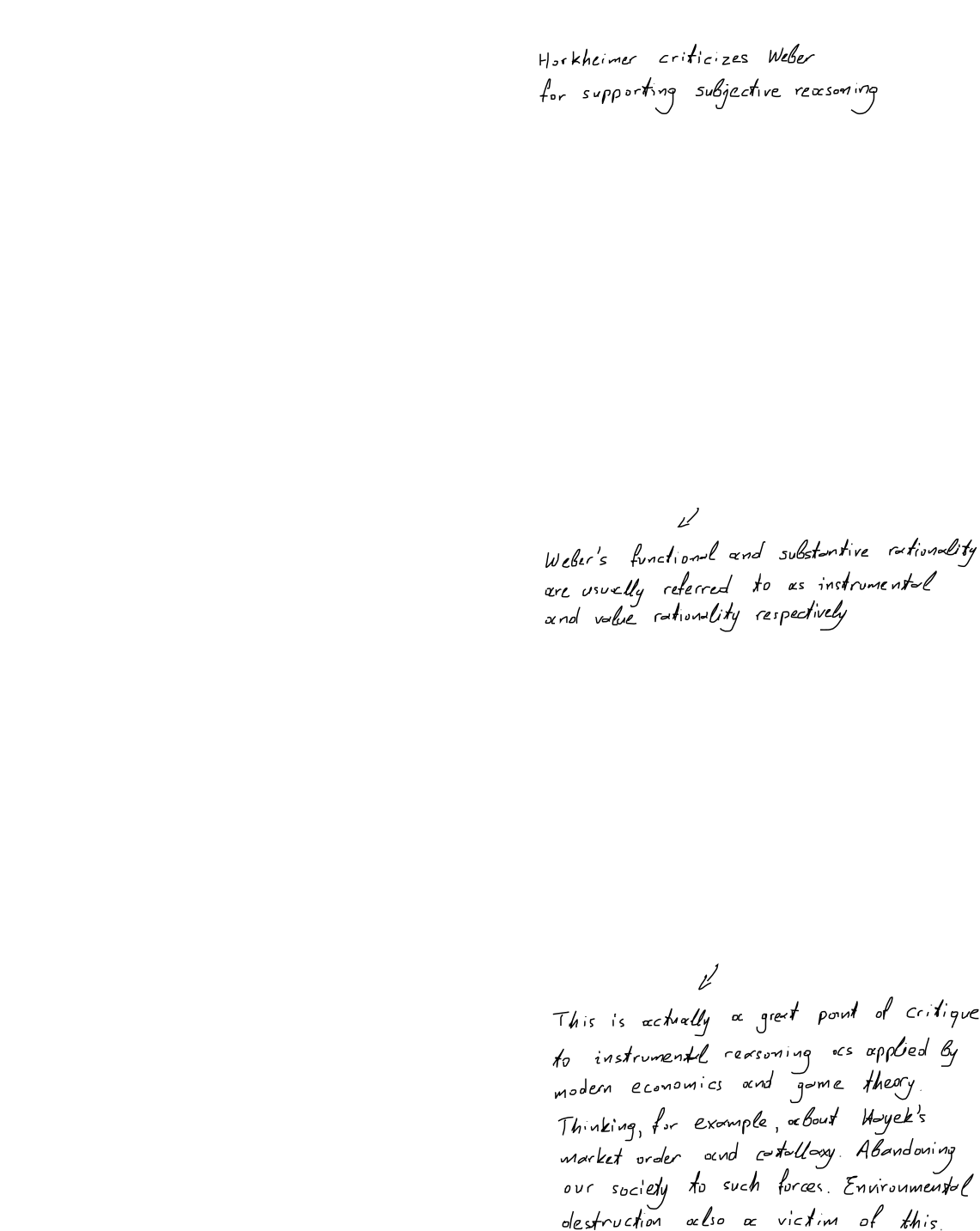
The difference between this connotation of reason and the objectivistic conception resembles to a certain degree the difference between functional and substantial rationality as these words are used in the Max Weber school. Max Weber, however, adhered so definitely to the subjectivistic trend that he did not conceive of any rationality—not even a 'substantial' one by which man can discriminate one end from another. If our drives, intentions, and finally our ultimate decisions must a priori be irrational, substantial reason becomes an agency merely of correlation and is therefore itself essentially 'functional.' Although Weber's own and his followers' descriptions of the bureaucratization and monopolization of knowledge have illuminated much of the social aspect of the transition from objective to subjective reason (cl. particularly the analyses of Karl Mannheim in Man and Society, London, 1940). Max Weber's pessimism with regard to the possibility of rational insight and action, as expressed in his philosophy (cf., e.g., 'Wisscnschaft als Beruf,' in Gesammelte Aufodtze zur Wissenschaftslehre, Tubingen, 1922), is itself a stepping-stone in the renunciation of philosophy and science as regards their aspiration of defining man's goal.
Horkheimer, Eclipse of Reason, Means and Ends, p.5
Horkheimer and Adorno are interested precisely in the ironic connection that the rationalization of society seems to establish between the transformation of traditional realms of life into subsystems of purposive-rational action, on the one hand, and the "atrophy of individuality," on the other.
In Horkheimer's view the destruction of the identity that an individual gains from the orientation to "basic intellectual concepts" or principles is directly connected not only with bureaucratization but with the detachment of systems of purposive-rational action from "culture," from a horizon of the lifeworld experienced as rational. The more the economy and the state change into embodiments of cognitive-instrumental rationality and subordinate other departments of life to their imperatives, and the more they push to the fringes anything in which moral-practical and aesthetic-practical rationality can be embodied, the less support processes of individuation find in a domain of cultural reproduction that has been shunted into the irrational or wholly tailored to the pragmatic.
Habermas, The Theory of Communicative Action, Vol.1, p.354
Individualism is the very heart of the theory and practice of bourgeois liberalism, which sees society as progressing through the automatic interaction of diverging interests in a free market.
Horkheimer, Eclipse of Reason, p.138-139
The fact that the bourgeois has always defined "reason" through its relation to individual self-preservation seems to run counter to Locke's exemplary determination, according to which "reason" designates the management of intellectual activity, no matter which ends are served by this activity. But reason is far from leaving the jurisdiction of monadic self-interest with this dissociation from every particular end; rather, it merely develops procedures with which it can all the more obligingly serve any arbitrary monadic end. The growing formal universality of bourgeois reason does not mean a growing consciousness of universal solidarity.
Max Horkheimer, "Vernunft und Selbsterhaltung," in Ebeling, ed., Subjektivitat und Selbsterhaltung, p.47-48 (in Habermas, The Theory of Communicative Action, p.388)
Rational action as such is the relating of ends to means; economic rationality, specifically, assumes means to be scarce. But human society involves more than that. What should be the end of man, and how should he choose his means? Economic rationalism, in the strict sense, has no answer to these questions, for they imply motivations and valuations of a moral and practical order that go beyond the logically irresistible, but otherwise empty exhortation to be ‘economical’”.
Karl Polanyi, The Livelihood of Man (New York: Academic Press, 1977), p. 13.
[…] Max Weber directly challenged all these tenets of the Enlightenment faith in reason and progress in ways that remain relevant for us today. In his view, the rationality that defines modernity is at bottom a Zweckrationalitat, a purposive or means/ends rationality, the inherent aim of which is the mastery of the world in the service of human interests. As a consequence, the growth and spread of reason does not, as Enlightenment thinkers supposed it would, furnish a new, nonillusory center of meaning to modern culture. It does, to be sure, gradually dissolve traditional superstitions, prejudices and errors; but this "dis- enchantment of the world," as Weber calls it, does not replace traditional religious worldviews with anything that could fulfill the functions of, for instance, giving meaning and unity to life. Rather, the disenchanted world is stripped of all ethical meaning; it is devalued and objectified as the material and setting for purposive-rational pursuit of interests. The gain in control is paid for with a loss of meaning. And the control that we gain is itself value- neutral—an instrumental potential that can be harnessed from any one of an unlimited number of value perspectives. This subjectivization of "ultimate" ends means that the unity of the world has fallen to pieces. In place of the one God or the unitary ground of being, we have an irreducible plurality of competing, often irreconcilable values, and as Weber says, "over these gods and their struggles it is fate, and certainly not any "science," that holds sway”.
Because in the final analysis values cannot be rationally grounded but only chosen, there are at the core of life rationally unjustifiable commitments through which we give the dis- enchanted world meaning and unity. Correspondingly, the sphere of politics has to be understood as a sphere of decision and power and not of reason: Legitimacy is not a question of rational justification but of de facto acceptance of an order of authority by those subject to it; and law is not an expression of rational will but a product of enactment by duly constituted authorities according to established procedures. Weber's views on economy and society are equally antithetical to Enlightenment hopes regarding the institutionalization of reason. The progress of societal rationalization was indeed well along by the end of the nineteenth century; but what this progress turned out to be, according to Weber, was the ascendency of purposive rationality, of technique and calculation, of organization and administration. The triumph of reason brings with it not a reign of freedom but the dominion of impersonal economic forces and bureaucratically organized administrations—a "vast and mighty cosmos" that "determines with irresistible force the lifestyles of all the individuals who are born into (it)". Nor would the advent of socialism improve the situation; it would, says Weber, merely mean the final and complete victory of bureaucracy. The realization of reason that the eighteenth-century philosophers envisioned as a Kingdom of God on earth has turned out to be an "iron cage" in which we are henceforth condemned to live. Disenchantment and rationalization are irreversible, as are the loss of meaning and the loss of freedom that accompany them.
The undeniable power of this analysis has, of course, often been harnessed for conservative purposes […].
McCarthy, Translator’s Introduction, The Theory of Communicative Action, Vol.1, p.xvii-xviii
Weber has at his disposal a complex concept of practical rationality that takes the coordination of purposive-rational and value-rational aspects of action as its point of departure. Nevertheless, on the other hand, Weber considers societal rationalization explicitly from the perspective of purposive-rationality. At the level of institutions, he does not apply the comprehensive concept of rationality upon which he bases his investigations of cultural tradition. Only the cognitive-instrumental complex of rationality acquires significance for the rationality of action systems. At the level of the economic and political subsystems, only the aspect of purposive-rational, and not that of value-rational action is supposed to have structure-forming effects. From Weber's sociology of the economy, state, and law, one gets the impression that in modern societies rationalization processes attach only to empirical-theoretical knowledge and to the instrumental and strategic aspects of action, whereas practical rationality cannot be institutionalized independently, that is, with an inner logic specific to a subsystem.
Habermas, The Theory of Communicative Action, Vol.1, p.254
In analyzing this hopeless situation, Horkheimer and Adorno keyed in on a factor that Weber had singled out: the spread of formal, means/ends rationality, which they called instrumental reason. In doing so, they completely revised Marx's positive evaluation of scientific-technological progress. What for him represented an unambiguously emancipatory potential, for them was the core of a domination generalized to all spheres of life. Subjects who, in Horkheimer's words, "have to form themselves, body and soul, in relation to the technical apparatus" are no longer potential subjects of revolution (1:353). This was empirically borne out by the collapse of the revolutionary labor movement in all industrial societies and by the dis- appearance of the proletariat into the pores of consumer society. Thus the scientific-technological progress that Marx connected with the unleashing of productive forces and the overthrow of capitalism had for Horkheimer and Adorno the ironic effect of immobilizing the very subjective forces that were supposed to accomplish this overthrow. As Horkheimer put it, "All life today tends to be increasingly subjected to rationalization and planning… The individual's self-preservation presupposes his adjustment to the requirements for the preservation of the system". Given this pessimistic diagnosis, it is not surprising that they saw little hope of changing things. Critical theory became resignative, contemplative. It could, at best, disclose the unreason at the heart of what passes for reason, without offering any positive account of its own.
McCarthy, Translator’s Introduction, The Theory of Communicative Action, Vol.1, p.xix
Durkheim first discusses the Kantian opposition between duty and inclination from the standpoint that the relation of moral precepts to the interests of the individual is one of tension. Imperatives of self-maintenance, interests in the satisfaction of private needs and desires - in short, action orientations that are utilitarian and related to oneself- are not as such in accord with moral requirements, which demand, rather, that the actor raise himself above himself. The selfiessness of the morally acting individual corresponds to the universality of morally normed expectations, which are directed to all the members of a community: "Morality begins with membership in a group, whatever that group may be.’
Habermas, The Theory of Communicative Action, Vol. 2, p.48