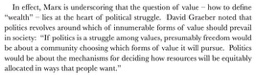
it is by pursuing value that we reproduce societies. Therefore, different types of value pursuit, hence of value practices, reproduce different types of societies, of wholes, of self-organising systems, of forms of social cooperation. Hence the study of how we reproduce capitalist social relations is a study of how we pursue the values that are characteristic of it. The politics of alternatives is ultimately a politics of value, that is a politics of establishing what the value is that connects individuals and wholes.
De Angelis, The Beginning of History, p.176
To introduce the question of measures is thus to introduce the question of process and feedback in the articulation between social body and body subjects. This articulation can be conceptualised as in a feedback relation: this is a modern way of looking at an old insight, namely that we are social individuals (or subjects), and that we change the world, but in conditions that we do not choose (yet it is we who change it!). To introduce the problematic of measuring is to open up the question: how do we measure what we measure? Who or what sets the standard for the measurement? What forms of measurement are used in different discourses? What powers have been deployed and/or repressed with this or that measuring processes? And what loops articulate human practices to practices of measuring?
De Angelis, The Beginning of History, p.178
Marxists start by asking how what we call “society” is continually being re-created through various sorts of productive action, and how a society’s most basic forms of exploitation and inequality are thus rooted in the social relations through which people do so.
Graeber, Toward an Anthropological Theory of Value, p.24
Marx himself did develop a theory of value. In Capital, and elsewhere, he argued that the value of commodities is derived from the human labor that went into producing them, but that this fact tends to be forgotten when the object is bought and sold on the market, so that it seems that its value somehow arises naturally from the qualities of the object itself. This is of course a very famous argument that has generated a vast literature. But there were few explicit attempts to see how it might be applied to non-capitalist systems, or if indeed it could be.
Graeber, Toward an Anthropological Theory of Value, p.26
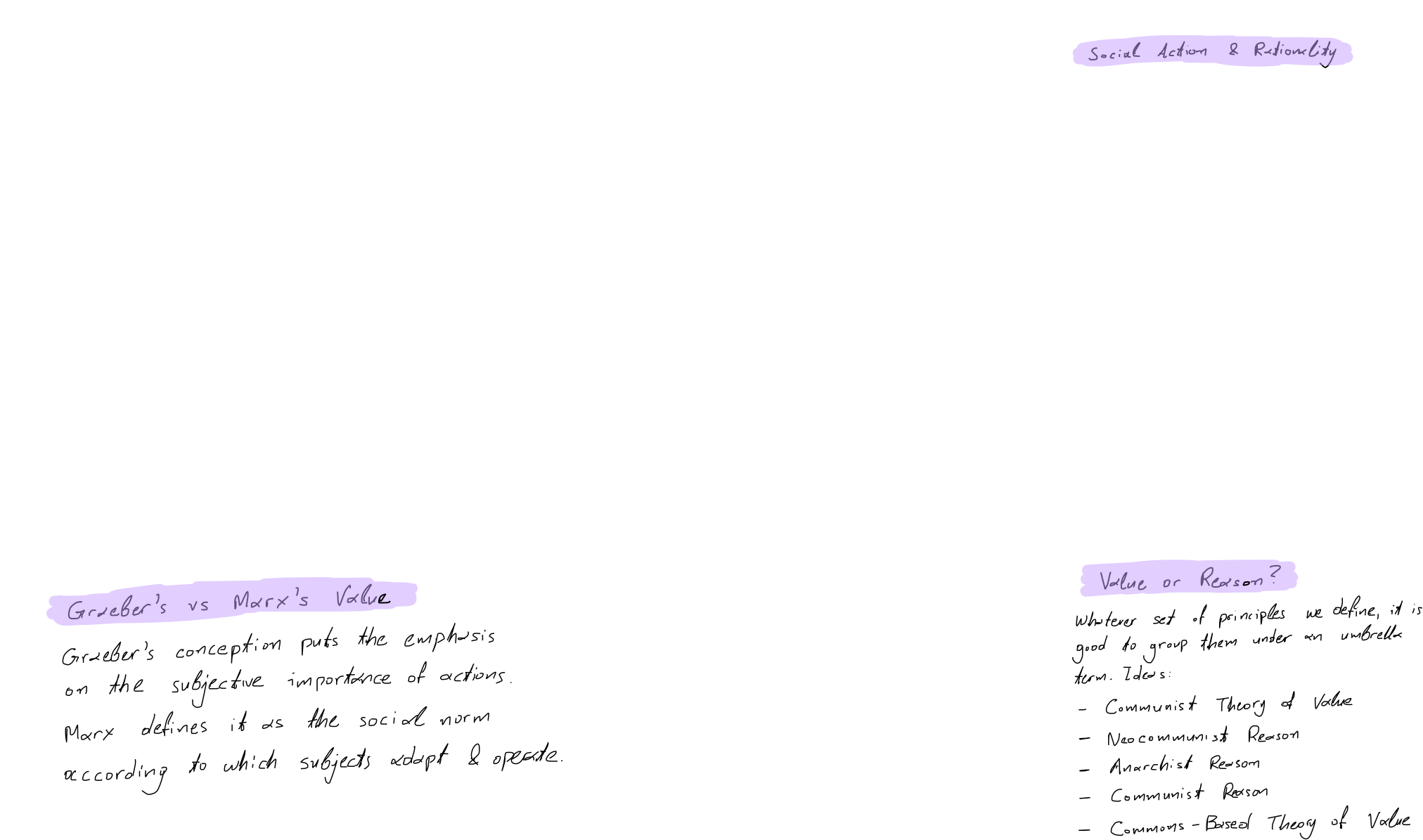
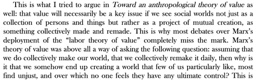
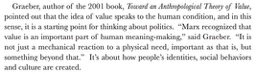
Value, then, is the way people represent the importance of their own actions to themselves - though […] we are not talking about something that could occur in isolation: […] it can only happen through that importance being recognized by someone else.
Graeber, Toward an Anthropological Theory of Value, p.45
Commodities have to be produced (and yes, they also have to be moved around, exchanged, consumed…), social relations have to be created and maintained; all of this requires an investment of human time and energy, intelligence, concern. If one sees value as a matter of the relative distribution of that, then one has a common denominator. One invests one’s energies in those things one considers most important, or most meaningful.
[…]
We are clearly dealing with something along the lines of a labor theory of value. But only if we define “labor” much more broadly than almost anyone working in the Marxist tradition ever has. […] creative action exists everywhere, and one would be justified in being highly suspicious of anyone who claims that a given society completely fails to recognize this fact. The problem is that if you define action this broadly, there’s clearly no way to make any exact count of how much of it has been invested in any given object or relation. Even the outside analyst can at best make an extremely rough estimate.
Graeber, Toward an Anthropological Theory of Value, p.45
Capitalist Value according to Marx:
How do we measure/compare our doing (concrete labor performed) in a quantified manner assuming cultural/societal measurement norms (SNLT)
We shall speak of "action" insofar as the acting individual attaches a subjective meaning to his behavior - be it overt or covert, omission or acquiescence. Action is "social" insofar as its subjective meaning takes account of the behavior of others and is thereby oriented in its course.
Weber, Economy and Society, p.4
Social action, like all action, may be oriented in four ways. It may be:
1. Ιnstrumentally rational (zweckrational), that is, determined by expectations as to the behavior of objects in the environment and of other human beings; these expectations are used as "conditions" or "means" for the attainment of the actor's own rationally pursued and calculated ends;
2. Value-rational (wertrational), that is, determined by a conscious belief in the value for its own sake of some ethical, aesthetic, religious, or other form of behavior, independently of its prospects of success;
3. Affectual (especially emotional), that is, determined by the actor's specific affects and feeling states;
4. Traditional, that is, determined by ingrained habituation.
Weber, Economy and Society, p. 24-25
It is always a question of the relative importance of the particular things with which he is concerned […].
Even the single controlling mind, in possession of all the data for some small, self-contained economic system, would not every time some small adjustment in the allocation of resources had to be made - go explicitly through all the relations between ends and means which might possibly be affected. It is indeed the great contribution of the pure logic of choice that it has demonstrated conclusively that even such a single mind could solve this kind of problem only by constructing and constantly using rates of equivalence (or "values," or "marginal rates of substitution"), i.e., by attaching to each kind of scarce resource a numerical index which cannot be derived from any property possessed by that particular thing, but which reflects, or in which is condensed, its significance in view of the whole means-end structure. In any small change he will have to consider only these quantitative indices (or "values") in which all the relevant information is concentrated; and by adjusting the quantities one by one, he can appropriately rearrange his dispositions without having to solve the whole puzzle ab initio, or without needing at any stage to survey it at once in all its ramifications.
Fundamentally, in a system where the knowledge of the relevant facts is dispersed among many people, prices can act to coordinate the separate actions of different people in the same way as subjective values help the individual to coordinate the parts of his plan.
Hayek, The Use of Knowledge in Society (The American Economic Review, p.525)