Kioupkiolis’ Feedback (27/4/2023)
1. Need to mention/answer newer conceptions on value (on the ones that deny it is applicable). E.g. Hardt & Negri (Multitude & Commonwealth mainly) and Fuchs.
2. Need to emphasize on the novel points of the argument early on
3. Commons theories: De Angelis, Bollier & Helfrich, P2PF (no need to pick one)
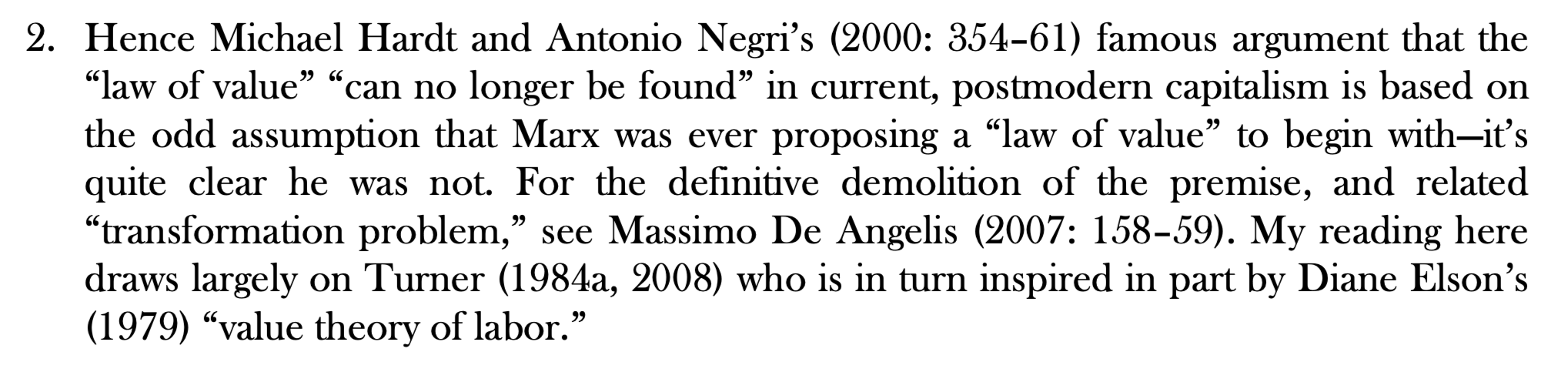
There is also another limitation that may be pointed out. It is the fact that our treatment seems not to include a particular form of doing in production, a form that many observers believe is a peculiar contemporary feature of what they call post-Fordism, namely the doing that creates the new, that imagines, that innovates, and that is based on team work, forms of cooperation and relational labour among the doers, which give them a higher autonomy in conceptualisation and production than that possessed by the classic mass workers tied to assembly lines. As we have seen in Chapter 12, Hardt and Negri among others refer to this as ‘immaterial labour’ and argue that this form of labour is beyond capitalist measure precisely because it is a form of social cooperation that is constituted by relational and communicational patterns defined by the doers themselves (hence measured by themselves). While it might be argued that ‘no transcendent power or measure will determine the values of our world [since] value will be determined only by humanity’s own continuous innovation and creation’ (Hardt and Negri 2000: 356), it is also true that when innovating and creating singular producers are pitted against each other in an endless rat race, the values that emerge from this ongoing clash are measurable by capital. Indeed, it is through this antagonistic mode of relation among social producers that capital values are constituted. Thus, the ongoing creation of SNLT is a feature not only of what is called, ‘material’ (capitalist) production, but also of what is referred to as ‘immaterial’ (capitalist) production, i.e., the production of ideas and affects. Here too we can have ongoing competition among producers who are then locked in the feedback loop of their own rat race against each other. What is continuously compared in order to give rise to differentials are here the perceived quality of ideas, whether in the form of creative work for advertising or that leading to product or process innovation, and improvements in the time and efficiency of their execution, of getting the job done. All the same, in terms of affects, what is measured is not only the speed of service, but also the perceived service quality as measured by given indicators: smiling, ‘costumer satisfaction’, and so on. In both these cases, the set of systematic pressures is the same as in the traditional case of ‘material’ work.
[…]
Indeed, with respect to this immaterial labour, the degree of autonomy of the doers has precise limits defined by processes of capitalist measurement and not by the creative workers themselves. The selection of new ideas that can be turned into products or processes of doing occurs with respect to the SNLT process of measurement. The communicational patterns within work teams are bounded by the priorities set by their employers and managers, who measure the results of these communicational patterns in terms of price, quality and profit deviations from benchmarks. Nurses, doctors, teachers have a variety of degrees of autonomy, but are increasingly exposed to measures imposed from outside themselves which are heteronymous, which instruct them, in a context of declining resources and numbers of staff, to meet certain quality targets that relate in one way or another to external benchmarks (Harvie 2005).
De Angelis, The Beginning of History, Capital’s measuring of ‘material’ and ‘immaterial’ labour