There are in principle three ways of defining value norms of production for society as a whole. First, through administrative decree, a ‘state body’ or a management body that decrees what must be standard. Second, through community’s consensus, that is the community of the co-producers defining ways of setting standards. Third, through ongoing homeostatic mechanisms, such as market forces, that force individual producers to catch up with or surpass the norm. In reality, all these three are present in capitalist-dominated societies and the question is how they are articulated. While the second type, however, presupposes individual producers’ definitions of their own standards, in the first and the third types discipline come from outside the individual producers. In the first case, the outside is represented by a ‘foreman’, a ‘line manager’, a person holding the whip. In the second case, disciplinary forces of norm creation come from a mechanism, a dispositif, that hides, rather than highlights, particular types of relations among people. There is nobody in particular holding the whip – or at least so it appears for most of us – but still the whip is cracked: restructuring, flexibility, cuts in social spending, debt repayment, structural adjustment, ongoing scarcity, competition, the rat race; and the carrots are distributed: promotions, new cars, credit lines, debt forgiveness.
It is this impersonal disciplinary mechanism (re)producing the norms of our social cooperation that must be tackled. There are, however, actual designers of the mechanism, as we have seen in Chapters 10 and 11 on enclosures, and as we shall see in Chapter 14 on Hayek.
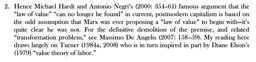
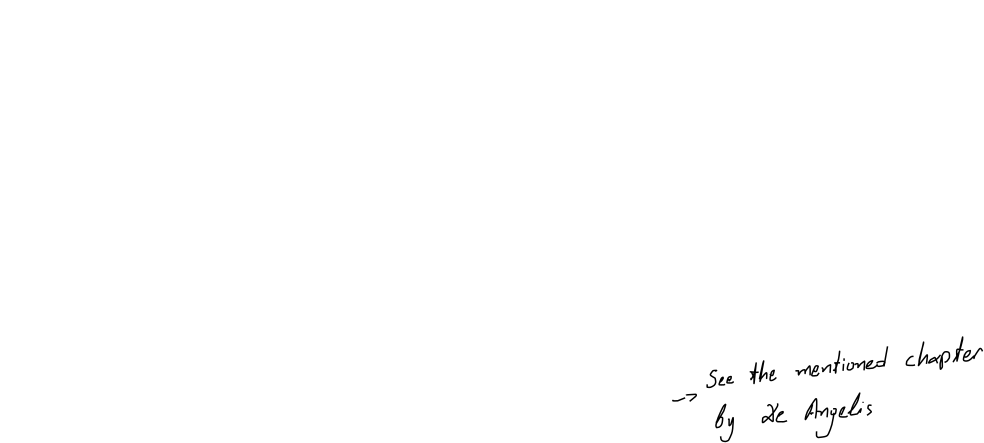
De Angelis, The Beginning of History, Note 3 of Chapter 3 - The Valuing and Measuring of Capital
In a capitalist system, in which what has worth, 'wealth', takes the form of commodities, the reproduction of people's livelihoods and corresponding value practices is largely subordinated to the production of commodities.
De Angelis, The Beginning of History, p.179
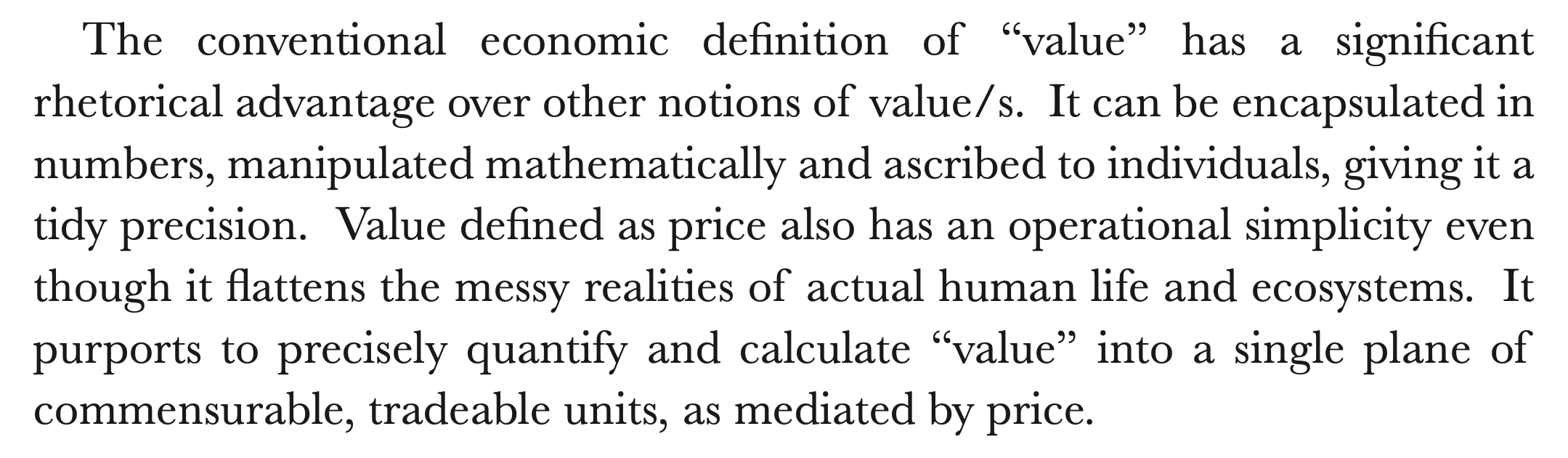
As we have seen, value is the importance people attribute to action and as such is measured using discursively and culturally given units of measurement. Commodity value is this importance turned upside down: it is the importance people attribute to the products of their action, in so far as these products are objects of market exchange and the production is production for profit. When things have a price tag, it is these things that have value, not the human labour that has produced them. The importance of all commodities here is measured through money, i.e., units of a particular commodity (gold, silver, etc.) or, in modem times, signs of value (dollars, euros, etc.). We call this the external measure of value, and this is the most obvious measure of value with which we are all familiar.
De Angelis, The Beginning of History, p.179
Capitalist Value according to Marx:
How do we measure/compare our doing (concrete labor performed) in a quantified manner assuming cultural/societal measurement norms (SNLT)
But benchmarks here are not only informational flows; rather, they are concrete socially defIned norms of production that describe how we produce, what we produce, and how much we produce. It is also clear that individual parts of the social body might deviate from this social definition of norms. Indeed, in disciplinary markets the ongoing opposition among these deviations - constitutes what Marx calls socially necessary labour time (SNLT) the norm that emerges from this ongoing opposition across the social body in the production of commodities. SNLT has a double meaning, depending on whether we look at it from the perspective of the whole of a co-producing social body or its parts . From the perspective of the whole, this is an average, the average labour time, which is necessary for the production of a particular commodity. But from the perspective of individual productive nodes, the same average is a benchmark, a discursive device that signals a particular type of information, an aid to decision making and action with respect to conditions of production and working rhythms. But as we have seen, these two perspectives, the perspective of the part and of the whole, are articulated by a process, a feedback loop that constitutes the value norm and that captures Our life activities within it.
De Angelis, The Beginning of History, p.186-187
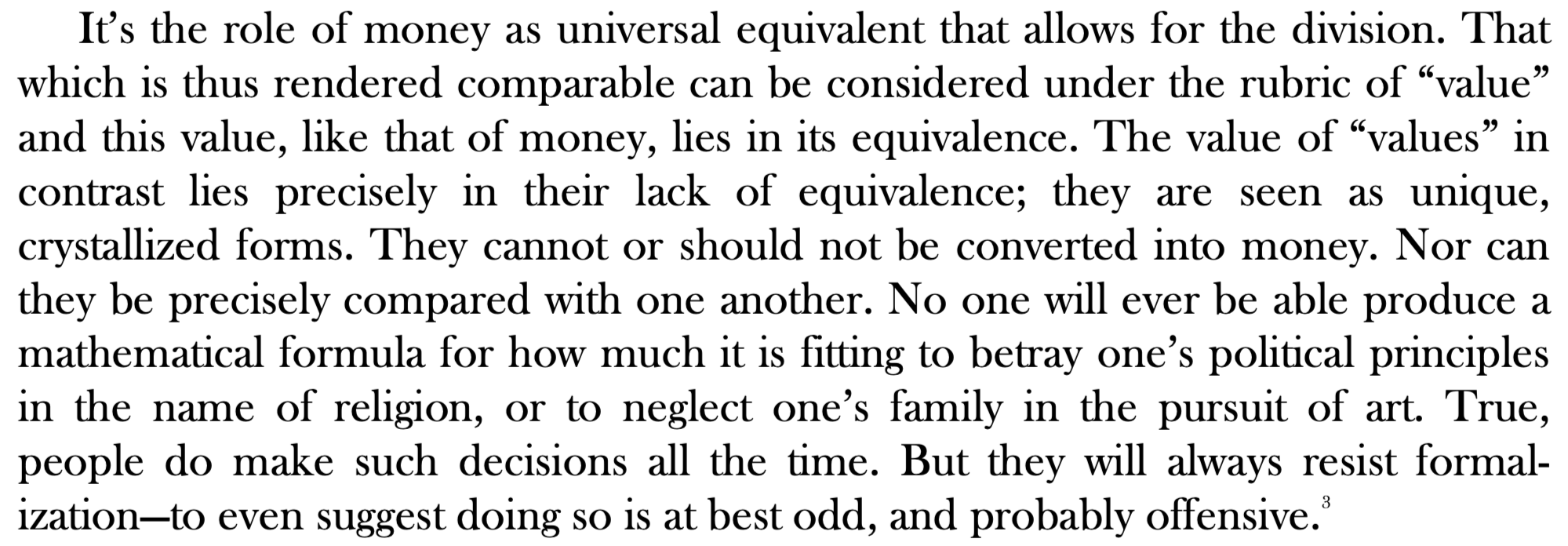
Not until hierarchy had scored its triumph in the early world and begun its journey into class society did equivalence, "equity," and contract begin to form the context for human social relationships. The quid pro quo of exchange and its ethical balance sheets were simply irreJevant to a community guided by the customs of usufruct, complementarity, and the irreducible minimum. The means of life and community support were there to be had rather than apportioned, and even where apportionment did exist, it was guided by egalitarian traditions that respected age, acknowledged infirmities, and fostered a loving care for children. Only "civilization" was to put the figure of Justitia on a pedestal and place its purely quantitative weights on her scale. Her blindfold may have very well been a token of her shame rather than her indifference to the realities of inequality.
The treaties that existed between preliterate communities were more procedural than distributive in their intent; they were meant to establish agreement in decision-making processes and ways of coordinating common actions, not to apportion power and things. And under conditions of general reciprocity, personal alliances were simply a way of breaking out of the kinship nexus and broadening support systems beyond the perimeter of the tribe. Hence the "commodities" that were exchanged between people seemingly as "gifts" were actually tokens of mutual loy alty. By no means did they necessarily have an intrinsic "value" of their own beyond a symbolic one, much less ratios or "price tags" that gave them exchange value.
Bookchin, The Ecology of Freedom, p.320-321
Exchange is all about equivalence. It's a back-and-forth process involving two sides in which each side gives as good as it gets. This is why one can speak of people exchanging words (if there's an argu ment), blows, or even gunfire.25 In these examples, it's not that there is ever an exact equivalence--even if there were some way to measure an exact equivalence--but more a constant process of interaction tend ing toward equivalence. Actually, there's something of a paradox here: each side in each case is trying to outdo the other, but, unless one side is utterly put to rout, it's easiest to break the whole thing off when both consider the outcome to be more or less even. When we move to the exchange of material goods, we find a similar tension. Often there is an element of competition; if nothing else, there's always that pos sibility. But at the same time, there's a sense that both sides are keeping accounts, and that, unlike what happens in communism, which always partakes of a certain notion of eternity, the entire relationship can be canceled out, and either party can call an end to it at any time.
Graeber, Debt, p.103
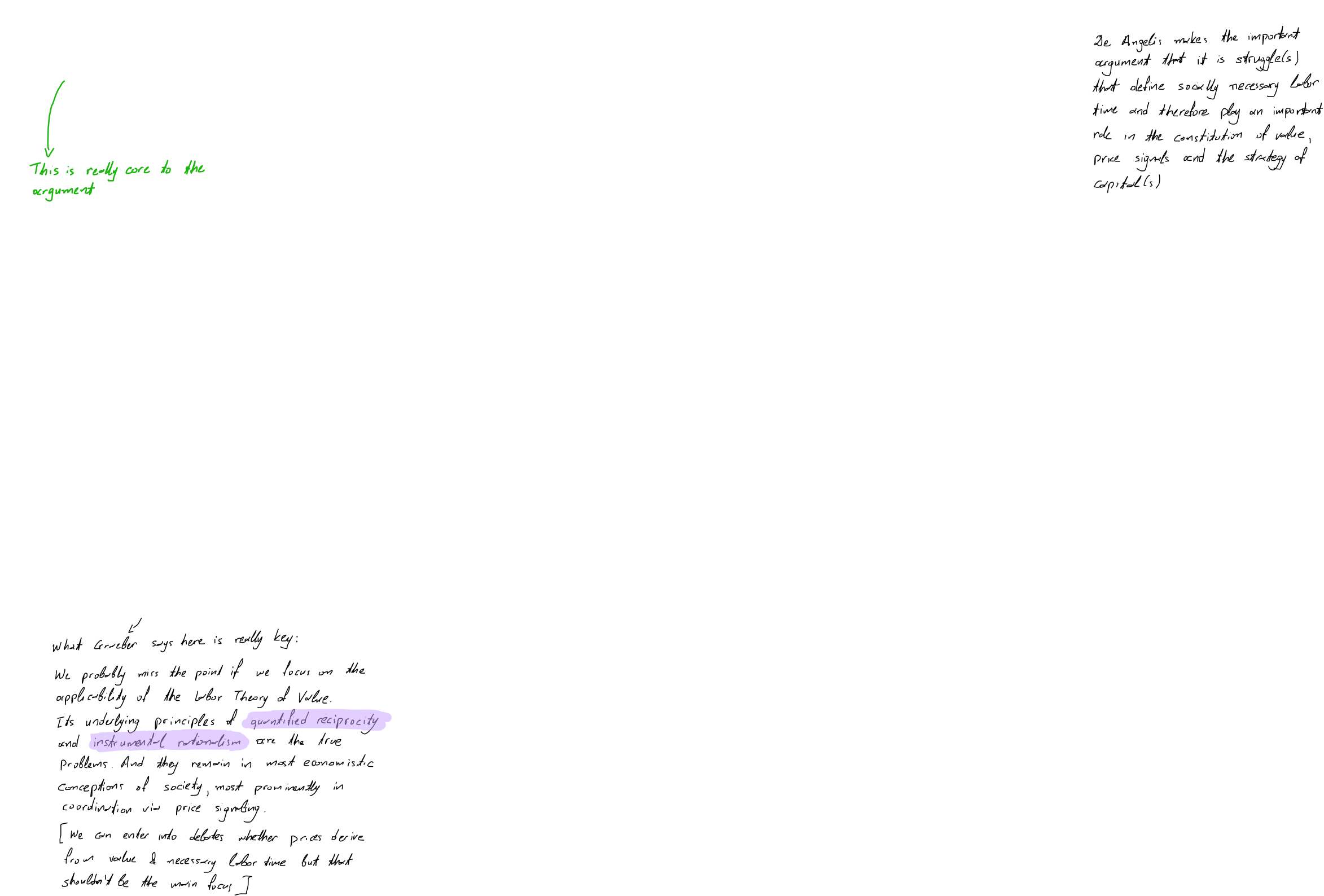
Price signaling is the coordinating activity in capitalism (Hayek)
Price is simply a form of Value (Marx)
Value is based on strict and quantified equivalence
Therefore, price signaling is rooted on strict and quantified equivalence