In the final analysis, capitalism consists of nothing more than a reduction of all relations into relations of production. From business to the family, consumption itself appears as another episode in the general production, the production of society. The overthrowing of capitalism will come from those who are able to create the conditions for other types of relations. Therefore the communism we are talking about is the exact opposite of what has been historically termed “communism,” which was mostly nothing but socialism, a form of monopolist state capitalism. Communism is not made through the expansion of new relations of production, but rather in their abolition. Not having relations of production within our milieu or among ourselves means never letting the search for results become more important than paying attention to the process, bankrupting all conventions of value, and watching that we do not disconnect affection and co-operation. Being attentive to worlds, to their perceptible configurations, is exactly what renders the isolation of something like relations of production impossible. In the places we open, around the means we share, it is this favor that we seek, that we experience. To name this experience, we often hear about everything being free. Instead of free, we prefer to speak of communism — for we cannot possibly forget what the practice of this freedom implies in terms of organization, and in the short term, of political antagonism. Anonymous, Call, p.22-23
It's necessary above all to maintain the reign of the economy beyond the extinction of the wage system. This has to do with the fact that if there is less and less work, everything is all the more mediated by money, be it in very small amounts. Given the absence of work, the need to earn money in order to survive must be maintained. Even if a universal basic income is established one day, as so many liberal economists recommend, its amount would need to be large enough to keep a person from dying of hunger, but utterly insufficient to live on, even fru­ gally. We are witnessing a change of regime within economy. The majestic figure of the Worker is being succeeded by the puny figure of the Needy Opportunist [le Crevard]-because if money and control are to infiltrate everywhere, it's necessary for money to be lacking everywhere. Henceforth, everything must be an occasion for generating a little money, a little value, for earning "a little cash." The present technological offensive should also be understood as a way to occupy and valorize those who can no longer be exploited through waged labor. What is too quickly described as the uberization of the world, unfolds in two different ways. Thus on the one hand you have Uber, Deliveroo and the like, that unskilled job opportu­nity requiring only one's old machine as capital. Every driver is free to self-exploit as much as they like, knowing that they must roll around fifty hours a week to earn the equivalent of the minimum wage. And then there are Airbnb, BlaBlaCar, dating sites, "coworking," and now even "cohoming" or "costorage," and all the applications that enable the sphere of the valorizable to be extended to infinity. What is involved with the "collaborative economy," with its inexhaustible possibilities of valorization, is not just a mutation of life-it's a mutation of the possible, a mutation of the norm. Before Airbnb, an unoccupied room was a "guest room" or a room available for a new use; now it's a loss of income. Before BlaBlaCar, a solo drive in one's car was an occasion to daydream, or pick up a hitchhiker, or whatever, but now it's a missed chance to make a little money, and hence a scandal, economically speaking. What one gave to recycling or to friends one now sells on Le bon coin. It's expected that always and from every point of view one will be engaged in calculating. That the fear of "missing an opportunity" will goad us forward in life. The important thing is not working for one euro an hour or making a few pennies by scanning contents for Amazon Mechanical Turk, but where this participation might lead someday. Henceforth everything must enter into the sphere ofprofitability. Everything in life becomes valorizable, even its trash. And we ourselves are becoming needy opportunists, human trash, who exploit each other under the pretext of a "sharing economy." If a growing share of the population is destined to be excluded from the wage system this is not in order to allow it the leisure to go hunt Pokemons in the morning and to fish in the afternoon. The inven­tion of new markets where one didn't imagine them to be the year before illustrates this fact that is so difficult to explain to a Marxist: capitalism doesn't so much consist in selling what is produced as in rendering accountable whatever is not yet accountable, in assigning a measureable worth to what seemed to be absolutely unsusceptible to that the day before, in creating new markets. That is its oceanic reserve of accumulation. Capitalism is the universal expansion of measurement. The Invisible Committee, Now, p.96-98
With the theory of human capital, man is less the possessor of an indefinite duster of capitals-cultural, relational, professional, financial, symbolic, sexual, health­ than he is himselfthat duster. He is capital. He constantly arbitrates between increasing what he is as capital, and the fact of selling it in some market or other. He is inseparably the producer, the product, and the seller of the product. Football players, actors, stars, and popular YouTubers are logically the heroes of the era of human capital, people whose value fully coincides with what they are. Micro-economics thus becomes the general science of behaviors, whether this is in commerce, at church, or in love. Everyone becomes an enterprise guided by a constant concern with self­ valorization, by a vital imperative of self-promotion. In essence man becomes the optimizing creature­ the Needy Opportunist. The Invisible Committee, Now, p.99-100
The folly of evaluation obviously dominates every aspect of contemporary work, but it also rules as a mistress over everything that escapes that sphere. It determines even the solitary jogger's relationship with themselves, the jogger who, in order to improve their performances, needs to know them in detail. Measurement has become the obligatory mode of being of all that intends to exist socially. The Invisible Committee, Now, p.101
Price signaling and strict equivalence
Money is the purely quantitative representation of social wealth Agnes Heller, The Theory of Need in Marx, Chapter 2
Objections to Value Being an Important Concept
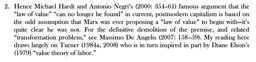
Kioupkiolis’ Feedback (27/4/2023) 1. Need to mention/answer newer conceptions on value (on the ones that deny it is applicable). E.g. Hardt & Negri (Multitude & Commonwealth mainly) and Fuchs. 2. Need to emphasize on the novel points of the argument early on 3. Commons theories: De Angelis, Bollier & Helfrich, P2PF (no need to pick one)
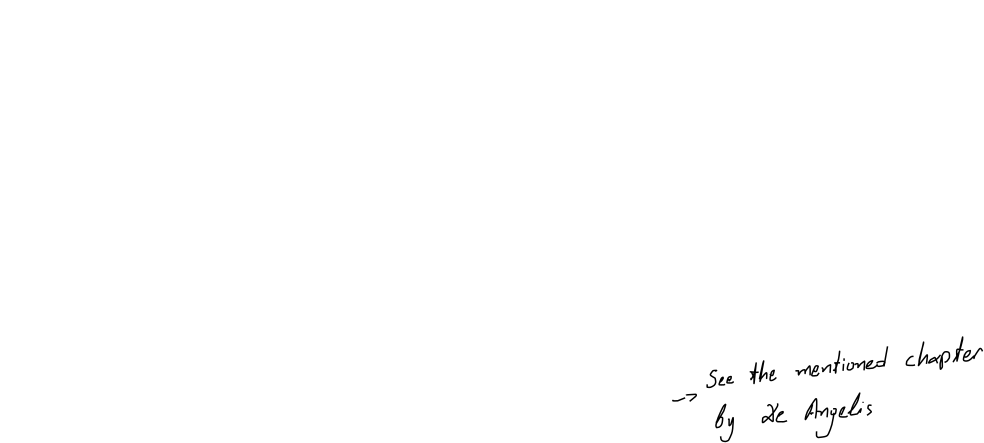
There is also another limitation that may be pointed out. It is the fact that our treatment seems not to include a particular form of doing in production, a form that many observers believe is a peculiar contemporary feature of what they call post-Fordism, namely the doing that creates the new, that imagines, that innovates, and that is based on team work, forms of cooperation and relational labour among the doers, which give them a higher autonomy in conceptualisation and production than that possessed by the classic mass workers tied to assembly lines. As we have seen in Chapter 12, Hardt and Negri among others refer to this as ‘immaterial labour’ and argue that this form of labour is beyond capitalist measure precisely because it is a form of social cooperation that is constituted by relational and communicational patterns defined by the doers themselves (hence measured by themselves). While it might be argued that ‘no transcendent power or measure will determine the values of our world [since] value will be determined only by humanity’s own continuous innovation and creation’ (Hardt and Negri 2000: 356), it is also true that when innovating and creating singular producers are pitted against each other in an endless rat race, the values that emerge from this ongoing clash are measurable by capital. Indeed, it is through this antagonistic mode of relation among social producers that capital values are constituted. Thus, the ongoing creation of SNLT is a feature not only of what is called, ‘material’ (capitalist) production, but also of what is referred to as ‘immaterial’ (capitalist) production, i.e., the production of ideas and affects. Here too we can have ongoing competition among producers who are then locked in the feedback loop of their own rat race against each other. What is continuously compared in order to give rise to differentials are here the perceived quality of ideas, whether in the form of creative work for advertising or that leading to product or process innovation, and improvements in the time and efficiency of their execution, of getting the job done. All the same, in terms of affects, what is measured is not only the speed of service, but also the perceived service quality as measured by given indicators: smiling, ‘costumer satisfaction’, and so on. In both these cases, the set of systematic pressures is the same as in the traditional case of ‘material’ work. […] Indeed, with respect to this immaterial labour, the degree of autonomy of the doers has precise limits defined by processes of capitalist measurement and not by the creative workers themselves. The selection of new ideas that can be turned into products or processes of doing occurs with respect to the SNLT process of measurement. The communicational patterns within work teams are bounded by the priorities set by their employers and managers, who measure the results of these communicational patterns in terms of price, quality and profit deviations from benchmarks. Nurses, doctors, teachers have a variety of degrees of autonomy, but are increasingly exposed to measures imposed from outside themselves which are heteronymous, which instruct them, in a context of declining resources and numbers of staff, to meet certain quality targets that relate in one way or another to external benchmarks (Harvie 2005). De Angelis, The Beginning of History, Capital’s measuring of ‘material’ and ‘immaterial’ labour
There are in principle three ways of defining value norms of production for society as a whole. First, through administrative decree, a ‘state body’ or a management body that decrees what must be standard. Second, through community’s consensus, that is the community of the co-producers defining ways of setting standards. Third, through ongoing homeostatic mechanisms, such as market forces, that force individual producers to catch up with or surpass the norm. In reality, all these three are present in capitalist-dominated societies and the question is how they are articulated. While the second type, however, presupposes individual producers’ definitions of their own standards, in the first and the third types discipline come from outside the individual producers. In the first case, the outside is represented by a ‘foreman’, a ‘line manager’, a person holding the whip. In the second case, disciplinary forces of norm creation come from a mechanism, a dispositif, that hides, rather than highlights, particular types of relations among people. There is nobody in particular holding the whip – or at least so it appears for most of us – but still the whip is cracked: restructuring, flexibility, cuts in social spending, debt repayment, structural adjustment, ongoing scarcity, competition, the rat race; and the carrots are distributed: promotions, new cars, credit lines, debt forgiveness. It is this impersonal disciplinary mechanism (re)producing the norms of our social cooperation that must be tackled. There are, however, actual designers of the mechanism, as we have seen in Chapters 10 and 11 on enclosures, and as we shall see in Chapter 14 on Hayek. De Angelis, The Beginning of History, Note 3 of Chapter 3 - The Valuing and Measuring of Capital
Price Signaling and the Market
But why is continuous ‘change’ necessary? In the presence of Hayek’s rejection of a ‘hierarchy of ends’ to evaluate human societies, the criteria brought forward by Hayek that justify this continuous compulsion are the identification of an abstractly defined ‘progress’ as an end in itself: ‘Progress is movement for movement’s sake’ (Hayek 1960: 41). This idealisation of movement for movement’s sake, irrespective of the direction of the movement, its social outcome, what is produced and how needs are formed and met, and irrespective of the nature of social interaction, makes Hayek the quintessential capitalist apologist. [Note] This philosophical stand is in fact close to what Marx identifies as the nature of the capitalist movement, i.e., ‘production for production’s sake’ or ‘accumulation for accumulation’s sake’. The continuous process of accumulation implies the continuous need for individual private agents to blindly adapt to its movement. De Angelis, The Beginning of History, Chapter 14: Market freedom and the prison: Hayek and Bentham: The Market
The price system is a communication system. Knowledge that is widely dispersed throughout society can thus become effectively utilised (Hayek 1978:181–2, 188), not simply as the know-how necessary for the production of individual commodities, but as a social force that makes it necessary to produce in certain ways and for certain purposes. De Angelis, The Beginning of History, Chapter 14: Market freedom and the prison: Hayek and Bentham: The Market
Freedom and Coercion in Hayek
[…] freedom as a relation between individuals as defined by private property. For Hayek, liberty has nothing to do with social individuals being able to define the conditions of their interaction. Freedom is defined negatively, as the state of ‘independence of the arbitrary will of another’ (Hayek 1960: 12). Freedom is taken away from an individual when ‘in order to avoid greater evil, he is forced to act not according to a coherent plan of his own but to serve the ends of another’ (ibid.: 12). In this sense, freedom is to be free to choose from a given menu, in which the emphasis is not so much on the range of choices listed on the menu, but on the ‘given character’ of the menu: "‘freedom’ refers solely to a relation of men to other men, and the only infringement on it is coercion by men. This means, in particular, that the range of physical possibilities from which a person can choose at a given moment has no relevance to freedom.” (Ibid.: 12) Coercion exists in Hayek when a specific individual bends another to his will; when it is done by impersonal market forces, it is not coercion, by definition. De Angelis, The Beginning of History, Chapter 14: Market freedom and the prison: Hayek and Bentham: Market and Panopticism: Two Overlapping Orders
The economic problem of society is thus not merely a problem of how to allocate "given" resources - if "given” is taken to mean given to a single mind which deliberately solves the problem set by these "data." It is rather a problem of how to secure the best use of resources known to any of the members of society, for ends whose relative importance only these individuals know. Or, to put it briefly, it is a problem of the utilization of knowledge not given to anyone in its totality. Hayek, The Use of Knowledge in Society (The American Economic Review, p.519-520)
If we can agree that the economic problem of society is mainly one of rapid adaptation to changes in the particular circumstances of time and place, it would seem to follow that the ultimate decisions must be left to the people who are familiar with these circumstances, who know directly of the relevant changes and of the resources immediately available to meet them. We cannot expect that this problem will be solved by first communicating all this knowledge to a central board which, after integrating all knowledge, issues its orders. We must solve it by some form of decentralization. But this answers only part of our problem. We need decentralization because only thus can we ensure that the knowledge of the particular circumstances of time and place will be promptly used. But the "man on the spot" cannot decide solely on the basis of his limited but intimate knowledge of the facts of his immediate surroundings. There still remains the problem of communicating to him such further information as he needs to fit his decisions into the whole pattern of changes of the larger economic system. Hayek, The Use of Knowledge in Society (The American Economic Review, p.524)
We must look at the price system as such a mechanism for communicating information if we want to understand its real function. […] The most significant fact about this system is the economy of knowledge with which it operates, or how little the individual participants need to know in order to be able to take the right action. In abbreviated form, by a kind of symbol, only the most essential information is passed on, and passed on only to those concerned. Hayek, The Use of Knowledge in Society (The American Economic Review, p.526-527)
The marvel is that in a case like that of a scarcity of one raw material, without an order being issued, without more than perhaps a handful of people knowing the cause, tens of thousands of people whose identity could not be ascertained by months of investigation, are made to use the material or its products more sparingly; i.e., they move in the right direction. This is enough of a marvel even if, in a constantly changing world, not all will hit it off so perfectly that their profit rates will always be maintained at the same constant or "normal" level. I have deliberately used the word "marvel" to shock the reader out of the complacency with which we often take the working of this mechanism for granted. I am convinced that if it were the result of deliberate human design, and if the people guided by the price changes understood that their decisions have significance far beyond their immediate aim, this mechanism would have been acclaimed as one of the greatest triumphs of the human mind. Its misfortune is the double one that it is not the product of human design and that the people guided by it usually do not know why they are made to do what they do. But those who clamor for "conscious direction" and who cannot believe that anything which has evolved without design (and even without our understanding it) should solve problems which we should not be able to solve consciously should remember this: The problem is precisely how to extend the span of our utilization of resources beyond the span of the control of any one mind; and, therefore, how to dispense with the need of conscious control and how to provide inducements which will make the individuals do the desirable things without anyone having to tell them what to do. Hayek, The Use of Knowledge in Society (The American Economic Review, p.527)
The price system is just one of those formations which man has learned to use (though he is still very far from having learned to make the best use of it) after he had stumbled upon it without understanding it. Through it not only a division of labor but also a coordinated utilization of resources based on an equally divided knowledge has become possible. The people who like to deride any suggestion that this may be so usually distort the argument by insinuating that it asserts that by some miracle just that sort of system has spontaneously grown up which is best suited to modern civilization. It is the other way round: man has been able to develop that division of labor on which our civilization is based because he happened to stumble upon a method which made it possible. Had he not done so he might still have developed some other, altogether different, type of civilization, something like the "state" of the termite ants, or some other altogether unimaginable type. All that we can say is that nobody has yet succeeded in designing an alternative system in which certain features of the existing one can be preserved which are dear even to those who most violently assail it - such as particularly the extent to which the individual can choose his pursuits and consequently freely use his own knowledge and skill. Hayek, The Use of Knowledge in Society (The American Economic Review, p.528)
If the market cannot be said to have a ‘unitary order of ends’, it prioritises a unitary rationale for human social interaction: the endless promotion of efficiency, the endless unqualified ‘progress’, the never-ending rat race, the competitive compulsion that ‘goes on all the time’. This is not an external ‘end product’ of Hayek’s market order, but its raison d’être. De Angelis, The Beginning of History, Chapter 14: Market freedom and the prison: Hayek and Bentham: Market and Panopticism: Two Overlapping Orders
It is always a question of the relative importance of the particular things with which he is concerned […]. Even the single controlling mind, in possession of all the data for some small, self-contained economic system, would not every time some small adjustment in the allocation of resources had to be made - go explicitly through all the relations between ends and means which might possibly be affected. It is indeed the great contribution of the pure logic of choice that it has demonstrated conclusively that even such a single mind could solve this kind of problem only by constructing and constantly using rates of equivalence (or "values," or "marginal rates of substitution"), i.e., by attaching to each kind of scarce resource a numerical index which cannot be derived from any property possessed by that particular thing, but which reflects, or in which is condensed, its significance in view of the whole means-end structure. In any small change he will have to consider only these quantitative indices (or "values") in which all the relevant information is concentrated; and by adjusting the quantities one by one, he can appropriately rearrange his dispositions without having to solve the whole puzzle ab initio, or without needing at any stage to survey it at once in all its ramifications. Fundamentally, in a system where the knowledge of the relevant facts is dispersed among many people, prices can act to coordinate the separate actions of different people in the same way as subjective values help the individual to coordinate the parts of his plan. Hayek, The Use of Knowledge in Society (The American Economic Review, p.525)
Concerning our modern economic system, understanding of the principles by which its order forms itself shows us that it rests on the use of knowledge (and of skills in obtaining relevant information), which no one possesses in its entirety, and that it is brought about because individuals are in their actions guided by certain general rules. Certainly, we ought not to succumb to the false belief, or delusion, that we can replace it with a different kind of order, which presupposes that all this knowledge can be concentrated in a central brain, or group of brains of any practicable size. The fact, however, that in spite of all the advance of our knowledge, the results of our endeavours remain dependent on circumstances about which we know little or nothing, and on ordering forces we cannot control, is precisely what so many people regard as intolerable. Constructivists ascribe this interdependence to still allowing ourselves to be guided by values which are not rationally demonstrated or given positive proof as justification for them. They assert that we no longer need to entrust our fate to a system, the results of which we do not determine beforehand, although it opens up vast new opportunities for the efforts of individuals, but at the same time resembles a game of chance in some respects, since no single person bears responsibility for the ultimate outcome. The anthropomorphic hypostatisation of a personified mankind, who pursue aims they have consciously chosen, thus leads to the demand that all those grown values not visibly serving approved ends, but which are conditions for the formation of an abstract order, should be discarded to offer individuals improved prospects of achieving their different and often conflicting goals. Scientific error of this kind tends to discredit values, on the observance of which the survival of our civilisation may depend. Hayek - New studies in philosophy, politics, economics and the history of ideas, p.13
So long as we cannot yet agree on crucial questions, such as whether a competitive market order is possible without the recognition of private several property in the instruments of production, it is clear that we still understand only very imperfectly the fundamental principles on which the existing order is based. Hayek - New studies in philosophy, politics, economics and the history of ideas, p.20
Catallaxy vs Economy & Hayek’s Opposition to a Needs-Based Arrangement
For Hayek, the end result of the market order (say a particular distribution of income, or any other particular ‘snapshot’ of the socio-economic condition) cannot be judged ‘by criteria which are appropriate only to a single organised community serving a given hierarchy of ends’, because such a hierarchy of ends is not relevant to the ‘complex structure composed of countless individual economic arrangements’ (Hayek 1978: 183). The word ‘economy’ is in fact inadequate to describe a multitude of individual ends, because it refers to ‘an organisation or arrangement in which someone deliberately allocates resources to a unitary order of ends’. Instead, the market order, or catallaxy, does not have any particular end. De Angelis, The Beginning of History, Chapter 14: Market freedom and the prison: Hayek and Bentham: Market and Panopticism: Two Overlapping Orders
An economy, in the strict sense of the word, is an organisation or arrangement in which someone deliberately allocates resources to a unitary order of ends. Spontaneous order produced by the market is nothing of the kind; and in important respects it does not behave like an economy proper. In particular, such spontaneous order differs because it does not ensure that what general opinion regards as more important needs are always satisfied before the less important ones. This is the chief reason why people object to it. Indeed, the whole of socialism is nothing but a demand that the market order (or catallaxy, as I like to call it, to prevent confusion with an economy proper) should be turned into an economy in the strict sense, in which a common scale of importance determines which of the various needs are to be satisfied, and which are not to be satisfied. The trouble with this socialist aim is a double one. As is true of every deliberate organisation, only the knowledge of the organiser can enter into the design of the economy proper, and all the members of such an economy, conceived as a deliberate organisation, must be guided in their actions by the unitary hierarchy of ends which it serves. On the other hand, advantages of the spontaneous order of the market, or the catallaxy, are correspondingly two. Knowledge that is used in it is that of all of its members. Ends that it serves are the separate ends of those individuals, in all their variety and contrariness. Out of this fact arise certain intellectual difficulties which worry not only socialists, but all economists who want to assess the accomplishments of the market order; because, if the market order does not serve a definite order of ends, indeed if, like any spontaneously formed order, it cannot legitimately be said to have particular ends, it is also not possible to express the value of the results as a sum of its particular individual products. What, then, do we mean when we claim that the market order produces in some sense a maximum or optimum? The fact is, that, though the existence of a spontaneous order not made for a particular purpose cannot be properly said to have a purpose, it may yet be highly conducive to the achievement of many different individual purposes not known as a whole to any single person, or relatively small group of persons. Indeed, rational action is possible only in a fairly orderly world. Therefore it clearly makes sense to try to produce conditions under which the chances for any individual taken at random to achieve his ends as effectively as possible will be very high - even if it cannot be predicted which particular aims will be favoured, and which not. As we have seen, the results of a discovery procedure are in their nature unpredictable; and all we can expect from the adoption of an effective discovery procedure is to improve the chances for unknown people. The only common aim whicll we can pursue by tIle choice of this technique ofordering social affairs is the general kind of pattern, or the abstract character, of the order that will form itself. Hayek - New studies in philosophy, politics, economics and the history of ideas, p.183-184
When communicative acts take the shape of grammatical speech, the symbolic structure has penetrated all components of interaction; the cognitive-instrumental grasp of reality and the steering mechanism that attunes the behavior of different interaction partners to one another, as well as the actors and their behavior dispositions, get connected to linguistic communication and are symbolically restructured. At the same time, this transposition of cognitions, obligations, and expressions onto a linguistic basis makes it possible in turn for the means of communication to take on new functions-in addition to the function of reaching understanding, those of coordinating action and socializing actors as well. Under the aspect of reaching understanding, communicative acts serve the transmission of culturally stored knowledge-as shown above, cultural tradition reproduces itself through the medium of action oriented to reaching understanding. Under the aspect of coordinating action, the same communicative acts serve the fulfillment of norms appropriate to a given context; social integration also takes place via this medium. Under the aspect of socialization, finally, communicative acts serve the construction of internal controls on behavior, in general, the formation of personality structures; one of Mead's fundamental insights is that socialization processes take place via linguistically mediated interaction. Habermas, The Theory of Communicative Action, Vol 2, p.63

Whereas the word economy suggests that people in a community possess a common and congruent set of values and goals, catallaxy suggests that the emergent properties of a market (prices, division of labor, growth, etc.) are the outgrowths of the diverse and disparate goals of the individuals in a community.

After being discussed by Ludwig von Mises the term catallaxy was later made popular by Friedrich Hayek who defines it as "the order brought about by the mutual adjustment of many individual economies in a market".

https://en.wikipedia.org/wiki/Catallaxy

In a capitalist system, in which what has worth, 'wealth', takes the form of commodities, the reproduction of people's livelihoods and corresponding value practices is largely subordinated to the production of commodities. De Angelis, The Beginning of History, p.179
As we have seen, value is the importance people attribute to action and as such is measured using discursively and culturally given units of measurement. Commodity value is this importance turned upside down: it is the importance people attribute to the products of their action, in so far as these products are objects of market exchange and the production is production for profit. When things have a price tag, it is these things that have value, not the human labour that has produced them. The importance of all commodities here is measured through money, i.e., units of a particular commodity (gold, silver, etc.) or, in modem times, signs of value (dollars, euros, etc.). We call this the external measure of value, and this is the most obvious measure of value with which we are all familiar. De Angelis, The Beginning of History, p.179
Capitalist Value according to Marx: How do we measure/compare our doing (concrete labor performed) in a quantified manner assuming cultural/societal measurement norms (SNLT)
But benchmarks here are not only informational flows; rather, they are concrete socially defIned norms of production that describe how we produce, what we produce, and how much we produce. It is also clear that individual parts of the social body might deviate from this social definition of norms. Indeed, in disciplinary markets the ongo­ing opposition among these deviations - constitutes what Marx calls socially necessary labour time (SNLT) the norm that emerges from this ongoing opposition across the social body in the production of commodities. SNLT has a double meaning, depending on whether we look at it from the perspective of the whole of a co-producing social body or its parts . From the perspective of the whole, this is an average, the average labour time, which is necessary for the production of a particular commodity. But from the perspective of individual productive nodes, the same average is a benchmark, a discursive device that signals a particular type of information, an aid to decision making and action with respect to conditions of production and working rhythms. But as we have seen, these two perspectives, the perspective of the part and of the whole, are articulated by a process, a feedback loop that constitutes the value norm and that captures Our life activities within it. De Angelis, The Beginning of History, p.186-187
Not until hierar­chy had scored its triumph in the early world and begun its journey into class society did equivalence, "equity," and contract begin to form the context for human social relationships. The quid pro quo of exchange and its ethical balance sheets were simply irreJevant to a community guided by the customs of usufruct, complementarity, and the irreducible mini­mum. The means of life and community support were there to be had rather than apportioned, and even where apportionment did exist, it was guided by egalitarian traditions that respected age, acknowledged infirmities, and fostered a loving care for children. Only "civilization" was to put the figure of Justitia on a pedestal and place its purely quanti­tative weights on her scale. Her blindfold may have very well been a token of her shame rather than her indifference to the realities of inequality. The treaties that existed between preliterate communities were more procedural than distributive in their intent; they were meant to establish agreement in decision-making processes and ways of coordinating com­mon actions, not to apportion power and things. And under conditions of general reciprocity, personal alliances were simply a way of breaking out of the kinship nexus and broadening support systems beyond the perimeter of the tribe. Hence the "commodities" that were exchanged between people seemingly as "gifts" were actually tokens of mutual loy­ alty. By no means did they necessarily have an intrinsic "value" of their own beyond a symbolic one, much less ratios or "price tags" that gave them exchange value. Bookchin, The Ecology of Freedom, p.320-321
Exchange is all about equivalence. It's a back-and-forth process involving two sides in which each side gives as good as it gets. This is why one can speak of people exchanging words (if there's an argu­ ment), blows, or even gunfire.25 In these examples, it's not that there is ever an exact equivalence--even if there were some way to measure an exact equivalence--but more a constant process of interaction tend­ ing toward equivalence. Actually, there's something of a paradox here: each side in each case is trying to outdo the other, but, unless one side is utterly put to rout, it's easiest to break the whole thing off when both consider the outcome to be more or less even. When we move to the exchange of material goods, we find a similar tension. Often there is an element of competition; if nothing else, there's always that pos­ sibility. But at the same time, there's a sense that both sides are keeping accounts, and that, unlike what happens in communism, which always partakes of a certain notion of eternity, the entire relationship can be canceled out, and either party can call an end to it at any time. Graeber, Debt, p.103

Price signaling is the coordinating activity in capitalism (Hayek)

Price is simply a form of Value (Marx)

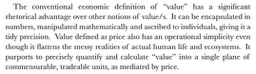
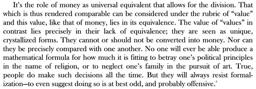
Value is based on strict and quantified equivalence

Therefore, price signaling is rooted on strict and quantified equivalence

Currently the employer federation MEDEF is proposing that a SIRET number, a business identification number, be assigned to every French citizen at their birth. The value of beings becomes the set of their "individual characteristics"-their health, their humor, their beauty, their know-how, their relations, their "social skills," their imagination, their creativity, and so on. That's the theory, and the reality, of "human capital." The value field has incorporated so many dimensions that it has become a complex space. It's become the whole ensemble of the socially sayable, legible, and visible. The Invisible Committee, Now, p.104
To leave the economy is to bring out the plane of reality it covers over. Commodity exchange and all that it comprises in the way of harsh negotiation, mistrust, deceit, and wabu wabu, as the Melanesians say, is not exclusively Western. In places where people know how to live, one only practices this type of relations with outsiders, people one is not connected with, who are distant enough so that a mix-up cannot develop into a general conflict. To pay, in Latin, comes from pacare, "to satisfy, to calm," for example by distributing money to sol­diers so they can buy themselves some salt-thus a wage. One pays in order to have peace. The whole vocabulary of economy is basically a vocabulary of avoided war. "There is a link, a continuity, between hostile relations and the provision of reciprocal prestations: Exchanges are peacefully resolved wars, and wars are the result of unsuccessful transactions." (Levi-Strauss). Economy's defect is to reduce all possible relationships to hostile rela­tions, every distance to foreignness. What it covers over in this way is the entire gamut, all the grada­tion, all the heterogeneity among the different existing and imaginable relations. Depending on the degree of proximity between beings, there is a commonality of goods, a sharing of certain things, exchange with an adjusted reciprocity, mercantile exchange, or a total absence of exchange. And every form of life has its language and its notions for expressing this multiplicity of regimes. Making the bastards pay is good warfare. When you love you don't count the cost. Where money talks, words are worth nothing. Where words matter, money's worth nothing. Thus, exiting the economy is being able to dearly distinguish between the possible divisions and, from where one is, to deploy a whole art of distances. It's to push the hostile relations - and the sphere of money, accounting, measurement - as far away as possible. It's to banish to the margins of life that which is presently its norm, its core, its essential condition. The Invisible Committee, Now, p.107-108