Nothing shocks us about this; nothing catches us unawares or radically alters our feeling toward life. We were born inside the catastrophe and we have established a strange and comfortable relation of habit with it. Almost an intimacy. For as long as we can remember there has been no news besides that of the Global Civil War. We have been raised as survivors, as machines of survival. We have been raised with the idea that life consists in continually going on; walking in indifference until crushed among other bodies who walk identically, who stumble and get crushed in turn. In the end, the only novelty of the present epoch is that none of this can be hidden anymore, that in a sense everybody knows it. Hence the most recent visible hardening of the system: its motives are exposed, it would be pointless to wish them away.
Anonymous, Call, p.6-7
The real lie is not the one we tell others but the one we tell ourselves. The first lie is relatively exceptional in comparison with the second. The big lie is refusing to see certain things that one does see, and refusing to see them just as one sees them. The real lie is all the screens, all the images, all the explanations that are allowed to stand between oneself and the world. It's how we regularly dismiss our own perceptions. So much so that where it's not a question of truth, it won't be a question of anything.
The Invisible Committee, Now, p.11-12
Politics, in truth, is the interplay between different realms, the alliance between those that are compatible and the confrontation between those that are irreconcilable.
Therefore we say that the central political fact of the last thirty years went unnoticed. Because it took place at such a deep level of reality that it cannot be called political without bringing about a revolution in the very notion of the political. Because this level of reality is also the one where the division is elaborated between what is taken for reality and what is not. This central fact is the triumph of Existential Liberalism. The fact that it is now considered natural for everyone to have a rapport with the world based on the idea that each person has her own life. That such a life consists in a series of choices, good or bad. That each person can define herself by an ensemble of qualities, of properties, that make her, through her continual balancing of those properties, a unique and irreplaceable being. That the contract adequately epitomizes relations between individuals, and that respect epitomizes all virtue. That language is nothing but a means of arriving at an agreement. That, in reality, the world is composed on one side of things to manage, and on the other of an ocean of self-absorbed individuals, who in turn have a regrettable tendency to turn themselves into things, letting themselves become managed.
Of course, cynicism is only one of the possible features of the infinite clinical diagnoses of Existential Liberalism. It also includes depression, apathy, immunodeficiency (every immune system is intrinsically collective), dishonesty, judicial harassment, chronic dissatisfaction, denied affection, isolation, illusions of citizenship, and the loss of all generosity.
Existential liberalism has propagated its desert so well that even the most sincere Leftists express their utopia with its very terms. “We will rebuild an egalitarian society in which each person makes her contribution and from which each person gets her needs met from it... As far as individual desires are concerned, it could be egalitarian if each person consumes in proportion to the efforts she is ready to contribute. Naturally it will be necessary to redefine the method of evaluating the efforts contributed by each person,” write the organizers of the Alternative, Anti-capitalist, and Anti-war Village against the G8 summit in Evian in a text entitled When Capitalism and Wage Labor Will Have Been Abolished! Here is a key to the triumph of Empire: managing to keep in the shadows, to surround with silence the very terrain on which it maneuvers, the field upon which it fights the decisive battle: that of manipulating feelings, of defining the limits of the perceptible. In such a way it preventively paralyzes any defense at the very moment of its operation, and ruins the very idea of a counter-offensive. The victory is won whenever the militant, at the end of a hard day of Political Work, slumps down in front of an action movie.
Anonymous, Call, p.7-8
The pervasiveness of the commodity has inserted itself everywhere. This pervasiveness is the most effective instrument for disconnecting ends from means, to reduce everyday life to a living-space we are only required to manage. Everyday life is what we are supposed to want to return to; the acceptance of a necessary and universal neutralization. It is the ever-growing renunciation of the possibility of an unpostponed joy. As a friend once said, it is the average of all our possible crimes.
Anonymous, Call, p.14
Rare are the collectivities that can escape the abyss that waits for them: mashing of the real into an extreme flatness, community as the epitome of average intensity, a slow disintegration clumsily filled with a bunch of banal and falsely sophisticated banter.
Neutralization is an essential characteristic of Liberal Society. Everybody knows the centers of neutralization, where it is required that no emotion stands out, where each person has to contain herself, and everybody experiences them as such: businesses (and what isn’t a business these days?), night clubs, bowling alleys and golf courses, museums, etc. Since everyone knows what these places are about, the real question is to know why — despite that — they can still be so popular. Why wish for, always and above all, that nothing happens that might provoke stirrings that go too deep? Out of habit? Because of despair? Because of cynicism? Or else: because you can feel the delight of being somewhere while not being there, of being there while being essentially somewhere else; because what we are at base would be preserved to the point of no longer even having to exist.
[…]
The acceptance of these neutralizations can of course go hand in hand with great creative efforts. You can experiment up to the point of madness, on condition that you are a single creator, and that you produce the proof of this singularity in public (your works). You can still know what the stirrings are, but only on condition that you experience them alone, and that you are limited to passing them on indirectly. You will thereby be recognized as an artist or as a thinker, and, perhaps if you are politically engaged, you will be able to toss as many bottles into the ocean as you like, with the clear conscience of one who sees farther and who has warned others.
Like many, we have experienced that emotions stuck internally turn out badly: they can even turn into symptoms. The rigidities we observe in ourselves come from the partitions that every person believes herself obliged to put up in order to define her own limits, and to contain within her self what must not burst forth.
Anonymous, Call, p.15
At root it is here that we begin, where we find each other. What is most singular in us calls to be shared.
But we note this: not only is what we have to share obviously incompatible with the dominant order, but this order strives to track down any kind of sharing for which it does not lay down the rules. For instance, the barracks, the hospital, the prison, the asylum, and the retirement home are the only forms of collective living allowed in the metropole. The normal condition is the isolation of everyone in their private cubicle. This is where they return endlessly, however strong the repulsion they feel, however great the encounters they make elsewhere.
We have known these conditions of existence, and we will never return to them. They weaken us too much. Make us too vulnerable. Make us waste away.
Isolation, in primal cultures, was the harshest sentence that could be passed on a member of the community. It is now the common condition. The rest of the disaster follows logically. It is on account of this narrow idea that everybody has of their own home that makes it seem natural to leave the street to the police. The world could not have been made so uninhabitable, nor sociality so controlled — from malls to bars, from boardrooms to backrooms — had not everyone been previously granted the shelter of private space.
Anonymous, Call, p.17
We do not perceive humans to be isolated from each other or from the other beings of this world; we see them bound by multiple connections that we have learned to deny. This denial allows the blocking of emotional exchanges through which these multiple connections are experienced. This blockage, in turn, is necessary to make us accustomed to the most neutral, the most lifeless, the most average feelings; that which makes us long for vacations, lunch-breaks, or evenings out as a godsend — that is to say something just as neutral, average, and lifeless — but freely chosen. The imperial order, which is particularly Westernized, is nourished through this boredom.
Anonymous, Call, p.15
Not so long ago, when one met some one it was still natural to ask: "So what do you do in life?" And the answer came just as naturally. One still managed to say what position one held in the general organization of production. That could even serve as a calling card. In the time since, the wage-earning society has imploded to such an extent that one avoids questions of this sort, which tend to make people uneasy. Everyone patches things together, gets by, branches off, takes a break, starts up again. Work has lost its luster and its centrality, not just socially but existentially as well.
The Invisible Committee, Now, p.91-92
Waged labor was the form by which a certain order was maintained. The fundamental violence it contains, the violence that is obscured by the broken down body of the assembly-line worker, the miner killed in a methane explosion, or the burnout of employees under extreme managerial pressure, has to do with the meaning of life. By selling their time, by turning themselves into the subject of the thing they're employed to do, the wage worker places the meaning of their existence in the hands of those who care nothing about them, indeed whose purpose is to ride roughshod over them.
The Invisible Committee, Now, p.94
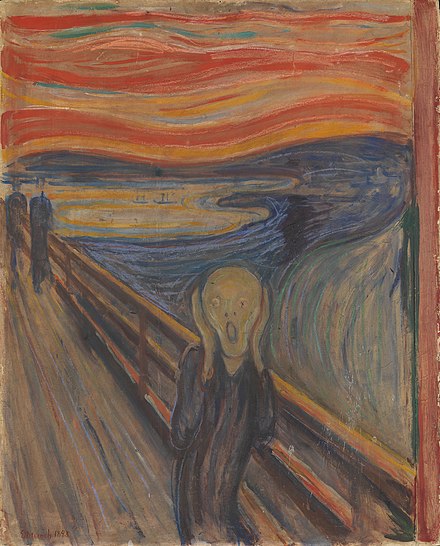
The wage system has enabled generations of men and women to live while evading the question of life's meaning, by "making themselves useful," by "making a career," by "serving." The wage worker has always been free to postpone this question till later-till retirement, let's say-while leading an honorable social life. And since it is apparently "too late" to raise it once retired, all that's left to do is to wait patiently for death. We will thus have been able to spend an entire life without entering into existence. There is a good reason why Munch's painting, The Scream, portrays, still today, the true face of contemporary humanity. What this desperate individual on their jetty doesn't find is an answer to the question, "How am I to live?"
The Invisible Committee, Now, p.94-95
It's necessary above all to maintain the reign of the economy beyond the extinction of the wage system. This has to do with the fact that if there is less and less work, everything is all the more mediated by money, be it in very small amounts. Given the absence of work, the need to earn money in order to survive must be maintained. Even if a universal basic income is established one day, as so many liberal economists recommend, its amount would need to be large enough to keep a person from dying of hunger, but utterly insufficient to live on, even fru gally. We are witnessing a change of regime within economy. The majestic figure of the Worker is being succeeded by the puny figure of the Needy Opportunist [le Crevard]-because if money and control are to infiltrate everywhere, it's necessary for money to be lacking everywhere. Henceforth, everything must be an occasion for generating a little money, a little value, for earning "a little cash." The present technological offensive should also be understood as a way to occupy and valorize those who can no longer be exploited through waged labor. What is too quickly described as the uberization of the world, unfolds in two different ways. Thus on the one hand you have Uber, Deliveroo and the like, that unskilled job opportunity requiring only one's old machine as capital. Every driver is free to self-exploit as much as they like, knowing that they must roll around fifty hours a week to earn the equivalent of the minimum wage. And then there are Airbnb, BlaBlaCar, dating sites, "coworking," and now even "cohoming" or "costorage," and all the applications that enable the sphere of the valorizable to be extended to infinity. What is involved with the "collaborative economy," with its inexhaustible possibilities of valorization, is not just a mutation of life-it's a mutation of the possible, a mutation of the norm. Before Airbnb, an unoccupied room was a "guest room" or a room available for a new use; now it's a loss of income. Before BlaBlaCar, a solo drive in one's car was an occasion to daydream, or pick up a hitchhiker, or whatever, but now it's a missed chance to make a little money, and hence a scandal, economically speaking. What one gave to recycling or to friends one now sells on Le bon coin. It's expected that always and from every point of view one will be engaged in calculating. That the fear of "missing an opportunity" will goad us forward in life. The important thing is not working for one euro an hour or making a few pennies by scanning contents for Amazon Mechanical Turk, but where this participation might lead someday. Henceforth everything must enter into the sphere ofprofitability. Everything in life becomes valorizable, even its trash. And we ourselves are becoming needy opportunists, human trash, who exploit each other under the pretext of a "sharing economy." If a growing share of the population is destined to be excluded from the wage system this is not in order to allow it the leisure to go hunt Pokemons in the morning and to fish in the afternoon. The invention of new markets where one didn't imagine them to be the year before illustrates this fact that is so difficult to explain to a Marxist: capitalism doesn't so much consist in selling what is produced as in rendering accountable whatever is not yet accountable, in assigning a measureable worth to what seemed to be absolutely unsusceptible to that the day before, in creating new markets. That is its oceanic reserve of accumulation. Capitalism is the universal expansion of measurement.
The Invisible Committee, Now, p.96-98
With the theory of human capital, man is less the possessor of an indefinite duster of capitals-cultural, relational, professional, financial, symbolic, sexual, health than he is himselfthat duster. He is capital. He constantly arbitrates between increasing what he is as capital, and the fact of selling it in some market or other. He is inseparably the producer, the product, and the seller of the product. Football players, actors, stars, and popular YouTubers are logically the heroes of the era of human capital, people whose value fully coincides with what they are. Micro-economics thus becomes the general science of behaviors, whether this is in commerce, at church, or in love. Everyone becomes an enterprise guided by a constant concern with self valorization, by a vital imperative of self-promotion. In essence man becomes the optimizing creature the Needy Opportunist.
The Invisible Committee, Now, p.99-100
The folly of evaluation obviously dominates every aspect of contemporary work, but it also rules as a mistress over everything that escapes that sphere. It determines even the solitary jogger's relationship with themselves, the jogger who, in order to improve their performances, needs to know them in detail. Measurement has become the obligatory mode of being of all that intends to exist socially.
The Invisible Committee, Now, p.101
Monetary accumulation is the postponement of any actual enjoyment; since money brings into equivalence as possibilities the whole array of things that can be bought with it. Every expenditure, every purchase is first a forfeiture, relative to what money is capable of Every specific enjoyment it allows one to acquire is first a negation of the set of other potential enjoyments it contains within it. In the epoch of human capital and living currency, every moment of life and every real relation are haloed by a set of possible equivalents that gnaw at them. Being here involves the untenable renunciation of being everywhere else, where life is apparently more intense, as our smartphone has charged itself with informing us. Being with a particular person is an unbearable sacrifice of all the other persons with whom one could just as well be with. Every love is vitiated in advance by all the other possible loves. Hence the impossibility of being there, the ineptitude for being-with. Universal unhappiness. Torture by possibilities. Sickness unto death. "Despair," as Kierkegaard diagnosed it.
The Invisible Committee, Now, p.105-106
What within us is anxious to protect the inner chains that bind us,
What there is within us so sick that it clings to our conditions of existence, precarious though they are,
What's so exhausted from troubles, jolts, needs, that on a given day tomorrow seems farther away than the moon,
What finds it pleasant to pass the time in hip cafes sipping lattes with jungle in the background while surfing on one's MacBook-the Sunday of life alloyed with the end of history,
Is expecting solutions.
Cities in transition, social and solidarity economy, Sixth Republic, alternative municipalism, universal basic income, the film Tomorrow, migration into space, a thousand new prisons, expulsion of all foreigners from the planet, man-machine fusion. Whether they're engineers, managers, act1v1sts, politicians, ecologists, actors, or simple hucksters, all those who claim to offer solutions to the present disaster are really doing just one thing: imposing their definition of the problem on us, hoping to make us forget that they themselves are plainly part of the problem. As a friend said, "The solution to the problem you see in life is a way of living that makes the problem disappear."
The Invisible Committee, Now, p.127-128
However repressed it may be, the question of communism remains the heart of our epoch. If only because the rule of its contrary-economy-has never been so complete. The delegations from the Chinese state who go every year to place flowers on Marx's tomb in London don't fool anybody. One can avoid the communist question, of course. One can get used to stepping over the bodies of the homeless or migrants on one's way to the office every morning. One can follow the melting of the polar ice in real time, or the rise of the oceans and the panicked pell-mell migrations of animals and humans alike. One can go on preparing one's cancer with every forkful of mashed potatoes that one swallows. One can tell oneself that the recovery, or a dose of authority, or ecofeminism will eventually fix all this. Continuing in such a manner is possible, at the cost of suppressing our feeling that the society we live in is intrinsically criminal, and one that doesn't miss a chance to remind us that we belong to its little association of miscreants. Every time we come in contact with it-by using any of its devices, consuming the least of its commodities, or doing whatever job we do for it-we make our selves its accomplices, we contract a little of the vice on which it is based: that of exploiting, wrecking, undermining the very conditions of every earthly existence. There's no longer any place for innocence in this world. We only have the choice between two crimes: taking part in it or deserting it in order to bring it down.
The Invisible Committee, Now, p.127-128
One can live a whole life without experiencing anything, by being very careful not to think and feel. Existence is then reduced to a slow process of degradation. It wears down and ruins, instead of giving form. After the miracle of the encounter, relations can only go from wound to wound towards their consumption. Life, on the contrary, gradually gives form to whoever refuses to live beside themselves, to whoever allows themselves to experience. They become a form of life in the full sense of the term.
The Invisible Committee, Now, p.143
Existential Liberalism is the spontaneous ethics suitable for Social Democracy seen as a political ideal. You will never be a better citizen than when you are capable of renouncing a relation or a struggle in order to maintain your status. It will not always be without suffering, but that is precisely where Existential Liberalism is efficient: it even provides the remedies to the discomforts that it generates. The check to Amnesty International, the fair trade coffee, the demo against the last war, seeing the latest Michael Moore film, are so many non-acts disguised as gestures that will save you. Carry on exactly as usual; that is to say go for a walk in the designated spaces and do your shopping, the same as always. But on top of that, in addition, ease your conscience; buy No Logo, boycott Shell. This should be enough to convince you that political action, at bottom, does not require very much, and that you too are capable of engaging in it. There is nothing new in this buying and selling of indulgences, but the problem becomes palpable in the prevailing confusion. The invocatory culture of Another World Is Possible leaves little room to speak of ethics beyond consumer etiquette. The increase in the number of environmentalist, humanitarian, and solidarity associations opportunely channels general discontent and thus contributes to the perpetuation of this state of affairs, through personal valorization, official recognition and its first prize of honestly awarded subsidies; the worship, in short, of social usefulness. Above all, no more enemies. At the very most, problems, abuses seen as catastrophes — dangers from which only the mechanisms of power can protect us.
Anonymous, Call, p.14
Like many, we have experienced that emotions stuck internally turn out badly: they can even turn into symptoms. The rigidities we observe in ourselves come from the partitions that every person believes herself obliged to put up in order to define her own limits, and to contain within herself what must not burst forth. When, for some reason or other, these partitions happen to crack and break, then things come up that might be unpleasant, which may even appear frightful — but it is a fright capable of freeing us from fear. Calling into question both our individual limits and the borders drawn by civilization can be a life-saver. The existence of any real community necessitates a certain physical danger: when emotions and thoughts are no longer ascribable to any one person, when interactions are recovered in which feelings, ideas, impressions, and emotions are exchanged carelessly. It must be understood that community per se is not the solution: it is its disappearance, everywhere and always, that is the problem.
Anonymous, Call, p.15
Until the environment is collectively dominated, there will be no individuals — only specters haunting the objects anarchically presented to them by others. In chance situations we meet separated people moving randomly. Their divergent emotions neutralize each other and maintain their solid environment of boredom. As long as we are unable to make our own history, to freely create situations, striving toward unity will introduce other separations. The quest for a central activity leads to the formation of new specializations.
Debord, Critique of Separation (Film), 1961 - https://remixedcity.wordpress.com/2014/02/17/critique-of-separation-english-subtitles-by-guy-debord-1961/
Here is daylight, and here are perspectives that now no longer mean anything. The sectors of a city are, at a certain level, decipherable. But the personal meaning they have had for us is incommunicable, like all that secrecy of private life regarding which we possess nothing but pitiful documents.
Debord, Critique of Separation (Film), 1961 - https://remixedcity.wordpress.com/2014/02/17/critique-of-separation-english-subtitles-by-guy-debord-1961/
All existing equilibrium, however, is brought back into question each time unknown people try to live differently. But it’s always far away. We learn of it through the papers and newscasts. We remain outside it, confronted with just another spectacle. We are separated from it by our own nonintervention. It makes us disappointed in ourselves. At what moment was choice postponed? We haven’t found the arms we needed. We have let things go.
I have let time slip away. I have lost what I should have defended.
This general critique of separation obviously contains and covers some particular memories. A less recognized pain, the awareness of a less explainable indignity. Exactly what separation was it? How quickly we have lived! It is to this point in our unreflecting history that I bring us back.
Everything that concerns the sphere of loss — that is to say, the past time I have lost, as well as disappearance, escape, and more generally the flowing past of things, and even what in the prevalent and therefore most vulgar social sense of the use of time is called wasted time — all this finds in that strangely apt old military expression, en enfants perdus, its meeting ground with the sphere of discovery, of exploration of unknown terrains; with all the forms of quest, investigation, adventure, avant-garde. It is the crossroads where we have found and lost ourselves.
Debord, Critique of Separation (Film), 1961 - https://remixedcity.wordpress.com/2014/02/17/critique-of-separation-english-subtitles-by-guy-debord-1961/
We have invented nothing. We adapt ourselves, with a few variations, into the network of possible courses. We get used to it, it seems.
No one has the enthusiasm on returning from a venture that they had on setting out on it. My dears, adventure is dead.
Debord, Critique of Separation (Film), 1961 - https://remixedcity.wordpress.com/2014/02/17/critique-of-separation-english-subtitles-by-guy-debord-1961/
It isn’t only work that has become more tenuous. The neoliberal attacks on public services, welfare programmes and trade unions mean that we are increasingly living in a world deprived of security or solidarity.
Mark Fisher & Darren Ambrose, Time-Wars: Towards an Alternative for the Neo-Capitalist Era, K-Punk: The Collected and Unpublished Writings of Mark Fisher, 2018, p.519
The consequence of the normalisation of uncertainty is a permanent state of low-level panic. Fear, which attaches to particular objects, is replaced by a more generalised anxiety, a constant twitching, an inability to settle. The uncertainty of work is intensified by digital communication technology. As soon as there is email, there are no longer working hours nor a workplace. What characterises the present moment more than our anxious checking — of our messages, which may bring opportunities or demands (often both at the same time), or, more abstractly, of our status, which, like the stock market is constantly under review, never finally resolved?
Mark Fisher & Darren Ambrose, Time-Wars: Towards an Alternative for the Neo-Capitalist Era, K-Punk: The Collected and Unpublished Writings of Mark Fisher, 2018, p.519
Campagna’s call for a “radial atheism” is based on the recognition that the precariousness that cannot be eliminated is that of life and the body. If there is no afterlife, then our time is finite. Curiously, however, we subjects of late capitalism act as if there is infinite time to waste on work. Work looms over us as never before.“In an eccentric and an extreme society like ours”, argue Carl Cederstrom and Peter Fleming in their book Dead Man Working, “working has assumed a universal presence — a worker’s society in the worst sense of the term — where even the unemployed and children become obsessed with it.” Work now colonises weekends, late evenings, even our dreams. “Under Fordism, weekends and leisure time were still relatively untouched”, Cederstrom and Fleming point out, “Today, however, capital seeks to exploit our sociality in all spheres of work. When we all become “human capital” we not only have a job, or perform a job. We are the job.”
Mark Fisher & Darren Ambrose, Time-Wars: Towards an Alternative for the Neo-Capitalist Era, K-Punk: The Collected and Unpublished Writings of Mark Fisher, 2018, p.519-520
We are required to live in the condition that Linda Stone has called “continuous partial attention”, where our attention is habitually distributed across multiple communication platforms.
As Franco “Bifo” Berardi has argued, we now live in the tension between the infinity of cyberspace and the vulnerable finitude of the body and the nervous system. “The acceleration of information exchange has produced and is producing an effect of a pathological type on the individual human mind and even more on the collective mind,” Berardi writes in Precarious Rhapsody,
"Individuals are not in a position to process the immense and always growing mass of information that enters their computers, their cell phones, their television screens, their electronic diaries and their heads. However, it seems indispensable to follow, recognise, evaluate, process all this information if you want to be efficient, competitive, victorious. [...] The necessary time for paying attention to the fluxes of information is lacking.”
The consequence is a strange kind of existential state, in which exhaustion bleeds into insomniac overstimulation (no matter how tired we are, there is still time for one more click) and enjoyment and anxiety co-exist (the urge to check emails, for instance, is both something we must do for work and a libidinal compulsion, a psychoanalytic drive that is never satisfied no matter how many messages we receive). The fact that the smartphone makes cyberspace available practically anywhere at anytime means that boredom (or at least the old style, “Fordist” boredom) has effectively been eliminated from social life. Yet boredom, like death, posed existential challenges that are far more easily deferred in the always-on cyberspatial environment. Ultimately, communicative capitalism does not vanquish boredom so much as it “sublates” it, seeming to destroy it only to preserve it in a new synthesis. The characteristic affective tonality for the insomniac drift of cyberspace, in which there is always one more click to make, one more update to check, combines fascination with boredom.
Mark Fisher & Darren Ambrose, Time-Wars: Towards an Alternative for the Neo-Capitalist Era, K-Punk: The Collected and Unpublished Writings of Mark Fisher, 2018, p.520-521
Anxiety is the emotional state that correlates with the (economic, social, existential) precariousness which neoliberal governance has normalised.
Mark Fisher & Darren Ambrose, No One is Bored, Everything is Boring, K-Punk: The Collected and Unpublished Writings of Mark Fisher, 2018, p.556
many cases of depression and anxiety are the effects of neoliberalism’s successful tendency to privatise stress, to convert political antagonisms into medical conditions.
Mark Fisher & Darren Ambrose, No One is Bored, Everything is Boring, K-Punk: The Collected and Unpublished Writings of Mark Fisher, 2018, p.557
Perhaps the feeling most characteristic of our current moment is a mixture of boredom and compulsion. Even though we recognise that they are boring, we nevertheless feel compelled to do yet another Facebook quiz, to read yet another Buzzfeed list, to click on some celebrity gossip about someone we don’t even remotely care about. We endlessly move among the boring, but our nervous systems are so overstimulated that we never have the luxury of feeling bored. No one is bored, everything is boring.
Mark Fisher & Darren Ambrose, No One is Bored, Everything is Boring, K-Punk: The Collected and Unpublished Writings of Mark Fisher, 2018, p.558
Till now we have been considering the estrangement; the alienation of the worker only in one of its aspects, i.e., the worker's relationship to the products of his labour. But the estrangement is manifested not only in the result but in the act of production, within the producing activity itself. How could the worker come to face the product of his activity as a stranger, were it not that in the very act of production he was estranging himself from himself? The product is after all but the summary of the activity, of production. If then the product of labour is alienation, production itself must be active alienation, the alienation of activity, the activity of alienation. In the estrangement of the object of labour is merely summarised the estrangement, the alienation, in the activity of labour itself.
What, then, constitutes the alienation of labour?
First, the fact that labour is external to the worker, i.e., it does not belong to his intrinsic nature; that in his work, therefore, he does not affirm himself but denies himself, does not feel content but unhappy, does not develop freely his physical and mental energy but mortifies his body and ruins his mind. The worker therefore only feels himself outside his work, and in his work feels outside himself. He feels at home when he is not working, and when he is working he does not feel at home. His labour is therefore not voluntary, but coerced; it is forced labour. It is therefore not the satisfaction of a need; it is merely a means to satisfy needs external to it. Its alien character emerges clearly in the fact that as soon as no physical or other compulsion exists, labour is shunned like the plague. External labour, labour in which man alienates himself, is a labour of self-sacrifice, of mortification. Lastly, the external character of labour for the worker appears in the fact that it is not his own, but someone else's, that it does not belong to him, that in it he belongs, not to himself, but to another. Just as in religion the spontaneous activity of the human imagination, of the human brain and the human heart, operates on the individual independently of him—that is, operates as an alien, divine or diabolical activity—so is the worker's activity not his spontaneous activity. It belongs to another; it is the loss of his self.
[…]
This relation [the relation of labour to the act of production] is the relation of the worker to his own activity as an alien activity not belonging to him; it is activity as suffering, strength as weakness, begetting as emasculating, the worker's own physical and mental energy, his personal life—for what is life but activity?—as an activity which is turned against him, independent of him and not belonging to him. Here we have self-estrangement, as previously we had the estrangement of the thing.
Marx, Economic and Philosophic Manuscripts, Marx Engels Collected Works Volume 3 (International Publishers), p.274-275
Vea said, “But tell us about Anarres—what’s it really like? Is it so wonderful there really?” […]
“I don’t know,” he [Shevek] said; his tongue felt half paralyzed. “No. It is not wonderful. It is an ugly world. Not like this one. Anarres is all dusty and dry hills. All meager, all dry. And the people aren’t beautiful. They have big hands and feet, like me and the waiter there. But not big bellies. They get very dirty, and take baths together, nobody here does that. The towns are very small and dull, they are dreary. No palaces. Life is dull, and hard work. You can’t always have what you want, or even what you need, because there isn’t enough. You Urrasti have enough. Enough air, enough rain, grass, oceans, food, music, buildings, factories, machines, books, clothes, history. You are rich, you own. We are poor, we lack. You have, we do not have. Everything is beautiful here. Only not the faces. On Anarres nothing is beautiful, nothing but the faces. The other faces, the men and women. We have nothing but that, nothing but each other. Here you see the jewels, there you see the eyes. And in the eyes you see the splendor, the splendor of the human spirit. Because our men and women are free—possessing nothing, they are free. And you the possessors are possessed. You are all in jail. Each alone, solitary, with a heap of what he owns. You live in prison, die in prison. It is all I can see in your eyes—the wall, the wall!”
Le Guin, The Dispossessed, p.298-299 (HarperCollins 2002 ISBN 0-06-050400-5)