That an emblem is useful as a rallying-center for any sort of a group it is superfluous to point out. By expressing the social unity in a material form, it makes this more obvious to all, and for that very reason the use of emblematic symbols must have spread quickly when once thought of. But more than that, this idea spontaneously arises out of the conditions of common life; for the emblem is not merely a convenient process for clarifying the sentiments society has of itself: it also serves to create these sentiments; it is one of its constituent elements. In fact, if left to themselves, individual consciousnesses are closed to each other; they can communicate only by means of signs which express their internal states. If the communication established between them is to become a real communion, that is to say, a fusion of all particular sentiments into one common sentiment, the signs expressing them must themselves be fused into one single and unique resultant. It is the appearance of this that informs the individuals that they are in harmony and makes them conscious of their moral unity. It is by uttering the same cry, pronouncing the same words, or performing the same gesture regarding the same object that they become and feel themselves to be in unison. Durkheim, Elementary Forms, p.262, quoted in Habermas, The Theory of Communicative Action, Vol.2, p.55
All sacred objects-flags, emblems, decorations, tatoos, ornaments, figures, idols, or natural objects and events-share this symbolic status. They figure as signs with conventional significations, and they all have the same semantic core: they represent the power of the sacred; they are "collective ideals that have fixed themselves on material objects:' This formulation comes from the interesting essay in which Durkheim gives his theory of collective consciousness the shape of a theory of symbolic forms: "collective representations originate only when they are embodied in mate- rial objects, things, or beings of every sort-figures, movements, sounds, words, and so on - that symbolize and delineate them in some outward appearance. For it is only by expressing their feelings, by translating them into signs, by symbolizing them externally, that the individual consciousnesses, which are, by nature, closed to each other, can feel that they are communicating and are in unison. The things that embody the collective representations arouse the same feelings as do the mental states that they represent and, in a manner of speaking, materialize. They, too, are respected, feared, and sought after as helping powers”. Habermas, The Theory of Communicative Action, Vol.2, p.51-52
One can see the structural similarities between ritual action and symbolically mediated interaction steered via signals. Paleosymbols have a meaning that is not yet modally differentiated, and, like signals, they possess the power to steer behavior. On the other hand, ritual actions have lost their adaptive function; they serve to establish and maintain a collective identity, on the strength of which the steering of interaction is transferred from a genetic program anchored in the individual organism over to an intersubjectively shared cultural program. This program can be transmitted only if the intersubjective unity of a communication community is secured. The group can constitute itself as a collectivity when the motivational makeup of the associated individuals is taken hold of symbolically and structured through the same semantic contents. The predominantly appelative-expressive character of rites suggests that instinctual residues are symbolically absorbed and sublimated […]. Habermas, The Theory of Communicative Action, Vol.2, p.55
In societies that have attained the level of civilizations, worldviews have the function, among others, of legitimating political leadership. They offer a potential for grounding that can be used to justify a political order or the institutional framework of a society in general. Thus they lend support to the moral authority or validity of basic norms. As Weber emphasized, the legitimating power of worldviews is to be explained primarily by the fact that cultural knowledge can meet with rationally motivated approval. The situation is different with the not yet intellectually elaborated worldviews common in tribal societies; they do make available a potential for narrative explanations, but they are still so tightly interwoven with the system of institutions that they explicate it rather than subsequently legitimate it. These worldviews establish an analogical nexus between man, nature, and society which is represented as a totality in the basic concepts of mythical powers. Because these worldviews project a totality in which everything corresponds with everything else, they subjectively attach the collective identity of the group or the tribe to the cosmic order and integrate it with the system of social institutions. In the limit case, worldviews function as a kind of drive belt that transforms the basic religious consensus into the energy of social solidarity and passes it on to social institutions, thus giving them a moral authority. What is of primary interest in analyzing the interrelation between normative consensus, worldview, and institutional system, however, is that the connection is established through channels of linguistic communication. Whereas ritual actions take place at a pregrammatical level, religious worldviews are connected with full-fledged communicative actions. Habermas, The Theory of Communicative Action, Vol.2, p.56
We need to abandon the idea that there is politics only where there is vision, program, project, and perspective, where there is a goal, decisions to be made, and problems to be solved. What is truly political is only what emerges from life and makes it a definite, oriented reality. And it is born from what is nearby and not from a projection toward the far-distant. The nearby doesn't mean the restricted, the limited, the narrow, the local. It means rather what is in tune, vibrant, adequate, present, sensible, luminous, and familiar-the prehensible and comprehensible. It's not a spatial notion but an ethical one. Geographic distance is unable to remove us from that which we feel to be near. Conversely, being neighbors doesn't always make us close. It's only.from contact that the friend and the enemy are discovered. The Invisible Committee, Now, p.65
Faced with capitalist organization, a destituent potential cannot confine itself to its own immanence, to all that grows under the ice in the absence of sunshine, to all the attempts at local construction, to a series of punctual attacks, even if this whole little world were to regularly find itself caught up in great turbulent demonstrations. And the insurrection will definitely not wait for every­ one to become insurrectionary. The mistake of the Leninists, Trotskyists, Negriists, and other sub­ politicians, a telling one fortunately, is to believe that a period that sees all the hegemonies lying broken on the ground could still tolerate a political hegemony, even a partisan one of the sort that Pablo Iglesias or Chantal Mouffe fantasize. What they don't see is that in a time of general horizontality, horizontality itself is the verticality. No one can expect to organize the autonomy of others any longer. The only verticality still possible is that of the situation, which commands all of its components because it exceeds them, because the sum of forces in presence is greater than each one of them. The only thing capable of transversally uniting all the elements deserting this society into a historical party is an intelligence of the situation. It is everything that makes the situation gradually understandable, everything that tracks the movements of the adver­sary, everything that identifies the usable paths and the obstacles-the systematic character of the obstacles. Based on that intelligence, an occasional vertical expedient needed to tilt certain situations in the desired direction can well be improvised. The Invisible Committee, Now, p.157-158

Classes and Fragmentation in Society
The attitude of realism that dominant capitalism requires is essentially depressive. The management of this collective depression goes through a series of thresholds. First of all, we come to expect very little: nothing will ever happen again. Then we think that maybe the things that once happened weren’t actually so great. Finally, we accept that nothing has ever happened, nor could ever happen. The more that depression is normalised, the harder it is to even identify it. Radically lowered expectations become habituated. Time flattens out. This generalised depression is one reason that so little has happened since the major capitalist crisis of 2008. Yet this depression is itself both a symptom and a cause of something else: the decomposition of class solidarity. We would have to go deep into the nineteenth century to find a moment when class consciousness was as weak as it is now. Not only capital, but also elements of the post-68 left, have maintained that class is an outmoded category, unfit to deal with the multiplicities and complications of twentyfirst-century life. Yet these complications are in some respects a mirage, concealing the persistence of a class structure in which the majority of the population is marked as inferior. The reality of class continues, but without class consciousness. Beverley Skeggs and Helen Wood’s work on the class basis of reality TV and Owen Jones’s analysis of the “demonisation of the working class” show that class is displayed even as it is disavowed in contemporary culture. Mark Fisher & Darren Ambrose, For Now, Our Desire is Nameless - The Reality of Class Continues, K-Punk: The Collected and Unpublished Writings of Mark Fisher, 2018, p.598
Far from representing the emergence of a coherent agent, the expansion of the surplus population marks the tendential disappearance of the previous revolutionary horizon. It was once possible — indeed quite reasonable — to think of the proletariat as an emergent social subject, becoming ever larger and more unified with the global spread and development of the capitalist mode of production, and particularly with the incorporation of a growing portion of the class into industrial employment. Today, in an era of slowing economic growth — which is also an era of general deindustrialisation — the revolutionary orientations of the past no longer make sense. The working class — always internally differentiated — displays a diminishing capacity for unification under a single hegemonic figure, thus realising its always latent tendency to decompose into fragments, facing off one against the other. At the heart of this fractiousness is the division of the class into two parts: (1) a shrinking one that retains higher wages and social protections, but must constantly fight rearguard actions against capitalist “reforms” and restructurings; and (2) a growing one that faces poor prospects of employment and is offered few social protections. The more secure sector — which is also more organised — often needs the support of the more precarious in order to win its struggles. However, calls for greater “inclusion” of such people may stoke valid fears that this will undermine more secure positions, opening up access to education and training, and thereby increasing labour supply and reducing bargaining power. At the same time, members of the more precarious part may be rightly suspicious of the motives of the more secure: after the sacrifices have been made, won’t it be merely the latter’s rearguard battles that have been won? After all, those with security rarely take to the streets when it is the less fortunate who are getting screwed. The expansion of the surplus population is important in explaining this division, but it is not the only meaningful one within the class. There is a potentially infinite variety of such distinctions, so the question of explaining current divisions can in a sense be reversed: What was the unity that is now in advanced stages of decay? How did it come about? This is a question that we have attempted to answer elsewhere in this issue, in ‘A History of Separation’. For our purposes here though, it is enough to note simply that there was once a hegemonic identity and orientation among workers that could provide grounds for affirming certain struggles as central, while excluding others as secondary or unimportant. It is equally clear that this affirmation seems less and less plausible today. In place of the identity of the worker, we are now faced with so many competing alternatives, each with its own strategic priorities: those who want more jobs against those who want to stave off environmental catastrophe; those who want to preserve the family wage for unionised male workers against those who want gender equality; those of dominant national or racial identities against those of racialised minorities, and so on. In this sense, the fractiousness of “identity politics” is symptomatic of an era. In a period of increasingly slow economic growth under the threat of ecological catastrophe, it seems diminishingly plausible to claim that fighting the battles of one part of the class will advance the class as a whole. This is why we reject any attempt to find in surplus populations an ersatz social subject that might replace the hegemonic role played by the white male factory worker in the workers’ movement. At present there seems to be no class fraction — whether “the most strategically placed” or “the most oppressed” — whose struggles express a general interest. At the same time, attempts to conjure up a new unity from this diversity by simply renaming it as “multitude” or “precariat”, for example, merely gloss over this fundamental problem of internal division. If there is any revolutionary potential at present, it seems that it stands to be actualised not in the struggle of any particular class fraction, but rather, in those moments when diverse fractions are drawn together in struggle in spite of their mutual suspicions; despite the lack of a stable, consistent hegemonic pole. In such moments, the demands of various sections of the class come into conflict with one another — a conflict that may bring the prospect of destabilising or undermining mutually exclusive demands and identities. The modes by which social life is organised and segmented within capitalist societies can then come to appear as obstacles to further struggle, dividing workers against one another. The question of how to move forward is then at least raised, though with no easy answers. After all, a definitive answer would involve an overcoming of the unity-in-separation that organises social life. Endnotes, An Identical Abject-Subject?, Endnotes #4 (2015), https://endnotes.org.uk/articles/an-identical-abject-subject
It is amongst these pressurised sections of the working class — the more insecure, informal, racialised stratum, which struggled to be reabsorbed by the labour market — that the riot became particularly prominent as a mode of struggle, from the mid to late 1970s, and it seems reasonable to hypothesise that this newfound prominence is directly related to the absence of possibilities for “normal”, regulatory, demands-making of the corporatist type. In developments dialectically entwined with the struggles of this section of the working class, the police in this period increasingly developed new tactics of repression specifically targeted at poor urban neighbourhoods. One might even say that the riot and its repression became a sort of proxy way in which class relations were regulated, in the absence of the “normal” mode of regulation exercised by wage bargaining, etc. This is not a perverse point: historically riots have pushed demands towards which the state has made concessions. This proved true of 2011 just as it did of 1981; more recently it has proved true in the US, after the 2014 Ferguson riots. In Endnotes 3 we termed the social logic of stigmatisation associated with such developments “abjection” — a concept borrowed from Imogen Tyler’s recent book Revolting Subjects. With its in some ways dubious provenance, we were not especially fond of this term, but it seemed nonetheless quite appropriate as a name for certain problematics with which we were grappling. What was useful was that this term named a particular kind of abstract structure in which something is cast off, marked as contingent or lowly, without actually being exteriorised. The relevance of such a structure here should be obvious: the initially racialised communities subject to the forms of oppression that develop through this period are socially marked as a problem — or even as a sort of rejection from the healthy core of the body politic — without being literally exteriorised in any sense from either economy or state. Police repression looms large in the immediate experience of abjection in this sense, but the term is also intended to capture broader social processes, such as the moral crusades of reactionary press, or the constant obsessing of politicians over the various failed subjects of the nation. These are not simply unconnected moments; concrete connections between all of them could be articulated such that we see a particular socio-political pattern of oppression. […] If the development of new styles of policing might be partially linked to the management of a surplus population at the outset then, this tie becomes increasingly tenuous as we get into the 1980s and 90s. One might speak of a developing “autonomisation” of the apparatus of repression and its related stigmatising and racialising logics. By this we mean that an apparatus which initially seems to apply in particular to clear, economically marginal, parts of the class, becomes dissociated from that strict function. While those who are subject to these processes of abjection come to symbolise the limits of affirmable class, these limits are in actuality unstable, shifting and ill-defined. They become more a socio-political, or perhaps socio-cultural, than a political-economic construct. If this is the case, it is doubtful whether we are likely to have any luck constructing the object of this apparatus in purely political-economic terms. Who is “abjected” then? We might provisionally reply, somewhat tautologically: those who are defined as such by the fact that they are the object of these processes of repression. There is no particular pre-existing trait or social categorisation which must, in itself, necessarily or inevitably mark one out as an object of these processes, which is not to say that certain social categories do not end up being reproduced in such positions. Abjection is closely related — though not identical — to racialisation. […] If we are now speaking of the subjects of “abjection” rather than “surplus population” here, how about the abject as a social subject? These developments signify, however, not the creation of a new form of social (or potentially, revolutionary) subject, but rather the problem of any class subject at all. In itself, that which is abjected would seem to be by definition unaffirmable, ununifiable, for it is not a positive existence of its own, but merely the negative of something else. Those who are abjected are not something other than the proletariat. More often than not they are workers, students etc. Only, they are workers, students etc who are vilified, cast beyond the pale of social respectability. These developments represent problems for the constitution of a unified class subject; indeed, they are direct expressions of the decomposition of the class. The abject is projected as a sort of limit-concept of affirmable social class, in an operation where that class is itself negatively defined against what has been abjected. “We are not like them” replaces “the workers united will never be defeated”. And as such, abjection can have a somewhat fractal quality: not applying uniformly to one social group, but across and between social groups, depending to some extent on where one stands in the social landscape. There is always someone more abject than you. Endnotes, An Identical Abject-Subject?, Endnotes #4 (2015), https://endnotes.org.uk/articles/an-identical-abject-subject
It is often asserted that, within the definition of wage labor, women in domestic labor are not productive. In fact precisely the opposite is true if one thinks of the enormous quantity of social services which capitalist organization transforms into privatized activity, putting them on the backs of housewives. Domestic labor is not essentially “feminine work”; a woman doesn’t fulfill herself more or get less exhausted than a man from washing and cleaning. These are social services inasmuch as they serve the reproduction of labor power. And capital, precisely by instituting its family structure, has “liberated” the man from these functions so that he is completely “free” for direct exploitation; so that he is free to “earn” enough for a woman to reproduce him as labor power. It has made men wage slaves, then, to the degree that it has succeeded in allocating these services to women in the family, and by the same process controlled the flow of women onto the labor market […]. And women are of service not only because they carry out domestic labor without a wage and without going on strike, but also because they always receive back into the home all those who are periodically expelled from their jobs by economic crisis. The family, this maternal cradle always ready to help and protect in time of need, has been in fact the best guarantee that the unemployed do not immediately become a horde of disruptive outsiders. Dalla Costa & James, The Power of Women and the Subversion of Community, p.33-34
In order to found the bourgeois mode of production, it was not necessary for all workers to be given equality under the sign of “the citizen”. Historically, “citizen” only names a specific category to which both property owners and certain proletarians are able to belong. As capitalist juridical relations disavow class through the reconstitution of the difference between citizen and other, the historical conditions under which the bourgeois mode of production was itself constituted were various forms of unfreedom. For this reason we have citizen and other as mapping onto: male (white)/ non-(white) male. For instance, under the conditions of slavery in North America, the classification of white was necessary to maintain the property of masters over slaves. Women were also classified as other, but for different reasons, as we shall see. […] Endnotes, The Logic of Gender, Endnotes #3 (2013), https://endnotes.org.uk/articles/the-logic-of-gender
Ironically, the reproduction of dual spheres of gender and the anchoring of women to one and not the other is perpetuated and constantly re-established by the very mechanism of the “sex-blind” labour-market, which obtains not for the man/woman distinction directly but rather for the price distinction, or the exchange-value of their labour-power. Indeed, labour markets, if they are to remain markets, must be “sex-blind”. Markets, as the locus of exchanges of equivalents, are supposed to blur concrete differences in a pure comparison of abstract values. How then can this “sex-blind” market reproduce the gender difference? Once a group of individuals, women, are defined as “those who have children” and once this social activity, “having children”, is structurally formed as constituting a handicap, women are defined as those who come to the labour-market with a potential disadvantage. This systematic differentiation — through the market-determined risk identified as childbearing “potential” — keeps those who embody the signifier “woman” anchored to the IMM sphere. Therefore, because capital is a “sex-blind” abstraction, it concretely punishes women for having a sex, even though that “sexual difference” is produced by capitalist social relations, and absolutely necessary to the reproduction of capitalism itself. […]. As an apparent contradiction, once sexual difference becomes structurally defined and reproduced, woman as a bearer of labour-power with a higher social cost becomes its opposite: the commodity labour-power with a cheaper price. […] capitalists […] will […] privilege the labour-power that is likely to be the most reliable over a long period. If the worker is potentially going to leave, then she will not be as good an investment, and will get a lower price. Endnotes, The Logic of Gender, Endnotes #3 (2013), https://endnotes.org.uk/articles/the-logic-of-gender
Aris Goudouras
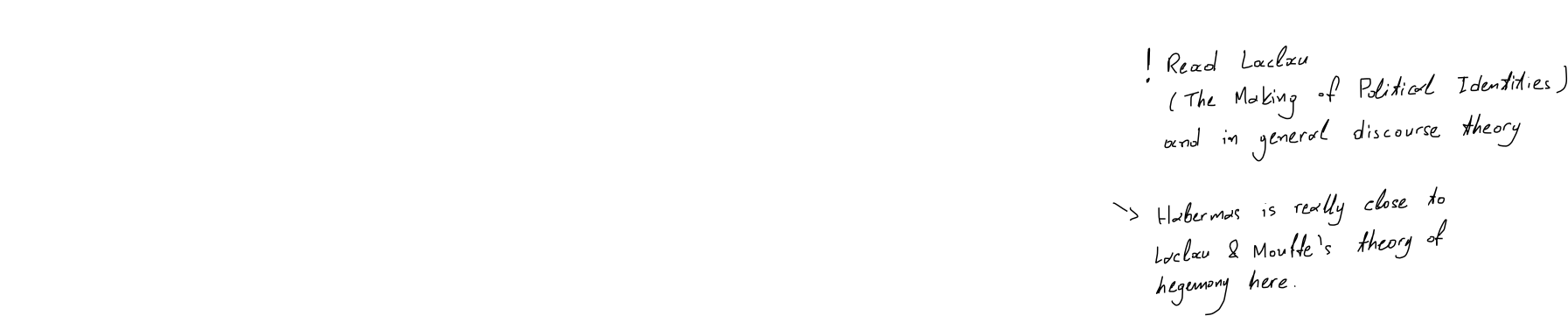
It seems that the Endnotes group admits that there is no strict politico-economic category for a unified working class subject (corresponding to surplus population). And Laclau and Mouffe’stegory constructed in the socio-political or (at least partially) discursive field. Laclau and Mouffe’s theory of hegemony could be useful here.