How DisCOs Reimagine Value
DisCO_Manifesto-v1-1.pdfPDF
In DisCOs, production is explicitly guided by need, including social and environmental priorities. This orientation towards positive outcomes is the heart of a DisCO’s values. The needs-based priorities defined by the cooperative are embedded in each DisCOs legal statutes, as well as the technologies and cultural practices that let DisCOs assess and reflect on the outcomes of their effort. The disco elements
In DisCOs, production is communal and value measurement aims to be transparent. Three types of value are highlighted and rewarded: - Livelihood Work: productive market value (the DisCO’s goods and services are paid for); - Love Work: productive pro-bono value (the commons created through self-selected volunteer work); and - Care Work: reproductive work value (towards the collective and among its members, see above). All are tracked through complementary value metrics that apply to all DisCO members. Recognizing different types of value influences functions including payments, work priorities and certain key decisions. This recognition gives visibility and empowerment to other The DisCO Elements

Reimagining Value in DisCOs

DisCOs Character

Playful

Caring

Aesthetically pleasant / artistic

In terms of subject matter, feminist economics takes a more holistic approach, factoring in all activities that currently fall outside of the mainstream economic sphere, but that without which the economy would not be able to run. In short, it is concerned with all of the things that human beings need to survive and flourish, but particularly with the provision of care of and unpaid domestic labour, sometimes referred to as “social provisioning”. In making this its focus, it seeks to challenge notions of “work” and “production” that are based solely on manufacturing, and asks us to rethink how we value the different sorts of activity that occur within our economy.

https://wbg.org.uk/blog/what-is-feminist-economics/
Technology and DisCOs

Criticism to CBPP and P2P Approach
We may experience social change driven by the intangible and immaterial (like P2P networks), but until social change has reached the realm of the tangible, we haven’t had any radical change, or any change has not been translated into a change in the material conditions of existence. De Angelis, Omnia Sunt Communia, p.69
My first concern about all the P2P stuff ... is ... the fact that it depends on both other modes of labour and extraction (like digging coltan in the Eastern Congo) and other modes of enforced and very material (guns, fences, guards, borders etc.) social division within and between societies. (Pithouse 2010; private correspondence) in De Angelis, Omnia Sumn Communia, p.73
Bollier, Benkler and Bauwens thus converge on a techno-legal and economic fix when they anticipate transitions in the direction of the commons. Despite allusions to ‘commonist’ movements, we are left completely in the dark as to how these will gather a critical mass, how they will overhaul the ‘neoliberal dominance’ and how they will reform the state and the market (Bauwens 2005; see also Bauwens 2014: 28). Instead, we are served a list of techno-economic conditions that will pro- mote peer-to-peer production (Bauwens 2005). The ‘vital condition’ for a historical transition towards a commons-based society is not political but the existence of commons-based peer production, as proto-practices for a full mode of production. . . . These proto-practices have to evolve within the older system, first as emergent practices, then on a parity level, before they can become dominant themselves. (Bauwens 2011; emphasis added) In the technocratic outlook that has prevailed from the beginning of the millennium in the digital commons literature, technology, economic practices, the law and vague references to ‘social movements’ are the main entries. Change society by designing a new model that makes the existing model obsolete, not by fighting ‘the system’. Kioupkiolis, The Common and Counter-Hegemonic Policies, p.59
The Commons - Theory & Definitions
The commons is…. - A social system for the long-term stewardship of resources that preserves shared values and community identity. - A self-organized system by which communities manage resources (both depletable and and replenishable) with minimal or no reliance on the Market or State. - The wealth that we inherit or create together and must pass on, undiminished or enhanced, to our children. Our collective wealth includes the gifts of nature, civic infrastructure, cultural works and traditions, and knowledge. - A sector of the economy (and life!) that generates value in ways that are often taken for granted – and often jeopardized by the Market-State. Bollier, https://blog.p2pfoundation.net/commons-short-sweet/2017/09/25
Starting from the position that we should not confuse the commons with resources held in common, I approach commons as social systems in which resources are pooled by a community of subjects who also govern these resources to guarantee the sustainability of the resources (if they are natural resources) and the reproduction of the community, and who engage in commoning, that is, doing in commons that has a direct relation to the needs, desires and aspirations of the commoners. De Angelis, Omnia Sunt Communia, p.90
Communism and Commons
The only difference between communists and any other struggling subjects whatever their identity, is that communists confront capital while holding a mirror in their hands. The alternative to capital, at whatever scale of social action, is a social force that creates a world within the space defined by that reverse image: the image of commons and democratic communities instead of enclosures and market disciplinary integration. Communists are those who seek to create alternative ways to meet needs and follow desires at whatever scale of social action, wherever they are, knowing that the means can be shared, while the goals and the modes of doing that those means make possible can emerge from direct engagement with the other. Just as the social force we call capital seeks to preserve itself by extending and defending enclosures and the realm of the markets, so the social force we call communism can preserve itself only by extending and defending the realm of commons and grass-roots democratic processes and practices. The bottom-line ground within which to problematise alternatives, or the beginning of history is, in my opinion, all here. De Angelis, The Beginning of History, Chapter: Anarchism, Communism and Socialism
Communists therefore are not those who ‘fight for communism’, as if communism were a fixed thing, a fixed set of rules, of norms we could fight for. There is nothing static in communism understood as social force; all of it is dynamic, flowing and relational, because the commoners create it. Communists are those who take part in the value struggles we are all involved in with awareness that alternatives linking our particular struggles to those of others can only be constructed beyond enclosures and beyond disciplinary integration. […] Communists in this sense are not enchanted by the parables of reform or revolution, since neither of these is the point of the beginning of history. The point is to live a different type of life, linked to others and to nature through different value practices. De Angelis, The Beginning of History, Chapter: Anarchism, Communism and Socialism
Discursive/Ideological Struggle
The Significance of Political Struggles
It is obvious that, stated in these terms, class struggle is pervasive in society. It is in the workers demanding higher wages, and in ‘consumers’ boycotting a brand. It is in environmentalists stopping the construction of a new airport terminal, and in women questioning the traditional division of labour and its corresponding relations. It is in refugees crossing borders, in landless peasants reclaiming land and in indigenous people reclaiming dignity. But it is also in the universe of micro-conflictuality happening at any scale of social cooperation. All these and many others are instances of non-monetary value practices and the corresponding social forces that in given contexts and circumstances posit a limit to capital and its own specific value practices. Unless the different value practices posited by these movements are able to weave themselves into self-sustaining social feedback processes that are alternative to the parametric centre of capital’s value mechanism and its corresponding mode of relations, these struggles risk being either repressed or assimilated into capitalism’s evolving forms. We need to work through a politics of value that problematises strategically how we sustain new social relations of production, new value practices through which we reproduce our individual livelihoods and their articulation, vis-à-vis the value practices of capital that, through enclosures and a pointless competitive rat race, reproduce scarcity while we could be celebrating abundance. De Angelis, The Beginning of History, Chapter 13: Measuring and Struggles
Indeed, in order to be subsumable, struggles must to some extent be dispersed across the social field, because their dispersion and relative isolation facilitates their integration into capitalist markets. If struggles circulate and coagulate, there emerges a political recomposition that is able to articulate all these values opposing capital’s value, to sustain them, to give force to their constitutive action as a new mode of relations, an absolute limit to capital in that it is a limit to the production of its value. De Angelis, The Beginning of History, Chapter 13: Measuring and Struggles
A political critique of the more technocratic imaginary of the commons should not catapult us into a diametrically opposite error. Indeed, material social practices can help to educate people in alternative values. They can also stage an appealing prefigurative example that serves to win over larger swathes of the population. Moreover, they could manufacture an infrastructure that reduces dependence on the power of dominant structures and elites, yielding the base for an effective counter-hegemonic bloc. Yet ‘the political’ needs to be alive and kicking throughout, even within the techno-economic advances. If, for instance, ‘open communities of peer producers are largely oriented towards the start-up model and are subsumed to profit maximization’ (Bauwens and Kostakis 2014b: 358), how are they going to rally around the cause of an autonomous peer production of the commons without a political articulation of a commons vision and a deliberate collective agency around it? A political perspective should not simply turn this scheme upside down by positing a voluntarist primacy of the political as the paramount factor of historical change. More plausibly, it should reassert the required activation of the political and the need to combine progress in the modes of production with concerted cultural and political activity in order to push forward a systemic reform (see Rigi 2014: 403). Kioupkiolis, The Common and Counter-Hegemonic Policies, p.61-62
Similarly, the ultimate freedom is not the freedom to create or accumulate value, but the freedom to decide (collectively or individually) what it is that makes life worth living. In the end, then, politics is about the meaning of life. Any such project of constructing meanings necessarily involves imagining totalities (since this is the stuff of meaning), even if no such project can ever be completely translated into reality—reality being, by definition, that which is always more complicated than any construction we can put on it. Graeber, Toward an Anthropological theory of value, p.88

Kioupkiolis - Hegemonic Strategies

De Angelis - Connect with Social Movements

Establishing what value (or values) is important discursively (in the struggle for hegemony between capitalism and the commons)

Instead of price-signalling and profit drives, commons-based innovation is premised on direct social relations to reinvigorate a needs-based paradigm for economic affairs. Commons-based innovation generates value from innovation that is not registered in successful market strategies, but rather in meaningful social relations. Pazaitis, Towards a Theory of Value as a Commons, p.17
The view of value as a commons preconditions an inherently collective process in the creation, management, and actualisation of value, and places these conditions under democratic arrangements. Pazaitis, Towards a Theory of Value as a Commons, p.21
Value as a commons is manifested in the generalisation of capacities for sharing and participation in common doing. Value is created when these capacities are improved, and destroyed when they diminish. Pazaitis, Towards a Theory of Value as a Commons, p.22
One can see the structural similarities between ritual action and symbolically mediated interaction steered via signals. Paleosymbols have a meaning that is not yet modally differentiated, and, like signals, they possess the power to steer behavior. On the other hand, ritual actions have lost their adaptive function; they serve to establish and maintain a collective identity, on the strength of which the steering of interaction is transferred from a genetic program anchored in the individual organism over to an intersubjectively shared cultural program. This program can be transmitted only if the intersubjective unity of a communication community is secured. The group can constitute itself as a collectivity when the motivational makeup of the associated individuals is taken hold of symbolically and structured through the same semantic contents. The predominantly appelative-expressive character of rites suggests that instinctual residues are symbolically absorbed and sublimated […]. Habermas, The Theory of Communicative Action, Vol.2, p.55
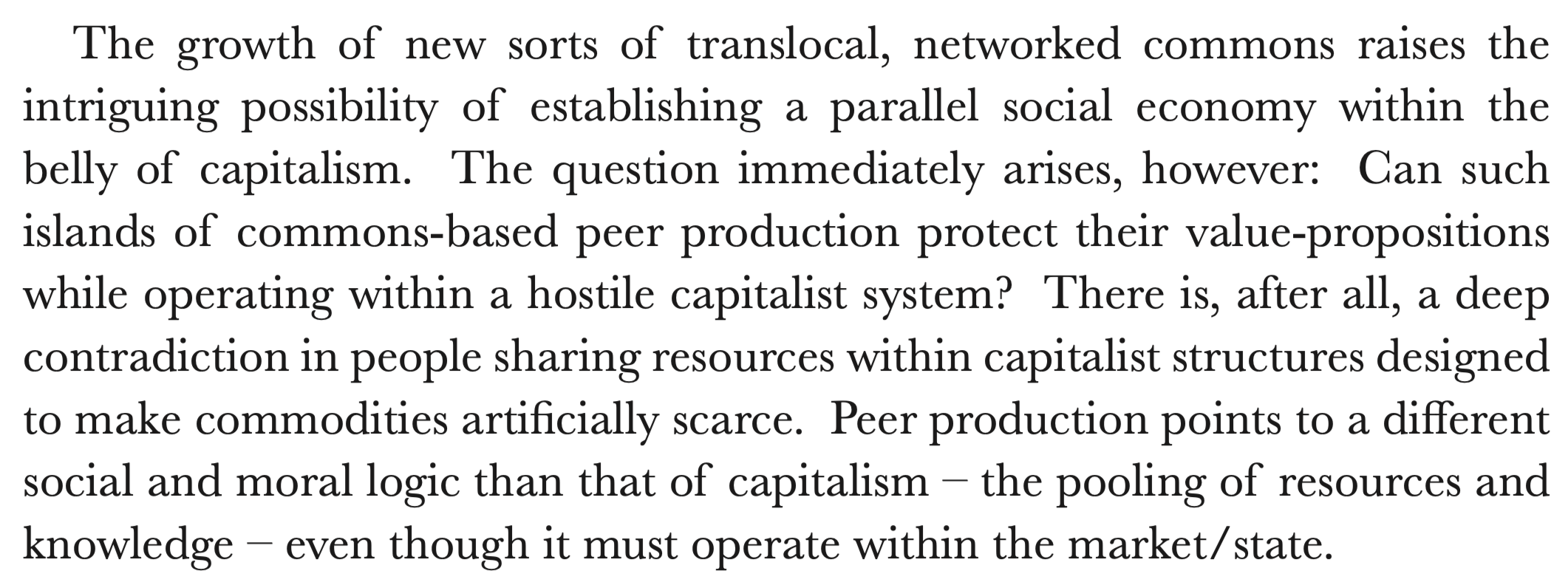
The value perceptions in CBPP communities are diverse and operate outside the sphere of market exchange. Yet CBPP communities maintain interfaces with the market and the state to generate livelihood opportunities for the community and expand its membership. These transactions are arranged by a structured framework based on the commons. Collectively developed and administered legal tools, such as commons-based licences, recognise the commons agency and protect them from predatory forces. The commons are defined as a distinctive part of the economy in its own right and can provide the basis for other economic forms to operate under the commons logic. Pazaitis, Towards a Theory of Value as a Commons, p.24
Untitled board

Challenges

Strategies

Radical Transformation of Digital Commons

What would such an arrangement mean for digital commons and the community maintaining them today? I think it would mean switching the communities mindset from one that maintains a public good for a number of reasons that vary from fun and experimentation to personal branding and profit motivations to one that is more oriented towards care and cooperation with co-workers building a commons with statutory political character. It would also probably mean organizing around smaller units that are federated to maintain larger projects, instead of having big corporations steer digital commons like big open-source projects.