Nate Gaylinn (@[email protected] ) tech.lgbt Acting ethically in an imperfect world tante.cc Pluralistic: Six Years of Pluralistic (19 Feb 2026) – Pluralistic: Daily links from Cory Doctorow pluralistic.net There are some aspects of LLMs that are indeed impressive:
- The capability of processing input which is ambiguous and contextual.
- The capability of analyzing complex knowledge artifacts like complex codebases.
- The generality of their applicability
They are in a way the revenge of spam in our digital life.
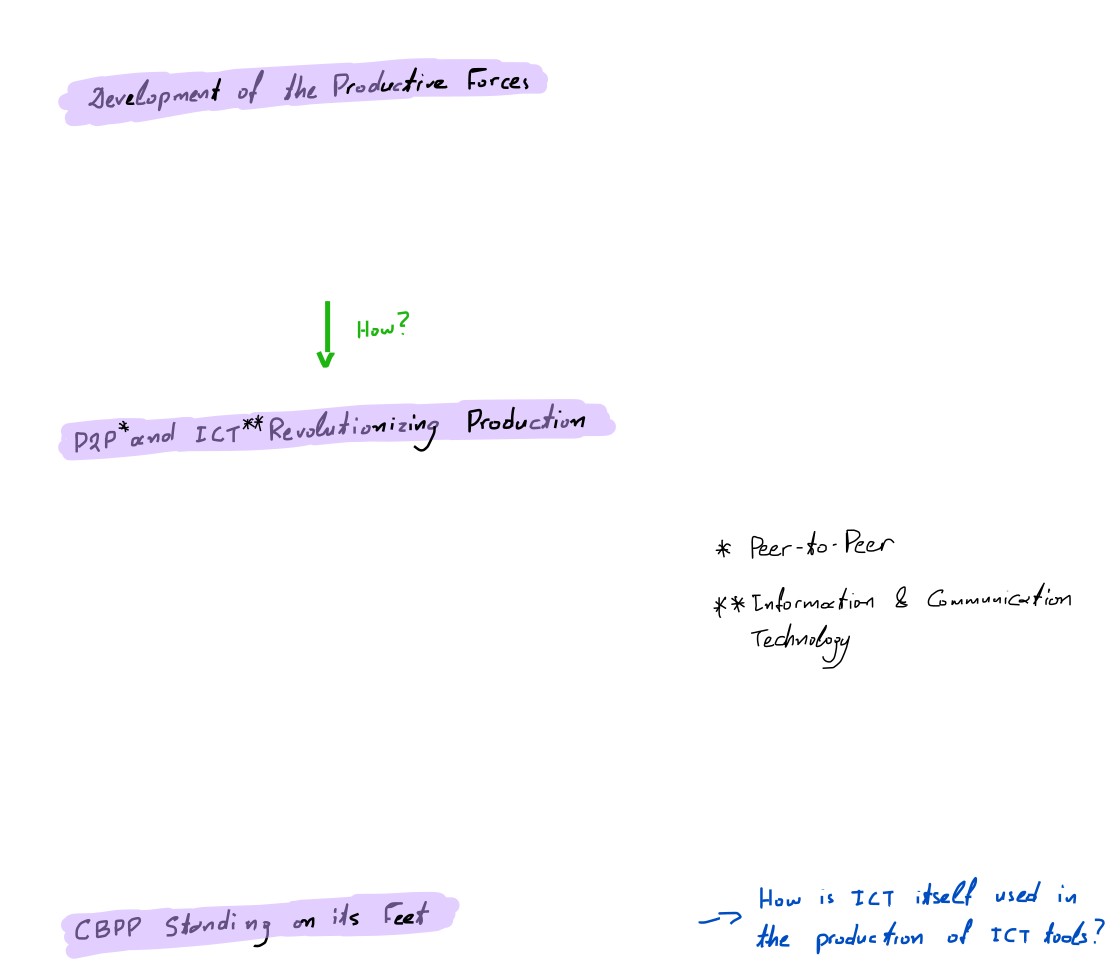
According to Marx, despite the technical foundation of Industry was found in Manufacture, it was not until industry abolished handicraft and manufacturing systems that it was to effect a revolution in production:
"[…] we see in Manufacture the immediate technical foundation of modern industry. Manufacture produced the machinery, by means of which modern industry abolished the handicraft and manufacturing systems in those spheres of production that it first seized upon. The factory system was therefore raised, in the natural course of things, on an inadequate foundation. When the system attained to a certain degree of development, it had to root up this ready-made foundation, which in the meantime had been
elaborated on the old lines, and to build-up for itself a basis that should correspond to its methods of production. [...] At a certain stage of its development, modern industry became technologically incompatible with the basis furnished by it by handicraft and Manufacture. […]
Modern industry had therefore itself to take in hand the machine, its characteristic instrument of production, and to construct machines by machines. It was not until it did this, that it built up for itself a fitting technical foundation, and stood on its own feet. (Marx, 2018, pp. 266–267)”.
We believe we are starting to see a similar trend with software today. Software developing algorithms and other software - artificial intelligence - may indeed be the next revolution in the sphere of production.
Real wealth manifests itself, rather - and large industry reveals this - in the monstrous disproportion between the labour time applied, and its product, as well as in the qualitative imbalance between labour, reduced to a pure abstraction, and the power of the production process it superintends. Labour no longer appears so much to be included within the production process; rather, the human being comes to relate more as watchman and regulator to the production process itself. (What holds for machinery holds likewise for the combination of human activities and the development of human intercourse.) No longer does the worker insert a modified natural thing [Naturgegenstand] as middle link between the object [Objekt] and himself; rather, he inserts the process of nature, transformed into an industrial process, as a means between himself and inorganic nature, mastering it. He steps to the side of the production process instead of being its chief actor. In this transformation, it is neither the direct human labour he himself performs, nor the time during which he works, but rather the appropriation of his own general productive power, his understanding of nature and his mastery over it by virtue of his presence as a social body - it is, in a word, the development of the social individual which appears as the great foundation-stone of production and of wealth.
Marx, Grundrisse (Penguin Classics), p.705
Related to the dominant social formation (capitalism)
Increase in the productivity of labour
Ubiquitous surveillance / panopticon. Becomes very powerful with the pattern recognition capabilities of LLMs.
[On software and industries where vertical products are launched] Agentic workflows dictating the rhythm of software production. Intensification of labour (absolute surplus value extraction?). Interesting that capitalists talk openly about “software factories”.
Effects of division of labour. Maybe deskilling? Needs more thinking. See Marx, Braverman.
Radical Potential
LLMs a manifestation of the emergence of a collective intelligence from society’s knowledge work.
Provided that they are indeed part of revolutionizing the production process, they can help us move towards a post-scarcity society.
Social arguments against LLMs
Changing the technical foundation of production
Algorithms and software becoming the characteristic instrument of production.
Humans stepping to a supervisor role as production gets automated.