The Material Nature of Knowledge Production
human action, or even human thought, can only take place through some kind of material medium and therefore can’t be understood without taking the qualities of that medium into account. Graeber, Toward an Anthropological Theory of Value, p.83
If one were to insist on seeing all such spheres primarily as domains of human action, it quickly becomes obvious that just as much as the production of food requires thinking, art and literature are really a set of material processes. Literature, from this kind of materialist perspective, would no longer be so much about “texts” (usually thought of as abstractions that can then seem to float apart from time or space) but about the writing and reading of them. This is obviously in every way material: actual, flesh-and-blood people have to write them, they have to have the leisure and resources, they need pens or typewriters or computers, there are practical constraints of every sort entailed in the circulation of literature, and so on. Graeber, Toward an Anthropological Theory of Value, p.54
The neat distinction between immaterial and material, therefore, becomes meaningful only from the perspective of relatively isolated and privileged spheres of practices. From the perspective of a radical paradigm and a possible political recomposition, I think this is an isolation that must be overcome, and it can only be overcome if and to the extent that some forms of constituent commoning across ‘material’ and ‘immaterial’ circuits become a reality and a social force at the basis of transformative politics. There is no panacea, no new invention operating as a silver bullet, only the expansion, multiplication and interlacing of commons systems, especially those that reproduce life (food, care, housing, biodiversity, ...). De Angelis, Omnia Sunt Communia, p. 74
Commons-based peer production and post-scarcity
[…] human action, or even human thought, can only take place through some kind of material medium and therefore can’t be understood without taking the qualities of that medium into account. Hence the importance in Turner’s analysis of the notion of material media of circulation. The media have qualities in and of themselves. For all the (often quite legitimate) criticisms of Jack Goody’s dichotomies between orality and literacy, for example, it is simply obvious that technologies of writing allow for possibilities that do not exist in speech (and equally, vice versa). Graeber, Toward an Anthropological Theory of Value, p.83
Digital Media and Computing
Computers as creative tools
Principles and characteristics of creating tools fostering creativity and collaboration
Computer visionaries and pioneers of the 60s and 70s
[…] human action, or even human thought, can only take place through some kind of material medium and therefore can’t be understood without taking the qualities of that medium into account. Hence the importance in Turner’s analysis of the notion of material media of circulation. The media have qualities in and of themselves. For all the (often quite legitimate) criticisms of Jack Goody’s dichotomies between orality and literacy, for example, it is simply obvious that technologies of writing allow for possibilities that do not exist in speech (and equally, vice versa). Graeber, Toward an Anthropological Theory of Value, p.83
The open problem of writing and rendering math using inline equations
Digital tools and human-computer interaction
Software Longevity
Information Storage
Critique of digital media and computing in capitalism
Culture of digital media producers
Absence of interoperability and its relationship with capitalism and prevailing social structures
Political economy of digital media
The sense of a lost vision of computer pioneers of the 60s and 70s. Dynamics of digital media production
Human users dominated by computers instead of the opposite
Important open problems for knowledge work primarily not tackled due to economic reasons
Digital Commons and their Critique
Decentralized Media
Naming Systems
Security
Design Patterns
Critique of Decentralized Media
LLMs
Sorolop 15PDF
There are some aspects of LLMs that are indeed impressive: - The capability of processing input which is ambiguous and contextual. - The capability of analyzing complex knowledge artifacts like complex codebases. - The generality of their applicability
They are in a way the revenge of spam in our digital life.
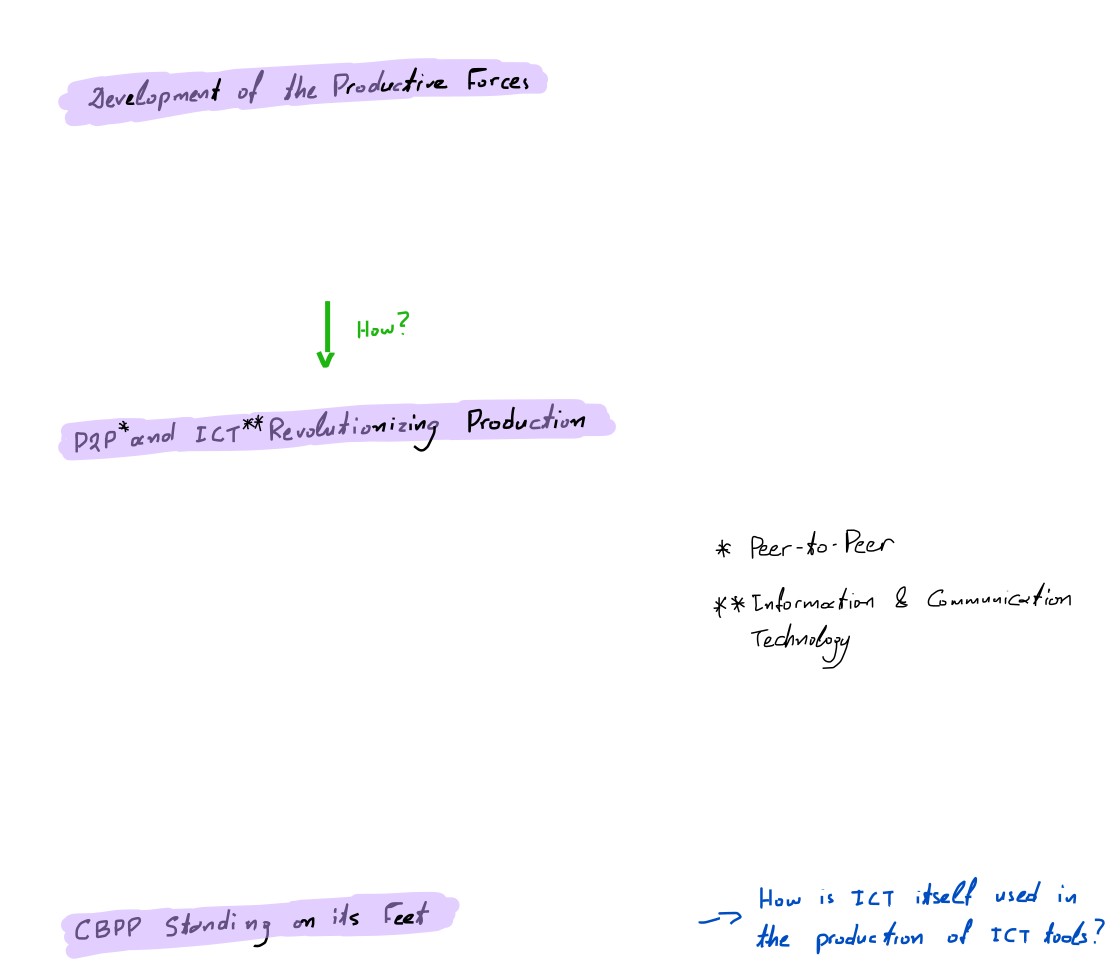
According to Marx, despite the technical foundation of Industry was found in Manufacture, it was not until industry abolished handicraft and manufacturing systems that it was to effect a revolution in production: "[…] we see in Manufacture the immediate technical foundation of modern industry. Manufacture produced the machinery, by means of which modern industry abolished the handicraft and manufacturing systems in those spheres of production that it first seized upon. The factory system was therefore raised, in the natural course of things, on an inadequate foundation. When the system attained to a certain degree of development, it had to root up this ready-made foundation, which in the meantime had been elaborated on the old lines, and to build-up for itself a basis that should correspond to its methods of production. [...] At a certain stage of its development, modern industry became technologically incompatible with the basis furnished by it by handicraft and Manufacture. […] Modern industry had therefore itself to take in hand the machine, its characteristic instrument of production, and to construct machines by machines. It was not until it did this, that it built up for itself a fitting technical foundation, and stood on its own feet. (Marx, 2018, pp. 266–267)”. We believe we are starting to see a similar trend with software today. Software developing algorithms and other software - artificial intelligence - may indeed be the next revolution in the sphere of production.
Technical Considerations
Environmental impact
Philosophical Aspects
Real wealth manifests itself, rather - and large industry reveals this - in the monstrous disproportion between the labour time applied, and its product, as well as in the qualitative imbalance between labour, reduced to a pure abstrac­tion, and the power of the production process it superintends. Labour no longer appears so much to be included within the production process; rather, the human being comes to relate more as watchman and regulator to the production process itself. (What holds for machinery holds likewise for the combination of human activities and the development of human intercourse.) No longer does the worker insert a modified natural thing [Naturgegenstand] as middle link between the object [Objekt] and himself; rather, he inserts the process of nature, transformed into an industrial process, as a means between himself and inorganic nature, mastering it. He steps to the side of the production process instead of being its chief actor. In this transformation, it is neither the direct human labour he himself performs, nor the time during which he works, but rather the appropriation of his own general productive power, his understanding of nature and his mastery over it by virtue of his presence as a social body - it is, in a word, the development of the social individual which appears as the great foundation-stone of production and of wealth. Marx, Grundrisse (Penguin Classics), p.705
Aris Goudouras
Doctorow has some points but I lean more towards Tante’s point of view. Maybe with the exception that what he’s saying seems to be pro-intellectual-property, which is indeed more fitting to capitalism.

Related to the dominant social formation (capitalism)

Increase in the productivity of labour

Ubiquitous surveillance / panopticon. Becomes very powerful with the pattern recognition capabilities of LLMs.

[On software and industries where vertical products are launched] Agentic workflows dictating the rhythm of software production. Intensification of labour (absolute surplus value extraction?). Interesting that capitalists talk openly about “software factories”.

Effects of division of labour. Maybe deskilling? Needs more thinking. See Marx, Braverman.

Radical Potential

LLMs a manifestation of the emergence of a collective intelligence from society’s knowledge work.

Provided that they are indeed part of revolutionizing the production process, they can help us move towards a post-scarcity society.

Social arguments against LLMs

Changing the technical foundation of production

Algorithms and software becoming the characteristic instrument of production.

Humans stepping to a supervisor role as production gets automated.

The society of the future is a society of material wealth (Marx)

Limiting the realm of necessity -> Enabling Post-Scarcity

Reducing the sphere of society and economy where reciprocity is expected

Patterns and Innovations in the Production of ICT and specifically software

Version Control

Wiggins on version control and collaboration https://open.spotify.com/episode/5HoFWZzo4PAzEhF5Tn3WbD?si=oMSZ_QgzTuGifPp4WHHIJg&context=spotify%3Ashow%3A3YjROlRLxqsTftLd0xGDUI

Social Cooperation at Scale (GitHub)

Modularity and Reuse - Software Package Managers

Collective Creativity & Socialization of Production

Nikolaus Klein: Expanding the sphere of collaboration through computing:

https://open.spotify.com/episode/7DJpJLs0Bdrq9uQWxwuF4L?si=bBiqQxrBR96AeKYUAIWknw&t=726&context=spotify%3Ashow%3A3YjROlRLxqsTftLd0xGDUI

Nikolaus Klein on collective creativity (our ideas vs my ideas, fuzziness of ownership)

https://open.spotify.com/episode/7DJpJLs0Bdrq9uQWxwuF4L?si=k2suMxSkQ--Bj7ZEulR43g&t=961&context=spotify%3Ashow%3A3YjROlRLxqsTftLd0xGDUI

Emphasize on the difference in how FLOSS and SAAS approach modularity and interoperability in comparing capitalist and commons practices and development of productive forces

ICT as a Means of Production

P2P as a relationship and infrastructure enabling Commons-Based Peer Production (CBPP)

Radical expansion of cooperative scale

Automation technology manages mundane tasks, technically opening the way to the realm of freedom

Machine learning & artificial intelligence potentially the next revolution

Post-Scarcity
The society of the future is also a society of material wealth, which continues to grow. This idea is encountered in virtually all of Marx’s works. I shall cite just one example as proof. In the third volume of Theories of Surplus Value, he describes the two alternatives for increasing “disposable time”. One alternative would be to produce greater wealth in half the current average labour time. The other would be to reduce the labour time by half in such a way as to direct the remaining half towards the satisfaction of “necessary needs” as they are at present. Marx considers it a theoretical mistake, a lack of clarity, to confuse these two alternatives. He explicitly declares himself to be in favour of the first of them. The base for the future development of production will be the extraordinary growth in the proportion of fixed capital, which is quite possible because the increase in production will be independent of the valorisation of capital. The increase in the proportion of fixed capital to levels that are impossible under capitalism is the guarantee that material production will require ever less living labour. This is the only way to reduce labour time uninterruptedly whilst maintaining a constant increase in production. This does not of course mean that dead labour will dominate living labour (because the capital relation no longer exists); on the contrary, living labour will prevail over dead. Agnes Heller, The Theory of Need in Marx, Chapter 4
The “society of associated producers” appears in this quotation as a society in which labour is carried out by machines, in which “fixed capital” therefore completely predominates and in which — at least in the process of material production — labour power is employed only “as watchman and regulator”. To use a modern expression, Marx presupposes complete automation. In this way a specific type of labour acquires an extraordinary importance, namely, scientific labour, or (as Marx calls it) “labour in general”. Scientific labour is not, however, immediately productive labour, but the activity of the general intellect: planning, projection and so forth. This cannot however be measured in labour time, since the concept of “socially necessary labour time” is not applicable. In short, material wealth is still supplied by production, but no longer by productive labour in the conventional sense of the term. This determines the hegemony of intellectual labour over so-called “physical” labour. Agnes Heller, The Theory of Need in Marx, Chapter 4
The material wealth which comes about through production is not and cannot be anything but a condition of the general wealth of society. The true wealth of society is realised through the free self-activity of social individuals and through their qualitatively many-sided system of needs. The true wealth of man and society consists not in labour time but in free time. For this very reason the wealth of the society of associated producers cannot be measured by labour time but only by free time. I shall here refer not to the well known passages in the Grundrisse, but to the third volume of Theories of Surplus Value: “Labour time, even if exchange value is eliminated, always remains the creative substance of wealth and the measure of the cost of its production. But free time, disposable time, is wealth itself, partly for the enjoyment of the product, partly for free activity, which - unlike labour - is not dominated by the pressure of an extraneous purpose which must be fulfilled, and the fulfilment of which is regarded as a natural necessity or a social duty, according to one’s inclination.” Agnes Heller, The Theory of Need in Marx, Chapter 4
What are the organisational perspectives of life in a society which authentically "reorganises production on the basis of the free and equal association of the producers"? Work would more and more be reduced as an exterior necessity through the automation of production and the socialisation of vital goods, which would finally give complete liberty to the individual. Thus liberated from all economic responsibility, liberated from all the debts and responsibilities from the past and other people, humankind will exude a new surplus value, incalculable in money because it would be impossible to reduce it to the measure of waged work. The guarantee of the liberty of each and of all is in the value of the game, of life freely constructed. The exercise of this ludic recreation is the framework of the only guaranteed equality with non-exploitation of man by man. The liberation of the game, its creative autonomy, supersedes the ancient division between imposed work and passive leisure. Situationist Manifesto, Internationale Situationniste #4, https://libcom.org/article/situationist-manifesto
What would be the principle characteristics of the new culture and how would it compare with ancient art? Against the spectacle, the realised situationist culture introduces total participation. Against preserved art, it is the organisation of the directly lived moment. Against particularised art, it will be a global practice with a bearing, each moment, on all the usable elements. Naturally this would tend to collective production which would be without doubt anonymous (at least to the extent where the works are no longer stocked as commodities, this culture will not be dominated by the need to leave traces.) The minimum proposals of these experiences will be a revolution in behaviour and a dynamic unitary urbanism capable of extension to the entire planet, and of being further extensible to all habitable planets. Against unilateral art, situationist culture will be an art of dialogue, an art of interaction. Today artists - with all culture visible - have become entirely separated from society, just as they are separated from each other by competition. But faced with this impasse of capitalism, art has remained essentially unilateral in response. This enclosed era of primitivism must be superseded by complete communication. At a higher stage, everyone will become an artist, i.e., inseparably a producer-consumer of total culture creation, which will help the rapid dissolution of the linear criteria of novelty. Everyone will be a situationist so to speak, with a multidimensional inflation of tendencies, experiences, or radically different "schools" - not successively, but simultaneously. We will inaugurate what will historically be the last of the crafts. The role of amateur-professional situationist - of anti-specialist - is again a specialisation up to the point of economic and mental abundance, when everyone becomes an "artist," in the sense that the artists have not attained the construction of their own life. However, the last craft of history is so close to the society without a permanent division of labour, that when it appeared amongst the S.I., its status as a craft was generally denied. Situationist Manifesto, Internationale Situationniste #4, https://libcom.org/article/situationist-manifesto
Defining the new poverty also entails defining the new wealth. To the image propagated by the dominant society - according to which it has evolved (both on its own and in response to acceptable reformist pressure) from an economy of profit to an economy of needs - must be counterposed an economy of desires, which could be defined as: technological society plus the imagination of what could be done with it. The economy of needs is falsified in terms of habit. Habit is the natural process by which fulfilled desire is degraded into need and is confirmed, objectified and universally recognized as need. The present economy is directly geared to the fabrication of habits, and manipulates people by forcing them to repress their desires. Situationist International, The Bad Days will End, Internationale Situationniste #7, https://libcom.org/article/bad-days-will-end-0
The next form of society will not be based on industrial production. It will be a society of realized art. Situationist International, The Bad Days will End, Internationale Situationniste #7, https://libcom.org/article/bad-days-will-end-0
The present era can test innumerable innovations, but it is incapable of putting them to good use because it is chained to the fundamental conservation of an old order. Over and over, in all our innovating formulations, we must stress the need for a revolutionary transformation of society. Now, The SI, Internationale Situationniste #9, https://libcom.org/article/now-si
After thousands of years of torturous development, the countries of the Western world (and potentially all countries) are confronted by the possibility of a materially abundant, almost workless era in which most of the means of life can be provided by machines. As we shall see, a new technology has developed that could largely replace the realm of necessity by the realm of freedom. Bookchin, Post-Scarcity Anarchism, Black Rose Books 1986, p.115
In fact, the real issue we face today is not whether this new technology can provide us with the means of life in a toil-less society, but whether it can help to humanize society, whether it can contribute to the creation of entirely new relationships between man and man. The demand for a guaranteed annual income is still anchored in the quantitative promise of technology — in the possibility of satisfying material needs without toil. This quantitative approach is already lagging behind technological developments that carry a new qualitative promise — the promise of decentralized, communitarian lifestyles, or what I prefer to call ecological forms of human association. * * An exclusively quantitative approach to the new technology, I may add, is not only economically archaic, but morally regressive. This approach partakes of the old principle of justice, as distinguished from the new principle of freedom. Historically, justice is derived from the world of material necessity and toil; it implies relatively scarce resources which are apportioned by a moral principle which is either "just" or "unjust." Justice, even "equal" justice, is a concept of limitation, involving the denial of goods and the sacrifice of time and energy to production. Once we transcend the concept of justice — indeed, once we pass from the quantitative to the qualitative potentialities of modern technology — we enter the unexplored domain of freedom, based on spontaneous organization and full access to the means of life. I am asking a question that is quite different from what is ordinarily posed with respect to modern technology. Is this technology staking out a new dimension in human freedom, in the liberation of man? Can it not only liberate man from want and work, but also lead him to a free, harmonious, balanced human community — an ecocommunity that would promote the unrestricted development of his potentialities? Finally, can it carry man beyond the realm of freedom into the realm of life and desire? Bookchin, Post-Scarcity Anarchism, Black Rose Books 1986, p.116-117
Let me try to answer these questions by pointing to a new feature of modern technology. For the first time in history, technology has reached an open end. The potential for technological development, for providing machines as substitutes for labor is virtually unlimited. Technology has finally passed from the realm of invention to that of design — in other words, from fortuitous discoveries to systematic innovations. Bookchin, Post-Scarcity Anarchism, Black Rose Books 1986, p.117
In light of the freedom to choose products and needs, both as producer and consumer, one can envision a higher ideal of freedom­ one that removes the taint of economism and restores the ethical basis of past times, and that is infused with the options opened by technical achievement. Potentially, at least, we are faced with the broadest con­ception of freedom known thus far: the autonomous individual's freedom to shape material life in a form that is neither ascetic nor hedonistic, but a blend of the best in both-one that is ecological, national, and artistic. Bookchin, The Ecology of Freedom, p.218
Labor, perhaps even more than technics, must recover its own creative voice. Its form, its de­ployment in the framework of linear time as a res temporalis, its cruel objectification as mere, homogeneous energy, must yield to the con­creteness of skill, to the festiveness of communal activity, to a recogni­tion of its own subjectivity. Bookchin, The Ecology of Freedom, p.266
The exaltation of a hard-working ethos, whether it is salaried work (viz. the stigma attached to unemployment) or working out in a gym point to the internalization of the demand made by capital that every human being maximizes his or her productive effort, whatever the circumstances, and the word work ends up encompassing all human activities that can directly or indirectly be turned into a profit. Olivier Frayssé, Work and Labour as Metonymy and Metaphor (triple-C)
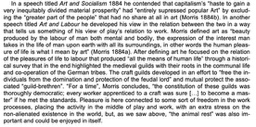
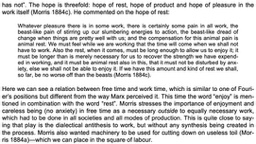
Marx’s ideal workday, when I am able “to hunt in the morning, fish in the afternoon, rear cattle in the evening, criticise after dinner, just as I have a mind, without ever becoming hunter, fisherman, shepherd or critic” (Marx and Engels 1845/46, 53), points to a crucial characteristic of work from a eudemonistic perspective: if a change of work is a holiday, then what makes work an especially painful activity is its continuation through an over-extended period of time […]. The repetition of the same, even innocuous per se, becomes a torment, as in the “Chinese water torture” where the pain comes from a steady dripping of water droplets on the same part of the body. And the classical image of the Fordist worker, chained to the assembly line so that he/she must repeat the same motion relentlessly, resembles that of the galley slave who does nothing but work the oars. Relentless repetition of the same is what Thanatos (the death impulse identified by Freud) is about. Relentlessness and endlessness are the two things that make hell hellish […] All in all, man is living through and craving for variety, alternation and diversity. Just as we alternate inhaling and exhaling, chewing and swallowing, sleeping and waking, we need to alternate our activities. Post-Fordist human resources specialists of Internet work, who have understood this, would allow private Internet surfing (cyberloafing) to employees while at their workstation to increase productivity by lowering stress Chen and Lim 2011). This raises the issue of rhythm. Autonomous work (when I choose to work) is set to individual bio-rhythms, heteronomous work (when I have work imposed on me from outside, whether by necessity or violence) is set to extraneous rhythms: slaves on a galley pulling on the oars to the drum’s rhythm, marching soldiers, workers on the assembly-line, Internet slaves desperately trying to catch up with incoming emails are all subject to a form of torture. In moderate doses, the extraneous rhythm energizes, as when dancing to a tune, while it becomes painful and even lethal in excessive doses, as any stimulus. Olivier Frayssé, Work and Labour as Metonymy and Metaphor (triple-C)
Even in the absence of an actual master, the very nature of work involves a certain form of subordination. As a matter of fact, both the goal of the freely chosen work activity, and the specificities of the chosen work material themselves, impose their irreducible strangeness on the worker. When “I’m committed to my work”, the goal, the end in view becomes my master, imposes a discipline, and, when I carve wood, I have to obey the dictates of the wood grain at the very moment when I transform nature. “Nature to be commanded must be obeyed” wrote Francis Bacon (Bacon 1960, 39). Olivier Frayssé, Work and Labour as Metonymy and Metaphor (triple-C)
The factory was not born from a need to integrate labor with modern machinery. On the contrary, this building block of what we call "in­dustrial society" arose from a need to rationalize the labor process - to intensify and exploit it more effectively than employers could ever hope to achieve with early cottage industries based on a self-regulated system of artisanship. Sidney Pollard, quoting an observer of the prefactory era, notes that workers who were free to regulate their own time as domestic craftpersons rarely worked the modern eight-hour day and five-day week. "The weavers were used to 'play frequently all day on Monday and the greater part of Tuesday, and work very late on Thursday night, and frequently all night on Friday' " to ready their cloth for the Saturday market day. This irregularity, or "naturalness," in the rhythm and inten­sity of traditional systems of work contributed more toward the bour­geoisie's craze for social control and its savagely antinaturalistic outlook than did the prices or earnings demanded by its employees. More than any single technical factor, this irregularity led to the rationalization of labor under a single ensemble of rule, to a discipline of work and regulation of time that yielded the modern factory, often with none of the technical developments we impute to the "Industrial Revolution." Before the steam engine, power loom, and flying shuttle came into use­ indeed, before some of these machines were even invented - the tradi­tional spinning wheel, hand loom, and dyeing vat that once filled the working areas of cottagers were assembled in large sheds primarily to mobilize the workers themselves, to regulate them harshly, and to in­tensify the exploitation of their labor. Bookchin, The Ecology of Freedom, p.311
Lund - Playing, Gaming, Working and LabouringPDF
Play, Work and Communicative Action
Carework and Feminist Conceptions of Work
[…] the development of a feminist concept of labour has to begin with a rejection of the distinction between socially necessary labour and leisure, and the Marxist view that self-realization, human happiness, freedom, autonomy - the realm of freedom - can be achieved only outside the sphere of necessity and of necessary labour, and by a reduction (or abolition) of the latter. If we take as our model of a worker not the white male industrial wage-worker (irrespective of whether he works under capitalist or socialist conditions), but a mother, we can immediately see that her work does not fit into the Marxian concept. For her, work is always both: a burden as well as a source of enjoyment, self-fulfilment, and happiness. Children may give her a lot of work and trouble, but this work is never totally alienated or dead. Even when children turn out to be a disappointment for the mother, when they eventually leave her or feel contempt for her - as in fact many do in our society - the pain she suffers at all this is still more human than the cold indifference of the industrial worker or engineer vis-a-vis his products, the commodities he produces and consumes. The same unity of work as a burden and work as enjoyment can be found among peasants whose production is not yet totally subsumed under commodity production and the compulsions of the market. The peasants who have to work from dawn to dusk during the harvesting season, for instance, feel the burden of work more than anybody else in their bodies and in their muscles. But in spite of the hardship of this work, it is never only ‘a curse’. I remember the times of haymaking or harvesting on our small subsistence farm in my childhood as times of extreme labour intensity for everybody-mother, children, father-and as times of the greatest excitement, enjoyment, social interaction. I found the same phenomenon among poor peasant and agricultural labourer women in India during the season of rice transplantation. […] During the collective work-processes in the fields, they sang an endless number of ballads which helped them ftp bear the burden of work more easily. And in the evening, after the evening meal, they danced and sang together till late (Mies, 1984). Anyone who has had an opportunity to observe the work-process of people involved in non-market oriented subsistence production will have found this interplay of work as necessity and burden, and work as a basic source of enjoyment and self-expression. The same is true for the work of the artisan or in handicrafts production, as long as this work is not yet fully subsumed under the compulsions of the market. Maria Mies, Patriarchy and Accumulation on a World Scale, Towards a Feminist Perspective of a New Society, p.216-217
A feminist concept of labour has, therefore, to be oriented towards a different concept of time, in which time is not segregated into portions of burdensome labour and portions of supposed pleasure and leisure, but in which times of work and times of rest and enjoyment are alternating and interspersed. If such a concept and such an organization of time prevail, the length of the working-day is no longer very relevant. Thus, a long working-day and even a lifetime full of work, will not then be felt as a curse but as a source of human fulfilment and happiness. Maria Mies, Patriarchy and Accumulation on a World Scale, Towards a Feminist Perspective of a New Society, p.217
The task of the workers councils will thus be not the self-management of the existing world, but its unceasing qualitative transformation: the concrete supersession of the commodity (that enormous detour in the history of human self-production). This supersession naturally implies the abolition of work and its replacement by a new type of free activity, thereby eliminating one of the fundamental splits of modern society: that between an increasingly reified labor and a passively consumed leisure. […] work itself must now be attacked. Far from being “utopian,” the abolition of work is the first condition for the effective supersession of commodity society, for the elimination within each person’s life of the separation between “free time” and “work time” — those complementary sectors of alienated life — that is a continual expression of the commodity’s internal contradiction between use-value and exchange-value. Only when this opposition is overcome will people be able to make their vital activity subject to their will and consciousness and see themselves in a world that they themselves have created. On the Poverty of Student Life - Members of Situationist International and Students of Strasbourg University (1966), theanarchistlibrary.org, p.18
Now it is clear that not one of us believes that emancipation, liberation, can be achieved through work. Work is still work, whether inside or outside the home. The independence of the Wage earner means only being a “free individual” for capital, no less for women than for men. Those who advocate that the (liberation of the-working class woman lies in her getting a job outside the home are part of the problem, not the solution. Slavery to an assembly line is not a liberation from slavery to a kitchen sink. To deny this is also to deny the slavery of the assembly line itself, proving again that if you don’t know how women are exploited, you can never really know how men are. But this question is so crucial that we deal with it separately. What we wish to make clear here is that by the non-payment of a wage when we are producing in a world capitalistically organized, the figure of the boss is concealed behind that of the husband. He appears to be the sole recipient of domestic services, and this gives an ambiguous and slavelike character to housework. The husband and children, through their loving involvement, their loving blackmail, become the first foremen, the immediate controllers of this labor. Dalla Costa & James, The Power of Women and the Subversion of Community, p.35
[…] even if it is possible to commodify childcare, it is not possible to make advances in productivity that would allow its cost to become ever cheaper. Even if the nourishing, washing of clothes, and so on, can be done more efficiently, the time for childcare is never reduced. You cannot look after children more quickly: they have to be attended to 24 hours a day. Endnotes, The Logic of Gender, Endnotes #3 (2013), https://endnotes.org.uk/articles/the-logic-of-gender
Work and Language
In French Sign Language, and in American Sign Language, which is derived from the French Sign Language, “the sign for ‘work’ is made by shaping both hands into ‘fist shapes’ [...]. With your palms facing downward, use your dominant fist to tap the wrist or the side of your non-dominant fist a few times (Memory Aid: Think of working with a hammer)”. This mimics the action of hammering, the repetition shows that there is a purpose to the activity, and the number of repetitions is left to the speaker. There is also a connotation of pain in the mutual shocks that flesh is heir to. Olivier Frayssé, Work and Labour as Metonymy and Metaphor (triple-C)
Work and Digital Media
Those in charge have even made sure, therefore, that we humans having the leisure are not at liberty to make use of it as we please. It's as if we needed to work more as consumers in proportion as we work less as producers. As if consumption no longer signified a satisfaction, but rather a social obligation. Moreover the technological equipment of leisure increasingly resembles that of labor. While in our fooling around on the Internet all our clicks produce the data that the GAFA resell, work is tricked out with all the enticements of gaming by introducing scores, levels, bonuses and other infantilizing caveats. The Invisible Committee, Now, p.95
Mascolo is right in saying (in Le Communisme) that the reduction of the work day by the dictatorship of the proletariat is “the most certain sign of the latter’s revolutionary authenticity.” Indeed, “if man is a commodity, if he is treated as a thing, if human relations are relations of thing to thing, this is because it is possible to buy his time.” But Mascolo is too quick to conclude that “the time of a man freely employed” is always well spent, and that “the purchase of time is the sole evil.” There can be no freely spent time until we possess the modern tools for the construction of everyday life. The use of such tools will mark the leap from a utopian revolutionary art to an experimental revolutionary art. Debord, Theses on Cultural Revolution, Internationale Situationniste #1, https://libcom.org/article/theses-cultural-revolution-guy-debord
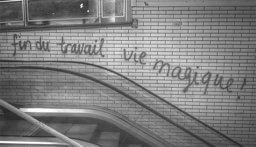
Our central idea is the construction of situations, that is to say, the concrete construction of momentary ambiences of life and their transformation into a superior passional quality. […] Our action on behavior, linked with other desirable aspects of a revolution in mores, can be briefly defined as the invention of games of an essentially new type. The most general goal must be to expand the nonmediocre part of life, to reduce the empty moments of life as much as possible. One could thus speak of our enterprise as a project of quantitatively increasing human life, an enterprise more serious than the biological methods currently being investigated, and one that automatically implies a qualitative increase whose developments are unpredictable. The situationist game is distinguished from the classic notion of games by its radical negation of the element of competition and of separation from everyday life. On the other hand, it is not distinct from a moral choice, since it implies taking a stand in favor of what will bring about the future reign of freedom and play. Debord, Report on the Creation of Situations, theanarchistlibrary.org, p.12
To transform the world and to change life are one and the same thing for the proletariat, the inseparable passwords to its suppression as a class, the dissolution of the present reign of necessity, and the finally possible accession to the reign of freedom. The radical critique and free reconstruction of all the values and patterns of behavior imposed by alienated reality are its maximum program. Free creativity in the construction of all moments and events of life is the only poetry it can acknowledge, the poetry made by all, the beginning of the revolutionary festival. Proletarian revolutions will be festivals or nothing, for festivity is the very keynote of the life they announce. Play (*) is the ultimate principle of this festival, and the only rules it can recognize are to live without dead time and to enjoy without restraints. (*) [The ending is stronger and more scandalous in the original: the French word jouir (“to enjoy”) also means “to come” in the sexual sense.] On the Poverty of Student Life - Members of Situationist International and Students of Strasbourg University (1966), theanarchistlibrary.org, p.19
The next phase of play’s advance seems to require the disappearance of any element of competition. The question of winning or losing, which has to date been nearly inseparable of ludic activity, appears to be tied to every other expression of competition between people in the appropriation of goods. The sense of importance in winning, which concerns concrete (or more frequently illusory) satisfactions, is the wretched product of a wretched society. The feeling [of winning] is, of course, exploited by every conservative force to conceal the monotony and the brutality of the conditions of life they impose. Simply consider the [social] demands détourned by competitive sports, which was most clearly established in its modern form in Great Britain, alongside the rise of factories. Not only do the crowds identify with professional players or clubs (which assume the same mythic role as the movie stars who live, and the statesmen who make decisions, in their place), but the endless sequence of match results also keeps hold over the passions of the spectators . Direct participation in a game, even in those requiring a certain degree of intellectual exertion, becomes uninteresting as soon as the established rules of play involve the acceptance of competition for its own sake. Contribution to a Situationist Definition of Play, Internationale Situationniste #1, https://libcom.org/article/contribution-situationist-definition-play
The element of competition must vanish in favour of a more authentically collective concept of play: the communal creation of selected ludic ambiences. The central distinction made between play and everyday life, which keeps play as an isolated and temporary anomaly, must be surpassed. Johan Huizinga writes, “Into an imperfect world and into the confusion of life, [play] brings a temporary, a limited perfection.” Everyday life, which was previously determined by the question of survival, can now be rationally controlled (this possibility is at the heart of every conflict of our time). Play, radically breaking with a delimited ludic time and space, must invade the whole of life. Perfection cannot be its endpoint, insofar as this perfection signifies a static construction opposed to life. However one can propose to push the beautiful chaos of life to its perfection. […] In this historical perspective, play — the constant experimentation with ludic innovations — only comes into being alongside ethics and questions of life’s meaning. The only success which we can appreciate in play is the immediate success of its ambience, and the constant increase of its powers. In its present co-existence with the residues of the phase of decline, play cannot completely free itself from a competitive aspect, it must at least aim to provoke conditions favourable to living directly. In this sense it is still both a struggle and a representation: a struggle for a life measured by desire, and a concrete representation of such a life. Play often feels imaginary, owing to its fringe existence in comparison to the oppressive reality of work, but the Situationists’ work is precisely the preparation of the ludic possibilities to come. Contribution to a Situationist Definition of Play, Internationale Situationniste #1, https://libcom.org/article/contribution-situationist-definition-play
The traditional goal of aesthetics is to produce, by means of art, impressions of certain past elements of life in circumstances where those elements are lacking or absent, in such a way that those elements escape the disorder of appearances subject to the ravages of time. The degree of aesthetic success is thus measured by a beauty that is inseparable from duration, and that even goes so far as pretensions of eternity. The goal of the situationists is immediate participation in a passionate abundance of life by means of deliberately arranged variations of ephemeral moments. The success of these moments can reside in nothing other than their fleeting effect. The situationists consider cultural activity in its totality as an experimental method for constructing everyday life, a method that can and should be continually developed with the extension of leisure and the withering away of the division of labor (beginning with the division of artistic labor). Debord, Theses on Cultural Revolution, Internationale Situationniste #1, https://libcom.org/article/theses-cultural-revolution-guy-debord
Mascolo is right in saying (in Le Communisme) that the reduction of the work day by the dictatorship of the proletariat is “the most certain sign of the latter’s revolutionary authenticity.” Indeed, “if man is a commodity, if he is treated as a thing, if human relations are relations of thing to thing, this is because it is possible to buy his time.” But Mascolo is too quick to conclude that “the time of a man freely employed” is always well spent, and that “the purchase of time is the sole evil.” There can be no freely spent time until we possess the modern tools for the construction of everyday life. The use of such tools will mark the leap from a utopian revolutionary art to an experimental revolutionary art. Debord, Theses on Cultural Revolution, Internationale Situationniste #1, https://libcom.org/article/theses-cultural-revolution-guy-debord
There is no revolutionary problem of leisure — of an emptiness to be filled — but a problem of free time. As we have already said: “There can be no free use of time until we possess the modern tools for the construction of everyday life. The use of such tools will mark the leap from a utopian revolutionary art to an experimental revolutionary art” (Debord, “Theses on Cultural Revolution,” Internationale Situationniste #1). The supersession of leisure through the development of an activity of free creation-consumption can only be understood in relation with the dissolution of the traditional arts — with their transformation into superior modes of action which do not refuse or abolish art, but fulfill it. In this way art will be superseded, conserved and surmounted within a more complex activity. Its traditional elements may still be partially present, but transformed, integrated and modified by the totality. The Use of Free Time, Internationale Situationniste #4, https://libcom.org/article/use-free-time-0
What are the organisational perspectives of life in a society which authentically "reorganises production on the basis of the free and equal association of the producers"? Work would more and more be reduced as an exterior necessity through the automation of production and the socialisation of vital goods, which would finally give complete liberty to the individual. Thus liberated from all economic responsibility, liberated from all the debts and responsibilities from the past and other people, humankind will exude a new surplus value, incalculable in money because it would be impossible to reduce it to the measure of waged work. The guarantee of the liberty of each and of all is in the value of the game, of life freely constructed. The exercise of this ludic recreation is the framework of the only guaranteed equality with non-exploitation of man by man. The liberation of the game, its creative autonomy, supersedes the ancient division between imposed work and passive leisure. Situationist Manifesto, Internationale Situationniste #4, https://libcom.org/article/situationist-manifesto
What would be the principle characteristics of the new culture and how would it compare with ancient art? Against the spectacle, the realised situationist culture introduces total participation. Against preserved art, it is the organisation of the directly lived moment. Against particularised art, it will be a global practice with a bearing, each moment, on all the usable elements. Naturally this would tend to collective production which would be without doubt anonymous (at least to the extent where the works are no longer stocked as commodities, this culture will not be dominated by the need to leave traces.) The minimum proposals of these experiences will be a revolution in behaviour and a dynamic unitary urbanism capable of extension to the entire planet, and of being further extensible to all habitable planets. Against unilateral art, situationist culture will be an art of dialogue, an art of interaction. Today artists - with all culture visible - have become entirely separated from society, just as they are separated from each other by competition. But faced with this impasse of capitalism, art has remained essentially unilateral in response. This enclosed era of primitivism must be superseded by complete communication. At a higher stage, everyone will become an artist, i.e., inseparably a producer-consumer of total culture creation, which will help the rapid dissolution of the linear criteria of novelty. Everyone will be a situationist so to speak, with a multidimensional inflation of tendencies, experiences, or radically different "schools" - not successively, but simultaneously. We will inaugurate what will historically be the last of the crafts. The role of amateur-professional situationist - of anti-specialist - is again a specialisation up to the point of economic and mental abundance, when everyone becomes an "artist," in the sense that the artists have not attained the construction of their own life. However, the last craft of history is so close to the society without a permanent division of labour, that when it appeared amongst the S.I., its status as a craft was generally denied. Situationist Manifesto, Internationale Situationniste #4, https://libcom.org/article/situationist-manifesto
The next form of society will not be based on industrial production. It will be a society of realized art. Situationist International, The Bad Days will End, Internationale Situationniste #7, https://libcom.org/article/bad-days-will-end-0
The Situationist International (SI) inherited the surrealists’ opposition between the concrete political means of the liberation of work and the utopian end of its abolition. In this sense the SI's theory represents the last sincere gesture of faith in a revolutionary conception of self-management integral to the programmee that propelled their conception of revolutionary activity. This latter consisted of a radical rethinking of the liberation of work, along lines which emphasised the refusal of any separation between revolutionary action and the total transformation of life — an idea expressed implicitly in their original project of “creating situations”. The importance of this development should not be underestimated, for the “critique of separation” here implied a negation of any temporal hiatus between means and ends (thus of any period of transition), as well as a refusal of any synchronic mediations — insisting on universal (direct democratic) participation in revolutionary action. […] It was thus on the basis of an existing workers’ power at the points of production that they saw the abolition of work as becoming possible, both from a technical and organisational standpoint. In transposing the techniques of the cyberneticians and the gestures of the bohemian anti-artist into the trusted, calloused hands of the organised working class, the situationists were able to imagine the abolition of work as the direct result of its liberation; that is, to imagine the overcoming of alienation as a result of an immediate technical-creative restructuring of the workplace by the workers themselves. In this sense the SI's theory represents the last sincere gesture of faith in a revolutionary conception of self-management integral to the programme of the liberation of work. Endnotes, Bring out your Dead, Endnotes #1, https://endnotes.org.uk/articles/bring-out-your-dead
The neoliberal gambit was that the destruction of social security would have a dynamic effect on culture and the economy, liberating an entrepreneurial spirit that was inhibited by the red tape of bureaucratic social democratic institutions. The reality, however, is that innovation requires certain forms of stability. The disintegration of social democracy has had a dampening, rather than a dynamic, effect on culture in highly neoliberalised countries such as the UK. Fredric Jameson’s claims that late-capitalist culture would be given over to pastiche and retrospection have turned out to be extraordinarily prophetic. We’ve grown so accustomed to repetition and recycling that we no longer notice them. Yet it’s no surprise that this is the case. New cultural production requires a use of time that communicative capitalism is profoundly hostile towards. Most social energy is sucked into the vortex of late-capitalist labour and its vast simulation of productivity. Innovation depends upon an absorbed (rather than distracted) drift; but it is increasingly difficult to muster the attentional resources necessary for such immersion. Cyberspatial urgencies — the smartphone’s flashing red light, the siren call of its alert — function like trance-inhibitors or alarm clocks that keep waking us out of collective dreaming. In these conditions, intellectual work can only be undertaken on a short-term basis. Only prisoners have time to read, and if you want to engage in a twenty-year-long research project funded by the state, you will have to kill someone. To understand the time-crisis, we only have to compare the current situation with the height of punk and post-punk in the UK and the US. It’s no accident that the efflorescence of punk and post-punk culture happened at a time when cheap and squatted property was available in London and New York. Now, simply to afford to pay rent in either city entails giving up most of your time and energy to work. The delirious rise in property prices over the last twenty years is probably the single most important cause of cultural conservatism in the UK and the US. In the UK, much of the infrastructure which indirectly supported cultural production has been systematically dismantled by successive neoliberal governments. Most of the innovations in British popular music which happened between the Sixties and the Nineties would have been unthinkable without the indirect funding provided by social housing, unemployment benefit and student grants. These developments precisely opened up a kind of time that is now increasingly difficult to access: a time temporarily freed from the pressure to pay rent or the mortgage; an experimental time, in which the outcomes of activities could neither be predicted nor guaranteed; a time which might turn out to be wasted, but which might equally yield new concepts, perceptions, ways of being. It is this kind of time, not the harassed time of the business entrepreneur, which gives rise to the new. This kind of time, where the collective mind can unfurl, also allows the social imagination to flourish. The neoliberal era — the time when, we were repeatedly told, there was no alternative — has been characterised by a massive deterioration of social imagination, an incapacity to even conceive of different ways to work, produce and consume. It’s now clear that, from the start (and with good reason) neoliberalism declared war on this alternative mode of time. It remains tireless in its propagation of resentment against those few fugitives who can still escape the treadmill of debt and endless work, promising to ensure that soon, they too will be condemned to performing interminable, meaningless labour — as if the solution to the current stagnation lay in more work, rather than an escape from the cult of work. If there is to be any kind of future, it will depend on our winning back the uses of time that neoliberalism has sought to close off and make us forget. Mark Fisher & Darren Ambrose, Time-Wars: Towards an Alternative for the Neo-Capitalist Era, K-Punk: The Collected and Unpublished Writings of Mark Fisher, 2018, p.521-522
We suggest two principles here: shadow and time. Shadow is an unintended consequence, an event vacuum, which remains invisible for passers-by. It does not register on the development maps of the managerial class. Time is needed in order for the substantially different to grow. Maturation, which is creative growth, requires time. Don’t be afraid of the cycle. Who’s afraid of the longue durée? The time of creativity is that of idleness and procrastination, indeed otium. This turns out to be the opposite of frantic entrepreneurship and instant valorization. This is why creative industries policy can only propose fixed formats and known concepts: template capitalism. Maker labs, with their standard 3D printers and software, can only produce more of the same. Open source is not the solution to this problem. Neither is it sufficient to place the wild, weird bohème at the helm. https://networkcultures.org/geert/2014/11/20/the-creative-question-nine-theses/
The pressure of the instantaneous — of what, in their new manifesto, “On the Creative Question — Nine Theses”, Geert Lovink, Sebastian Olma and Ned Rossiter call “frantic entrepreneurship and instant valorisation” — inevitably weighs heavy on cultural producers. In an enigmatic but suggestive formulation, Lovink, Olma and Rossiter argue that the urgencies of the immediate need to be replaced by principles of “shadow and time”. “Shadow,” they write, "is an unintended consequence, an event vacuum, which remains invisible for passers by. It does not register on the development maps of the managerial class. Time is needed in order for the substantially different to grow. Maturation, which is creative growth, requires time. It is imperative that we carve out some spaces beyond the hyper-bright instant. This instant is insomniac, amnesiac; it locks us into a reactive time, which is always full (of outrage and pseudo-novelty). " There is no continuous time in which shadows can grow, only a time that is simultaneously seamless (without gaps: there is always “new” content streaming in) and discontinuous (each new compulsion makes us forget what preceded it). The result is a mechanical and unacknowledged repetition. Is it still possible for us to cultivate shadows? Mark Fisher & Darren Ambrose, A Time for Shadows, K-Punk: The Collected and Unpublished Writings of Mark Fisher, 2018, p.560-561
So far therefore as labour is a creator of use value, is useful labour, it is a necessary condition, independent of all forms of society, for the existence of the human race; it is an eternal nature- imposed necessity, without which there can be no material exchanges between man and Nature, and therefore no life. Marx, Capital, Volume 1, Marx Engels Collected Works Volume 35 (International Publishers), p.53
For us, labour will be defined, in its opposition to non-labour, as an activity that is socially validated as such, because of its specific function, its specific social character in a given mode of production. Other bases for definitions of labour are also possible, to cite a few: exchange between man and nature, expense of energy, distinction between pleasant/unpleasant activities. However, we think that none of these definitions can help us understand anything about the character of unwaged IMM activities. These definitions only take into account their concrete characteristics, and in the case of unwaged IMM activities, this leads to banal or absurd descriptions. Is comforting a child an exchange with nature? Is sleeping a labour that reproduces labour-power? Is brushing one’s teeth labour? Brushing somebody else’s teeth? We think that our definition of labour, while it may seem banal at first glance, is the only one capable of passing over these meaningless questions, and that it constitutes the right starting-point for research into the specific character of these activities. Endnotes, The Logic of Gender, Endnotes #3 (2013), https://endnotes.org.uk/articles/the-logic-of-gender
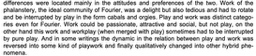
In the Grundrisse it is made clear that the new human being who develops with communist society does so through the expansion of ‘free time which is both leisure and time for higher activity’, which transforms ‘its possessor into another subject’. Work remains a realm of necessity in contrast with the realm of freedom outside work, where human development is an end in itself. This does not mean, however, as one commentator has suggested, that the problem of freedom is in the Grundrisse reduced to the problem of free time, nor does it mean that the realm of work consists of alienated labour. Work does not become ‘pure fun, pure amusement, as in Fourier’s ... childishly naive conception’, since ‘really free work ... is also the most damnably difficult, demanding the most intensive effort’. But if ‘labour cannot become a game, as desired by Fourier’, it remains to his great credit that he ‘stated that the ULTIMATE OBJECT is the raising of the mode of production itself, not [that] of distribution, to a higher form’. And the nature and conditions of work are to be transformed so that work, while necessary, is nevertheless free: "Work involved in material production can achieve this character only if (1) its social character is posited; (2) if it is of a scientific character and simultaneously general [in its application], and not the exertion of the worker as a natural force drilled in a particular way, as a subject, which appears in the production process not in a merely natural, spontaneous form, but as an activity controlling all natural forces.” (Marx, Grundrisse, Collected Works of Marx and Engels (Lawrence & Wishart: London), Vol. 28, p. 530; Collected Works of Marx and Engels (Lawrence & Wishart: London), Vol. 29, p. 97) Work in communist society is both greatly reduced and transformed in character. These features depend upon the expansion of productive powers, made possible in the first instance by capitalism but then exponentially so by its demise. Abundance is a necessary condition for communism. These four key features – the abolition of the division of labour, the development of individual potential, the transformation of work and the increase in material prosperity (made possible by the social ownership of the means of production) – are summed up in the Critique of the Gotha Programme: "In a higher phase of a communist society, after the enslaving subordination of the individual to the division of labour, and therewith also the antithesis between mental and physical labour, has vanished; after labour has become not only a means of life but life’s prime want; after the productive forces have also increased with the all-round development of the individual, and all the springs of common wealth flow more abundantly – only then can the narrow horizon of bourgeois right be crossed in its entirety and society inscribe on its banners: From each according to his ability, to each according to his needs!“ (Marx, Critique of the Gotha Programme, Collected Works of Marx and Engels (Lawrence & Wishart: London), Vol. 24, p. 87.) Levitas, The Concept of Utopia, p.49-50
Till now we have been considering the estrangement; the alienation of the worker only in one of its aspects, i.e., the worker's relationship to the products of his labour. But the estrangement is manifested not only in the result but in the act of production, within the producing activity itself. How could the worker come to face the product of his activity as a stranger, were it not that in the very act of production he was estranging himself from himself? The product is after all but the summary of the activity, of production. If then the product of labour is alienation, production itself must be active alienation, the alienation of activity, the activity of alienation. In the estrangement of the object of labour is merely summarised the estrangement, the alienation, in the activity of labour itself. What, then, constitutes the alienation of labour? First, the fact that labour is external to the worker, i.e., it does not belong to his intrinsic nature; that in his work, therefore, he does not affirm himself but denies himself, does not feel content but unhappy, does not develop freely his physical and mental energy but mortifies his body and ruins his mind. The worker therefore only feels himself outside his work, and in his work feels outside himself. He feels at home when he is not working, and when he is working he does not feel at home. His labour is therefore not voluntary, but coerced; it is forced labour. It is therefore not the satisfaction of a need; it is merely a means to satisfy needs external to it. Its alien character emerges clearly in the fact that as soon as no physical or other compulsion exists, labour is shunned like the plague. External labour, labour in which man alienates himself, is a labour of self-sacrifice, of mortification. Lastly, the external character of labour for the worker appears in the fact that it is not his own, but someone else's, that it does not belong to him, that in it he belongs, not to himself, but to another. Just as in religion the spontaneous activity of the human imagination, of the human brain and the human heart, operates on the individual independently of him—that is, operates as an alien, divine or diabolical activity—so is the worker's activity not his spontaneous activity. It belongs to another; it is the loss of his self. […] This relation [the relation of labour to the act of production] is the relation of the worker to his own activity as an alien activity not belonging to him; it is activity as suffering, strength as weakness, begetting as emasculating, the worker's own physical and mental energy, his personal life—for what is life but activity?—as an activity which is turned against him, independent of him and not belonging to him. Here we have self-estrangement, as previously we had the estrangement of the thing. Marx, Economic and Philosophic Manuscripts, Marx Engels Collected Works Volume 3 (International Publishers), p.274-275

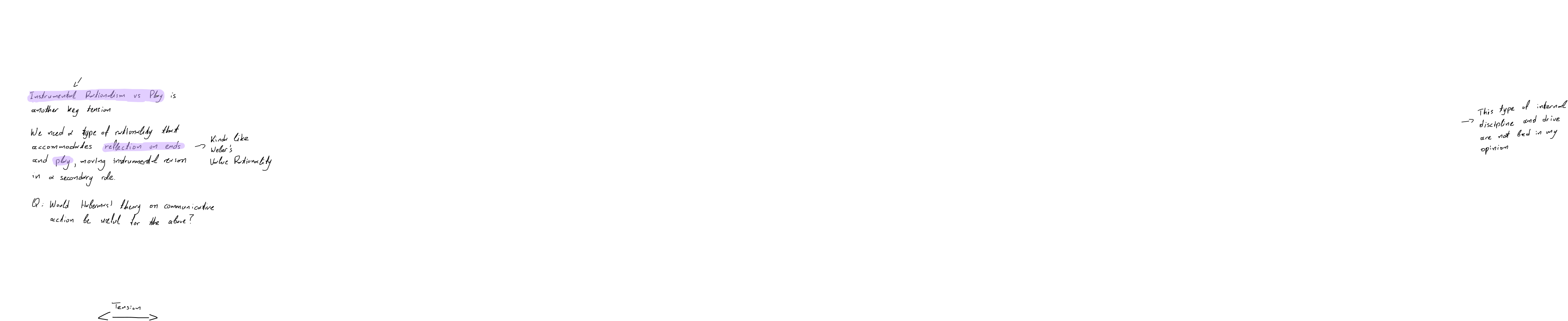
Play

Exploration

Curiosity

Alteration

Work

Goal

Discipline

Repetition

Work: Goal-oriented activity

Thinking about this as a spectrum between 2 opposing types of activity
Division of Labor and Specialization
There is no other way to be faithful to, or even simply to understand, the actions of our comrades of the past than to profoundly reconceive the problem of revolution, which has been increasingly deprived of thought as it has become posed more intensely in concrete reality. But why does this reconception seem so difficult? Starting from an experience of free everyday life (that is, from a quest for freedom in everyday life) it is not so difficult. It seems to us that this question is quite concretely felt today among young people. And to feel it with enough urgency enables one to rediscover lost history, to salvage and rejudge it. It is not difficult for thought that concerns itself with questioning everything that exists. It is only necessary not to have abandoned philosophy (as have virtually all the philosophers), not to have abandoned art (as have virtually all the artists), and not to have abandoned contestation of present reality (as have virtually all the militants). When they are not abandoned, these questions all converge toward the same supersession. The specialists, whose power is geared to a society of specialization, have abandoned the critical truth of their disciplines in order to preserve the personal advantages of their function. But all real researches are converging toward a totality, just as real people are going to come together in order to try once again to escape from their prehistory. Situationist International, The Bad Days will End, Internationale Situationniste #7, https://libcom.org/article/bad-days-will-end-0
The Rise of Division of Labour and Manufacture
That co-operation which is based on division of labour, assumes its typical form in manufacture, and is the prevalent characteristic form of the capitalist process of production throughout the manufacturing period properly so called. That period, roughly speaking, extends from the middle of the 16th to the last third of the 18th century. Marx, Capital, Volume 1, Marx Engels Collected Works Volume 35 (International Publishers), p.341
[Regarding the first way manufacture rises historically]: By the assemblage, in one workshop under the control of a single capitalist, of labourers belonging to various independent handicrafts, but through whose hands a given article must pass on its way to completion. A carriage, for example, was formerly the product of the labour of a great number of independent artificers, such as wheelwrights, harness-makers, tailors, locksmiths, upholsterers, turners, fringe-makers, glaziers, painters, polishers, gilders, etc. In the manufacture of carriages, however, all these different artificers are assembled in one building where they work into one another's hands. It is true that a carriage cannot be gilt before it has been made. But if a number of carriages are being made simultaneously, some may be in the hands of the gilders while others are going through an earlier process. So far, we are still in the domain of simple co-operation, which finds its materials ready to hand in the shape of men and things. But very soon an important change takes place. The tailor, the locksmith, and the other artificers, being now exclusively occupied in carriage-making, each gradually loses, through want of practice, the ability to carry on, to its full extent, his old handicraft. But, on the other hand, his activity now confined in one groove, assumes the form best adapted to the narrowed sphere of action. At first, carriage manufacture is a combination of various independent handicrafts. By degrees, it becomes the splitting up of carriage-making into its various detail processes, each of which crystallises into the exclusive function of a particular workman, the manufacture, as a whole, being carried on by the men in conjunction. In the same way, cloth manufacture, as also a whole series of other manufactures, arose by combining different handicrafts together under the control of a single capitalist. Marx, Capital, Volume 1, Marx Engels Collected Works Volume 35 (International Publishers), p.341-342

[Regarding the second way manufacture rises historically]: Manufacture also arises in a way exactly the reverse of this — namely, by one capitalist employing simultaneously in one workshop a number of artificers, who all do the same, or the same kind of work, such as making paper, type, or needles. This is co-operation in its most elementary form. Each of these artificers (with the help, perhaps, of one or two apprentices), makes the entire commodity, and he consequently performs in succession all the operations necessary for its production. He still works in his old handicraft-like way. But very soon external circumstances cause a different use to be made of the concentration of the workmen on one spot, and of the simultaneousness of their work. An increased quantity of the article has perhaps to be delivered within a given time. The work is therefore re-distributed. Instead of each man being allowed to perform all the various operations in succession, these operations are changed into disconnected, isolated ones, carried on side by side; each is assigned to a different artificer, and the whole of them together are performed simultaneously by the co-operating workmen. This accidental repartition gets repeated, develops advantages of its own, and gradually ossifies into a systematic division of labour. The commodity, from being the individual product of an independent artificer, becomes the social product of a union of artificers, each of whom performs one, and only one, of the constituent partial operations. The same operations which, in the case of a papermaker belonging to a German Guild, merged one into the other as the successive acts of one artificer, became in the Dutch paper manufacture so many partial operations carried on side by side by numerous co-operating labourers. The needlemaker of the Nuremberg Guild was the cornerstone on which the English needle manufacture was raised. But while in Nuremberg that single artificer performed a series of perhaps 20 operations one after another, in England it was not long before there were 20 needlemakers side by side, each performing one alone of those 20 operations, and in consequence of further experience, each of those 20 operations was again split up, isolated, and made the exclusive function of a separate workman. Marx, Capital, Volume 1, Marx Engels Collected Works Volume 35 (International Publishers), p.342-343
Manufacture takes its rise in two ways: — (1.) By the assemblage, in one workshop under the control of a single capitalist, of labourers belonging to various independent handicrafts, but through whose hands a given article must pass on its way to completion. A carriage, for example, was formerly the product of the labour of a great number of independent artificers, such as wheelwrights, harness-makers, tailors, locksmiths, upholsterers, turners, fringe-makers, glaziers, painters, polishers, gilders, etc. In the manufacture of carriages, however, all these different artificers are assembled in one building where they work into one another's hands. It is true that a carriage cannot be gilt before it has been made. But if a number of carriages are being made simultaneously, some may be in the hands of the gilders while others are going through an earlier process. […] (2.) Manufacture also arises in a way exactly the reverse of this — namely, by one capitalist employing simultaneously in one workshop a number of artificers, who all do the same, or the same kind of work, such as making paper, type, or needles. The mode in which manufacture arises, its growth out of handicrafts, is therefore twofold. On the one hand, it arises from the union of various independent handicrafts, which become stripped of their independence and specialised to such an extent as to be reduced to mere supplementary partial processes in the production of one particular commodity. On the other hand, it arises from the co-operation of artificers of one handicraft; it splits up that particular handicraft into its various detail operations, isolating, and making these operations independent of one another up to the point where each becomes the exclusive function of a particular labourer. On the one hand, therefore, manufacture either introduces division of labour into a process of production, or further develops that division; on the other hand, it unites together handicrafts that were formerly separate. But whatever may have been its particular starting-point, its final form is invariably the same — a productive mechanism whose parts are human beings. Marx, Capital, Volume 1, Marx Engels Collected Works Volume 35 (International Publishers), p.341-343
For a proper understanding of the division of labour in manufacture, it is essential that the following points be firmly grasped. First, the decomposition of a process of production into its various successive steps coincides, here, strictly with the resolution of a handicraft into its successive manual operations. Whether complex or simple, each operation has to be done by hand, retains the character of a handicraft, and is therefore dependent on the strength, skill, quickness, and sureness, of the individual workman in handling his tools. The handicraft continues to be the basis. This narrow technical basis excludes a really scientific analysis of any definite process of industrial production, since it is still a condition that each detail process gone through by the product must be capable of being done by hand and of forming, in its way, a separate handicraft. It is just because handicraft skill continues, in this way, to be the foundation of the process of production, that each workman becomes exclusively assigned to a partial function, and that for the rest of his life, his labour power is turned into the organ of this detail function. Marx, Capital, Volume 1, Marx Engels Collected Works Volume 35 (International Publishers), p.343-344
Computers as creative tools
Principles and characteristics of creating tools fostering creativity and collaboration
Interoperability
Computer visionaries and pioneers of the 60s and 70s
New frontiers exploration needs a group of people doing heavy knowledge work with a new technology that enables it. Doug Engelbart, https://youtu.be/LpIYdyOXqkk?t=2789
“We also see this in the million startups that have reinvented the spreadsheet except constrained it to perform a particular set of things and realize: no, really, people use spreadsheets because they are unconstrained”. https://youtu.be/07j2AXC9BH8?si=aekq9ikZ-xjlaeS-&t=1037
Our Collective IQ is boosted by concurrently developing, integrating and applying knowledge. Doug Engelbart, https://www.youtube.com/watch?v=LpIYdyOXqkk&t=880s
The sense of a lost vision of computer pioneers of the 60s and 70s. Dynamics of digital media production
Now that we have all these wonderful devices, it should be the goal of society to put them in the service of truth and learning. And this is the way I propose. Not through obscure forms of "information retrieval;" not through newly oppressive forms of "computer-assisted instruction;" and not through a purported science of "artificial intelligence“ that will create new personalisms to irk us. All these obstructive oddities, I think, have developed as separate ideals because of the grand preposterosity of Professionalism that has created a world-wide cult of mutual incomprehensibility and disconnected special goals. Now we need to get everybody together again. We want to go back to the roots of our civilization - the ability, which we once had, for everybody who could read to be able to read everything. We must once again become a community of common access to a shared heritage. This was of course what Vannevar Bush said in 1945 in an article everybody cites but nobody reads. Ted Nelson, Computer Lib/Dream Machines, Hypertext
This all has a certain vagueness if you do not understand how bound you are today by paper— the problems of finding it , sorting it, looking things up. (If you write, that is, write a lot, you know all too well how intractable is paper, what a damned nuisance.) With a system like Engelbart's, now, whatever is written is instantly there. Whatever you want to look up Is instantly there, simultaneously interconnected to everything else l t should be connected to - source materials, footnotes, comments and so on. A document is completed the moment it is written: no human being has to retype i t . (It need not be typed on paper at all ,if it’s just for the workshop members: a printout is only needed if it has to go to someone outside the system). In many ways, Engelbart's system is a prototype for the world of the future, I hope. ALL HANDLING OF PAPER IS ELIMINATED. Whatever you write, you write on the screens with keyboard and pointer. (No more backs of envelopes, yellow pads, file cards, typewriters.) Whatever you transmit to fellow users of the system you simply 'release' - no physical paper changes hands. The group has also worked out some remarkable techniques for collaborative endeavor. Two people - say, one in California and one in New York - can work together through their screens, plus a phone link; it's as if they were side-by-side at a magic table. Each sees on his screen what the other sees; each controls a moving dot (or "cursor") that shows where he's pointing. The effect is somewhere between a blackboard and a desk; both may call up documents, point things out in them, change them, and anything else two people might do when working on something together. Basically the system Is a large-scale setup for the storage, bringing forth, viewing and revision of documents and connections among them. Ted Nelson, Computer Lib/Dream Machines, Doug Engelbart and “The Augmentation of Intellect”
[…] human action, or even human thought, can only take place through some kind of material medium and therefore can’t be understood without taking the qualities of that medium into account. Hence the importance in Turner’s analysis of the notion of material media of circulation. The media have qualities in and of themselves. For all the (often quite legitimate) criticisms of Jack Goody’s dichotomies between orality and literacy, for example, it is simply obvious that technologies of writing allow for possibilities that do not exist in speech (and equally, vice versa). Graeber, Toward an Anthropological Theory of Value, p.83
The open problem of writing and rendering math using inline equations
Back in the days of WYSIWYG web editors like Dreamweaver and Microsoft FrontPage you would often end up with this problem, where you try to do any edit in the WYSIWYG side and then you look at the generated HTML and is ridiculous: There's like 16 nested, empty span tags and no one would ever be able to maintain that. And my worry is basically that when you automatically create markup for something that has a very complex graphical representation, it's really like one way: maybe it will help you produce a compiled output, but it doesn't actually help you go back in edit and tweak the representation later. I think we really need to get to some kind of good intermediate representation that allows you to flexibly go both ways. Slim Lim, Metamuse Episode 48 Rich Text with Slim Lim, 47:35, https://open.spotify.com/episode/51u2e3Ak6E4yMfqmA0NOdm?si=c8WSrsIUTvqlq4tfmT1CRA
[Slim] And that goes back to something that Adam and I were chatting about earlier, which is that a lot of people gripe and complain, that LaTex is the best we have, and, you know, I'm one of them. But it really is the case that LaTex was this monumental effort by really a few people, and amount of effort that would be considered really impressive if I were to try to do the same thing but better today. Not a lot of people have spare time to do this all-in-one text formatting and packaging document representation project even though it would have a huge impact on the way people write and publish these kinds of documents. And so, in many ways, we're sort of just bottlenecked on the fact that it's hard to do incremental improvements to this particular area. We really depend on these software monoliths to keep us afloat. […] [Wiggins] And yeah, I agree. It's a monumental effort, but I mean mathematics is so important and foundational and so much of human endeavor that certainly seems like one worth investing in, although perhaps hard to reap a profit from and that makes it harder to put concentrated capital behind it. Slim Lim & Wiggins, Metamuse Episode 48 Rich Text with Slim Lim, 48:30, https://open.spotify.com/episode/51u2e3Ak6E4yMfqmA0NOdm?si=BHebRCxjQVSETJlrxi1McQ
[McGranaghan]: Isn’t the state of the art [for rendering equations in the browser] generating PNG and sticking it in the web page? [Slim]: Not exactly but almost. So MathML, which is an XML dialect or mathematical markup language was this effort to build XML style syntax for typesetting mathematics naturally. It is only implemented in Firefox, so that's really unfortunate. So in terms of the state of the art, there are basically two libraries that you can use to typeset mathematics: there's MathJax and KaTex. MathJax supports all valid LaTex […]. The problem is that MathJax is very slow. So if you ever go on MathOverflow or another related StackExchange and you see all of these answers with weird gaps, and then as you watch before you the page starting to load all of the rendered equations bumping everything down one level at a time, that's MathJax in action. And oftentimes it is doing what you're describing where it is outputting an SVG or a PNG or something like that. And it's reflowing the page with every equation. Then you have KaTex, which was a library developed at Khan Academy where they realize that MathJax’s performance was not satisfactory for their exercises. KaTex supports a much more limited subset of all of LaTex syntax, but it does it all using CSS and it doesn't reflow the page for every equation, it’s basically instant rendering. And basically, it means that your options if you want to render math are: - Only target Firefox - Use a limited subset of math that’s supported by KaTex - Constrain yourself to extremely slow, dozens-of-reflow, full-expressive-power rendering to inline PNGs. And that's just not a great situation to be in and we haven't even gotten to the question of how people write math. So I would say that people underestimate how open this problem space is. Just take a moment of silence to like recognize the gravity of the situation. Slim Lim, Metamuse Episode 48 Rich Text with Slim Lim, 52:05, https://open.spotify.com/episode/51u2e3Ak6E4yMfqmA0NOdm?si=kKrmc0JWRdey8N1s1OXC9A
Digital tools and human-computer interaction
Spreadsheets
Hypertext
I believe computer screens can make people happier, smarter, and better able to cope with the copious problems of tomorrow. But only if we do right, right now. WHY? The computer's capability for branching among events, controlling exterior devices, controlling outside events, and mediating in all other events, makes possible a new era of media. Until now, the mechanical properties of external objects determined what they were to us and how we used them. But henceforth this is arbitrary. The recognition of that arbitrariness, and re-consideration among broader and more general alternatives, awaits us. All the previous units and mechanisms of learning, scholarship, arts, transaction and confirmation, and even self-reminder, were based in various ways upon physical objects - the properties of paper, carbon paper, files, books and bookshelves. To read from paper you must move the physical object in front of you. Its contents cannot be made to slide, fold, shrink, become transparent, or get larger. But all this Is now changing, and suddenly. The computer display screen does all these things if desired, to the same markings we have previously handled on paper. The computer display screen is going to become universal very fast; this is guaranteed by the suddenly rising cost of paper. And we will use them for everything. [...] Our screen displays will be alive with animation in their separate segments of activity, and will respond to our actions as if alive physically too. Ted Nelson, Computer Lib/Dream Machines, Fantics
Harnessing Complexity
Software Longevity
[Wiggins]: For me, thinking about that word longevity, I tend to think about what is long, I guess. What is a span of time that counts as long and of course it depends a lot on what you're talking about. So if you're talking about all of society, culture, humanity, then perhaps you’re talking in the thousands of years, hundreds or thousands of years. So for example, the long now is a phrase that we use to the local-first paper, we tend to use it internally on our team to refer to longer-term. Thinking this comes from the Long Now Foundation, and the long now clock project, which is sort of this idea to build a clock that can keep time for 10,000 years and it's basically an art project, but it's designed to inspire us to think longer term, and that can obviously connect to things about climate change or human culture. And since humans are naturally inclined to think probably pretty short term, actually really short term: We think about the day that's ahead or the week that's ahead of us, maybe at most the year that's ahead of us, we don't tend to think in tens or hundreds or thousands of years. That's maybe a society level thing. I think for individuals and thinking about, you know, software as it impacts our lives as individuals, I think a human lifespan is actually is a pretty good chunk of time to compare something to. Wiggins and McGranaghan, Metamuse Episode 49, Software Longevity, 05:06, https://open.spotify.com/episode/1DCNy94TBt3aoGbM8PNlRv?si=8Ny-UxkNStWnvjGA1EnO-A
Data and rolling it over to newer versions
[Wiggins]: Now, some have argued that perhaps part of the challenge here is the rapid pace of change of that underlying system of those APIs. I think it's interesting here to contrast the Apple versus Microsoft approach. So I think that Microsoft with DOS and later Windows was really focused on backwards compatibility quite in an impressive level. I'm not exactly sure when the cut-offs are, but I think you could run DOS stuff natively on windows till well into the Windows lineage, and much later versions of Windows could run much earlier versions. But that's part of, I think, what also created the relative instability and unreliability of that line of operating systems, which is when you need to support every conceivable thing that's ever existed in the past and put it all together in the same box, and things get messy pretty fast. Apple with the iOS world has gone very much the other route which is they basically are releasing new stuff, a new OS update, once a year and if app developers don't keep up-to-date you pretty quickly just fall out of the App Store. […] You have this very demanding operating system that requires developers be doing active maintenance, or else it [your app] tends to go away. [McGranaghan]: While I don't doubt that there was some contribution in the Windows situation to instability from needing to support all versions forever, I think what really gets you is when you need to do that, and things that are really end-user-facing, like visual in particular, because the strategies that you typically use for providing stability are not viable in that world. So, if you look at things like Unix-style server, operating systems, many programming languages, these are things that can have backwards compatibility for a long time, certainly decades. But the way they do that is they just never ever, ever ever break any APIs. And if you want to do something new, either too bad, or call it "thing 2” and just keep “thing 1” around forever. […] you can't really do that with a windowing system, for example, or a user interface paradigm or how things look on the screen, right? You just got to pick something and do it, and the old thing needs to go. And so I think it does become very hard to have that culture of very long-lived durability that you see in those systems-y programs. [Wiggins]: Yeah, maybe that points to the fundamental trade-off there, which is durability in many cases means stability, which means less change. But change is how we get things that are new and better and the world technology and computers in the internet is so at the very beginning, there's so much unexplored space, and it would be a shame if we just said, okay, well we've been working on making these computers here for a few decades now, this is pretty much how they are, probably it is probably good for the next several hundred years, let's just hold it there. That's not what we want to do. We want to keep changing and improving. So yeah, there just is a trade-off between those two. [McGranaghan]: Yeah, I think there's a very real tension and I agree want to keep exploring. I do think that in adopting this attitude of exploring and taking risks, we are going to find some things that in retrospect were not good choices. The intuition here is, I think we're projecting these very dynamic system benefits over lives that we have historically associated with durable goods. So we get the shiny new computer-enabled, software-enabled thing, and it works great the first year, and we think: things like this, before we had computers, they worked for 20 or 30 years, therefore, this thing is going to work for 20 or 30 years, it's gonna be awesome. And we've kind of projected that out for, and I think in many cases that's not going to be true. And so we are going to have to confront the downside of that tradeoff. [Wiggins]: And do you think the downside there is mainly economic? You buy the smart refrigerator seems great for the first year, some cloud service goes offline suddenly and your refrigerator doesn't work anymore and you got to throw it out and get a new one, or do you think there's something beyond the economic side? [McGranaghan]: Unfortunately I think there are several potential very serious downsides. Just to give you a couple, one that we're already seeing is this issue of repairability or even modifiability. Again, if you look at these durable goods categories like tractors, which is very prominent example right now, traditionally people could service and maintain and change and modify and improve their own tractors. But as tractors increasingly become like iPhones, you know, these black-box computers in many ways, or highly computerized hardware, Potentially you can’t service them yourself, you can't repair them yourself, you can't modify them yourself and that has all kinds of second order effects. There's also this whole thing about surveillance basically that I think we're sleeping on a little bit, but we do need to go down that rabbit hole today. [Wiggins]: On the economic side, I think there's all sort of the incentive which is basically Apple and other phone manufacturers have done very very well by always creating that shiny new thing that comes out every year or two. And you think: I want to upgrade. It’s even often built into cell phone contracts and things, people want to get a new phone very frequently. And I think that's paired with sometimes the operating system upgrades, or maybe the visual refreshes, it's almost more like fashion, the fashion industry found this very clever way to get around the fact their IP isn't really protectable, which is they just make new fashion trends the totally change for a couple of years. So then you like need to go out and get a new wardrobe. It's not the clothes wore out necessarily. It's that you want to be up-to-date and you look behind the times when you’re strolling around in your bell bottoms and those have been out of fashion for three years or whatever it is. And so I think there's an element of this kind of a fashion or desire to get the new thing that has driven a lot of revenue for these companies. I don't mean to imply that that some kind of a cackling in the back layer, they're using this opportunity to improve and genuinely make their products better: Each version of the iPhone has that better camera, that better battery life, the bigger brighter screen, it is genuinely better, but it's also the companies are very incentivized for a high pace of change that has you buying new products all the time, as opposed to something longer-term. Wiggins and McGranaghan, Metamuse Episode 49, Software Longevity, 18:33 , https://open.spotify.com/episode/1DCNy94TBt3aoGbM8PNlRv?si=euUyYhr6SWC4C0KFtLmMHQ
Software environment and dependencies
The constituent parts of software longevity. Software as a special class of information
Preserving games as a form of cultural history preservation
Techniques for achieving software longevity
[Wiggins] […] one of the things that points to that to me feels like maybe the most fundamental is to just think about longevity in the first place and just care about it in the first place. Part of the reason I thought this topic would be an interesting one.I think, again, tech industry skews (?) young, I think also had the same gap in my thinking as a younger person, which was I just didn't have the longer experience to be able to see what it is like for software that I've created that's in production for three years, five years, ten years, and longer and what happens over time. It's a part of what I like with the SQLite long-term support page, they basically lead with a statement that our goal is to support this until the year 2050 and so, will they achieve that? hard to know… But just by making that statement, calling it out as a value for themselves and thinking about it actively, maybe this comes back to the long-now clock idea, which is, they may or may not succeed but certainly one good way to not succeed is to not think about it in the first place. And so this makes it a first-class concern. Wiggins & McGranaghan, Metamuse Episode 49, Software Longevity, 30:14, https://open.spotify.com/episode/1DCNy94TBt3aoGbM8PNlRv?si=UT2qfBJAQWWjr5QsUGkunw
Local-first and software longevity
In the fullness of time, the files you create are more important than the tools you use to create them. Apps are ephemeral, but your files have a chance to last. The ancient temples of Egypt contain hieroglyphs that were chiseled in stone thousands of years ago. The ideas hieroglyphs convey are more important than the type of chisel that was used to carve them. The world is filled with ideas from generations past, transmitted through many mediums, from clay tablets to manuscripts, paintings, sculptures, and tapestries. These artifacts are objects that you can touch, hold, own, store, preserve, and look at. To read something written on paper all you need is eyeballs. Today, we are creating innumerable digital artifacts, but most of these artifacts are out of our control. They are stored on servers, in databases, gated behind an internet connection, and login to a cloud service. Even the files on your hard drive use proprietary formats that make them incompatible with older systems and other tools. […] If you want your writing to still be readable on a computer from the 2060s or 2160s, it’s important that your notes can be read on a computer from the 1960s. You should want the files you create to be durable, not only for posterity, but also for your future self. You never know when you might want to go back to something you created years or decades ago. Don’t lock your data into a format you can’t retrieve. These days I write using an app I help make called Obsidian, but it’s a delusion to think it will last forever. The app will eventually become obsolete. It’s the plain text files I create that are designed to last. Who knows if anyone will want to read them besides me, but future me is enough of an audience to make it worthwhile. Steph Ango, File over App, https://stephango.com/file-over-app
Information Storage
But why should things be saved? Everything is deeply intertwingled. We save for knowledge and nostalgia, but what we thought was knowledge often turns to nostalgia, and nostalgia often brings us deeper insights that cut across our lives and very selves. Ted Nelson, Computer Lib/Dream Machines, The Heritage
Computers offer an interesting daydream: that we may be able to store things digitally instead of physically. In other words, turn the libraries to digital storage (see Hypertexts); digitize paintings and photographs (see "Picture Processing);even digitize the genetic codes of animals, so that species can be restored at future dates (see "The Hitiest Computer,"). Digital storage possesses several special advantages. Digitally stored materials may be copied by automatic meanB; corrective measures are possible, to prevent errors from creeping In— i.e., "no deterioration" In principle; and they could be kept in various places, lessening man- kind's dependence on its eggs being all in one basket (like the Library at Alexandria, whose burning during the occupation of Julius Caesar was one of the greatest losses in human history). But this would of course require far more compact and reliable forms of digital storage than exist right now. Nevertheless, we better start thinking about it. Ted Nelson, Computer Lib/Dream Machines, The Heritage
Paper moulders. Microfilm is inconvenient. In the best libraries it takes at least minutes to get a particular thing. But as to linking them together - footnoting Aeschylus with Marcus Aurelius, linking genetic data to 15th-century accounts of Indian tribes - well, you can only do it on paper by writing something new that ties them together. Isn't that ridiculous? When you could do it all electronically in seconds? Ted Nelson, Computer Lib/Dream Machines, Hypertext
Critique of digital media and computing in capitalism
Culture of digital media producers
[Mielke]: I just think that fundamentally analysis is great […] of history, especially in a field like tech, which is in some ways, pretty disconnected from its own history and there's almost kind of like a pride in that of moving, so quickly that we don't even look to the past. [Wiggins]: Yeah, all right. Almost listed as a sort of willful disregard of history because I think there's the classic Y Combinator startup founder, fresh out of school. It's actually their naivety that allows them to reinvent their not dragged down by the legacy baggage of how we do things today. They can just think about it and kind of of a greenfield way and dream up a new idea. […] But that comes at the expense of well actual naivety and reinventing everything and not using scholarship of the past to learn what's worked and what hasn't in order to kind of stand on the shoulders of giants or build the way that any other field would. Of course, you learn from the past and then you use that to inform what you should do, going forward into the future, and yeah, the young naive startup founder, other types that we hold up as our role models sometimes and technology are not into scholarship. Mielke & Wiggins, Metamuse ep.30 Computers and Creativity with Molly Mielke 16:50, https://open.spotify.com/episode/5HoFWZzo4PAzEhF5Tn3WbD?si=KRW6ed30T1KEm4G8fa8FSA
It’s not just that the culture of the digital media industry is disconnected from it’s history, it’s uncritical and often unreflective, just going after the short/mid term profit and driven by hype.
[…] let me bring the positive side, which is I totally agree that they did lay out a vision for computing. That is grounding in a world where we do seem stuck in social media consumer not exactly sure what; everything is oriented around commerce, and again things are all good: commerce entertainment, these things are fine, I consume these. But the reason I got interested in computers that are very young ages seeing their potential for creativity, and unlocking the noblest parts of the human spirit. Wiggins, Metamuse ep.30 Computers and Creativity with Molly Mielke 23:25, https://open.spotify.com/episode/5HoFWZzo4PAzEhF5Tn3WbD?si=AmfN5kUhQK669_VhAK9e7w
[…] there was these amazing visionaries who saw the potential for computers and creativity, sort of laid out a vision way back in what seems like just the stone age's to us the 1960s and 1970s and then in some ways we lost our way. And we ended up with, I don't know, social media and kind of lockdown appliance like smartphones. And in fact, there's this glorious world of Smalltalk, Dynabook and Mother of all Demos style stuff that we still need to build, or we haven't built or something like that. Wiggins, Metamuse ep.30 Computers and Creativity with Molly Mielke 14:30, https://open.spotify.com/episode/5HoFWZzo4PAzEhF5Tn3WbD?si=AmfN5kUhQK669_VhAK9e7w
Situationist critique of the Spectacle and the passiveness of culture is very relevant here. It’s more problematic that Wiggins thinks here.
Ultimately, the problem with commercial offers and decentralized software applications boils down to the same thing. In order to challenge state reLavabitn and capitalist exploitation effectively, it is necessary to stand and organize collectively against the state and capital. Cypherpunk initiatives like Lavabit or decentralized software can go a long way to challenge the status quo, but they are historically limited by their understanding of social change and social conflict. Social change is not simply a matter of consumer preference like the choice of an individual’s email provider, neither social conflicts are mere mathematical problems that can be resolved through a strategic application of mathematics. Radical technology collectives build political solidarity and nurture security behaviors within and between activist groups in addition to providing things like email and putting the right cryptographic algorithms in place. Autistici/Inventati - +KAOS - 10 Years of Hacking and Media Activism, Institute of Network Cultures 2021, p.12
Absence of interoperability and its relationship with capitalism and prevailing social structures
I think this is a prime example of the political economy issue. It's very easy to say we should have x. And even if x is relatively easy to do, which is not, in this case, there's still this huge issue of the “we should” that's quite the weasel phrase, right? If we were to accomplish this, we will need a bunch of companies or individual developers to temporarily make more work for themselves. Lower the profitability, make their products worse for their customers in the short term to get to some kind of global maximum. It’s a case where the coordination problem is really important. McGranaghan, Metamuse ep.30 Computers and Creativity with Molly Mielke 32:05, https://open.spotify.com/episode/5HoFWZzo4PAzEhF5Tn3WbD?si=AmfN5kUhQK669_VhAK9e7w
I think that the lack of interoperability or standardization between digital tools today, really, it means that all work created within a tool is confined to that tool and to me that seems very clearly antithetical to creativity and specifically the collaborative aspect of creativity. I think that there's so much to be said for tools. Amplifying the power of our brains and really taking over the mechanical aspects of human thought and limiting creation to a single piece of software's capabilities is just kind of crazy if you have step back and think about it. And I just think that standardization and having tools talk to each other, which is fundamentally change the tide of how we use them and introduced in more collaborators, and really just expand the projects constraints beyond any one tool. Mielke, Metamuse ep.30 Computers and Creativity with Molly Mielke 30:00, https://open.spotify.com/episode/5HoFWZzo4PAzEhF5Tn3WbD?si=KRW6ed30T1KEm4G8fa8FSA
Data silos and lack of interoperability can very well be a contradiction of capitalism when we think of the political economy of social media.
Political economy of digital media
The capitalist who produces surplus-value – i.e., who extracts unpaid labour directly from the labourers, and fixes it in commodities, is, indeed, the first appropriator, but by no means the ultimate owner, of this surplus-value. He has to share it with capitalists, with landowners, etc., who fulfill other functions in the complex of social production. Surplus-value, therefore, splits up into various parts. Its fragments fall to various categories of persons, and take various forms, independent the one of the other, such as profit, interest, merchants’ profit, rent, &c. It is only in Book III. that we can take in hand these modified forms of surplus-value. On the one hand, then, we assume that the capitalist sells at their value the commodities he has produced, without concerning ourselves either about the new forms that capital assumes while in the sphere of circulation, or about the concrete conditions of reproduction hidden under these forms. On the other hand, we treat the capitalist producer as owner of the entire surplus-value, or, better perhaps, as the representative of all the sharers with him in the booty. We, therefore, first of all consider accumulation from an abstract point of view – i.e., as a mere phase in the actual process of production. So far as accumulation takes place, the capitalist must have succeeded in selling his commodities, and in reconverting the sale-money into capital. Moreover, the breaking-up of surplus-value into fragments neither alters its nature nor the conditions under which it becomes an element of accumulation. Whatever be the proportion of surplus-value which the industrial capitalist retains for himself, or yields up to others, he is the one who, in the first instance, appropriates it. We, therefore, assume no more than what actually takes place. On the other hand, the simple fundamental form of the process of accumulation is obscured by the incident of the circulation which brings it about, and by the splitting up of surplus-value. An exact analysis of the process, therefore, demands that we should, for a time, disregard all phenomena that hide the play of its inner mechanism. Marx, Capital, Volume 1 (Progress Publishers, 1887), p.400
Those in charge have even made sure, therefore, that we humans having the leisure are not at liberty to make use of it as we please. It's as if we needed to work more as consumers in proportion as we work less as producers. As if consumption no longer signified a satisfaction, but rather a social obligation. Moreover the technological equipment of leisure increasingly resembles that of labor. While in our fooling around on the Internet all our clicks produce the data that the GAFA resell, work is tricked out with all the enticements of gaming by introducing scores, levels, bonuses and other infantilizing caveats. The Invisible Committee, Now, p.95
Aris Goudouras
Marx decides to initially simplify the problem here by not considering the sphere of circulation. This sphere is very critical for the model of advertising and modern social media and. The power they have obtained arguably makes them the main appropriators of value, even if they are not the ones directly appropriating the unpaid labor. Another interesting argument on this is Varoufakis’ regarding technofeudalism. E.g. if cloud capital extracts a big chunk of the surplus value in the economy as rent by controlling the sphere of circulation, how much does the general paradigm change? Is it still “traditional” capitalism or do we consider it something else, such as technofeudalism?
The sense of a lost vision of computer pioneers of the 60s and 70s. Dynamics of digital media production
[…] there was these amazing visionaries who saw the potential for computers and creativity, sort of laid out a vision way back in what seems like just the stone age's to us the 1960s and 1970s and then in some ways we lost our way. And we ended up with, I don't know, social media and kind of lockdown appliance like smartphones. And in fact, there's this glorious world of Smalltalk, Dynabook and Mother of all Demos style stuff that we still need to build, or we haven't built or something like that. Wiggins, Metamuse ep.30 Computers and Creativity with Molly Mielke 14:30, https://open.spotify.com/episode/5HoFWZzo4PAzEhF5Tn3WbD?si=AmfN5kUhQK669_VhAK9e7w
[…] let me bring the positive side, which is I totally agree that they did lay out a vision for computing. That is grounding in a world where we do seem stuck in social media consumer not exactly sure what; everything is oriented around commerce, and again things are all good: commerce entertainment, these things are fine, I consume these. But the reason I got interested in computers that are very young ages seeing their potential for creativity, and unlocking the noblest parts of the human spirit. Wiggins, Metamuse ep.30 Computers and Creativity with Molly Mielke 23:25, https://open.spotify.com/episode/5HoFWZzo4PAzEhF5Tn3WbD?si=AmfN5kUhQK669_VhAK9e7w
And it's a good reminder, to go back and look at some of this history, maybe, especially because these folks didn't have any of that prior stuff computers were still so new. Particularly personal computing was essentially, you know, they were in the process of inventing it thinking what can people do if they had access to computers with graphics and networking and all the things that nowadays we take for granted but they dreamed something very different from the world we have today and that can be very grounding to look back at that and take a bit of a blank slate from where we are today. So yeah, I personally take a lot of inspiration from all their work as well. Wiggins, Metamuse ep.30 Computers and Creativity with Molly Mielke 24:05, https://open.spotify.com/episode/5HoFWZzo4PAzEhF5Tn3WbD?si=AmfN5kUhQK669_VhAK9e7w
I also think that they were operating in an environment that was largely kind of independent from the actual business environment and like, the technology sector as we see it today. Mielke, Metamuse ep.30 Computers and Creativity with Molly Mielke 16:04, https://open.spotify.com/episode/5HoFWZzo4PAzEhF5Tn3WbD?si=5lptp_mFReqInuu1Bjsbnw
Both Mielke and McGranaghan acknowledge that it’s the political economy and the business needs that prevented computer pioneers’ vision to be materialized. But, especially McGranaghan remains uncritical of capitalism (quite the opposite basically). I think the latter is a general sense I have, not directly expressed in this partcular excerpt.
[…] a lot of this study analysis has been at the level of the tools. So it's like what's on the screen, how do you program it, what's the user interface even. But there’s an entire complex system around how software is developed and used and, like you were saying, I think the reason that the vision for the software and the reality the software don't line up is because we haven't understood or at least accounted for how that ecosystem works. Sometimes I call this the political economy of software development, there's weird path dependence, there's economic incentives; you got to understand all of that if you are going to understand how we came to where we are now. And on the flip side, if you want to predict and guide the future in that direction, you need to become a sort of of political economist of software, and get not only the interfaces in the code, but also the funding and the incentives and legal stuff and all that. McGranaghan, Metamuse ep.30 Computers and Creativity with Molly Mielke 18:57, https://open.spotify.com/episode/5HoFWZzo4PAzEhF5Tn3WbD?si=hDV9jmWRQPSyXg1tvFtVeQ
Important open problems for knowledge work primarily not tackled due to economic reasons
Human users dominated by computers instead of the opposite
I really think that the power of tools lies in their ability to amplify human action or thought, versus the power of human beings is really about our ability to think creatively. And so, if that's true, then why do computers often ask us to act as almost execution machines ourselves to create something when that's like very uniquely the computers strong suit. Mielke, Metamuse ep.30 Computers and Creativity with Molly Mielke 12:31, https://open.spotify.com/episode/5HoFWZzo4PAzEhF5Tn3WbD?si=k2HU7gp5TLWwojMeCIAQ2Q
In the factory we have a lifeless mechanism independent of the workman, who becomes its mere living appendage. “The miserable routine of endless drudgery and toil in which the same mechanical process is gone through over and over again, is like the labour of Sisyphus. The burden of labour, like the rock, keeps ever falling back on the worn-out labourer.” At the same time that factory work exhausts the nervous system to the uttermost, it does away with the many-sided play of the muscles, and confiscates every atom of freedom, both in bodily and intellectual activity. The lightening of the labour, even, becomes a sort of torture, since the machine does not free the labourer from work, but deprives the work of all interest. Every kind of capitalist production, in so far as it is not only a labour-process, but also a process of creating surplus-value, has this in common, that it is not the workman that employs the instruments of labour, but the instruments of labour that employ the workman. But it is only in the factory system that this inversion for the first time acquires technical and palpable reality. By means of its conversion into an automaton, the instrument of labour confronts the labourer, during the labour-process, in the shape of capital, of dead labour, that dominates, and pumps dry, living labour-power. Marx, Capital Volume 1 (Progress Publishers, 1887), p. 285-286
I do feel like more often than not in the modern world, stealing your attention is one example, you're sort of fighting against the computer. And perhaps, it's not the computer itself, it's the whole world of computing: the internet or email inboxes notifications, the way that the web works, and so on. You're often either fighting against this thing trying to make you do things you don't want to do, or take away your attention, or distract you, or it wants you to do its chores: you know, click this update, this do this fill up this box. And it should be be a tool quietly waiting for what you're asking of it and to co-create and help you. I like this, quote from the original Tron movie, which at a one point the bad guy basically says: “look, the system's overloaded because we don't have time to handle every little user request” and the guy speaking to is kind of the wizened old computer scientist arguing: “actually user requests is what computers are for”, and I feel like it's so often forgotten. They are here to serve us and sometimes it feels more often the human has to serve the computer or perhaps the business interests. I'm a capitalist, don’t get me wrong. But the business needs, the KPI of whoever designed the product is asking me to do things to serve that rather than my needs. Wiggins, Metamuse ep.30 Computers and Creativity with Molly Mielke 25:30, https://open.spotify.com/episode/5HoFWZzo4PAzEhF5Tn3WbD?si=nJ1xydCVRs2FqbkIw_4cbQ
Those in charge have even made sure, therefore, that we humans having the leisure are not at liberty to make use of it as we please. It's as if we needed to work more as consumers in proportion as we work less as producers. As if consumption no longer signified a satisfaction, but rather a social obligation. Moreover the technological equipment of leisure increasingly resembles that of labor. While in our fooling around on the Internet all our clicks produce the data that the GAFA resell, work is tricked out with all the enticements of gaming by introducing scores, levels, bonuses and other infantilizing caveats. The Invisible Committee, Now, p.95
We are required to live in the condition that Linda Stone has called “continuous partial attention”, where our attention is habitually distributed across multiple communication platforms. As Franco “Bifo” Berardi has argued, we now live in the tension between the infinity of cyberspace and the vulnerable finitude of the body and the nervous system. “The acceleration of information exchange has produced and is producing an effect of a pathological type on the individual human mind and even more on the collective mind,” Berardi writes in Precarious Rhapsody, "Individuals are not in a position to process the immense and always growing mass of information that enters their computers, their cell phones, their television screens, their electronic diaries and their heads. However, it seems indispensable to follow, recognise, evaluate, process all this information if you want to be efficient, competitive, victorious. [...] The necessary time for paying attention to the fluxes of information is lacking.” The consequence is a strange kind of existential state, in which exhaustion bleeds into insomniac overstimulation (no matter how tired we are, there is still time for one more click) and enjoyment and anxiety co-exist (the urge to check emails, for instance, is both something we must do for work and a libidinal compulsion, a psychoanalytic drive that is never satisfied no matter how many messages we receive). The fact that the smartphone makes cyberspace available practically anywhere at anytime means that boredom (or at least the old style, “Fordist” boredom) has effectively been eliminated from social life. Yet boredom, like death, posed existential challenges that are far more easily deferred in the always-on cyberspatial environment. Ultimately, communicative capitalism does not vanquish boredom so much as it “sublates” it, seeming to destroy it only to preserve it in a new synthesis. The characteristic affective tonality for the insomniac drift of cyberspace, in which there is always one more click to make, one more update to check, combines fascination with boredom. Mark Fisher & Darren Ambrose, Time-Wars: Towards an Alternative for the Neo-Capitalist Era, K-Punk: The Collected and Unpublished Writings of Mark Fisher, 2018, p.520-521
The consequence of the normalisation of uncertainty is a permanent state of low-level panic. Fear, which attaches to particular objects, is replaced by a more generalised anxiety, a constant twitching, an inability to settle. The uncertainty of work is intensified by digital communication technology. As soon as there is email, there are no longer working hours nor a workplace. What characterises the present moment more than our anxious checking — of our messages, which may bring opportunities or demands (often both at the same time), or, more abstractly, of our status, which, like the stock market is constantly under review, never finally resolved? Mark Fisher & Darren Ambrose, Time-Wars: Towards an Alternative for the Neo-Capitalist Era, K-Punk: The Collected and Unpublished Writings of Mark Fisher, 2018, p.519
Perhaps the feeling most characteristic of our current moment is a mixture of boredom and compulsion. Even though we recognise that they are boring, we nevertheless feel compelled to do yet another Facebook quiz, to read yet another Buzzfeed list, to click on some celebrity gossip about someone we don’t even remotely care about. We endlessly move among the boring, but our nervous systems are so overstimulated that we never have the luxury of feeling bored. No one is bored, everything is boring. Mark Fisher & Darren Ambrose, No One is Bored, Everything is Boring, K-Punk: The Collected and Unpublished Writings of Mark Fisher, 2018, p.558
The lack of creative ecology means that today’s great idea for a better society turns into tomorrow’s unemployed taxi drivers and homeless city dwellers. Welcome to platform monopoly capitalism. Groupon, AirBNB, Uber, MyWheels and countless others. Here, we do not witness so much a gross violation of the rules of appropriation as an attempt to reshape existing economic activities and drive labour to its bones: a disruption without a cause. Let’s not delude ourselves: we are not sharing anything when we rate the last wretched soul who gave us a cheap lift with his Uber cab. We do not share anything when we drive a Hertz or Avis rental car (except our likes). Sharing only happens in the absence of market transactions. And it doesn’t have to ‘scale’. This begs the question: can we still speak of creative industries, which in Europe’s policy world (and beyond) rests on the economization of culture? Everyone is keenly aware of the fact that Creative Industries as a policy meme has passed its use-by date. This is why we need to warn ourselves: changing labels will not help us much. https://networkcultures.org/geert/2014/11/20/the-creative-question-nine-theses/
the incursion of capitalist cyberspace into every area of life and the psyche has intensified the processes of de-socialisation. This is not to say that there are no progressive potentials in the web, but these have almost certainly been overrated, while the impact of cyberspace in de-socialising culture and subjectivity has been massively underestimated. Here I merely rehearse Bifo’s account of semio-capitalism and Jodi Dean’s critique of communicative capitalism, but it is important to operationalise this critique. Blogs and social media have allowed us to talk to ourselves (but not to reach out beyond the left bubbles); they have also generated pathological behaviours and forms of subjectivity which not only generate misery and anger — they waste time and energy, our most crucial resources. Email and handhelds, meanwhile, have produced new forms of isolation and loneliness: the fact that we can receive communications from work anywhere and anytime means we are exposed to work’s order-words when we are alone, without the possibility of support from fellow workers. In sum, the obsession with the web, its monopolisation of any idea of the new, has served capitalist realism rather than undermined it. Which does not mean, naturally, that we should abandon the web, only that we should find out how to develop a more instrumental relationship with it. Put simply, we should use it — as a means of dissemination, communication and distribution — but not live inside it. The problem is that this goes against the tendencies of handhelds. We all recognise the by now clichéd image of a train carriage full of people pecking at their tiny screens, but have we really registered how miserable this really is, and how much it suits capital for these pockets of socialisation to be closed down? Mark Fisher & Darren Ambrose, Abandon Hope (Summer is Coming) - Socialization Beyond Social Media, K-Punk: The Collected and Unpublished Writings of Mark Fisher, 2018, p.592
Aris Goudouras
This is a similar thought to Marx’s observation that machines appear as an alienating and dominating force for the worker in capitalism. I think that Wiggins makes an observation that aligns very much with Marx’s critique of capitalism here but refuses to follow it to its conclusion and blame capitalism for what’s wrong.
Important open problems for knowledge work primarily not tackled due to economic reasons
[McGranaghan]: Isn’t the state of the art [for rendering equations in the browser] generating PNG and sticking it in the web page? [Slim]: Not exactly but almost. So MathML, which is an XML dialect or mathematical markup language was this effort to build XML style syntax for typesetting mathematics naturally. It is only implemented in Firefox, so that's really unfortunate. So in terms of the state of the art, there are basically two libraries that you can use to typeset mathematics: there's MathJax and KaTex. MathJax supports all valid LaTex […]. The problem is that MathJax is very slow. So if you ever go on MathOverflow or another related StackExchange and you see all of these answers with weird gaps, and then as you watch before you the page starting to load all of the rendered equations bumping everything down one level at a time, that's MathJax in action. And oftentimes it is doing what you're describing where it is outputting an SVG or a PNG or something like that. And it's reflowing the page with every equation. Then you have KaTex, which was a library developed at Khan Academy where they realize that MathJax’s performance was not satisfactory for their exercises. KaTex supports a much more limited subset of all of LaTex syntax, but it does it all using CSS and it doesn't reflow the page for every equation, it’s basically instant rendering. And basically, it means that your options if you want to render math are: - Only target Firefox - Use a limited subset of math that’s supported by KaTex - Constrain yourself to extremely slow, dozens-of-reflow, full-expressive-power rendering to inline PNGs. And that's just not a great situation to be in and we haven't even gotten to the question of how people write math. So I would say that people underestimate how open this problem space is. Just take a moment of silence to like recognize the gravity of the situation. Slim Lim, Metamuse Episode 48 Rich Text with Slim Lim, 52:05, https://open.spotify.com/episode/51u2e3Ak6E4yMfqmA0NOdm?si=kKrmc0JWRdey8N1s1OXC9A
[Slim] And that goes back to something that Adam and I were chatting about earlier, which is that a lot of people gripe and complain, that LaTex is the best we have, and, you know, I'm one of them. But it really is the case that LaTex was this monumental effort by really a few people, and amount of effort that would be considered really impressive if I were to try to do the same thing but better today. Not a lot of people have spare time to do this all-in-one text formatting and packaging document representation project even though it would have a huge impact on the way people write and publish these kinds of documents. And so, in many ways, we're sort of just bottlenecked on the fact that it's hard to do incremental improvements to this particular area. We really depend on these software monoliths to keep us afloat. […] [Wiggins] And yeah, I agree. It's a monumental effort, but I mean mathematics is so important and foundational and so much of human endeavor that certainly seems like one worth investing in, although perhaps hard to reap a profit from and that makes it harder to put concentrated capital behind it. Slim Lim & Wiggins, Metamuse Episode 48 Rich Text with Slim Lim, 48:30, https://open.spotify.com/episode/51u2e3Ak6E4yMfqmA0NOdm?si=BHebRCxjQVSETJlrxi1McQ
Digital Commons and their Critique
Tomorrow’s digital collective ownership could manifest itself as a composite of free software, cracked software, bootleg devices, samizdat source code, modded appliances, sneakernets, invite-only bespoke networks, squatted game servers, and all sorts of computational apparatus strategically and knowingly used in relation to their limits and potentials to build infrastructures with a specific purpose at the service of a clearly articulated political ambition. The earlier the grieving process starts, the earlier new forms of organisation and mobilisationthere might not be a clear alternative to the digital commons. It is crucial to move forward with new strategies. The earlier the grieving process starts, the earlier new forms of organisation and mobilisation can start. https://collectiefeigendom.nl/en/ownership/digital-collective-ownership
Decentralized Media
Naming Systems
Petnames
Decentralized Identifiers (DIDs)
Security
Consent
Security Models and Decentralized Auth
End-to-End Encryption (E2EE)
Design Patterns
It’s challenging to design a social collaboration layer for distributed/decentralized productivity apps. - Users are very familiar with opening a web app and performing mutations (often with an account that is specific to this app). An example is adding a comment to a PR on GitHub. - In a decentralized setting, you often have cryptographic identity, which means that you have to sign mutations (or really anything that needs to be identifiable). This is currently tricky to do in a web browser (unless there are solutions I am not familiar with). - So the pattern often is, mutate in the desktop app which has easy access to the private key. Web views become view-only (mostly for public data). - Web apps are typically very useful for accessing information edited by many people easily. - Is web very tied to the client-server model? Do we need a post-web social layer when we do things with cryptographic identity?

Major Challenges

Identity

Authorization

Post-Web / Post-Internet

Requirements (Decentralized Social Collaboration)

Data ownership (local-first)

Identity not controlled by central authority (sovereign?)

Content is searchable in the web for public projects

Critique of Decentralized Media
Ultimately, the problem with commercial offers and decentralized software applications boils down to the same thing. In order to challenge state reLavabitn and capitalist exploitation effectively, it is necessary to stand and organize collectively against the state and capital. Cypherpunk initiatives like Lavabit or decentralized software can go a long way to challenge the status quo, but they are historically limited by their understanding of social change and social conflict. Social change is not simply a matter of consumer preference like the choice of an individual’s email provider, neither social conflicts are mere mathematical problems that can be resolved through a strategic application of mathematics. Radical technology collectives build political solidarity and nurture security behaviors within and between activist groups in addition to providing things like email and putting the right cryptographic algorithms in place. Autistici/Inventati - +KAOS - 10 Years of Hacking and Media Activism, Institute of Network Cultures 2021, p.12
LLMs
Sorolop 15PDF
There are some aspects of LLMs that are indeed impressive: - The capability of processing input which is ambiguous and contextual. - The capability of analyzing complex knowledge artifacts like complex codebases. - The generality of their applicability
They are in a way the revenge of spam in our digital life.
According to Marx, despite the technical foundation of Industry was found in Manufacture, it was not until industry abolished handicraft and manufacturing systems that it was to effect a revolution in production: "[…] we see in Manufacture the immediate technical foundation of modern industry. Manufacture produced the machinery, by means of which modern industry abolished the handicraft and manufacturing systems in those spheres of production that it first seized upon. The factory system was therefore raised, in the natural course of things, on an inadequate foundation. When the system attained to a certain degree of development, it had to root up this ready-made foundation, which in the meantime had been elaborated on the old lines, and to build-up for itself a basis that should correspond to its methods of production. [...] At a certain stage of its development, modern industry became technologically incompatible with the basis furnished by it by handicraft and Manufacture. […] Modern industry had therefore itself to take in hand the machine, its characteristic instrument of production, and to construct machines by machines. It was not until it did this, that it built up for itself a fitting technical foundation, and stood on its own feet. (Marx, 2018, pp. 266–267)”. We believe we are starting to see a similar trend with software today. Software developing algorithms and other software - artificial intelligence - may indeed be the next revolution in the sphere of production.
Technical Considerations
At the top of the chute, people tell themselves they're going to use these tools as a kind of fancy autocomplete. As they descend, they say they'll spin up some agents to explore ideas, but they'll write the code themselves. Next their agents are generating the code for them, but don't worry, but they'll review all the output. Soon they're plummeting downward and well, they don't actually review the code being spat out much anymore, but they trust the agents, heck maybe the agents are actually better coders than they are they say. And where does it go from there? From "I don't even code anymore" to "I don't even prompt anymore"? https://dustycloud.org/blog/faulty-towers-vibe-sickness-and-the-vibe-bobsled/
Aris Goudouras
Lattner is a capitalist. He calls for intensification of labour and in general analyzes things from a tech executive perspective. But his knowledge of compilers and the fact that he seems to have read Claude’s implementation reveal interesting limitations on LLMs creativity.
Aris Goudouras
Lemmer-Webber’s main argument is that we give more and more freedom to agents and so we are gradually losing understanding over our code, which is very dangerous.
Environmental impact
Philosophical Aspects
Yes, AI is a buzzword, and we ourselves are hesitant to use it. But we should be humble enough to acknowledge that we don’t understand life and intelligence well enough to exclude the possibility of LLMs capturing an aspect of it. Maybe an aspect of intelligence (at least human-like intelligence) is emergent from language, and LLM researchers got it right.
Computation as a central ontological concept is becoming popular (e.g. Wolfram, Benjamin Bratton / Blaise Agüera y Arcas / Antikythera, Hassabis). It is an interesting idea and it’s connected with progress related to LLMs.
How do LLMs relate to theories in philosophy of language? I think they encode much of what Wittgenstein describes in Philosophical Investigations, where he calls for deciding meaning via how language is used in language games. This feels really close to how meaning is produced in the case of LLMs, but also in how they manage to resolve ambiguity.
Real wealth manifests itself, rather - and large industry reveals this - in the monstrous disproportion between the labour time applied, and its product, as well as in the qualitative imbalance between labour, reduced to a pure abstrac­tion, and the power of the production process it superintends. Labour no longer appears so much to be included within the production process; rather, the human being comes to relate more as watchman and regulator to the production process itself. (What holds for machinery holds likewise for the combination of human activities and the development of human intercourse.) No longer does the worker insert a modified natural thing [Naturgegenstand] as middle link between the object [Objekt] and himself; rather, he inserts the process of nature, transformed into an industrial process, as a means between himself and inorganic nature, mastering it. He steps to the side of the production process instead of being its chief actor. In this transformation, it is neither the direct human labour he himself performs, nor the time during which he works, but rather the appropriation of his own general productive power, his understanding of nature and his mastery over it by virtue of his presence as a social body - it is, in a word, the development of the social individual which appears as the great foundation-stone of production and of wealth. Marx, Grundrisse (Penguin Classics), p.705
Aris Goudouras
Doctorow has some points but I lean more towards Tante’s point of view. Maybe with the exception that what he’s saying seems to be pro-intellectual-property, which is indeed more fitting to capitalism.

Related to the dominant social formation (capitalism)

Increase in the productivity of labour

Ubiquitous surveillance / panopticon. Becomes very powerful with the pattern recognition capabilities of LLMs.

[On software and industries where vertical products are launched] Agentic workflows dictating the rhythm of software production. Intensification of labour (absolute surplus value extraction?). Interesting that capitalists talk openly about “software factories”.

Effects of division of labour. Maybe deskilling? Needs more thinking. See Marx, Braverman.

Radical Potential

LLMs a manifestation of the emergence of a collective intelligence from society’s knowledge work.

Provided that they are indeed part of revolutionizing the production process, they can help us move towards a post-scarcity society.

Social arguments against LLMs

Changing the technical foundation of production

Algorithms and software becoming the characteristic instrument of production.

Humans stepping to a supervisor role as production gets automated.

History of Technology
Writing
Compared with oral communication any sort of writing is a great labor saving device, since it frees communication from the restrictions of time and space and makes discourse wait on the convenience of the reader - who can interrupt the flow of thought or repeat it or concentrate upon isolated parts of it. Lewis Mumford, Technics and Civilization, University of Chicago Press 2010, p.136
Printing Press
More than any other device, the printed book released people from the domination of the immediate and the local. Lewis Mumford, Technics and Civilization, University of Chicago Press 2010, p.136
Paper
even when such a society has developed a technology and a language and is already a product of its own history, it is conscious only of a perpetual present. Knowledge is carried on only by the living, never going beyond the memory of the society's oldest members. […] With writing there appears a consciousness that is no longer carried and transmitted directly among the living. Debord, The Society of the Spectacle, Bureau of Public Secrets 2014, 126 (p.68), 131 (p.71)
Writing is not simple. As with vision or speech or riding a bicycle, an immensely complex process is being unconsciously pursued. Some people think you make an outline and follow it, filling out the details of the outline until the piece is finished. This is absurd. (True, some people can do this, but that is simply a shortcutting of the real process.) Basically writing is THE TRY-AND-TRY-AGAIN INTERPLAY of PARTS AND DETAILS against OVERALL AND UNIFYING IDEAS WHICH KEEP CHANGING. In fact a number of things are happening, often simultaneously. We can separate them into three: 1. Provisional development of ideas and points: A) forming overall organizing ideas, B) selecting tentative points; C) inductively finding overall organization among them; D) finding relations of interest between points. 2. Complex sifting and adjustment among collections of points, overall ideas. 3. Fine splicing within developed sequences. A) transition and juxtaposition managements, B) cross-citations, C) smoothing. Ted Nelson, Computer Lib/Dream Machines, On Writing
Hypertext
By "hypertext" I mean non-sequential writing. Ordinary writing is sequential for two reasons. First, it grew out of speech and speech-making, which have to be sequential; and second, because books are not convenient to read except in a sequence. But the structures of ideas are not sequential. They tie together every whichway. And when we write, we are always trying to tie things together in non-sequential ways. The footnote is a break from sequence; but it cannot really be extended (though some, like Will Cuppy, have toyed with the technique). […] writers do better if they don't have to write in sequence (but may create multiple structures, branches and alternatives), and readers do better if they don't have to read in sequence, but may establish impressions, jump around, and try different pathways until they find the ones they want to study most closely. [...] in my view, a new day is dawning. Computer storage and screen display mean that we no longer have to have things in sequence; totally arbitrary structures are possible, and I think that after we've tried them enough people will see how desirable they are. Ted Nelson, Computer Lib/Dream Machines, Hypertext
Paper moulders. Microfilm is inconvenient. In the best libraries it takes at least minutes to get a particular thing. But as to linking them together - footnoting Aeschylus with Marcus Aurelius, linking genetic data to 15th-century accounts of Indian tribes - well, you can only do it on paper by writing something new that ties them together. Isn't that ridiculous? When you could do it all electronically in seconds? Ted Nelson, Computer Lib/Dream Machines, Hypertext
Now that we have all these wonderful devices, it should be the goal of society to put them in the service of truth and learning. And this is the way I propose. Not through obscure forms of "information retrieval;" not through newly oppressive forms of "computer-assisted instruction;" and not through a purported science of "artificial intelligence“ that will create new personalisms to irk us. All these obstructive oddities, I think, have developed as separate ideals because of the grand preposterosity of Professionalism that has created a world-wide cult of mutual incomprehensibility and disconnected special goals. Now we need to get everybody together again. We want to go back to the roots of our civilization - the ability, which we once had, for everybody who could read to be able to read everything. We must once again become a community of common access to a shared heritage. This was of course what Vannevar Bush said in 1945 in an article everybody cites but nobody reads. Ted Nelson, Computer Lib/Dream Machines, Hypertext
The hypertext solution in many ways obviates some of these other approaches, and in addition retains and puts back together the great traditions of literature and scholarship, traditions based on the fact that dividing things up arbitrarily just generally doesn't work. Ted Nelson, Computer Lib/Dream Machines, Hypertext
In an important sense there are no "subjects" at all; there is only all knowledge since the cross- connections among the myriad topics of this world simply cannot be divided up neatly. Hypertext at last offers the possibility of representing and exploring it all without carving it destructively. Ted Nelson, Computer Lib/Dream Machines, Everything is Deeply Intertwingled
This all has a certain vagueness if you do not understand how bound you are today by paper— the problems of finding it , sorting it, looking things up. (If you write, that is, write a lot, you know all too well how intractable is paper, what a damned nuisance.) With a system like Engelbart's, now, whatever is written is instantly there. Whatever you want to look up Is instantly there, simultaneously interconnected to everything else l t should be connected to - source materials, footnotes, comments and so on. A document is completed the moment it is written: no human being has to retype i t . (It need not be typed on paper at all ,if it’s just for the workshop members: a printout is only needed if it has to go to someone outside the system). In many ways, Engelbart's system is a prototype for the world of the future, I hope. ALL HANDLING OF PAPER IS ELIMINATED. Whatever you write, you write on the screens with keyboard and pointer. (No more backs of envelopes, yellow pads, file cards, typewriters.) Whatever you transmit to fellow users of the system you simply 'release' - no physical paper changes hands. The group has also worked out some remarkable techniques for collaborative endeavor. Two people - say, one in California and one in New York - can work together through their screens, plus a phone link; it's as if they were side-by-side at a magic table. Each sees on his screen what the other sees; each controls a moving dot (or "cursor") that shows where he's pointing. The effect is somewhere between a blackboard and a desk; both may call up documents, point things out in them, change them, and anything else two people might do when working on something together. Basically the system Is a large-scale setup for the storage, bringing forth, viewing and revision of documents and connections among them. Ted Nelson, Computer Lib/Dream Machines, Doug Engelbart and “The Augmentation of Intellect”
Printing Press
More than any other device, the printed book released people from the domination of the immediate and the local. Lewis Mumford, Technics and Civilization, University of Chicago Press 2010, p.136
Paper
But the printing press by itself did not perform the revolution: paper played a scarcely less important part: for its uses went far beyond the printed page: The application of power-driven machinery to paper production was one of the important developments of this economy. Paper removed the necessity for face to face contact: debts, deeds, contracts, news, were all committed to paper, so that, while feudal society existed by virtue of customs that were rigorously maintained from generation to generation, the last elements of feudal society were abolished in England by the simple device of asking peasants who had always had a customary share in the common lands for some documentary proof that they had ever owned it. Custom and memory now played second fiddle to the written word: reality meant “established on paper.” Was it written in the bond? If so, it must be fulfilled. If not, it could be flouted. Lewis Mumford, Technics and Civilization, University of Chicago Press 2010, p.136
Information Storage
But why should things be saved? Everything is deeply intertwingled. We save for knowledge and nostalgia, but what we thought was knowledge often turns to nostalgia, and nostalgia often brings us deeper insights that cut across our lives and very selves. Ted Nelson, Computer Lib/Dream Machines, The Heritage
Computers offer an interesting daydream: that we may be able to store things digitally instead of physically. In other words, turn the libraries to digital storage (see Hypertexts); digitize paintings and photographs (see "Picture Processing);even digitize the genetic codes of animals, so that species can be restored at future dates (see "The Hitiest Computer,"). Digital storage possesses several special advantages. Digitally stored materials may be copied by automatic meanB; corrective measures are possible, to prevent errors from creeping In— i.e., "no deterioration" In principle; and they could be kept in various places, lessening man- kind's dependence on its eggs being all in one basket (like the Library at Alexandria, whose burning during the occupation of Julius Caesar was one of the greatest losses in human history). But this would of course require far more compact and reliable forms of digital storage than exist right now. Nevertheless, we better start thinking about it. Ted Nelson, Computer Lib/Dream Machines, The Heritage
Paper moulders. Microfilm is inconvenient. In the best libraries it takes at least minutes to get a particular thing. But as to linking them together - footnoting Aeschylus with Marcus Aurelius, linking genetic data to 15th-century accounts of Indian tribes - well, you can only do it on paper by writing something new that ties them together. Isn't that ridiculous? When you could do it all electronically in seconds? Ted Nelson, Computer Lib/Dream Machines, Hypertext
Tools for Thought
Writing
Compared with oral communication any sort of writing is a great labor saving device, since it frees communication from the restrictions of time and space and makes discourse wait on the convenience of the reader - who can interrupt the flow of thought or repeat it or concentrate upon isolated parts of it. Lewis Mumford, Technics and Civilization, University of Chicago Press 2010, p.136
Printing Press
More than any other device, the printed book released people from the domination of the immediate and the local. Lewis Mumford, Technics and Civilization, University of Chicago Press 2010, p.136
Paper
even when such a society has developed a technology and a language and is already a product of its own history, it is conscious only of a perpetual present. Knowledge is carried on only by the living, never going beyond the memory of the society's oldest members. […] With writing there appears a consciousness that is no longer carried and transmitted directly among the living. Debord, The Society of the Spectacle, Bureau of Public Secrets 2014, 126 (p.68), 131 (p.71)
Writing is not simple. As with vision or speech or riding a bicycle, an immensely complex process is being unconsciously pursued. Some people think you make an outline and follow it, filling out the details of the outline until the piece is finished. This is absurd. (True, some people can do this, but that is simply a shortcutting of the real process.) Basically writing is THE TRY-AND-TRY-AGAIN INTERPLAY of PARTS AND DETAILS against OVERALL AND UNIFYING IDEAS WHICH KEEP CHANGING. In fact a number of things are happening, often simultaneously. We can separate them into three: 1. Provisional development of ideas and points: A) forming overall organizing ideas, B) selecting tentative points; C) inductively finding overall organization among them; D) finding relations of interest between points. 2. Complex sifting and adjustment among collections of points, overall ideas. 3. Fine splicing within developed sequences. A) transition and juxtaposition managements, B) cross-citations, C) smoothing. Ted Nelson, Computer Lib/Dream Machines, On Writing
Hypertext
By "hypertext" I mean non-sequential writing. Ordinary writing is sequential for two reasons. First, it grew out of speech and speech-making, which have to be sequential; and second, because books are not convenient to read except in a sequence. But the structures of ideas are not sequential. They tie together every whichway. And when we write, we are always trying to tie things together in non-sequential ways. The footnote is a break from sequence; but it cannot really be extended (though some, like Will Cuppy, have toyed with the technique). […] writers do better if they don't have to write in sequence (but may create multiple structures, branches and alternatives), and readers do better if they don't have to read in sequence, but may establish impressions, jump around, and try different pathways until they find the ones they want to study most closely. [...] in my view, a new day is dawning. Computer storage and screen display mean that we no longer have to have things in sequence; totally arbitrary structures are possible, and I think that after we've tried them enough people will see how desirable they are. Ted Nelson, Computer Lib/Dream Machines, Hypertext
Paper moulders. Microfilm is inconvenient. In the best libraries it takes at least minutes to get a particular thing. But as to linking them together - footnoting Aeschylus with Marcus Aurelius, linking genetic data to 15th-century accounts of Indian tribes - well, you can only do it on paper by writing something new that ties them together. Isn't that ridiculous? When you could do it all electronically in seconds? Ted Nelson, Computer Lib/Dream Machines, Hypertext
Now that we have all these wonderful devices, it should be the goal of society to put them in the service of truth and learning. And this is the way I propose. Not through obscure forms of "information retrieval;" not through newly oppressive forms of "computer-assisted instruction;" and not through a purported science of "artificial intelligence“ that will create new personalisms to irk us. All these obstructive oddities, I think, have developed as separate ideals because of the grand preposterosity of Professionalism that has created a world-wide cult of mutual incomprehensibility and disconnected special goals. Now we need to get everybody together again. We want to go back to the roots of our civilization - the ability, which we once had, for everybody who could read to be able to read everything. We must once again become a community of common access to a shared heritage. This was of course what Vannevar Bush said in 1945 in an article everybody cites but nobody reads. Ted Nelson, Computer Lib/Dream Machines, Hypertext
The hypertext solution in many ways obviates some of these other approaches, and in addition retains and puts back together the great traditions of literature and scholarship, traditions based on the fact that dividing things up arbitrarily just generally doesn't work. Ted Nelson, Computer Lib/Dream Machines, Hypertext
In an important sense there are no "subjects" at all; there is only all knowledge since the cross- connections among the myriad topics of this world simply cannot be divided up neatly. Hypertext at last offers the possibility of representing and exploring it all without carving it destructively. Ted Nelson, Computer Lib/Dream Machines, Everything is Deeply Intertwingled
This all has a certain vagueness if you do not understand how bound you are today by paper— the problems of finding it , sorting it, looking things up. (If you write, that is, write a lot, you know all too well how intractable is paper, what a damned nuisance.) With a system like Engelbart's, now, whatever is written is instantly there. Whatever you want to look up Is instantly there, simultaneously interconnected to everything else l t should be connected to - source materials, footnotes, comments and so on. A document is completed the moment it is written: no human being has to retype i t . (It need not be typed on paper at all ,if it’s just for the workshop members: a printout is only needed if it has to go to someone outside the system). In many ways, Engelbart's system is a prototype for the world of the future, I hope. ALL HANDLING OF PAPER IS ELIMINATED. Whatever you write, you write on the screens with keyboard and pointer. (No more backs of envelopes, yellow pads, file cards, typewriters.) Whatever you transmit to fellow users of the system you simply 'release' - no physical paper changes hands. The group has also worked out some remarkable techniques for collaborative endeavor. Two people - say, one in California and one in New York - can work together through their screens, plus a phone link; it's as if they were side-by-side at a magic table. Each sees on his screen what the other sees; each controls a moving dot (or "cursor") that shows where he's pointing. The effect is somewhere between a blackboard and a desk; both may call up documents, point things out in them, change them, and anything else two people might do when working on something together. Basically the system Is a large-scale setup for the storage, bringing forth, viewing and revision of documents and connections among them. Ted Nelson, Computer Lib/Dream Machines, Doug Engelbart and “The Augmentation of Intellect”
Computers as creative tools
Principles and characteristics of creating tools fostering creativity and collaboration
Interoperability
Computer visionaries and pioneers of the 60s and 70s
New frontiers exploration needs a group of people doing heavy knowledge work with a new technology that enables it. Doug Engelbart, https://youtu.be/LpIYdyOXqkk?t=2789
“We also see this in the million startups that have reinvented the spreadsheet except constrained it to perform a particular set of things and realize: no, really, people use spreadsheets because they are unconstrained”. https://youtu.be/07j2AXC9BH8?si=aekq9ikZ-xjlaeS-&t=1037
Our Collective IQ is boosted by concurrently developing, integrating and applying knowledge. Doug Engelbart, https://www.youtube.com/watch?v=LpIYdyOXqkk&t=880s
The sense of a lost vision of computer pioneers of the 60s and 70s. Dynamics of digital media production
Now that we have all these wonderful devices, it should be the goal of society to put them in the service of truth and learning. And this is the way I propose. Not through obscure forms of "information retrieval;" not through newly oppressive forms of "computer-assisted instruction;" and not through a purported science of "artificial intelligence“ that will create new personalisms to irk us. All these obstructive oddities, I think, have developed as separate ideals because of the grand preposterosity of Professionalism that has created a world-wide cult of mutual incomprehensibility and disconnected special goals. Now we need to get everybody together again. We want to go back to the roots of our civilization - the ability, which we once had, for everybody who could read to be able to read everything. We must once again become a community of common access to a shared heritage. This was of course what Vannevar Bush said in 1945 in an article everybody cites but nobody reads. Ted Nelson, Computer Lib/Dream Machines, Hypertext
This all has a certain vagueness if you do not understand how bound you are today by paper— the problems of finding it , sorting it, looking things up. (If you write, that is, write a lot, you know all too well how intractable is paper, what a damned nuisance.) With a system like Engelbart's, now, whatever is written is instantly there. Whatever you want to look up Is instantly there, simultaneously interconnected to everything else l t should be connected to - source materials, footnotes, comments and so on. A document is completed the moment it is written: no human being has to retype i t . (It need not be typed on paper at all ,if it’s just for the workshop members: a printout is only needed if it has to go to someone outside the system). In many ways, Engelbart's system is a prototype for the world of the future, I hope. ALL HANDLING OF PAPER IS ELIMINATED. Whatever you write, you write on the screens with keyboard and pointer. (No more backs of envelopes, yellow pads, file cards, typewriters.) Whatever you transmit to fellow users of the system you simply 'release' - no physical paper changes hands. The group has also worked out some remarkable techniques for collaborative endeavor. Two people - say, one in California and one in New York - can work together through their screens, plus a phone link; it's as if they were side-by-side at a magic table. Each sees on his screen what the other sees; each controls a moving dot (or "cursor") that shows where he's pointing. The effect is somewhere between a blackboard and a desk; both may call up documents, point things out in them, change them, and anything else two people might do when working on something together. Basically the system Is a large-scale setup for the storage, bringing forth, viewing and revision of documents and connections among them. Ted Nelson, Computer Lib/Dream Machines, Doug Engelbart and “The Augmentation of Intellect”
[…] human action, or even human thought, can only take place through some kind of material medium and therefore can’t be understood without taking the qualities of that medium into account. Hence the importance in Turner’s analysis of the notion of material media of circulation. The media have qualities in and of themselves. For all the (often quite legitimate) criticisms of Jack Goody’s dichotomies between orality and literacy, for example, it is simply obvious that technologies of writing allow for possibilities that do not exist in speech (and equally, vice versa). Graeber, Toward an Anthropological Theory of Value, p.83
The open problem of writing and rendering math using inline equations
Back in the days of WYSIWYG web editors like Dreamweaver and Microsoft FrontPage you would often end up with this problem, where you try to do any edit in the WYSIWYG side and then you look at the generated HTML and is ridiculous: There's like 16 nested, empty span tags and no one would ever be able to maintain that. And my worry is basically that when you automatically create markup for something that has a very complex graphical representation, it's really like one way: maybe it will help you produce a compiled output, but it doesn't actually help you go back in edit and tweak the representation later. I think we really need to get to some kind of good intermediate representation that allows you to flexibly go both ways. Slim Lim, Metamuse Episode 48 Rich Text with Slim Lim, 47:35, https://open.spotify.com/episode/51u2e3Ak6E4yMfqmA0NOdm?si=c8WSrsIUTvqlq4tfmT1CRA
[Slim] And that goes back to something that Adam and I were chatting about earlier, which is that a lot of people gripe and complain, that LaTex is the best we have, and, you know, I'm one of them. But it really is the case that LaTex was this monumental effort by really a few people, and amount of effort that would be considered really impressive if I were to try to do the same thing but better today. Not a lot of people have spare time to do this all-in-one text formatting and packaging document representation project even though it would have a huge impact on the way people write and publish these kinds of documents. And so, in many ways, we're sort of just bottlenecked on the fact that it's hard to do incremental improvements to this particular area. We really depend on these software monoliths to keep us afloat. […] [Wiggins] And yeah, I agree. It's a monumental effort, but I mean mathematics is so important and foundational and so much of human endeavor that certainly seems like one worth investing in, although perhaps hard to reap a profit from and that makes it harder to put concentrated capital behind it. Slim Lim & Wiggins, Metamuse Episode 48 Rich Text with Slim Lim, 48:30, https://open.spotify.com/episode/51u2e3Ak6E4yMfqmA0NOdm?si=BHebRCxjQVSETJlrxi1McQ
[McGranaghan]: Isn’t the state of the art [for rendering equations in the browser] generating PNG and sticking it in the web page? [Slim]: Not exactly but almost. So MathML, which is an XML dialect or mathematical markup language was this effort to build XML style syntax for typesetting mathematics naturally. It is only implemented in Firefox, so that's really unfortunate. So in terms of the state of the art, there are basically two libraries that you can use to typeset mathematics: there's MathJax and KaTex. MathJax supports all valid LaTex […]. The problem is that MathJax is very slow. So if you ever go on MathOverflow or another related StackExchange and you see all of these answers with weird gaps, and then as you watch before you the page starting to load all of the rendered equations bumping everything down one level at a time, that's MathJax in action. And oftentimes it is doing what you're describing where it is outputting an SVG or a PNG or something like that. And it's reflowing the page with every equation. Then you have KaTex, which was a library developed at Khan Academy where they realize that MathJax’s performance was not satisfactory for their exercises. KaTex supports a much more limited subset of all of LaTex syntax, but it does it all using CSS and it doesn't reflow the page for every equation, it’s basically instant rendering. And basically, it means that your options if you want to render math are: - Only target Firefox - Use a limited subset of math that’s supported by KaTex - Constrain yourself to extremely slow, dozens-of-reflow, full-expressive-power rendering to inline PNGs. And that's just not a great situation to be in and we haven't even gotten to the question of how people write math. So I would say that people underestimate how open this problem space is. Just take a moment of silence to like recognize the gravity of the situation. Slim Lim, Metamuse Episode 48 Rich Text with Slim Lim, 52:05, https://open.spotify.com/episode/51u2e3Ak6E4yMfqmA0NOdm?si=kKrmc0JWRdey8N1s1OXC9A
Digital tools and human-computer interaction
Spreadsheets
Hypertext
I believe computer screens can make people happier, smarter, and better able to cope with the copious problems of tomorrow. But only if we do right, right now. WHY? The computer's capability for branching among events, controlling exterior devices, controlling outside events, and mediating in all other events, makes possible a new era of media. Until now, the mechanical properties of external objects determined what they were to us and how we used them. But henceforth this is arbitrary. The recognition of that arbitrariness, and re-consideration among broader and more general alternatives, awaits us. All the previous units and mechanisms of learning, scholarship, arts, transaction and confirmation, and even self-reminder, were based in various ways upon physical objects - the properties of paper, carbon paper, files, books and bookshelves. To read from paper you must move the physical object in front of you. Its contents cannot be made to slide, fold, shrink, become transparent, or get larger. But all this Is now changing, and suddenly. The computer display screen does all these things if desired, to the same markings we have previously handled on paper. The computer display screen is going to become universal very fast; this is guaranteed by the suddenly rising cost of paper. And we will use them for everything. [...] Our screen displays will be alive with animation in their separate segments of activity, and will respond to our actions as if alive physically too. Ted Nelson, Computer Lib/Dream Machines, Fantics
Harnessing Complexity
Software Longevity
[Wiggins]: For me, thinking about that word longevity, I tend to think about what is long, I guess. What is a span of time that counts as long and of course it depends a lot on what you're talking about. So if you're talking about all of society, culture, humanity, then perhaps you’re talking in the thousands of years, hundreds or thousands of years. So for example, the long now is a phrase that we use to the local-first paper, we tend to use it internally on our team to refer to longer-term. Thinking this comes from the Long Now Foundation, and the long now clock project, which is sort of this idea to build a clock that can keep time for 10,000 years and it's basically an art project, but it's designed to inspire us to think longer term, and that can obviously connect to things about climate change or human culture. And since humans are naturally inclined to think probably pretty short term, actually really short term: We think about the day that's ahead or the week that's ahead of us, maybe at most the year that's ahead of us, we don't tend to think in tens or hundreds or thousands of years. That's maybe a society level thing. I think for individuals and thinking about, you know, software as it impacts our lives as individuals, I think a human lifespan is actually is a pretty good chunk of time to compare something to. Wiggins and McGranaghan, Metamuse Episode 49, Software Longevity, 05:06, https://open.spotify.com/episode/1DCNy94TBt3aoGbM8PNlRv?si=8Ny-UxkNStWnvjGA1EnO-A
Data and rolling it over to newer versions
[Wiggins]: Now, some have argued that perhaps part of the challenge here is the rapid pace of change of that underlying system of those APIs. I think it's interesting here to contrast the Apple versus Microsoft approach. So I think that Microsoft with DOS and later Windows was really focused on backwards compatibility quite in an impressive level. I'm not exactly sure when the cut-offs are, but I think you could run DOS stuff natively on windows till well into the Windows lineage, and much later versions of Windows could run much earlier versions. But that's part of, I think, what also created the relative instability and unreliability of that line of operating systems, which is when you need to support every conceivable thing that's ever existed in the past and put it all together in the same box, and things get messy pretty fast. Apple with the iOS world has gone very much the other route which is they basically are releasing new stuff, a new OS update, once a year and if app developers don't keep up-to-date you pretty quickly just fall out of the App Store. […] You have this very demanding operating system that requires developers be doing active maintenance, or else it [your app] tends to go away. [McGranaghan]: While I don't doubt that there was some contribution in the Windows situation to instability from needing to support all versions forever, I think what really gets you is when you need to do that, and things that are really end-user-facing, like visual in particular, because the strategies that you typically use for providing stability are not viable in that world. So, if you look at things like Unix-style server, operating systems, many programming languages, these are things that can have backwards compatibility for a long time, certainly decades. But the way they do that is they just never ever, ever ever break any APIs. And if you want to do something new, either too bad, or call it "thing 2” and just keep “thing 1” around forever. […] you can't really do that with a windowing system, for example, or a user interface paradigm or how things look on the screen, right? You just got to pick something and do it, and the old thing needs to go. And so I think it does become very hard to have that culture of very long-lived durability that you see in those systems-y programs. [Wiggins]: Yeah, maybe that points to the fundamental trade-off there, which is durability in many cases means stability, which means less change. But change is how we get things that are new and better and the world technology and computers in the internet is so at the very beginning, there's so much unexplored space, and it would be a shame if we just said, okay, well we've been working on making these computers here for a few decades now, this is pretty much how they are, probably it is probably good for the next several hundred years, let's just hold it there. That's not what we want to do. We want to keep changing and improving. So yeah, there just is a trade-off between those two. [McGranaghan]: Yeah, I think there's a very real tension and I agree want to keep exploring. I do think that in adopting this attitude of exploring and taking risks, we are going to find some things that in retrospect were not good choices. The intuition here is, I think we're projecting these very dynamic system benefits over lives that we have historically associated with durable goods. So we get the shiny new computer-enabled, software-enabled thing, and it works great the first year, and we think: things like this, before we had computers, they worked for 20 or 30 years, therefore, this thing is going to work for 20 or 30 years, it's gonna be awesome. And we've kind of projected that out for, and I think in many cases that's not going to be true. And so we are going to have to confront the downside of that tradeoff. [Wiggins]: And do you think the downside there is mainly economic? You buy the smart refrigerator seems great for the first year, some cloud service goes offline suddenly and your refrigerator doesn't work anymore and you got to throw it out and get a new one, or do you think there's something beyond the economic side? [McGranaghan]: Unfortunately I think there are several potential very serious downsides. Just to give you a couple, one that we're already seeing is this issue of repairability or even modifiability. Again, if you look at these durable goods categories like tractors, which is very prominent example right now, traditionally people could service and maintain and change and modify and improve their own tractors. But as tractors increasingly become like iPhones, you know, these black-box computers in many ways, or highly computerized hardware, Potentially you can’t service them yourself, you can't repair them yourself, you can't modify them yourself and that has all kinds of second order effects. There's also this whole thing about surveillance basically that I think we're sleeping on a little bit, but we do need to go down that rabbit hole today. [Wiggins]: On the economic side, I think there's all sort of the incentive which is basically Apple and other phone manufacturers have done very very well by always creating that shiny new thing that comes out every year or two. And you think: I want to upgrade. It’s even often built into cell phone contracts and things, people want to get a new phone very frequently. And I think that's paired with sometimes the operating system upgrades, or maybe the visual refreshes, it's almost more like fashion, the fashion industry found this very clever way to get around the fact their IP isn't really protectable, which is they just make new fashion trends the totally change for a couple of years. So then you like need to go out and get a new wardrobe. It's not the clothes wore out necessarily. It's that you want to be up-to-date and you look behind the times when you’re strolling around in your bell bottoms and those have been out of fashion for three years or whatever it is. And so I think there's an element of this kind of a fashion or desire to get the new thing that has driven a lot of revenue for these companies. I don't mean to imply that that some kind of a cackling in the back layer, they're using this opportunity to improve and genuinely make their products better: Each version of the iPhone has that better camera, that better battery life, the bigger brighter screen, it is genuinely better, but it's also the companies are very incentivized for a high pace of change that has you buying new products all the time, as opposed to something longer-term. Wiggins and McGranaghan, Metamuse Episode 49, Software Longevity, 18:33 , https://open.spotify.com/episode/1DCNy94TBt3aoGbM8PNlRv?si=euUyYhr6SWC4C0KFtLmMHQ
Software environment and dependencies
The constituent parts of software longevity. Software as a special class of information
Preserving games as a form of cultural history preservation
Techniques for achieving software longevity
[Wiggins] […] one of the things that points to that to me feels like maybe the most fundamental is to just think about longevity in the first place and just care about it in the first place. Part of the reason I thought this topic would be an interesting one.I think, again, tech industry skews (?) young, I think also had the same gap in my thinking as a younger person, which was I just didn't have the longer experience to be able to see what it is like for software that I've created that's in production for three years, five years, ten years, and longer and what happens over time. It's a part of what I like with the SQLite long-term support page, they basically lead with a statement that our goal is to support this until the year 2050 and so, will they achieve that? hard to know… But just by making that statement, calling it out as a value for themselves and thinking about it actively, maybe this comes back to the long-now clock idea, which is, they may or may not succeed but certainly one good way to not succeed is to not think about it in the first place. And so this makes it a first-class concern. Wiggins & McGranaghan, Metamuse Episode 49, Software Longevity, 30:14, https://open.spotify.com/episode/1DCNy94TBt3aoGbM8PNlRv?si=UT2qfBJAQWWjr5QsUGkunw
Local-first and software longevity
In the fullness of time, the files you create are more important than the tools you use to create them. Apps are ephemeral, but your files have a chance to last. The ancient temples of Egypt contain hieroglyphs that were chiseled in stone thousands of years ago. The ideas hieroglyphs convey are more important than the type of chisel that was used to carve them. The world is filled with ideas from generations past, transmitted through many mediums, from clay tablets to manuscripts, paintings, sculptures, and tapestries. These artifacts are objects that you can touch, hold, own, store, preserve, and look at. To read something written on paper all you need is eyeballs. Today, we are creating innumerable digital artifacts, but most of these artifacts are out of our control. They are stored on servers, in databases, gated behind an internet connection, and login to a cloud service. Even the files on your hard drive use proprietary formats that make them incompatible with older systems and other tools. […] If you want your writing to still be readable on a computer from the 2060s or 2160s, it’s important that your notes can be read on a computer from the 1960s. You should want the files you create to be durable, not only for posterity, but also for your future self. You never know when you might want to go back to something you created years or decades ago. Don’t lock your data into a format you can’t retrieve. These days I write using an app I help make called Obsidian, but it’s a delusion to think it will last forever. The app will eventually become obsolete. It’s the plain text files I create that are designed to last. Who knows if anyone will want to read them besides me, but future me is enough of an audience to make it worthwhile. Steph Ango, File over App, https://stephango.com/file-over-app
Information Storage
But why should things be saved? Everything is deeply intertwingled. We save for knowledge and nostalgia, but what we thought was knowledge often turns to nostalgia, and nostalgia often brings us deeper insights that cut across our lives and very selves. Ted Nelson, Computer Lib/Dream Machines, The Heritage
Computers offer an interesting daydream: that we may be able to store things digitally instead of physically. In other words, turn the libraries to digital storage (see Hypertexts); digitize paintings and photographs (see "Picture Processing);even digitize the genetic codes of animals, so that species can be restored at future dates (see "The Hitiest Computer,"). Digital storage possesses several special advantages. Digitally stored materials may be copied by automatic meanB; corrective measures are possible, to prevent errors from creeping In— i.e., "no deterioration" In principle; and they could be kept in various places, lessening man- kind's dependence on its eggs being all in one basket (like the Library at Alexandria, whose burning during the occupation of Julius Caesar was one of the greatest losses in human history). But this would of course require far more compact and reliable forms of digital storage than exist right now. Nevertheless, we better start thinking about it. Ted Nelson, Computer Lib/Dream Machines, The Heritage
Paper moulders. Microfilm is inconvenient. In the best libraries it takes at least minutes to get a particular thing. But as to linking them together - footnoting Aeschylus with Marcus Aurelius, linking genetic data to 15th-century accounts of Indian tribes - well, you can only do it on paper by writing something new that ties them together. Isn't that ridiculous? When you could do it all electronically in seconds? Ted Nelson, Computer Lib/Dream Machines, Hypertext
Technical Basis of Production, Technological Development and Automation
Continuous Function of Machinery
From the moment, however, when fixed capital has developed to a certain extent - and this extent, as we indicated, is the measure of the development of large industry generally - hence fixed capital increases in propor­tion to the development of large industry's productive forces - it is itself the objectification of these productive forces, as pre­ supposed product - from this instant on, every interruption of the production process acts as a direct reduction of capital itself, of its initial value. The value of fixed capital is reproduced only in so far as it is used up in the production process. Through disuse it loses its use value without its value passing on to the product. Hence, the greater the scale on which fixed capital develops, in the sense in which we regard it here, the more does the continuity of the production process or the constant flow of reproduction become an externally compelling condition for the mode of production founded on capital. Marx, Grundrisse (Penguin Classics), p.703
Machines, Automation and its Effects in Production and Social Relations
The creation of a large quantity of disposable time apart from necessary labour time for society generally and each of its mem­bers (i.e. room for the development of the individuals' full pro­ductive forces, hence those of society also), this creation of not­ labour time appears in the stage of capital, as of all earlier ones, as not-labour time, free time, for a few. What capital adds is that it increases the surplus labour time of the mass by all the means of art and science, because its wealth consists directly in the appro­priation of surplus labour time ; since value directly its purpose, not use value. It is thus, despite itself, instrumental in creating the means of social disposable time, in order to reduce labour time for the whole society to a diminishing' minimum, and thus to free everyone's time for their own development. But its tendency always, on the one side, to create disposable time, on the other, to convert it into surplus labour. If it succeeds too well at the first, then it suffers from surplus production, and then necessary labour is interrupted, because no surplus labour can be realized by capital. The more this contradiction develops, the more does it become evident that the growth of the forces of production can no longer be bound up with the appropriation of alien labour, but that the mass of workers must themselves appropriate their own surplus labour. Marx, Grundrisse (Penguin Classics), p.708
Real wealth manifests itself, rather - and large industry reveals this - in the monstrous disproportion between the labour time applied, and its product, as well as in the qualitative imbalance between labour, reduced to a pure abstrac­tion, and the power of the production process it superintends. Labour no longer appears so much to be included within the production process; rather, the human being comes to relate more as watchman and regulator to the production process itself. (What holds for machinery holds likewise for the combination of human activities and the development of human intercourse.) No longer does the worker insert a modified natural thing [Naturgegenstand] as middle link between the object [Objekt] and himself; rather, he inserts the process of nature, transformed into an industrial process, as a means between himself and inorganic nature, mastering it. He steps to the side of the production process instead of being its chief actor. In this transformation, it is neither the direct human labour he himself performs, nor the time during which he works, but rather the appropriation of his own general productive power, his understanding of nature and his mastery over it by virtue of his presence as a social body - it is, in a word, the development of the social individual which appears as the great foundation-stone of production and of wealth. Marx, Grundrisse (Penguin Classics), p.705
[…] the mass of workers must themselves appropriate their own surplus labour. Once they have done so - and disposable time thereby ceases to have an antithetical existence - then, on one side, necessary labour time will be measured by the needs of the social individual, and, on the other, the development of the power of social production will grow so rapidly that, even though produc­tion is now calculated for the wealth of all, disposable time will grow for all. For real wealth is the developed productive power of all individuals. Marx, Grundrisse (Penguin Classics), p.708
Labour time as the measure of value posits wealth itself as founded on poverty, and disposable time as existing in and because of the antithesis to surplus labour time; or, the positing of an individual's entire time as labour time, and his degradation therefore to mere worker, subsumption under labour. The most developed machinery thus forces the worker to work longer than the savage does, or than he himself did with the simplest, crudest tools. Marx, Grundrisse (Penguin Classics), p.708-709
Capital itself is the moving contradiction, [in] that it presses to reduce labour time to a minimum, while it posits labour time, on the other side, as sole measure and source of wealth. Hence it diminishes labour time in the necessary form so as to increase it in the super­fluous form; hence posits the superfluous in growing measure as a condition - question of life or death - for the necessary. On the one side, then, it calls to life all the powers of science and of nature, as of social combination and of social intercourse, in order to make the creation of wealth independent (relatively) of the labour time employed on it. On the other side, it wants to use labour time as the measuring rod for the giant social forces thereby created, and to confine them within the limits required to main­ tain the already created value as value. Forces of production and social relations - two different sides of the development of the social individual - appear to capital as mere means, and are merely means for it to produce on its limited foundation. In fact, however, they are the material conditions to blow this foundation sky-high. 'Truly wealthy a nation, when the working day is 6 rather than 12 hours. Wealth is not command over surplus labour time' (real wealth), 'but rather, disposable time outside that needed in direct production, for every individual and the whole society.' Marx, Grundrisse (Penguin Classics), p.706
The exchange of living labour for objectified labour - i.e. the positing of social labour in the form of the contradiction of capital and wage labour - is the ultimate development of the value­ relation and of production resting on value. Its presupposition is - and remains - the mass of direct labour time, the quantity of labour employed, as the determinant factor in the production of wealth. But to the degree that large industry develops, the creation of real wealth comes to depend less on labour time and on the amount of labour employed than on the power of the agencies set in motion during labour time, whose 'powerful effectiveness' is itself in turn out of all proportion to the direct labour time spent on their production, but depends rather on the general state of science and on the progress of technology, or the application of this science to production. (The development of this science, especially natural science, and all others with the latter, is itself in turn related to the development of material production). Agriculture, e.g., becomes merely the application of the science of material metabolism, its regulation for the greatest advantage of the entire body of society. Real wealth manifests itself, rather - and large industry reveals this - in the monstrous disproportion between the labour time applied, and its product, as well as in the qualitative imbalance between labour, reduced to a pure abstrac­tion, and the power of the production process it superintends. Marx, Grundrisse (Penguin Classics), p.704-705
Nature builds no machines, no locomotives, railways, electric telegraphs, self-acting mules etc. These are products of human industry; natural material transformed into organs of the human will over nature, or of human participation in nature. They are organs of the human brain, created by the human hand; the power of knowledge, objectified. The development of fixed capital indicates to what degree general social knowledge has become a direct force of production, and to what degree, hence, the condi­tions of the process of social life itself have come under the control of the general intellect and been transformed in accordance with it. To what degree the powers of social production have been produced, not only in the form of knowledge, but also as immediate organs of social practice, of the real life process. Marx, Grundrisse (Penguin Classics), p.706
The theft of alien labour time, on which the present wealth is based, appears a miserable foundation in face of this new one, created by large-scale industry itself. As soon as labour in the direct form has ceased to be the great well-spring of wealth, labour time ceases and must cease to be its measure, and hence exchange value [must cease to be the measure] of use value. The surplus labour of the mass has ceased to be the condition for the develop­ment of general wealth, just as the non-labour of the few, for the development of the general powers of the human head. With that, production based on exchange value breaks down, and the direct, material production process is stripped of the form of penury and antithesis. The free development of individualities, and hence not the reduction of necessary labour time so as to posit surplus labour, but rather the general reduction of the necessary labour of society to a minimum, which then corresponds to the artistic, scientific etc. development of the individuals in the time set free, and with the means created, for all of them. […] 'Truly wealthy a nation, when the working day is 6 rather than 12 hours. Wealth is not command over surplus labour time' (real wealth), 'but rather, disposable time outside that needed in direct production, for every individual and the whole society.' Marx, Grundrisse (Penguin Classics), p.705-706
Once given the general basis of the capitalistic system, then, in the course of accumulation, a point is reached at which the development of the productivity of social labour becomes the most powerful lever of accumulation. Marx, Capital, Volume 1 (Progress Publishers, 1887), p.438
Apart from natural conditions, such as fertility of the soil, etc., and from the skill of independent and isolated producers (shown rather qualitatively in the goodness than quantitatively in the mass of their products), the degree of productivity of labour, in a given society, is expressed in the relative extent of the means of production that one labourer, during a given time, with the same tension of labour power, turns into products. The mass of the means of production which he thus transforms, increases with the productiveness of his labour. Marx, Capital, Volume 1 (Progress Publishers, 1887), p.438
Production and Social Reproduction
Whatever the form of the process of production in a society, it must be a continuous process, must continue to go periodically through the same phases. A society can no more cease to produce than it can cease to consume. When viewed, therefore, as a connected whole, and as flowing on with incessant renewal, every social process of production is, at the same time, a process of reproduction. The conditions of production are also those of reproduction. No society can go on producing, in other words, no society can reproduce, unless it constantly reconverts a part of its products into means of production, or elements of fresh products. All other circumstances remaining the same, the only mode by which it can reproduce its wealth, and maintain it at one level, is by replacing the means of production – i.e., the instruments of labour, the raw material, and the auxiliary substances consumed in the course of the year – by an equal quantity of the same kind of articles; these must be separated from the mass of the yearly products, and thrown afresh into the process of production. Hence, a definite portion of each year’s product belongs to the domain of production. Destined for productive consumption from the very first, this portion exists, for the most part, in the shape of articles totally unfitted for individual consumption. Marx, Capital, Volume 1 (Progress Publishers, 1887), p.401
Variable capital is therefore only a particular historical form of appearance of the fund for providing the necessaries of life, or the labour-fund which the labourer requires for the maintenance of himself and family, and which, whatever be the system of social production, he must himself produce and reproduce. If the labour-fund constantly flows to him in the form of money that pays for his labour, it is because the product he has created moves constantly away from him in the form of capital. But all this does not alter the fact, that it is the labourer’s own labour, realised in a product, which is advanced to him by the capitalist. Let us take a peasant liable to do compulsory service for his lord. He works on his own land, with his own means of production, for, say, 3 days a week. The 3 other days he does forced work on the lord’s domain. He constantly reproduces his own labour-fund, which never, in his case, takes the form of a money payment for his labour, advanced by another person. But in return, his unpaid forced labour for the lord, on its side, never acquires the character of voluntary paid labour. If one fine morning the lord appropriates to himself the land, the cattle, the seed, in a word, the, means of production of this peasant, the latter will thenceforth be obliged to sell his labour-power to the lord. He will, ceteris paribus, labour 6 days a week as before, 3 for himself, 3 for his lord, who thenceforth becomes a wages-paying capitalist. As before, he will use up the means of production as means of production, and transfer their value to the product. As before, a definite portion of the product will be devoted to reproduction. But from the moment that the forced labour is changed into wage labour, from that moment the labour-fund, which the peasant himself continues as before to produce and reproduce, takes the form of a capital advanced in the form of wages by the lord. The bourgeois economist whose narrow mind is unable to separate the form of appearance from the thing that appears, shuts his eyes to the fact, that it is but here and there on the face of the earth, that even nowadays the labour fund crops up in the form of capital. Marx, Capital, Volume 1 (Progress Publishers, 1887), p.402
Apart then from all accumulation, the mere continuity of the process of production, in other words simple reproduction, sooner or later, and of necessity, converts every capital into accumulated capital, or capitalized surplus-value. Even if that capital was originally acquired by the personal labor of its employer, it sooner or later becomes value appropriated without an equivalent, the unpaid labor of others materialized either in money or in some other object. We saw that in order to convert money into capital something more is required than the production and circulation of commodities. We saw that on the one side the possessor of value or money, on the other, the possessor of the value-creating substance; on the one side, the possessor of the means of production and subsistence, on the other, the possessor of nothing but labor-power, must confront one another as buyer and seller. The separation of labor from its product, of subjective labor-power from the objective conditions of labor, was therefore the real foundation in fact, and the starting point of capitalist production. But that which at first was but a starting point, becomes, by the mere continuity of the process, by simple reproduction, the peculiar result, constantly renewed and perpetuated, of capitalist production. On the one hand, the process of production incessantly converts material wealth into capital, into means of creating more wealth and means of enjoyment for the capitalist. On the other hand, the laborer, on quitting the process, is what he was on entering it, a source of wealth, but devoid of all means of making that wealth his own. Since, before entering on the process, his own labor has already been alienated from himself by the sale of his labor-power, has been appropriated by the capitalist and incorporated with capital, it must, during the process, be realized in a product that does not belong to him. Since the process of production is also the process by which the capitalist consumes labor-power, the product of the laborer is incessantly converted, not only into commodities, but into capital, into value that sucks-up the value creating power, into means of subsistence that buy the person of the laborer, into means of production that command the producers. The laborer therefore constantly produces material, objective wealth, but in the form of capital, of an alien power that dominates and exploits him; and the capitalist as constantly produces labor-power, but in the form of a subjective source of wealth, separated from the objects in and by which it can alone be realized; in short he produces the laborer, but as a wage laborer. This incessant reproduction, the perpetuation of the laborer, is the sine qua non of capitalist production. […] Capitalist production, therefore, of itself reproduces the separation between labor-power and the means of labor. It thereby reproduces and perpetuates the condition for exploiting the laborer. It incessantly forces him to sell his labor-power in order to live and enables the capitalist to purchase labor-power in order that he may enrich himself. It is no longer a mere accident, that capitalist and laborer confront each other in the market as buyer and seller. It is the process itself that incessantly hurls back the laborer on to the market as a vendor of his labor-power and that incessantly converts his own product into a means by which another man can purchase him. In reality, the laborer belongs to capital before he has sold himself to capital. His economic bondage is both brought about and concealed by the periodic sale of himself, by his change of masters, and by the oscillations in the market-price of labor-power. Capitalist production, therefore, under its aspect of a continuous connected process, of a process of reproduction, produces not only commodities, not only surplus-value, but it also produces and reproduces the capitalist relation; on the one side the capitalist, on the other the wage laborer. Marx, Capital, Volume 1 (Progress Publishers, 1887), p.403, 407
The husband tends to read the paper and wait for his dinner to be cooked and served, even when his wife goes out to work as he does and comes home with him. Clearly, the specific form of exploitation represented by domestic work demands a correspondingly specific form of struggle, namely the women’s struggle, within the family. If we fail to grasp completely that precisely this family is the very pillar of the capitalist organization of work, if we make the mistake of regarding it only as a superstructure, dependent for change only on the stages of the struggle in the factories, then we will be moving in a limping revolution that will always perpetuate and aggravate a basic contradiction in the class struggle, and a contradiction which is functional to capitalist development. We would, in other words, be perpetuating the error of considering ourselves as producers of use values only, of considering housewives external to the working class. As long as housewives are considered external to the class, the class struggle at every moment and any point is impeded, frustrated, and unable to find full scope for its action. To elaborate this further is not our task here. To expose and condemn domestic work as a masked form of productive labor, however, raises a series of questions concerning both the aims and the forms of struggle of women. Dalla Costa & James, The Power of Women and the Subversion of Community, p.35-36
The Realm of Necessity and Scarcity
Virtually all the Utopias, theories and revolutionary programs of the early nineteenth century were faced with problems of necessity—of how to allocate labor and material goods at a relatively low level of technological development. These problems permeated revolutionary thought in a way comparable only to the impact of original sin on Christian theology. The fact that men would have to devote a substantial portion of their time to toil, for which they would get scant returns, formed a major premise of all socialist ideology — authoritarian and libertarian, Utopian and scientific, Marxist and anarchist. Implicit in the Marxist notion of a planned economy was the fact, incontestably clear in Marx's day, that socialism would still be burdened by relatively scarce resources. Men would have to plan — in effect, to restrict — the distribution of goods and would have to rationalize — in effect, to intensify — the use of labor. Toil, under socialism, would be a duty, a responsibility which every able-bodied individual would have to undertake. Even Proudhon advanced this dour view when he wrote: "Yes, life is a struggle. But this struggle is not between man and man — it is between man and Nature; and it is each one's duty to share it." This austere, almost biblical, emphasis on struggle and duty reflects the harsh quality of socialist thought during the Industrial Revolution. […] The fact remains, however, that in both cases — the Marxist and the anarchist — the answer to the problem of want and work was shot through with ambiguity. The realm of necessity was brutally present; it could not be conjured away by mere theory and speculation. The Marxists could hope to administer necessity by means of a state, and the anarchists, to deal with it through free communities, but given the limited technological development of the last century, in the last analysis both schools depended on an act of faith to cope with the problem of want and work. […] In retrospect, it is astonishing to consider how long the problem of want and work cast its shadow over revolutionary theory. In a span of only nine decades — the years between 1850 and 1940 — Western society created, passed through and evolved beyond two major epochs of technological history — the paleotechnic age of coal and steel, and the neotechnic age of electric power, synthetic chemicals, electricity and internal combustion engines. Ironically, both ages of technology seemed to enhance the importance of toil in society. […] Surprising as it may seem today, little more than a generation ago socialism was equated with a work-oriented society and liberty with the material security provided by full employment. The world of necessity had subtly invaded and corrupted the ideal of freedom. Bookchin, Post-Scarcity Anarchism, Black Rose Books 1986, p.111-115