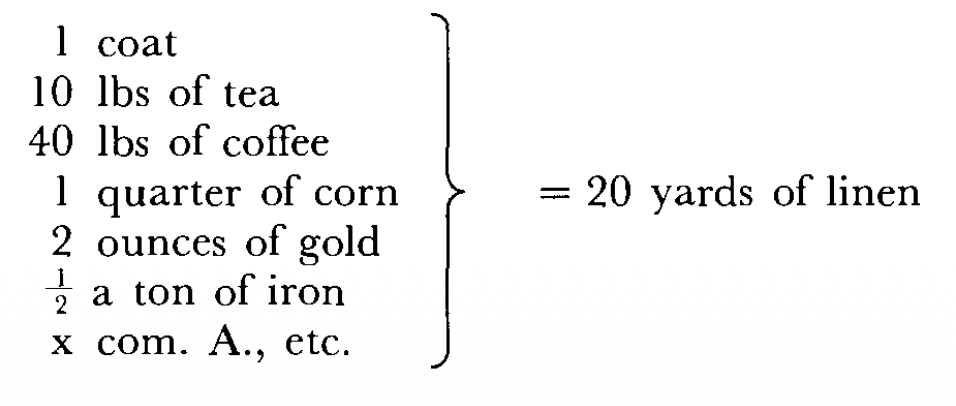
[…] expresses the values of the whole world of commodities in terms of a single commodity set apart for the purpose, namely, the linen, and thus represents to us their values by means of their equality with linen. The value of every commodity is now, by being equated to linen, not only differentiated from its own use value, but from all other use values generally, and is, by that very fact, expressed as that which is common to all commodities.
A commodity can acquire a general expression of its value only by all other commodities, simultaneously with it, expressing their values in the same equivalent; and every new commodity must follow suit. It thus becomes evident that, since the existence of commodities as values is purely social, this social existence can be expressed by the totality of their social relations alone, and consequently that the form of their value must be a socially recognised form. […]
The general form of relative value, embracing the whole world of commodities, converts the single commodity that is excluded from the rest, and made to play the part of equivalent — here the linen — into the universal equivalent. The bodily form of the linen is now the form assumed in common by the values of all commodities; it therefore becomes directly exchangeable with all and every of them. The substance linen becomes the visible incarnation, the social chrysalis state of every kind of human labour. Weaving, which is the labour of certain private individuals producing a particular article, linen, acquires in consequence a social character, the character of equality with all other kinds of labour. […]
The general value form, which represents all products of labour as mere congelations of undifferentiated human labour, shows by its very structure that it is the social resume of the world of commodities. That form consequently makes it indisputably evident that in the world of commodities the character possessed by all labour of being human labour constitutes its specific social character.
Marx, Capital, Volume 1, Marx Engels Collected Works Volume 35 (International Publishers), p.76-77
The universal equivalent form is a form of value in general. It can, therefore, be assumed by any commodity. On the other hand, if a commodity be found to have assumed the universal equivalent form (form C), this is only because and in so far as it has been excluded from the rest of all other commodities as their equivalent, and that by their own act. And from the moment that this exclusion becomes finally restricted to one particular commodity, from that moment only, the general form of relative value of the world of commodities obtains real consistence and general social validity.
The particular commodity, with whose bodily form the equivalent form is thus socially identified, now becomes the money commodity, or serves as money. It becomes the special social function of that commodity, and consequently its social monopoly, to play within the world of commodities the part of the universal equivalent. Amongst the commodities which, in form B, figure as particular equivalents of the linen, and, in form C, express in common their relative values in linen, this foremost place has been attained by one in particular— namely, gold.
Marx, Capital, Volume 1, Marx Engels Collected Works Volume 35 (International Publishers), p.80