The universal equivalent form is a form of value in general. It can, therefore, be assumed by any commodity. On the other hand, if a commodity be found to have assumed the universal equivalent form (form C), this is only because and in so far as it has been excluded from the rest of all other commodities as their equivalent, and that by their own act. And from the moment that this exclusion becomes finally restricted to one particular commodity, from that moment only, the general form of relative value of the world of commodities obtains real consistence and general social validity.
The particular commodity, with whose bodily form the equivalent form is thus socially identified, now becomes the money commodity, or serves as money. It becomes the special social function of that commodity, and consequently its social monopoly, to play within the world of commodities the part of the universal equivalent. Amongst the commodities which, in form B, figure as particular equivalents of the linen, and, in form C, express in common their relative values in linen, this foremost place has been attained by one in particular— namely, gold.
Marx, Capital, Volume 1, Marx Engels Collected Works Volume 35 (International Publishers), p.80
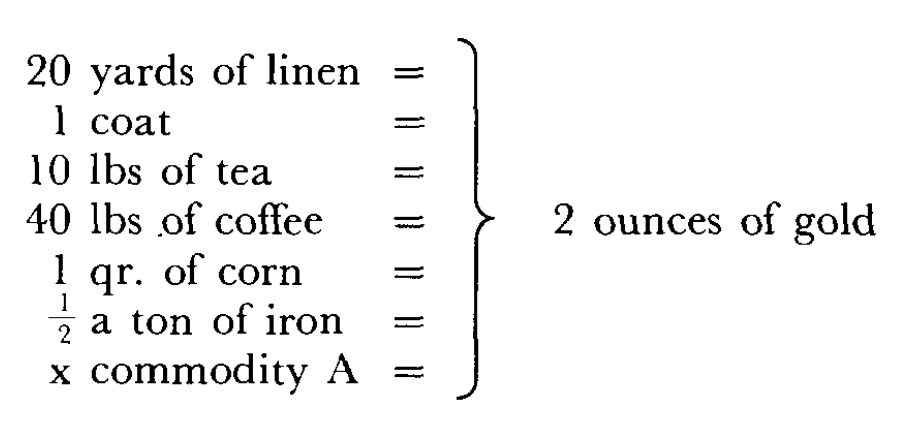
The elementary expression of the relative value of a single commodity, such as linen, in terms of the commodity, such as gold, that plays the part of money, is the price form of that commodity. The price form of the linen is therefore 20 yards of linen = 2 ounces of gold, or, if 2 ounces of gold when coined are £2, 20 yards of linen = £2.
Marx, Capital, Volume 1, Marx Engels Collected Works Volume 35 (International Publishers), p.81